논문 해설
Evaluating Correctness and Faithfulness of Instruction-Following Models for Question Answering
질의응답을 위한 지시 따르기 모델의 정확성과 충실성 평가
- 연구 문제 지시 수행 모델의 장황한 응답은 EM과 F1로 정확하게 평가하기 어렵습니다.
- 연구 방법 정답성은 Recall, 충실성은 K-Precision이라는 토큰 중첩 지표로 측정하고 사람 판단과 상관을 검증합니다.
- 주요 결과 Recall과 K-Precision은 사람 판단과 높은 상관을 보이며, GPT-3.5는 Recall 기준으로 세 과제 모두에서 FiD보다 높은 정답성을 보입니다.
명령형 모델 QA 평가의 문제
지시 수행 모델은 관련 문서와 지시문을 프롬프트에 붙이는 것만으로 추가 학습 없이 질의응답에 적응할 수 있습니다. 그러나 이 모델들은 장황한 응답을 만들기 때문에 EM과 F1 같은 전통적 QA 지표가 정답성을 안정적으로 재지 못합니다. 또한 응답이 제공된 지식에 근거하는지도 참조 답변 기반 지표로는 확인할 수 없습니다.
이 논문은 두 축으로 평가를 나눕니다. 첫째는 사용자의 정보 요구를 얼마나 충족하는지에 해당하는 정답성이고, 둘째는 응답이 제공된 지식에 근거하는지에 해당하는 충실성입니다. 실험은 Flan-T5, Alpaca, GPT-3.5, Llama-2를 Natural Questions, HotpotQA, TopiOCQA에서 평가합니다.
Recall과 사람 판단의 상관
정답성 평가에서 저자들은 참조 답변의 토큰이 모델 응답에 포함되는 비율인 Recall을 제안하고 사용합니다. Recall은 응답이 장황하더라도 참조 답변 토큰을 포함하면 감점하지 않습니다. 사람이 판정한 1200개 응답에서 EM과 F1은 사람이 정답이라고 판단한 응답을 엄격하게 놓치는 경향을 보였습니다.
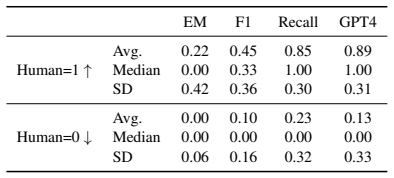
Table 2 : Average, Median and standard deviation (SD) of scores by evaluation metrics when humans judge the model response correct (1) vs incorrect (0). EM and F1 tend to be strict whereas Recall and GPT4-Eval are more balanced.
원문 · CC BY 4.0 · Vaibhav Adlakha, Parishad BehnamGhader, Xing Han Lu, Nicholas Meade, Siva Reddy · Evaluating Correctness and Faithfulness of Instruction-Following Models for Question Answering · 원문 그림 인용 · 원본 PDF 5쪽에서 그림 영역을 추출했습니다.상관 분석에서 GPT4-Eval이 가장 높은 Spearman과 Kendall 상관을 보였고, 어휘 지표 중에서는 Recall이 가장 높았습니다. 저자들은 Recall이 추가 장황함을 벌하지 않기 때문에 다른 어휘 지표나 BERTScore, BEM보다 높게 나타난다고 해석합니다.
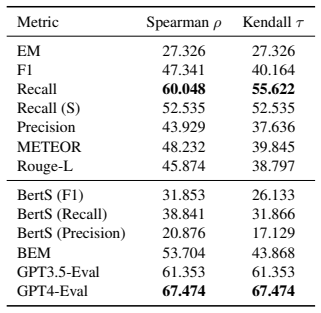
Table 3 : Correlation of several automatic evalua- tion metrics with human judgments for correctness w.r.t information need. GPT4-Eval achieves the highest correlation overall. Recall is the highest correlated among all lexical metrics.
원문 · CC BY 4.0 · Vaibhav Adlakha, Parishad BehnamGhader, Xing Han Lu, Nicholas Meade, Siva Reddy · Evaluating Correctness and Faithfulness of Instruction-Following Models for Question Answering · 원문 그림 인용 · 원본 PDF 7쪽에서 그림 영역을 추출했습니다.FiD와 비교한 정답성 결과
정답성 비교에서 FiD는 NQ, HotpotQA, TopiOCQA 각각에서 과제별로 미세조정된 기준선입니다. EM과 F1에서는 FiD가 대부분 더 높게 나타나지만, Recall 기준으로 보면 지시 수행 모델과의 격차가 크게 줄어듭니다.
Recall 기준에서 GPT-3.5는 세 데이터셋 모두에서 FiD보다 높았고, Llama-2는 세 과제 중 두 과제에서 FiD보다 높거나 TopiOCQA에서는 같은 수준이었습니다. 이 결과는 검색 기반 설정에서 지시 수행 모델이 정답 응답 생성에 있어 과제별 미세조정 생성기와 비슷하거나 때로는 더 나을 수 있음을 보여 줍니다.
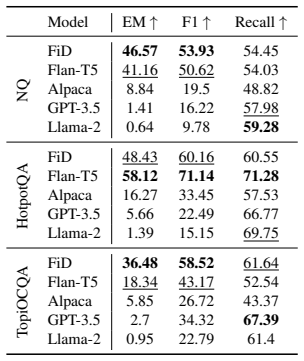
Table 4 : Comparison of instruction-following mod- els with FiD for correctness. EM and F1 rank FiD higher on NQ and TopiOCQA. According to Recall, which is more correlated with human judgments, GPT-3.5 outperforms FiD on all three datasets.
원문 · CC BY 4.0 · Vaibhav Adlakha, Parishad BehnamGhader, Xing Han Lu, Nicholas Meade, Siva Reddy · Evaluating Correctness and Faithfulness of Instruction-Following Models for Question Answering · 원문 그림 인용 · 원본 PDF 8쪽에서 그림 영역을 추출했습니다.K-Precision과 충실성 평가
충실성 평가에서 저자들은 응답 토큰 가운데 제공된 지식 스니펫에 있는 비율인 K-Precision을 제안합니다. 이 지표는 응답이 지식을 얼마나 근거로 삼는지 보며, 기존 K-F1과 달리 지식의 길이에 덜 민감하도록 설계되었습니다.
골드 구절에 대한 사람 판단에서 K-Precision은 GPT-4 기반 LLMCritic 다음으로 높은 상관을 보였습니다. 다만 K-Precision은 응답의 토큰을 지식과 비교하므로 지식 전체를 복사하는 방식으로 조작될 수 있다는 한계가 저자들에 의해 제기됩니다.
관련 없는 지식에서의 답변 자제
충실성 평가는 관련 없는 구절을 제공했을 때 모델이 답변을 자제하는지도 봅니다. 이를 위해 지시문을 수정하여 답이 없으면 I don’t know라고 답하도록 했으며, 이 응답 비율을 PIR로 측정합니다. 정답 구절을 제공했을 때 자제한 비율은 PG로 보고되며 낮을수록 좋습니다.
결과에서 Flan-T5는 관련 구절 충실성이 가장 높았지만 PG가 높은 데이터셋도 있어 정답 구절에서도 자제하는 경향이 함께 나타납니다. GPT-3.5와 Llama-2는 응답을 자제하는 경향이 크고, Alpaca는 지시를 잘 따르지 못해 거의 답하지 않았습니다.
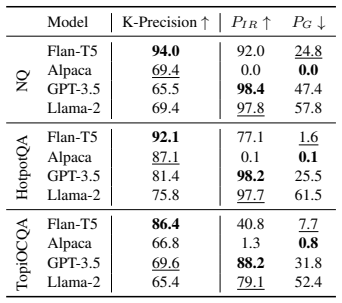
Table 6 : Performance of instruction-following models for faithfulness. K-Precision evaluates faithfulness w.r.t relevant knowledge (Section 5.2). PIR and PG denote the proportion of responses where model refrained from answering when pro- vided with incorrect or gold passage respectively, along with a modified instruction (Section 5.3).
원문 · CC BY 4.0 · Vaibhav Adlakha, Parishad BehnamGhader, Xing Han Lu, Nicholas Meade, Siva Reddy · Evaluating Correctness and Faithfulness of Instruction-Following Models for Question Answering · 원문 그림 인용 · 원본 PDF 11쪽에서 그림 영역을 추출했습니다.지표의 적용 범위와 한계
정답성과 충실성 지표는 사람 판단과 높은 상관을 보였지만, 이 논문이 평가하는 특성은 정답성, 충실성, 답변 자제에 한정됩니다. 장문 QA에서 중요한 완결성이나 이해 용이성 같은 다른 속성은 이 연구의 범위 밖입니다.
또한 낮은 충실성이 곧 오답을 뜻하지는 않습니다. 모델은 파라메트릭 지식으로 정확한 정보를 제공할 수 있지만, 그 지식은 해석과 수정이 어렵습니다. 따라서 이 지표들은 응답의 근거성을 보여 주는 도구이며 사실성 전체를 대신하지는 않습니다.
논문 정보
- 저자
- Vaibhav Adlakha, Parishad BehnamGhader, Xing Han Lu, Nicholas Meade, Siva Reddy
- 학회·저널
- arXiv · 프리프린트
- 최초 공개일
- 2023년 7월 31일
- 등록일
- 2026년 11월 6일
- 수정일
- 2024년 4월 17일
- 버전
- v2
- arXiv
- 2307.16877
- 분류
- cs.CL · cs.AI
- 원문 이용 조건
- CC BY 4.0
- 제공 범위
- 논문 정보, 해설, 허용된 원문 그림
AI 해설은 논문 원문과 별개의 설명이며 오류가 있을 수 있습니다. 원문과 그림은 각 출처의 이용 조건과 따로 표시된 권리를 따릅니다.
초록
Retriever-augmented instruction-following models are attractive alternatives to fine-tuned approaches for information-seeking tasks such as question answering (QA). By simply prepending retrieved documents in its input along with an instruction, these models can be adapted to various information domains and tasks without additional fine-tuning. While the model responses tend to be natural and fluent, the additional verbosity makes traditional QA evaluation metrics such as exact match (EM) and F1 unreliable for accurately quantifying model performance. In this work, we investigate the performance of instruction-following models across three information-seeking QA tasks. We use both automatic and human evaluation to evaluate these models along two dimensions: 1) how well they satisfy the user's information need (correctness), and 2) whether they produce a response based on the provided knowledge (faithfulness). Guided by human evaluation and analysis, we highlight the shortcomings of traditional metrics for both correctness and faithfulness. We then propose simple token-overlap based and model-based metrics that reflect the true performance of these models. Our analysis reveals that instruction-following models are competitive, and sometimes even outperform fine-tuned models for correctness. However, these models struggle to stick to the provided knowledge and often hallucinate in their responses. We hope our work encourages a more holistic evaluation of instruction-following models for QA. Our code and data is available at https://github.com/McGill-NLP/instruct-qa
원문 인용
Vaibhav Adlakha, Parishad BehnamGhader, Xing Han Lu, Nicholas Meade, Siva Reddy (2023). Evaluating Correctness and Faithfulness of Instruction-Following Models for Question Answering. arXiv:2307.16877v2. https://arxiv.org/abs/2307.16877v2
BibTeX
@misc{adlakha2023evaluating,
  title = {{Evaluating Correctness and Faithfulness of Instruction-Following Models for Question Answering}},
  author = {Vaibhav Adlakha and Parishad BehnamGhader and Xing Han Lu and Nicholas Meade and Siva Reddy},
  year = {2023},
  eprint = {2307.16877},
  archivePrefix = {arXiv},
  url = {https://arxiv.org/abs/2307.16877v2}
}