논문 해설
Deep Learning for Wireless Networked Systems: a joint Estimation-Control-Scheduling Approach
무선 네트워크 시스템을 위한 딥러닝: 추정-제어-스케줄링 결합 접근법
- 연구 문제 무선 네트워크 제어 시스템에서 추정, 제어, 스케줄링을 따로 설계하면 제어 성능을 충분히 얻기 어렵습니다.
- 연구 방법 패킷 수신 여부에 따라 측정값과 RNN 추정값을 함께 쓰고, AoI 기반 샘플링을 적용한 TD3 제어기와 DQN 스케줄러를 함께 학습합니다.
- 주요 결과 MuJoCo 과제의 여러 WNCS 설정에서 공동 학습과 AoI 기반 샘플링이 기준선보다 높은 제어 성능을 보였고, Q값 기반 스케줄러는 통신 비용을 고려한 전체 성능을 높였습니다.
무선 제어에서 통신과 제어를 함께 설계하는 어려움
무선 네트워크 제어 시스템(WNCS)은 센서, 제어기, 액추에이터를 무선 채널로 연결합니다. 기존 연구는 통신 성능과 제어 성능을 분리하여 설계하는 경우가 많았습니다. 제어 성능을 설계 목표로 삼으면 추정, 제어, 스케줄링 정책이 큰 상태 공간과 이산·연속 행동 공간을 함께 가지므로 최적화가 어려워집니다. 이 논문은 모델을 알 수 없는 비선형 플랜트와 페이딩 채널 환경에서 추정기, 제어기, 스케줄러를 함께 학습하는 문제를 다룹니다.
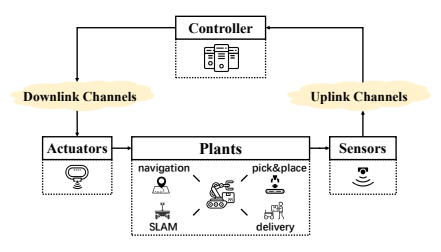
Fig. 1 : A wireless networked control system (WNCS).
원문 · CC BY 4.0 · Zihuai Zhao, Wanchun Liu, Daniel E. Quevedo, Yonghui Li, Branka Vucetic · Deep Learning for Wireless Networked Systems: a joint Estimation-Control-Scheduling Approach · 원문 그림 인용 · 원본 PDF 1쪽에서 그림 영역을 추출했습니다.패킷 손실을 보완하는 MB-MF 데이터와 원격 추정기
센서 패킷이 제어기에 수신되면 측정값을 그대로 사용하고, 수신되지 않으면 최근 추정 상태 이력을 입력받는 RNN 기반 추정기가 현재 상태를 예측합니다. 이렇게 모델 프리 데이터와 모델 기반 데이터를 함께 쓰는 MB-MF 방식은 제어기 학습 데이터를 만듭니다. 추정기는 예측 상태와 수신된 관측값의 차이를 줄이도록 지도학습으로 갱신됩니다. 추정기와 DRL 제어기는 순차적으로 학습하지 않고 함께 학습되며, 초기에 부정확한 추정도 탐색 범위를 넓히는 데 이용됩니다.
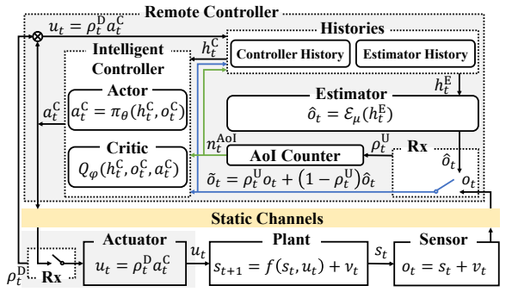
Fig. 2 : Estimator-controller co-design of the low-mobility WNCS.
원문 · CC BY 4.0 · Zihuai Zhao, Wanchun Liu, Daniel E. Quevedo, Yonghui Li, Branka Vucetic · Deep Learning for Wireless Networked Systems: a joint Estimation-Control-Scheduling Approach · 원문 그림 인용 · 원본 PDF 3쪽에서 그림 영역을 추출했습니다.AoI 기반 중요도 샘플링과 TD3 제어기
제어기는 TD3 액터-비평가 구조를 기반으로 하며, 현재 입력과 이력을 각각 처리하고 이력 처리에 RNN을 사용합니다. 쌍둥이 비평가 중 더 작은 Q값을 액터 학습에 사용하여 과대추정을 줄입니다. 경험 재생 버퍼의 전이는 AoI, 전이의 최신성, TD 오차를 함께 고려한 순위에 따라 샘플링됩니다. 샘플링 확률은 순위의 음이 아닌 거듭제곱을 정규화한 값이며, 중요도 샘플링 가중치는 편향을 보정하기 위해 손실에 곱해집니다.
고이동성 시나리오의 스케줄러와 공동 학습
고이동성 시나리오에서는 센서 전송 에너지가 중요하므로, 이산 행동을 선택하는 DQN 스케줄러가 센서 전송 여부를 정합니다. 스케줄러는 전송 횟수를 줄이려는 경향 때문에 학습이 불안정해질 수 있어, 먼저 센서를 항상 전송하는 pre-training 후 공동 학습을 수행합니다. 공동 학습에서 스케줄러의 보상은 즉시 전체 보상 대신 제어기 Q값으로 대체됩니다. 이는 스케줄 행동이 즉시 보상에 직접 영향을 주지 않으므로 전송 횟수를 지속적으로 줄이는 경향을 막기 위한 선택입니다.
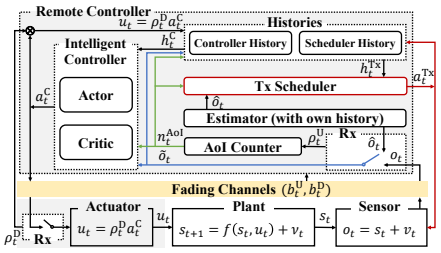
Fig. 5 : Estimator-controller-scheduler co-design of the high-mobility WNCS.
원문 · CC BY 4.0 · Zihuai Zhao, Wanchun Liu, Daniel E. Quevedo, Yonghui Li, Branka Vucetic · Deep Learning for Wireless Networked Systems: a joint Estimation-Control-Scheduling Approach · 원문 그림 인용 · 원본 PDF 8쪽에서 그림 영역을 추출했습니다.MuJoCo 과제에서의 공동 학습과 기준선 비교
검증은 OpenAI Gym의 MuJoCo 과제인 HalfCheetah, Hopper, InvertedDoublePendulum에서 수행되었습니다. 제어 성능은 에피소드 전체의 제어 보상 합의 평균으로 평가됩니다. 저이동성 설정에서 분리 학습은 무작위 제어 입력으로 추정기를 먼저 학습한 뒤 제어기를 학습하는 방식이며, 공동 학습과 비교되었습니다. 또한 AoI 기반 샘플링, 균일 샘플링, 순수 모델 프리 기준선을 6개 WNCS 설정에서 비교하였습니다. MF Uniform 기준선은 패킷 손실 시 제어 보상을 항상 안다고 가정한 이상적 경우입니다.
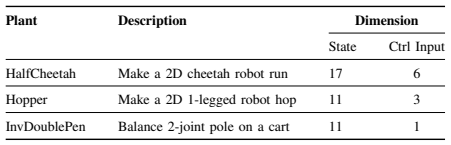
원문 그림 TABLE I: Description of MuJoCo tasks
원문 · CC BY 4.0 · Zihuai Zhao, Wanchun Liu, Daniel E. Quevedo, Yonghui Li, Branka Vucetic · Deep Learning for Wireless Networked Systems: a joint Estimation-Control-Scheduling Approach · 원문 그림 인용 · 원본 PDF 10쪽에서 그림 영역을 추출했습니다.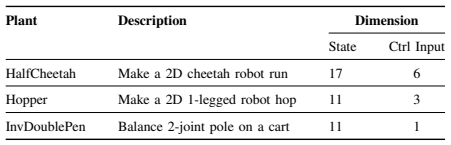
원문 그림 TABLE II: Description of control reward in MuJoCo
원문 · CC BY 4.0 · Zihuai Zhao, Wanchun Liu, Daniel E. Quevedo, Yonghui Li, Branka Vucetic · Deep Learning for Wireless Networked Systems: a joint Estimation-Control-Scheduling Approach · 원문 그림 인용 · 원본 PDF 10쪽에서 그림 영역을 추출했습니다.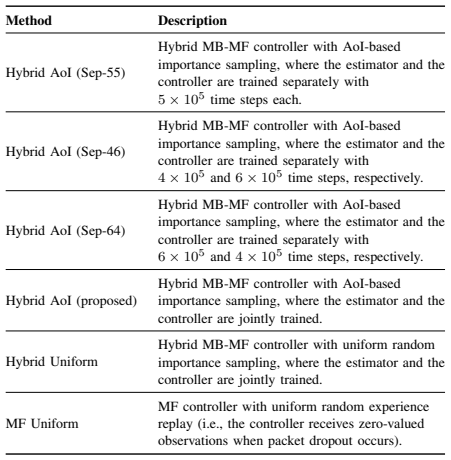
원문 그림 TABLE VII: Benchmark Policies (low-mobility scenario).
원문 · CC BY 4.0 · Zihuai Zhao, Wanchun Liu, Daniel E. Quevedo, Yonghui Li, Branka Vucetic · Deep Learning for Wireless Networked Systems: a joint Estimation-Control-Scheduling Approach · 원문 그림 인용 · 원본 PDF 12쪽에서 그림 영역을 추출했습니다.결과 해석과 적용 범위
공동 학습은 InvertedDoublePendulum의 시나리오 2에서 분리 학습 방식보다 제어 성능이 두 배가 되었다고 보고됩니다. AoI 기반 샘플링은 5% 상향 패킷 오류율의 시나리오에서 균일 샘플링 대비 7%에서 24%의 향상을 보였습니다. MF Uniform 기준선 대비 Hopper 시나리오 6에서는 70%, InvDoublePen 시나리오 2와 6에서는 각각 73%와 202%의 향상이 보고됩니다. 고이동성 시나리오에서 Q값 기반 스케줄러는 통신 비용 5에서 No-Scheduler 대비 약 11%, 통신 비용 10에서 약 52% 높은 전체 성능을 보입니다. 이 결과들은 각 설정에서 측정된 값이며, 다른 과제나 하드웨어로 일반화되지 않습니다.
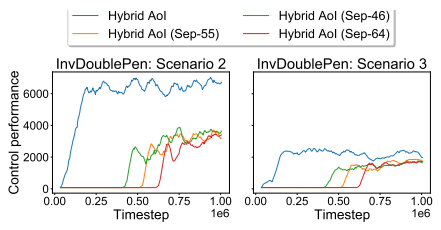
Fig. 8 : Comparison of the learning curves of the joint and separative estimation-control methods. Hybrid AoI (in blue) denotes the proposed joint algorithm and the remaining three are the separative ones (see Table VII for explanation).
원문 · CC BY 4.0 · Zihuai Zhao, Wanchun Liu, Daniel E. Quevedo, Yonghui Li, Branka Vucetic · Deep Learning for Wireless Networked Systems: a joint Estimation-Control-Scheduling Approach · 원문 그림 인용 · 원본 PDF 10쪽에서 그림 영역을 추출했습니다.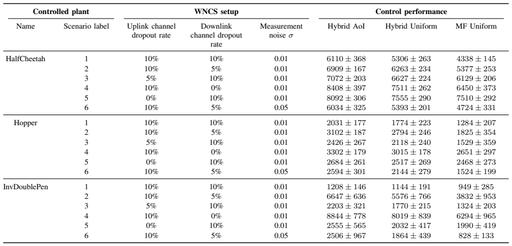
원문 그림 TABLE III: Comparison of control performance in the low-mobility scenario.
원문 · CC BY 4.0 · Zihuai Zhao, Wanchun Liu, Daniel E. Quevedo, Yonghui Li, Branka Vucetic · Deep Learning for Wireless Networked Systems: a joint Estimation-Control-Scheduling Approach · 원문 그림 인용 · 원본 PDF 11쪽에서 그림 영역을 추출했습니다.
원문 그림 TABLE IV: Comparison of overall performance in the high-mobility scenario.
원문 · CC BY 4.0 · Zihuai Zhao, Wanchun Liu, Daniel E. Quevedo, Yonghui Li, Branka Vucetic · Deep Learning for Wireless Networked Systems: a joint Estimation-Control-Scheduling Approach · 원문 그림 인용 · 원본 PDF 11쪽에서 그림 영역을 추출했습니다.한계와 가정
논문은 순시 채널 상태를 제어기가 고전적 채널 추정 기법으로 안다고 가정하고, 동적 채널 모델은 알 수 없다고 가정합니다. 액추에이터의 1비트 확인 응답은 완벽한 피드백 채널로 전달된다고 가정합니다. MuJoCo 환경에는 플랜트 외란이 없어 시뮬레이션에서 외란을 0으로 두었습니다. MF Uniform 기준선의 제어 보상 가정은 이상적인 조건이므로 비교 결과는 이 가정 아래에서 해석해야 합니다. 본문의 실험은 시뮬레이션 기반이며 실제 무선 장비에서의 검증은 원문에 제시되지 않습니다.
논문 정보
- 저자
- Zihuai Zhao, Wanchun Liu, Daniel E. Quevedo, Yonghui Li, Branka Vucetic
- 학회·저널
- arXiv · 프리프린트
- 최초 공개일
- 2022년 10월 3일
- 등록일
- 2026년 11월 6일
- 수정일
- 2022년 10월 3일
- 버전
- v1
- arXiv
- 2210.00673
- 분류
- eess.SY · cs.AI · cs.IT · cs.LG · eess.SP
- 원문 이용 조건
- CC BY 4.0
- 제공 범위
- 논문 정보, 해설, 허용된 원문 그림
AI 해설은 논문 원문과 별개의 설명이며 오류가 있을 수 있습니다. 원문과 그림은 각 출처의 이용 조건과 따로 표시된 권리를 따릅니다.
초록
Wireless networked control system (WNCS) connecting sensors, controllers, and actuators via wireless communications is a key enabling technology for highly scalable and low-cost deployment of control systems in the Industry 4.0 era. Despite the tight interaction of control and communications in WNCSs, most existing works adopt separative design approaches. This is mainly because the co-design of control-communication policies requires large and hybrid state and action spaces, making the optimal problem mathematically intractable and difficult to be solved effectively by classic algorithms. In this paper, we systematically investigate deep learning (DL)-based estimator-control-scheduler co-design for a model-unknown nonlinear WNCS over wireless fading channels. In particular, we propose a co-design framework with the awareness of the sensor's age-of-information (AoI) states and dynamic channel states. We propose a novel deep reinforcement learning (DRL)-based algorithm for controller and scheduler optimization utilizing both model-free and model-based data. An AoI-based importance sampling algorithm that takes into account the data accuracy is proposed for enhancing learning efficiency. We also develop novel schemes for enhancing the stability of joint training. Extensive experiments demonstrate that the proposed joint training algorithm can effectively solve the estimation-control-scheduling co-design problem in various scenarios and provide significant performance gain compared to separative design and some benchmark policies.
원문 인용
Zihuai Zhao, Wanchun Liu, Daniel E. Quevedo, Yonghui Li, Branka Vucetic (2022). Deep Learning for Wireless Networked Systems: a joint Estimation-Control-Scheduling Approach. arXiv:2210.00673v1. https://arxiv.org/abs/2210.00673v1
BibTeX
@misc{zhao2022deep,
  title = {{Deep Learning for Wireless Networked Systems: a joint Estimation-Control-Scheduling Approach}},
  author = {Zihuai Zhao and Wanchun Liu and Daniel E. Quevedo and Yonghui Li and Branka Vucetic},
  year = {2022},
  eprint = {2210.00673},
  archivePrefix = {arXiv},
  url = {https://arxiv.org/abs/2210.00673v1}
}