논문 해설
TileWeave: Heterogeneous Tiling for Sparse Prefill on Mobile SoCs
TileWeave: 모바일 SoC에서 희소 프리필을 위한 이종 타일링
- 연구 문제 모바일 NPU에서 블록 희소 프리필은 큰 정규 타일과 선택 정보 보존이 충돌해 효율을 얻기 어렵습니다.
- 연구 방법 TileWeave는 키 블록의 교차-쿼리 재사용에 따라 공유 블록은 NPU 타일에서, 재사용이 낮은 예외는 GPU에서 실행합니다.
모바일 NPU에서 희소 어텐션이 어려운 이유
긴 프롬프트를 스마트폰에서 처리하면 프리필 지연과 K/V 캐시 메모리 부담이 커집니다. 블록 희소 어텐션은 계산과 메모리 이동을 줄이지만, 선택된 키 블록이 쿼리마다 흩어져 있어 큰 정규 타일을 선호하는 모바일 NPU와 잘 맞지 않습니다. 기존 희소 프리필 방법은 주로 GPU를 대상으로 설계되었고, NPU에서는 큰 타일을 쓰면 선택되지 않은 상호작용이 함께 계산되며, 작은 타일을 쓰면 K/V 스테이징과 조정 비용이 반복됩니다. 이 논문은 이 긴장을 실행 단위의 문제로 보고, 선택 정보를 버리지 않으면서 NPU 효율을 확보하는 방법을 다룹니다.
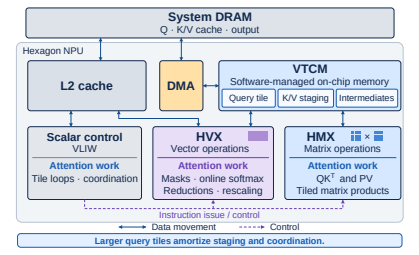
Figure 2 . Hexagon NPU architecture and attention mapping. Larger query tiles amortize K/V staging and coordination.
원문 · CC BY 4.0 · Wentao Ni, Hong Cai, Mingu Lee, Chihao Yu, Zhongming Yu, Hejia Zhang, Kangqi Zhang, Fatih Porikli, Zhijian Liu, Jishen Zhao · TileWeave: Heterogeneous Tiling for Sparse Prefill on Mobile SoCs · 원문 그림 인용 · 원본 PDF 2쪽에서 그림 영역을 추출했습니다.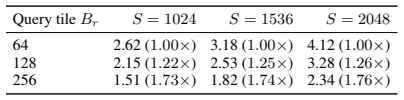
Table 1 . NPU attention latency in ms (speedup over Br = 64). Larger query tiles improve efficiency, giving up to 1.76× speedup at fixed selected work.
원문 · CC BY 4.0 · Wentao Ni, Hong Cai, Mingu Lee, Chihao Yu, Zhongming Yu, Hejia Zhang, Kangqi Zhang, Fatih Porikli, Zhijian Liu, Jishen Zhao · TileWeave: Heterogeneous Tiling for Sparse Prefill on Mobile SoCs · 원문 그림 인용 · 원본 PDF 3쪽에서 그림 영역을 추출했습니다.교차-쿼리 재사용으로 실행 단위 나누기
TileWeave는 키 블록이 여러 쿼리 블록에서 얼마나 공유되는지를 기준으로 실행 위치를 정합니다. 네 개의 인접한 64-쿼리 블록의 wanted 목록에서 키 블록별 요청 횟수 c(b)를 세고, c(b)가 c∗=3 이상인 블록은 공유 풀 P로 묶어 256-쿼리 NPU 타일에서 실행합니다. 나머지 블록은 쿼리 특이 예외 E_i=W_i∖P로 두고, 이를 요청한 64-쿼리 블록에 대해서만 GPU에서 계산합니다. 식 (6)에서 U는 네 블록 wanted 목록의 합집합, P는 U 가운데 c(b)≥c∗인 블록의 집합입니다. 이 분할의 목적은 공유된 블록에 대한 coarse 실행을 유지하면서 재사용이 낮은 블록의 추가 상호작용을 줄이는 것입니다.
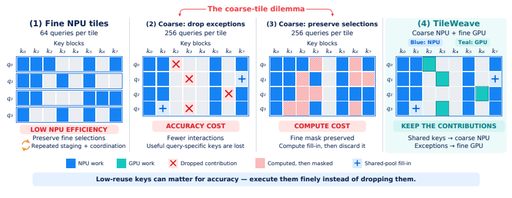
Figure 1 . Thin blue frames mark NPU query tiles: 64 queries in (1) and 256 in (2)–(4). Small tiles preserve selections but repeat K/V staging and coordination, limiting NPU efficiency. Coarse tiles improve reuse, but dropping exceptions risks accuracy (2), while coarse masked tiles compute unwanted interactions (3). TileWeave keeps shared keys on coarse NPU tiles and preserves exceptions through fine GPU execution (4).
원문 · CC BY 4.0 · Wentao Ni, Hong Cai, Mingu Lee, Chihao Yu, Zhongming Yu, Hejia Zhang, Kangqi Zhang, Fatih Porikli, Zhijian Liu, Jishen Zhao · TileWeave: Heterogeneous Tiling for Sparse Prefill on Mobile SoCs · 원문 그림 인용 · 원본 PDF 2쪽에서 그림 영역을 추출했습니다.NPU 친화적 풀링 키 선택기
선택기는 큰 재정렬이나 복사 없이 작은 행렬곱으로 블록 중요도를 계산합니다. 각 64-쿼리 블록에서 네 개의 쿼리 샘플을 쓰고, 각 64-키 블록은 16개 키의 평균으로 만든 네 개의 풀로 표현합니다. 점수는 쿼리 샘플과 풀의 내적을 √D로 나눈 값이며, 샘플마다 볼 수 있는 풀 위에서 소프트맥스를 정규화한 뒤 쿼리 샘플과 헤드에 대해 평균하고, GQA 그룹 안에서는 최댓값을 취합니다. 이후 평균 확률 대비 임계값 τ를 넘는 블록과 sink·diagonal 블록을 K/V 헤드별 wanted 목록으로 씁니다. 저자들은 이 설계가 선택 비용을 줄인다고 보고하지만, 그 효율 수치는 실행 조건에 따라 달라집니다.
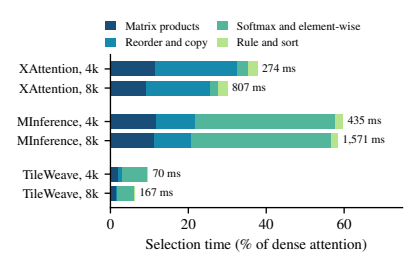
Figure 4 . Qwen3-1.7B NPU selection cost relative to dense atten- tion (totals in ms). TileWeave reduces selection to 6–10% of dense attention’s time.
원문 · CC BY 4.0 · Wentao Ni, Hong Cai, Mingu Lee, Chihao Yu, Zhongming Yu, Hejia Zhang, Kangqi Zhang, Fatih Porikli, Zhijian Liu, Jishen Zhao · TileWeave: Heterogeneous Tiling for Sparse Prefill on Mobile SoCs · 원문 그림 인용 · 원본 PDF 5쪽에서 그림 영역을 추출했습니다.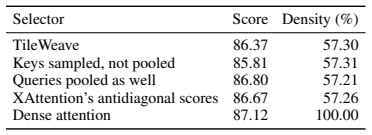
Table 6 . Selector ablation at matched density (Qwen3-1.7B, RULER 4k). Pooled keys improve accuracy, while pooled queries and antidiagonal scores trade additional NPU time for small gains.
원문 · CC BY 4.0 · Wentao Ni, Hong Cai, Mingu Lee, Chihao Yu, Zhongming Yu, Hejia Zhang, Kangqi Zhang, Fatih Porikli, Zhijian Liu, Jishen Zhao · TileWeave: Heterogeneous Tiling for Sparse Prefill on Mobile SoCs · 원문 그림 인용 · 원본 PDF 10쪽에서 그림 영역을 추출했습니다.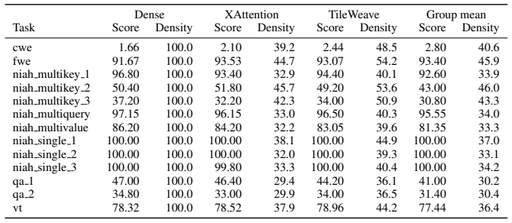
Table 9 . RULER 16k task scores and density (%) for Qwen3-1.7B. Taking the GQA-group maximum improves retrieval over the group mean at the same threshold.
원문 · CC BY 4.0 · Wentao Ni, Hong Cai, Mingu Lee, Chihao Yu, Zhongming Yu, Hejia Zhang, Kangqi Zhang, Fatih Porikli, Zhijian Liu, Jishen Zhao · TileWeave: Heterogeneous Tiling for Sparse Prefill on Mobile SoCs · 원문 그림 인용 · 원본 PDF 15쪽에서 그림 영역을 추출했습니다.하나의 어텐션 연산자를 두 엔진에서 실행하기
NPU와 GPU는 한 층의 어텐션을 서로 겹치지 않는 키 부분집합으로 나누어 계산합니다. 각 엔진은 최댓값 m, 정규화 합 ℓ, 가중 합 a를 내고, 식 (8)은 이를 온라인 소프트맥스 방식으로 합쳐 O를 만듭니다. 이 합성은 유효한 선택 집합에 대해서는 대수적으로 정확하지만, 희소 정책 자체를 dense attention과 같게 만들지는 않습니다. 실행 중에는 처음 여덟 개의 실행 타일이 전체 합집합 U를 NPU에 두어 GPU 시작 지연을 가리고, 이후에는 식 (6)의 분할을 씁니다. GPU는 NPU가 저장하는 순서대로 부분 결과를 게시하며, 게시된 Q와 멤버십 버퍼가 두 엔진의 캐시에서 보이도록 호스트 중계를 사용합니다.
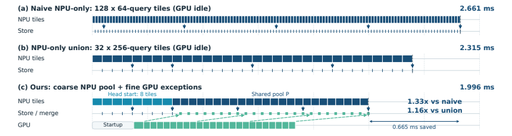
Figure 5 . Fine-grained schedules on a shared time axis (1024 queries, eight K/V heads). Endpoints are measured two-round means from the historical 4k Qwen3-1.7B/SM8750 study using the earlier threshold scorer; selection finishes before t= 0 and other model operators are excluded. Tile intervals are approximate; store/merge marks encode no duration. GPU completion spans 0.37–1.47 ms from a nearby trace, with intermediate groups interpolated. Timing calibration illustrates overlap and relative latency, not a single event trace.
원문 · CC BY 4.0 · Wentao Ni, Hong Cai, Mingu Lee, Chihao Yu, Zhongming Yu, Hejia Zhang, Kangqi Zhang, Fatih Porikli, Zhijian Liu, Jishen Zhao · TileWeave: Heterogeneous Tiling for Sparse Prefill on Mobile SoCs · 원문 그림 인용 · 원본 PDF 7쪽에서 그림 영역을 추출했습니다.RULER와 LongBench 정확도 비교
Qwen3-1.7B에서 RULER 4k 평균은 Dense 87.12, XAttention 86.31, TileWeave 86.37입니다. 같은 표에서 Llama-3.2-3B-Instruct의 4k 평균은 Dense 86.77, XAttention 86.00, TileWeave 86.32입니다. 저자들은 Qwen3에서는 XAttention과 거의 같고 Llama에서는 조금 더 높다고 보고합니다. 다만 각 희소 방법의 설정은 길이와 벤치마크에 걸쳐 고정되었으며, LongBench 평균은 TileWeave가 XAttention과 0.5점 이내, dense attention과 0.6점 이내로 보고됩니다. ShadowAttn은 여러 설정에서 더 높은 정확도를 보이므로, 정확도 유지가 모든 기준선에 대한 우위를 뜻하지 않습니다.
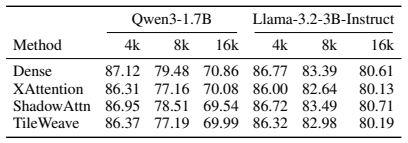
Table 4 . RULER mean accuracy. TileWeave matches XAttention on Qwen3-1.7B and is slightly more accurate on Llama-3.2-3B- Instruct at every tested length.
원문 · CC BY 4.0 · Wentao Ni, Hong Cai, Mingu Lee, Chihao Yu, Zhongming Yu, Hejia Zhang, Kangqi Zhang, Fatih Porikli, Zhijian Liu, Jishen Zhao · TileWeave: Heterogeneous Tiling for Sparse Prefill on Mobile SoCs · 원문 그림 인용 · 원본 PDF 8쪽에서 그림 영역을 추출했습니다.
Table 5 . LongBench accuracy (F1; ROUGE-L for QMSum). TileWeave’s mean stays within 0.6 points of dense attention on both models.
원문 · CC BY 4.0 · Wentao Ni, Hong Cai, Mingu Lee, Chihao Yu, Zhongming Yu, Hejia Zhang, Kangqi Zhang, Fatih Porikli, Zhijian Liu, Jishen Zhao · TileWeave: Heterogeneous Tiling for Sparse Prefill on Mobile SoCs · 원문 그림 인용 · 원본 PDF 9쪽에서 그림 영역을 추출했습니다.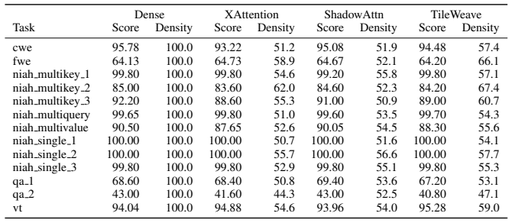
Table 11 . RULER 4k task scores and density (%) for Qwen3-1.7B. TileWeave gains on multi-key retrieval but loses on question answering relative to XAttention.
원문 · CC BY 4.0 · Wentao Ni, Hong Cai, Mingu Lee, Chihao Yu, Zhongming Yu, Hejia Zhang, Kangqi Zhang, Fatih Porikli, Zhijian Liu, Jishen Zhao · TileWeave: Heterogeneous Tiling for Sparse Prefill on Mobile SoCs · 원문 그림 인용 · 원본 PDF 16쪽에서 그림 영역을 추출했습니다.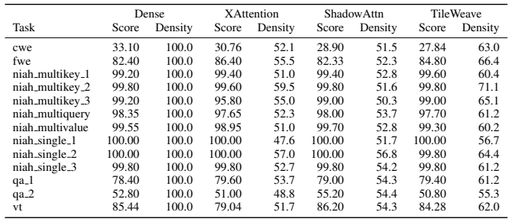
Table 12 . RULER 4k task scores and density (%) for Llama-3.2-3B-Instruct. TileWeave improves variable tracking and multi-key retrieval over XAttention.
원문 · CC BY 4.0 · Wentao Ni, Hong Cai, Mingu Lee, Chihao Yu, Zhongming Yu, Hejia Zhang, Kangqi Zhang, Fatih Porikli, Zhijian Liu, Jishen Zhao · TileWeave: Heterogeneous Tiling for Sparse Prefill on Mobile SoCs · 원문 그림 인용 · 원본 PDF 16쪽에서 그림 영역을 추출했습니다.스마트폰 프리필과 어텐션 지연
Qwen3-1.7B를 SM8750과 SM8850 폰에서 측정하면, 전체 모델 프리필은 SM8750에서 1k에서 dense와 비슷하고 2k부터 빨라져 16k에서 1.58배입니다. XAttention 대비 프리필 속도는 1.35–3.23배 범위로 보고됩니다. 어텐션 지연은 선택과 조정 비용을 포함해 청크별로 직접 측정했으며, 16k에서 dense 대비 최대 2.14배입니다. 두 측정은 별도 실행으로 얻은 값이므로 하나의 가산적 지연 분해로 읽지 않습니다. ShadowAttn의 CPU 버전은 이 조건에서 훨씬 느리게 측정되었습니다.
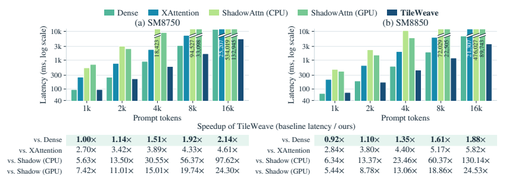
Figure 6 . Qwen3-1.7B attention latency, including selection and coordination. TileWeave achieves speedups of up to2.14× over dense attention,5.82×over XAttention,130.14×over ShadowAttn (CPU), and24.53×over ShadowAttn (GPU).
원문 · CC BY 4.0 · Wentao Ni, Hong Cai, Mingu Lee, Chihao Yu, Zhongming Yu, Hejia Zhang, Kangqi Zhang, Fatih Porikli, Zhijian Liu, Jishen Zhao · TileWeave: Heterogeneous Tiling for Sparse Prefill on Mobile SoCs · 원문 그림 인용 · 원본 PDF 9쪽에서 그림 영역을 추출했습니다.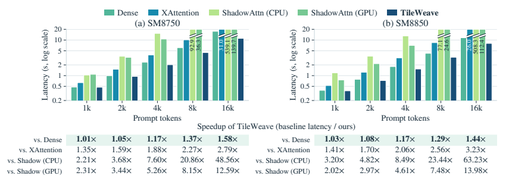
Figure 7 . Qwen3-1.7B full-model prefill latency over 1k–16k tokens. TileWeave achieves speedups of up to1.58× over dense attention, 3.23×over XAttention,63.23×over ShadowAttn (CPU), and13.98×over ShadowAttn (GPU).
원문 · CC BY 4.0 · Wentao Ni, Hong Cai, Mingu Lee, Chihao Yu, Zhongming Yu, Hejia Zhang, Kangqi Zhang, Fatih Porikli, Zhijian Liu, Jishen Zhao · TileWeave: Heterogeneous Tiling for Sparse Prefill on Mobile SoCs · 원문 그림 인용 · 원본 PDF 9쪽에서 그림 영역을 추출했습니다.공유 풀 실행과 대체 실행 방식 비교
Llama-3.2-3B-Instruct에서 선택기와 임계값을 고정한 뒤 TileWeave, 합집합 실행, masked tile을 비교합니다. TileWeave는 RULER 8k에서 82.98, union은 83.16, masked tile은 82.64이며, 밀도는 각각 58.0%, 70.1%, 51.1%입니다. 8k와 16k에서 TileWeave의 attention은 union 대비 1.24–1.28배, masked tile 대비 1.29–1.34배 빠르게 측정되었습니다. 이 비교는 밀도를 맞춘 실험이 아니므로, 정확도 차이와 속도 차이를 같은 밀도 조건의 결론으로 읽지 않습니다.
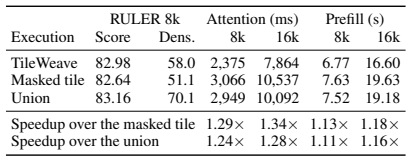
Table 8 . Llama-3.2-3B executions at a fixed selector and thresh- old. TileWeave gives 1.11–1.18× faster prefill with competitive RULER 8k accuracy.
원문 · CC BY 4.0 · Wentao Ni, Hong Cai, Mingu Lee, Chihao Yu, Zhongming Yu, Hejia Zhang, Kangqi Zhang, Fatih Porikli, Zhijian Liu, Jishen Zhao · TileWeave: Heterogeneous Tiling for Sparse Prefill on Mobile SoCs · 원문 그림 인용 · 원본 PDF 10쪽에서 그림 영역을 추출했습니다.예외 복원의 효과와 한계
이 차이는 0.75점이며, 쌍 부트스트랩 95% 구간은 [0.37, 1.14]로 보고됩니다. 두 정책 모두 고정 구성이며 밀도를 맞춘 선택기가 아닙니다. 따라서 이 결과는 재사용이 낮은 예외를 보존하는 것이 정확도에 도움이 된다는 근거로 읽되, 밀도 대비 최적성까지 주장하지는 않습니다.
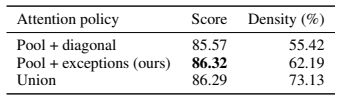
Table 2 . Llama-3.2-3B on RULER 4k. Non-diagonal exceptions add 0.75 points; the union retains more pairs for a similar score.
원문 · CC BY 4.0 · Wentao Ni, Hong Cai, Mingu Lee, Chihao Yu, Zhongming Yu, Hejia Zhang, Kangqi Zhang, Fatih Porikli, Zhijian Liu, Jishen Zhao · TileWeave: Heterogeneous Tiling for Sparse Prefill on Mobile SoCs · 원문 그림 인용 · 원본 PDF 4쪽에서 그림 영역을 추출했습니다.적용 범위와 남은 제약
이 결과는 Qwen3-1.7B와 Llama-3.2-3B-Instruct, RULER와 LongBench, Snapdragon SM8750과 SM8850 폰이라는 범위에서 얻어졌습니다. 전체 모델 지연 시간은 Qwen3-1.7B 중심으로 측정되었고, Llama-3.2-3B-Instruct는 실행 방식 비교에 주로 사용되었습니다. 임계값 c∗=3과 선택 임계값 τ도 각 모델의 고정 설정이므로, 다른 모델이나 과제에서 같은 설정이 최적이라는 증거로 읽지 않습니다. 또한 ShadowAttn과 비교한 CPU 버전 결과는 본 논문의 재구현 조건에 따른 것입니다.
논문 정보
- 저자
- Wentao Ni, Hong Cai, Mingu Lee, Chihao Yu, Zhongming Yu, Hejia Zhang, Kangqi Zhang, Fatih Porikli, Zhijian Liu, Jishen Zhao
- 학회·저널
- arXiv · 프리프린트
- 최초 공개일
- 2026년 10월 30일
- 등록일
- 2026년 11월 7일
- 수정일
- 2026년 10월 30일
- 버전
- v1
- arXiv
- 2611.00408
- 분류
- cs.LG
- 원문 이용 조건
- CC BY 4.0
- 제공 범위
- 논문 정보, 해설, 허용된 원문 그림
AI 해설은 논문 원문과 별개의 설명이며 오류가 있을 수 있습니다. 원문과 그림은 각 출처의 이용 조건과 따로 표시된 권리를 따릅니다.
초록
Smartphone applications increasingly require large language models to process long contexts, whereas high prefill latency and memory demands constrain local inference. Block-sparse attention reduces computation and memory traffic, but its irregular selections conflict with mobile NPUs' preference for large, regular tiles. Efficient execution must exploit cross-query reuse while avoiding redundant computation and preserving selections needed for accuracy. In this paper, we present TileWeave, which partitions sparse attention by this cross-query reuse: highly shared key blocks run in coarse NPU tiles, while low-reuse blocks run on the GPU only for the query blocks that selected them. In addition, we design an NPU-native pooled-key selector that keeps selection inexpensive, and a runtime that publishes GPU partials in the order the NPU consumes them and merges them in its existing output store. On RULER, HeteroSparse matches XAttention's accuracy with Qwen3-1.7B and improves it with Llama-3.2-3B-Instruct; its mean LongBench scores match XAttention as well. On Snapdragon SM8750 and SM8850 phones, it achieves 1.35--3.23$\times$ faster full-model prefill than XAttention over 1k--16k tokens and up to 1.58$\times$ faster than dense attention.
원문 인용
Wentao Ni, Hong Cai, Mingu Lee, Chihao Yu, Zhongming Yu, Hejia Zhang, Kangqi Zhang, Fatih Porikli, Zhijian Liu, Jishen Zhao (2026). TileWeave: Heterogeneous Tiling for Sparse Prefill on Mobile SoCs. arXiv:2611.00408v1. https://arxiv.org/abs/2611.00408v1
BibTeX
@misc{ni2026tileweave,
  title = {{TileWeave: Heterogeneous Tiling for Sparse Prefill on Mobile SoCs}},
  author = {Wentao Ni and Hong Cai and Mingu Lee and Chihao Yu and Zhongming Yu and Hejia Zhang and Kangqi Zhang and Fatih Porikli and Zhijian Liu and Jishen Zhao},
  year = {2026},
  eprint = {2611.00408},
  archivePrefix = {arXiv},
  url = {https://arxiv.org/abs/2611.00408v1}
}