논문 해설
Towards Improved Preference Optimization Pipeline: from Data Generation to Budget-Controlled Regularization
개선된 선호 최적화 파이프라인을 향하여: 데이터 생성에서 예산 제어 정규화까지
- 연구 문제 DPO는 보상 모델 없이 선호 쌍으로 모델을 직접 최적화하지만, 점수 기반 보상 모델로 만든 선호 데이터의 품질과 학습 중 선호 completion likelihood 감소라는 불안정성 문제를 안고 있습니다.
- 연구 방법 반복 쌍별 순위(IPR)로 선호 데이터를 만들고, 선호 completion likelihood 감소를 예산 δ까지 허용하는 예산 제어 정규화(BCR)를 DPO 계열 목적함수에 더합니다.
- 주요 결과 Llama-3.1 8B 설정에서 IPR(Llama70B) SimPO는 AlpacaEval 2 점수 85.32를, SimPOBCR은 85.90을 기록했으며, UltraFeedback 품질 분석에서 IPR(Llama-3.1 70B)는 모델 판정자와 82.33% 일치하여 Armo Llama-3의 75.31%보다 높았습니다.
선호 데이터 품질과 DPO 학습 불안정성
DPO는 보상 모델을 따로 학습하지 않고 선호 쌍으로 대상 모델을 직접 최적화하므로 널리 쓰입니다. 그러나 선호 쌍을 만드는 단계에서 기존 점수 기반 보상 모델은 노이즈가 많은 선호 데이터를 만들고, 분포 밖(out-of-distribution) 과제에서 성능이 크게 떨어집니다. 또한 DPO 학습 중에는 선호 completion의 log-likelihood가 함께 줄어드는 실패 모드가 나타날 수 있습니다. 이 논문은 이 두 문제를 각각 선호 데이터 생성과 학습 정규화의 관점에서 다룹니다.
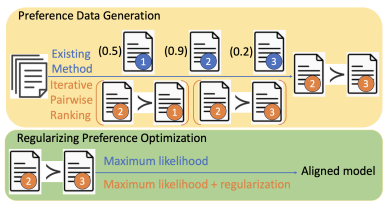
Figure 1 : Overview for DPO pipeline. Preference data gen- eration: existing scoring-based methods select preferred and dispreferred completions based on a single score, our proposed iterative pairwise ranking uses pairwise comparison signals to construct preference data. Regularizing preference opti- mization: we propose a budget-controlled regularization that balances training stability and model alignment performance.
원문 · CC BY 4.0 · Zhuotong Chen, Fang Liu, Jennifer Zhu, Wanyu Du, Yanjun Qi · Towards Improved Preference Optimization Pipeline: from Data Generation to Budget-Controlled Regularization · 원문 그림 인용 · 원본 PDF 2쪽에서 그림 영역을 추출했습니다.원문은 선호 completion의 likelihood가 약간 줄어드는 것이 수렴에 도움이 될 수 있다고 관찰하지만, 기존의 supervised next-word prediction 정규화는 선호 completion의 likelihood 감소를 엄격히 막습니다. 이 논문은 이 차이를 바탕으로 감소량을 예산으로 허용하는 정규화를 제안합니다.
반복 쌍별 순위(IPR)의 순차 비교
IPR은 여러 completion 후보 중 가장 선호되는 것을 찾기 위해 쌍별 비교 신호를 사용합니다. 절대 점수 대신 두 후보의 상대적 우열만 필요하며, 이는 dueling bandit 틀에서 동기를 얻었습니다. 완전한 Copeland 방식은 O(M²) 비교가 필요하지만, 원문은 전이성과 대칭성 가정을 두면 M개 후보에서 (M − 1)회의 비교로 최선 completion을 찾을 수 있다고 설명합니다.
구체적으로 첫 두 후보를 비교하고, 그 승자를 다음 후보와 비교하는 과정을 전체 승자가 정해질 때까지 반복합니다. 이 절차는 Condorcet 승자의 존재를 전제로 하며, 비교자가 LLM 판정자일 때 계산 비용이 커질 수 있습니다.
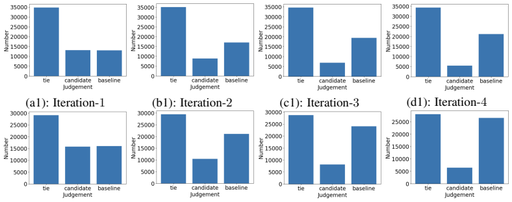
Figure 5 : Statistics of IPR. For IPR(Llama70B) with Llama-3.1-Instruct as base model: (a1), (b1), (c1) and (d1) present the statistics of preference comparisons at all 4 iterations. For IPR(Llama70B) with Mistral-Instruct as base model: (a2), (b2), (c2) and (d2) present the statistics of preference comparisons at all 4 iterations.
원문 · CC BY 4.0 · Zhuotong Chen, Fang Liu, Jennifer Zhu, Wanyu Du, Yanjun Qi · Towards Improved Preference Optimization Pipeline: from Data Generation to Budget-Controlled Regularization · 원문 그림 인용 · 원본 PDF 13쪽에서 그림 영역을 추출했습니다.예산 제어 정규화(BCR)
DPOP는 supervised next-word prediction 항을 log-sigmoid 내부에 두어 선호 completion의 likelihood가 감소하지 않도록 합니다. 원문은 이 방식이 결정론적에 가까운 선호 데이터에서 과적합을 일으키고 KL 정규화 효과를 소홀히 할 수 있다고 설명합니다. BCR은 정규화를 log-sigmoid 바깥에 두어 DPO 목적함수에 더하는 방식입니다.
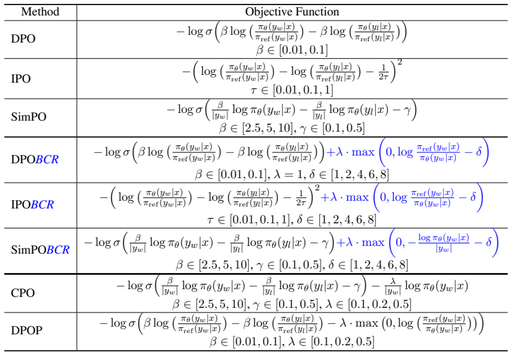
Table 5 : Preference optimization objective functions and hyperparameter choices.
원문 · CC BY 4.0 · Zhuotong Chen, Fang Liu, Jennifer Zhu, Wanyu Du, Yanjun Qi · Towards Improved Preference Optimization Pipeline: from Data Generation to Budget-Controlled Regularization · 원문 그림 인용 · 원본 PDF 11쪽에서 그림 영역을 추출했습니다.식 (4)에서 BCR 항은 λ·E[max(0, log π_ref(yw|x) − log π_θ(yw|x) − δ)]로 주어집니다. 여기서 δ는 허용되는 감소량인 예산이며, δ = 0이면 선호 completion likelihood의 어떤 감소도 벌점화됩니다. δ가 작은 양수이면 약간의 감소는 허용되고, 그 이상의 감소만 벌점화됩니다.
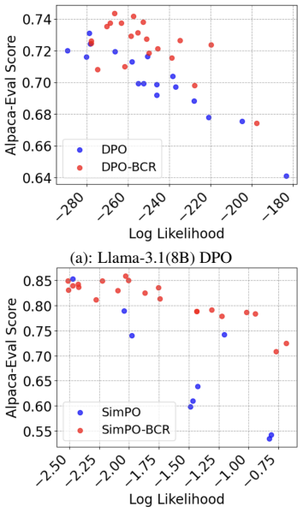
Figure 4 : Optimization budget (log-likelihood of preferred completions) versus Alpaca-Eval. (a) DPO versus DPO-BCR: sum of log-likelihood of preferred completions is used. (b) SimPO versus SimPO-BCR: average of log-likelihood of pre- ferred completions is used.
원문 · CC BY 4.0 · Zhuotong Chen, Fang Liu, Jennifer Zhu, Wanyu Du, Yanjun Qi · Towards Improved Preference Optimization Pipeline: from Data Generation to Budget-Controlled Regularization · 원문 그림 인용 · 원본 PDF 6쪽에서 그림 영역을 추출했습니다.평가 설정과 판정자
성능은 AlpacaEval 2와 Arena-Hard로 평가합니다. 두 벤치마크는 개방형 instruction-following 과제이며, 승률 기반 평가에서 Mixtral-8x7B-Instruct가 모델 판정자로 사용됩니다. AlpacaEval 2에서 모델 성능은 골든 참조 completion과 비교한 win rate로 정의됩니다.
실험 기반 모델은 Llama-3.1-8B instruct와 Mistral-Instruct-7B입니다. 선호 데이터는 기반 모델이 생성한 completion으로 구성되며, 기준 보상 모델로 ArmoRM-Llama3-8B-v0.1이 사용됩니다. 이 논문의 주요 평가는 이 설정에서 얻은 결과입니다.
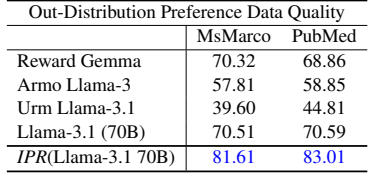
Table 4 : The scores represent the agreement (in %) with the model judge (Mixtral-8x7B-Instruct) by using the dispreferred completion as the baseline and the preferred completion as the candidate. Completions are generated using Llama-3.1 (8B).
원문 · CC BY 4.0 · Zhuotong Chen, Fang Liu, Jennifer Zhu, Wanyu Du, Yanjun Qi · Towards Improved Preference Optimization Pipeline: from Data Generation to Budget-Controlled Regularization · 원문 그림 인용 · 원본 PDF 8쪽에서 그림 영역을 추출했습니다.주요 결과와 선호 데이터 품질
Table 2에서 Llama-3.1 8B 설정의 IPR(Llama70B) SimPO는 AlpacaEval 2 점수 85.32를 얻었고, SimPOBCR은 85.90을 얻었습니다. 이 차이는 BCR이 SimPO의 성능을 약간 높였다는 관찰이며, 원문은 BCR이 같은 수준의 성능을 더 작은 optimization budget으로 달성한다고 설명합니다.
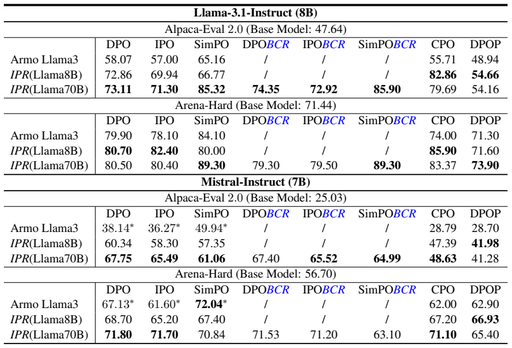
Table 2 : AlpacaEval 2 (Dubois et al., 2024) and Arena-Hard (Li et al., 2024) evaluation results for preference-tuned Llama-3.1 (8B) and Mistral-Instruct (7B) models. Armo Llama3 applies ArmoRM-Llama3-8B-v0.1 to construct preference data, IPR(Llama8B) and IPR(Llama70B) apply the proposed iterative pairwise ranking with Llama-3.1 8B and Llama-3.1 70B, respectively. x ∗ indicates that the scores are obtained from public models. BCR is only applied to train on the highest-quality preference data generated from IPR(Llama70B).
원문 · CC BY 4.0 · Zhuotong Chen, Fang Liu, Jennifer Zhu, Wanyu Du, Yanjun Qi · Towards Improved Preference Optimization Pipeline: from Data Generation to Budget-Controlled Regularization · 원문 그림 인용 · 원본 PDF 7쪽에서 그림 영역을 추출했습니다.UltraFeedback에서 IPR(Llama-3.1 70B)는 Llama-3.1 8B가 생성한 completion에 대해 모델 판정자와 82.33%의 agreement를 보였고, Armo Llama-3는 75.31%였습니다. 이 수치는 같은 생성 설정에서 선호 데이터 품질을 비교한 결과입니다. 분포 밖 과제인 MsMarco와 PubMedQA에서도 IPR은 높은 agreement를 보고했습니다.
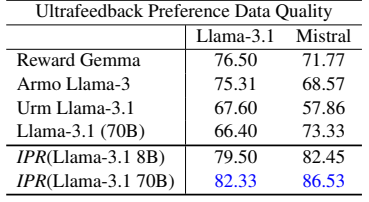
Table 3 : The scores represent the agreement (in %) with the model judge (Mixtral-8x7B-Instruct) by using the dispreferred completion as the baseline and the preferred completion as the candidate. Scores in columns 1 and 2 use completions generated from Llama-3.1 (8B) and Mistral-Instruct (7B), respectively.
원문 · CC BY 4.0 · Zhuotong Chen, Fang Liu, Jennifer Zhu, Wanyu Du, Yanjun Qi · Towards Improved Preference Optimization Pipeline: from Data Generation to Budget-Controlled Regularization · 원문 그림 인용 · 원본 PDF 8쪽에서 그림 영역을 추출했습니다.DPO의 실패 모드 관찰
DPO를 Llama-3.1-8B instruct에 UltraFeedback Binarized 데이터로 적용했을 때, reward margin과 reward accuracy는 개선되지만 선호 completion의 log-likelihood는 크게 줄었습니다. 원문은 이를 DPO의 실패 모드로 설명합니다. 같은 현상은 DPOP와 SimPO에서도 비교되며, 정규화 강도가 커질수록 log-likelihood 감소는 억제되지만 reward accuracy는 낮아지는 경향이 보고됩니다.
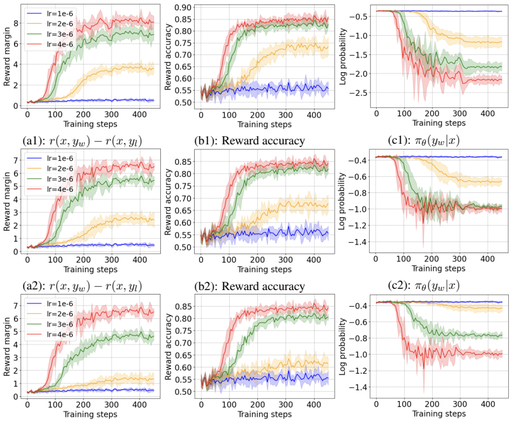
Figure 7 : Training progress for SimPO and CPO. (a1), (b1), and (c1) display the reward margin, reward accuracy, and log- likelihood of predicting preferred completions for SimPO, respectively. (a2), (b2), and (c2) present the same metrics for CPO with λ = 0.5, while (a3), (b3), and (c3) show the training progresses for DPOP with λ = 1. Each configuration is evaluated using four different learning rates: 1e − 6, 2e − 6, 3e − 6, and 4e − 6.
원문 · CC BY 4.0 · Zhuotong Chen, Fang Liu, Jennifer Zhu, Wanyu Du, Yanjun Qi · Towards Improved Preference Optimization Pipeline: from Data Generation to Budget-Controlled Regularization · 원문 그림 인용 · 원본 PDF 15쪽에서 그림 영역을 추출했습니다.이 관찰은 특정 설정과 학습 기간에서의 결과이며, 모든 선호 최적화 방법에 대한 일반 증명이 아닙니다.
계산 비용과 적용 범위
IPR은 대형 LLM으로 여러 반복 추론을 수행하고, 이 과정을 모든 학습 데이터에 반복하므로 상당한 계산 자원을 요구합니다. 원문은 이를 명시적 한계로 밝힙니다. 또한 주요 결과는 Llama-3.1 8B와 Mistral-Instruct 7B 기반 모델, AlpacaEval 2와 Arena-Hard, Mixtral-8x7B 판정자라는 설정에서 얻은 것입니다. 다른 모델이나 온라인 설정으로 결과를 옮기려면 별도의 검증이 필요합니다.
논문 정보
- 저자
- Zhuotong Chen, Fang Liu, Jennifer Zhu, Wanyu Du, Yanjun Qi
- 학회·저널
- arXiv · 프리프린트
- 최초 공개일
- 2024년 11월 7일
- 등록일
- 2026년 11월 5일
- 수정일
- 2024년 11월 7일
- 버전
- v1
- arXiv
- 2411.05875
- 분류
- cs.LG · cs.AI · cs.CL
- 원문 이용 조건
- CC BY 4.0
- 제공 범위
- 논문 정보, 해설, 허용된 원문 그림
AI 해설은 논문 원문과 별개의 설명이며 오류가 있을 수 있습니다. 원문과 그림은 각 출처의 이용 조건과 따로 표시된 권리를 따릅니다.
초록
Direct Preference Optimization (DPO) and its variants have become the de facto standards for aligning large language models (LLMs) with human preferences or specific goals. However, DPO requires high-quality preference data and suffers from unstable preference optimization. In this work, we aim to improve the preference optimization pipeline by taking a closer look at preference data generation and training regularization techniques. For preference data generation, we demonstrate that existing scoring-based reward models produce unsatisfactory preference data and perform poorly on out-of-distribution tasks. This significantly impacts the LLM alignment performance when using these data for preference tuning. To ensure high-quality preference data generation, we propose an iterative pairwise ranking mechanism that derives preference ranking of completions using pairwise comparison signals. For training regularization, we observe that preference optimization tends to achieve better convergence when the LLM predicted likelihood of preferred samples gets slightly reduced. However, the widely used supervised next-word prediction regularization strictly prevents any likelihood reduction of preferred samples. This observation motivates our design of a budget-controlled regularization formulation. Empirically we show that combining the two designs leads to aligned models that surpass existing SOTA across two popular benchmarks.
원문 인용
Zhuotong Chen, Fang Liu, Jennifer Zhu, Wanyu Du, Yanjun Qi (2024). Towards Improved Preference Optimization Pipeline: from Data Generation to Budget-Controlled Regularization. arXiv:2411.05875v1. https://arxiv.org/abs/2411.05875v1
BibTeX
@misc{chen2024towards,
  title = {{Towards Improved Preference Optimization Pipeline: from Data Generation to Budget-Controlled Regularization}},
  author = {Zhuotong Chen and Fang Liu and Jennifer Zhu and Wanyu Du and Yanjun Qi},
  year = {2024},
  eprint = {2411.05875},
  archivePrefix = {arXiv},
  url = {https://arxiv.org/abs/2411.05875v1}
}