논문 해설
Who Asks, Who Answers: Linear Attention Builds the Query in Hybrid Language Models
누가 묻고, 누가 답하는가: 선형 어텐션이 하이브리드 언어 모델에서 쿼리를 구성한다
- 연구 문제 하이브리드 언어 모델에서 선형 어텐션은 압축 기능만 한다고 여겨졌지만, 이 논문은 선형 어텐션이 소프트맥스 리더가 쓸 검색 query를 구성하는지 묻습니다.
- 연구 방법 Qwen3.5와 Granite4.0-H에서 Encode 블록과 Address 블록을 나누고, 블록 제거와 최종 위치 출력 이식으로 각 블록의 역할을 구분합니다.
- 주요 결과 Qwen3.5-9B에서 Address 블록의 최종 위치 출력을 이식하면 검색 대상이 0.97–0.99의 경우에서 재지정되며, Address 계산은 교차 아키텍처 전이와 규모별 분산 패턴도 보입니다.
선형 어텐션은 검색에 어떤 역할을 하는가
하이브리드 언어 모델은 선형 어텐션 계층과 소수의 소프트맥스 어텐션 계층을 섞어 씁니다. 선형 어텐션은 과거 문맥을 고정 크기 상태로 압축하므로 효율적이지만, 프롬프트 앞부분의 정확한 정보를 다시 찾는 능력은 약한 것으로 알려져 있습니다. 선행 연구는 검색을 주로 소프트맥스 어텐션의 몫으로 보았고, 선형 어텐션은 문맥을 압축하는 수단으로 다루었습니다.
이 논문은 그 분업을 다시 묻습니다. 선형 어텐션 계층이 소프트맥스 어텐션이 쓸 질의를 직접 만드는지를 확인하는 것이 질문입니다. 이를 위해 사전형 키-값 검색 과제를 사용하며, 선형 어텐션 계층을 제거하면 소프트맥스 계층을 모두 유지해도 검색 정확도가 최대 0.05로 떨어진다는 관찰에서 출발합니다.
Encode 블록과 Address 블록으로 나눈 회로
논문은 먼저 검색이 일어나는 소프트맥스 계층을 찾습니다. 점진적 가지치기 분석은 층 L 이후를 잘라 내며 정규화 검색 정확도의 변화를 봅니다. Qwen3.5-9B에서는 소프트맥스 계층 L19를 유지할 때 정규화 정확도가 0에서 0.67로 올라가며, 이 계층을 리더로 지정합니다.
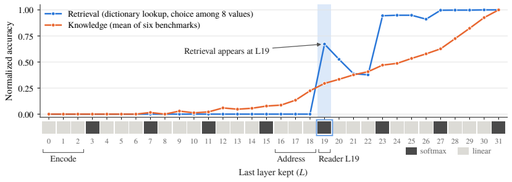
Figure 2 : Performance of Qwen3.5-9B truncated after layerL. Retrieval appears abruptly when the softmax layer L19 is kept; knowledge grows gradually with depth.
원문 · CC BY 4.0 · Wenqi Zeng, Chen Feng, YuAng Chen · Who Asks, Who Answers: Linear Attention Builds the Query in Hybrid Language Models · 원문 그림 인용 · 원본 PDF 4쪽에서 그림 영역을 추출했습니다.다음으로 리더 앞의 선형 어텐션 블록을 제거와 이식이라는 두 개입으로 봅니다. 제거는 블록의 토큰 믹서 출력을 모든 위치에서 0으로 두고 MLP와 소프트맥스 계층은 그대로 둡니다. 이식은 같은 사전을 가지되 질의 키만 다른 donor와 host 프롬프트에서, donor 블록의 최종 위치 출력을 host의 같은 위치에 넣습니다. 이 과정에서 가장 이른 G0 블록은 제거하면 검색을 거의 무너뜨리지만 이식해도 효과가 없었습니다. 반대로 리더 바로 앞의 G4 블록은 제거해도 정확도는 1.00으로 유지되고 로짓 차이만 약 절반으로 줄었으나, 이식하면 host의 답이 donor의 값으로 0.99의 비율로 바뀌었습니다.
이 결과에 따라 G0를 Encode 블록, G4를 Address 블록이라고 부릅니다.
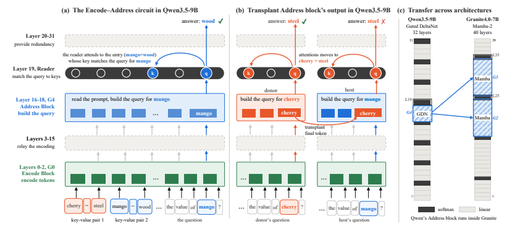
Figure 1 : Overview. (a) The Encode block re-encodes token identity, the Address block constructs the retrieval query, and softmax attention retrieves the matching value. (b) Transplanting the address from prompt A into prompt B makes the model answer A’s question. (c) Addresses transfer between Qwen3.5 (Gated DeltaNet) and Granite4.0 (Mamba-2)
원문 · CC BY 4.0 · Wenqi Zeng, Chen Feng, YuAng Chen · Who Asks, Who Answers: Linear Attention Builds the Query in Hybrid Language Models · 원문 그림 인용 · 원본 PDF 2쪽에서 그림 영역을 추출했습니다.Encode 블록은 토큰 정체성을 보존합니다
Encode 블록의 역할은 토큰 수준 개입으로 확인합니다. value swap과 key swap에서 Encode 출력을 원래 값으로 복원하면 원래 키-값 연결이 0.98의 비율로 회복됩니다. 입력 토큰 임베딩만 패치해도 1.00이 되었고, 다른 블록의 출력을 패치하면 효과가 없었습니다. 따라서 검색에 필요한 정보는 입력 임베딩에 이미 있으며, Encode 블록은 이를 다시 인코딩하는 역할을 한다고 해석할 수 있습니다.
또한 G0를 원래 입출력에 릿지 회귀로 맞춘 토큰별 선형 투영으로 바꾸면 검색 정확도는 1.00을 유지합니다. 그러나 WikiText-2 perplexity는 10.6에서 44.7로 증가합니다. 이는 검색에 필요한 역할은 단순한 선형 변환으로 대체될 수 있지만, 원래 블록은 일반 언어 모델링에 중요한 추가 계산을 수행한다는 뜻입니다.
Address 블록은 리더의 query를 결정합니다
Address 블록이 리더의 key를 바꾸는지 query를 바꾸는지를 확인하기 위해, G4를 제거한 뒤 query만 바꾸거나 key만 바꾸어 어텐션을 다시 계산합니다. 선택성은 질의된 항목의 로그 어텐션 질량과 다른 항목 평균의 차이이며, top-1 rate는 질의된 항목이 가장 큰 어텐션을 받은 비율입니다. G4 없이 계산한 query를 쓰면 선택성은 5.45에서 1.36으로 줄고 리더가 맞는 항목을 고르는 비율은 약 절반으로 떨어집니다. 반면 G4 없이 계산한 key를 쓰면 선택성은 4.80으로 거의 유지되고 top-1 rate는 1.00입니다.
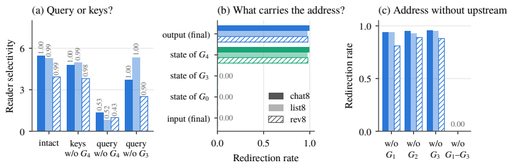
Figure 4 : How the Address block constructs the retrieval target in Qwen3.5-9B. (a) Reader selectivity when its query or keys are computed without the indicated block; numbers show top-1 rates. Solid, light, and hatched bars denote the three prompt formats. (b) Transplanting the Address block’s final-position output, or its recurrent state, redirects retrieval; the states of earlier blocks and the block’s input at the final position do not. (c) Address block outputs computed without any single upstream block still redirect retrieval, but those computed without all three do not.
원문 · CC BY 4.0 · Wenqi Zeng, Chen Feng, YuAng Chen · Who Asks, Who Answers: Linear Attention Builds the Query in Hybrid Language Models · 원문 그림 인용 · 원본 PDF 7쪽에서 그림 영역을 추출했습니다.따라서 Address 블록은 리더의 어텐션 query를 주로 결정한다고 읽을 수 있습니다. 같은 맥락에서 Address 블록의 순환 상태를 donor에서 host로 복사하면 검색 대상이 0.99의 비율로 재지정되며, G0 또는 G3의 상태를 이식하면 효과가 없습니다. 입력만 바꾸고 host의 순환 상태를 유지하는 대조군도 0.00이므로, 검색 목표는 Address 블록의 재귀 상태에 실려 있다고 저자들은 해석합니다.

Table 4 : Whole-block versus single-layer interventions on the block preceding the reader (chat8).Transplant: fraction of donor–host pairs that return the donor’s value, with the reader’s attention on the donor’s entry in parentheses (host baseline≤0.01); for single layers, the best layer of the block is shown.Removal: accuracy with the block, or the most damaging single layer of the block, removed. The last column gives accuracy with layer 0 alone removed.
원문 · CC BY 4.0 · Wenqi Zeng, Chen Feng, YuAng Chen · Who Asks, Who Answers: Linear Attention Builds the Query in Hybrid Language Models · 원문 그림 인용 · 원본 PDF 13쪽에서 그림 영역을 추출했습니다.Address 계산은 서로 다른 아키텍처 사이에서 전이됩니다
교차 아키텍처 실험은 Gated DeltaNet 계열 Qwen3.5와 Mamba-2 계열 Granite4.0-H 사이에서 독립적으로 학습된 모델 쌍을 비교합니다. 두 모델의 활성값은 릿지 회귀로 맞춘 선형 정렬 맵으로 연결하며, 어떤 모델의 가중치도 갱신하지 않습니다. 작은 모델 쌍에서는 Qwen3.5-0.8B의 Address 출력을 Granite4.0-1B로 옮기는 전이가 0.98의 비율로 성공합니다.
Granite4.0-7B에는 두 개의 리더와 두 개의 Address 블록이 있어 더 복잡합니다. G2만 이식하면 대부분 답이 바뀌지 않지만, G2와 G3를 함께 이식하면 1.00, 1.00, 0.90의 비율로 답이 재지정됩니다. Granite4.0-7B의 두 Address 블록을 Qwen3.5-9B의 Address 블록으로 교체하면 검색 정확도가 0.94가 되며, 교체가 없을 때 0.00입니다. 반대 방향에서는 Qwen3.5-9B의 Address 블록을 Granite4.0-7B의 두 블록으로 교체해도 정확도가 0.46에 그쳐, 온전한 수신 모델의 0.75보다 낮습니다. 따라서 이 전이는 방향에 따라 효과가 다르며, 여러 Address 블록과 소프트맥스 계층이 나뉘어 있는 구조는 옮기기 어렵다고 해석됩니다.
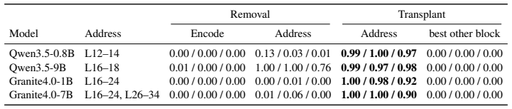
Table 5 : The circuit across models (chat8/list8/rev8). Removal: accuracy with the block removed (intact ≥0.90). Transplant: fraction of pairs that return the donor’s value when the block’s output is transplanted at the final position. For Granite4.0-7B, the Address comprises two blocks,G 2 andG 3, which are removed and transplanted jointly; transplantingG 2 alone gives 0.03 / 0.06 / 0.05.
원문 · CC BY 4.0 · Wenqi Zeng, Chen Feng, YuAng Chen · Who Asks, Who Answers: Linear Attention Builds the Query in Hybrid Language Models · 원문 그림 인용 · 원본 PDF 14쪽에서 그림 영역을 추출했습니다.규모가 커지면 Address 계산이 여러 블록에 분산됩니다
여섯 Qwen3.5 모델은 모두 선형 어텐션 계층 세 개마다 소프트맥스 계층 하나를 둡니다. 0.8B부터 9B까지의 작은 모델에서는 G3 또는 G4 하나가 세 개의 리더를 모두 안내하며, 이 블록을 이식하면 0.70에서 1.00의 비율로 검색이 재지정됩니다. 그러나 제거 효과는 규모에 따라 다릅니다. Qwen3.5-0.8B에서는 Address 블록을 제거하면 정확도가 0.06, 2B에서는 0.41로 떨어지지만 4B와 9B에서는 0.94와 0.92로 유지됩니다.
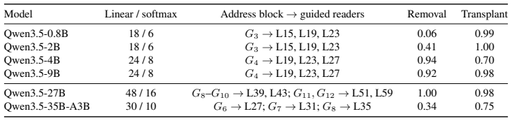
Table 3 : Address blocks and the readers they guide in Qwen3.5 models.Removal: accuracy after removing the Address blocks.Transplant: fraction of prompts redirected to the donor’s target when the Address blocks are transplanted jointly.
원문 · CC BY 4.0 · Wenqi Zeng, Chen Feng, YuAng Chen · Who Asks, Who Answers: Linear Attention Builds the Query in Hybrid Language Models · 원문 그림 인용 · 원본 PDF 10쪽에서 그림 영역을 추출했습니다.27B와 35B-A3B에서는 단일 블록이 검색을 재지정하지 못하고, 서로 다른 Address 블록이 서로 다른 리더를 안내합니다. 여러 블록을 함께 이식하면 27B에서는 0.98, 35B-A3B에서는 0.75의 응답이 재지정됩니다. 제거 효과도 다르게 나타납니다. 27B에서 Address 블록을 제거하면 정확도가 1.00으로 유지되고, 35B-A3B에서는 0.34로 줄어듭니다. 이 두 모델의 차이를 밀집과 혼합 전문가 구조의 일반 차이로 해석하는 것은 이 논문의 범위를 넘으며, 저자들도 이를 향후 과제로 남깁니다.
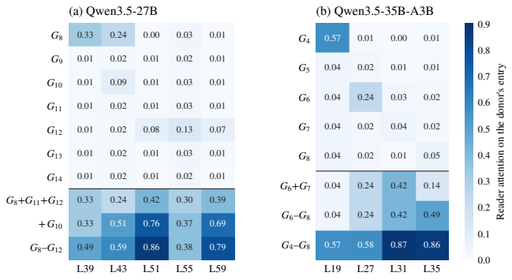
Figure 5 : Attention of the top head of each reader layer on the donor’s entry after transplanting single core blocks (above the line) or their combinations (below) at the final position, in Qwen3.5-27B (a) and Qwen3.5-35B-A3B (b). Intact host≤0.04.
원문 · CC BY 4.0 · Wenqi Zeng, Chen Feng, YuAng Chen · Who Asks, Who Answers: Linear Attention Builds the Query in Hybrid Language Models · 원문 그림 인용 · 원본 PDF 14쪽에서 그림 영역을 추출했습니다.적용 범위와 한계
이 결과는 Qwen3.5와 Granite4.0-H의 여러 모델, 그리고 키와 값이 단일 토큰인 합성 사전 검색 과제에서 얻은 것입니다. 과제를 합성 설정으로 만든 이유는 검색 능력을 다른 지식이나 추론 능력과 분리하기 위해서입니다. 따라서 이 결과를 임의의 자연어 과제나 모든 하이브리드 모델로 옮기는 것은 근거가 제한됩니다.
Encode 블록에 대한 토큰별 선형 투영 실험은 검색 정확도를 유지하지만 언어 모델링 perplexity를 크게 높입니다. 또한 Qwen3.5-9B에서 Granite4.0-7B로의 반대 방향 전이는 완전하지 않았습니다. 이 논문은 Address 블록의 출력이 질의를 결정하는 역할, 상태가 검색 목표를 담는 역할, 규모에 따른 분산을 보여 주지만, 이러한 구조가 모든 입력 경로와 모든 과제에서 같은 방식으로 작동한다고 증명하지는 않습니다.
논문 정보
- 저자
- Wenqi Zeng, Chen Feng, YuAng Chen
- 학회·저널
- arXiv · 프리프린트
- 최초 공개일
- 2026년 11월 1일
- 등록일
- 2026년 11월 3일
- 수정일
- 2026년 11월 1일
- 버전
- v1
- arXiv
- 2611.01909
- 분류
- cs.AI
- 원문 이용 조건
- CC BY 4.0
- 제공 범위
- 논문 정보, 해설, 허용된 원문 그림
AI 해설은 논문 원문과 별개의 설명이며 오류가 있을 수 있습니다. 원문과 그림은 각 출처의 이용 조건과 따로 표시된 권리를 따릅니다.
초록
Hybrid language models interleave linear-attention layers with a small number of softmax-attention layers. Prior work largely attributes in-context retrieval to softmax attention, treating linear attention primarily as a mechanism for compressing past context. We revisit this division of labor and show that linear attention plays a direct role in retrieval by constructing the query used by softmax attention. Studying Qwen3.5 (Gated DeltaNet) and Granite4.0 (Mamba-2), we identify an Encode--Address circuit. An early Encode block preserves token identity, while an Address block constructs the final-position representation from which a softmax \emph{reader} forms its attention query. Transplanting this representation between prompts with different queried keys redirects retrieval in 0.97--0.99 of cases. The Address block's recurrent state carries the retrieval target, and its computation transfers across architectures: replacing Granite's Address block with Qwen's restores retrieval accuracy to 0.92--0.94 without updating either model's weights. Across six Qwen3.5 models, Address computation becomes distributed at larger scales over a chain of blocks, each guiding a successive reader, as the query no longer passes from one reader to the next through attention. These findings reveal a division of labor in hybrid retrieval: linear attention constructs the query, while softmax attention performs the lookup. Code is available at https://github.com/yuang-chen/LinearQuery
원문 인용
Wenqi Zeng, Chen Feng, YuAng Chen (2026). Who Asks, Who Answers: Linear Attention Builds the Query in Hybrid Language Models. arXiv:2611.01909v1. https://arxiv.org/abs/2611.01909v1
BibTeX
@misc{zeng2026asks,
  title = {{Who Asks, Who Answers: Linear Attention Builds the Query in Hybrid Language Models}},
  author = {Wenqi Zeng and Chen Feng and YuAng Chen},
  year = {2026},
  eprint = {2611.01909},
  archivePrefix = {arXiv},
  url = {https://arxiv.org/abs/2611.01909v1}
}