논문 해설
InformedXRD: Reproducible Benchmarks and Physics-Informed Evaluation for Powder Diffraction Symmetry Classification
InformedXRD: 분말 회절 대칭 분류를 위한 재현 가능한 벤치마크와 물리 정보 기반 평가
- 연구 문제 PXRD 기계학습 대칭 분류 연구는 데이터 아카이브, 대상 라벨, 전처리, 지표가 연구마다 달라 결과를 비교하기 어렵습니다. InformedXRD는 이 문제를 extinction group 라벨 공간, 재현 가능한 벤치마크 구성, 입력 무관 기준선과 계층 인식 평가로 다룹니다.
- 연구 방법 공간군을 분말 회절으로 구분 가능한 99개 extinction group으로 바꾸고, 원본 아카이브를 알고리즘 규칙으로 고정된 벤치마크로 만듭니다. 평가에는 사전 분포 기준선, 라벨 순열 검정, DAG 거리 지표, 품질과 라벨 엔트로피에 따른 층화 보고를 함께 사용합니다.
- 주요 결과 같은 예측도 평탄한 Top-1, 계층 거리, 쌍체 검정에 따라 다른 결론을 낳습니다. 최종 보정 ViT는 Top-5에서 배포 가능한 prior를 크게 넘지만 오라클 prior와는 같거나 낮으며, 패턴별 순열 근거는 작지만 검출됩니다. 층별 재가중은 품질 층 차이의 약 45%를 라벨 집중도로 설명합니다.
평가 기준이 흔들리는 문제
분말 X선 회절(PXRD)로 결정의 대칭을 분류하는 기계학습 연구는 빠르게 늘고 있지만, 공통 평가 기준이 아직 없습니다. 연구마다 실험 아카이브의 부분집합, 대상 분류 체계, 전처리, 지표가 달라서 보고된 정확도가 모델의 진전인지 벤치마크 설계 선택의 결과인지 구분하기 어렵습니다. 논문은 이 문제를 세 가지 실패로 정리합니다. 첫째, 분말 회절은 공간군을 서로 구분하지 못하므로 230-way 분류는 구분할 수 없는 패턴을 혼동했다고 모델에 불리하게 작용합니다. 둘째, 손으로 고른 RRUFF 부분집합과 문서화되지 않은 제외 기준은 가장 어려운 사례를 빼고 재현을 어렵게 만듭니다. 셋째, Top-k 정확도는 가까운 부분군을 예측한 경우와 전혀 무관한 대칭을 예측한 경우를 똑같이 실패로 세며, 사전 분포만 따르는 기준선이 없으면 정확도가 회절 근거에서 나온 것인지 라벨 빈도에서 나온 것인지 알 수 없습니다.
InformedXRD는 이 문제를 새 모델 구조가 아니라 평가 인프라와 보고 프로토콜로 다룹니다.
230개 공간군에서 99개 extinction group으로
이 논문의 첫 번째 변경은 평가 라벨을 공간군 대신 extinction group으로 바꾸는 것입니다. 나사축이나 글라이드면은 특정 지수 패턴의 반사를 체계적으로 소멸시키며, 서로 다른 공간군이 같은 소멸 집합을 가지면 분말 패턴만으로는 구별할 수 없습니다. extinction group은 이렇게 소멸 집합이 같은 공간군들의 동등류이며, 230개 공간군을 99개로 줄입니다. 논문은 이것을 분말 회절으로 정당화할 수 있는 가장 세밀한 평가 라벨 공간으로 봅니다. 매핑은 EXPO에 배포된 extinction 기호 표를 바탕으로 만들어졌고, 이를 파싱하고 정규화한 뒤 230행 조회표로 뒤집어 International Tables와 대조했습니다.
공개된 산출물은 JSON과 CSV이며, 이 매핑이 있으면 230-way 모델의 출력을 사후에 99-way 공간으로 다시 채점할 수 있습니다.
이 선택의 효과를 확인하기 위해 같은 패턴, 같은 분할, 같은 백본과 학습 예산에서 공간군 모델과 extinction group 모델을 비교했습니다. 공간군 모델은 자기 공간에서 Top-1 15.17%, extinction group 공간으로 확률을 합산하면 18.46%였고, extinction group을 직접 학습한 모델은 전체 규모에서 19.32%였습니다. 이 차이는 전체 규모에서 +0.86포인트이지만, 학습 데이터를 8분의 1로 줄이면 +2.77포인트로 커집니다. 따라서 직접 extinction group 학습의 이점은 주로 표본 효율에서 나타나며, 공간군 모델은 데이터가 늘수록 같은 등가 구조를 상당 부분 암묵적으로 배웁니다.
재현 가능한 벤치마크 구성
두 번째 변경은 벤치마크 구성 자체를 알고리즘 규칙으로 명세하는 것입니다. 원본 아카이브가 곧바로 벤치마크가 되지 않으므로, 논문은 단일 할당 가능한 라벨, 파장과 격자 게이트, 구조 기반 그룹화, 가족 일관성 검사, 충돌을 고려한 정확 중복 제거, 패턴별 층 부여, 동결과 감사의 일곱 단계를 제안합니다. 1단계, 2단계, 7단계는 모든 아카이브에 동일하게 적용되고, 3단계부터 6단계는 아카이브마다 다르게 구현될 수 있습니다.
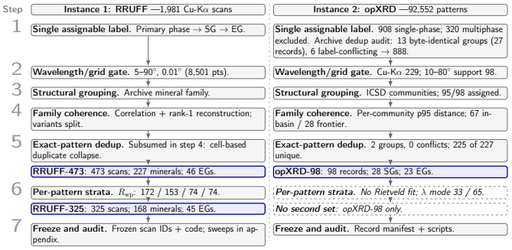
Figure 1 : The construction method of §4.1 instantiated on two archives. Left: RRUFF, yielding the frozen RRUFF-473 and RRUFF-325 benchmarks with their nuisance-fit strata. Right: opXRD, a small example yielding opXRD-98. Rows are the steps of the method aligned across the two archives, with dashed boxes marking omitted steps and blue boxes marking the released evaluation sets. Per-step detail—thresholds, diagnostics, and the full gate cascade—is in Appendix E (RRUFF) and Appendix F (opXRD).
원문 · CC BY 4.0 · Edward G Friedman, Elizabeth J. Baggett, Abhishek Shetty, Derrick Chan-Sew, Vanellsa Acha, Harshitha Dwaracherla, P. A. Kienzle, William Ratcliff · InformedXRD: Reproducible Benchmarks and Physics-Informed Evaluation for Powder Diffraction Symmetry Classification · 원문 그림 인용 · 원본 PDF 4쪽에서 그림 영역을 추출했습니다.RRUFF의 1,981개 Cu-Kα 스캔 풀에서 가족 일관성 검사를 거쳐 RRUFF-473을 만들고, 여기에 Rietveld 적합 기반 Rwp 기준을 적용해 RRUFF-325를 얻습니다. RRUFF-473은 227개 광물과 46개 extinction group을, RRUFF-325는 168개 광물과 45개 extinction group을 포함합니다. 이 두 세트는 학습용이 아니라 고정된 평가 세트입니다. opXRD에 같은 방법을 적용한 opXRD-98은 98개 기록의 작은 예시이며, 벤치마크가 아니라 스트레스 테스트로 제시됩니다. 원문은 opXRD에 가족 라벨이 없으므로 ICSD 구조 지도에 투영하여 구조만으로 그룹화와 층화를 수행했다고 설명합니다.
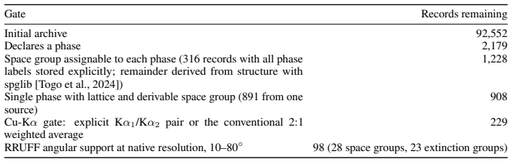
Table 7 : Filtering gates applied to opXRD to obtain opXRD-98, a one-pattern, one-label Cu-Kαset comparable with the RRUFF benchmarks.
원문 · CC BY 4.0 · Edward G Friedman, Elizabeth J. Baggett, Abhishek Shetty, Derrick Chan-Sew, Vanellsa Acha, Harshitha Dwaracherla, P. A. Kienzle, William Ratcliff · InformedXRD: Reproducible Benchmarks and Physics-Informed Evaluation for Powder Diffraction Symmetry Classification · 원문 그림 인용 · 원본 PDF 19쪽에서 그림 영역을 추출했습니다.입력 무관 기준선과 순열 검정
세 번째 변경은 Top-k 정확도 옆에 입력을 보지 않는 기준선과 라벨 순열 검정을 두는 것입니다. 사전 분포 기준선은 학습 빈도로 extinction group을 정렬하여 모든 패턴에 같은 Top-k 목록을 예측합니다. 배포 가능한 prior는 RRUFF 실제 패턴에서 Top-1 9.7%, Top-5 27.2%를 얻었고, 오라클 prior는 벤치마크 자체의 라벨 빈도로 RRUFF-473에서 Top-1 12.9%, Top-5 51.4%를 얻습니다. 최종 보정 ViT는 RRUFF-473에서 Top-1 9.94%, Top-5 50.74%를 기록하여, 배포 가능한 prior는 Top-5에서 크게 넘지만 오라클 prior를 넘지 못합니다.
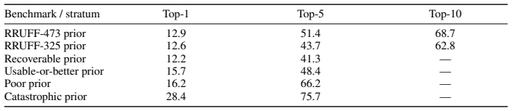
Table 6 : Benchmark-matched prior-only controls. “RRUFF prior” denotes the empirical extinction- group distribution of the named benchmark itself rather than the aggregate synthetic-training prior.
원문 · CC BY 4.0 · Edward G Friedman, Elizabeth J. Baggett, Abhishek Shetty, Derrick Chan-Sew, Vanellsa Acha, Harshitha Dwaracherla, P. A. Kienzle, William Ratcliff · InformedXRD: Reproducible Benchmarks and Physics-Informed Evaluation for Powder Diffraction Symmetry Classification · 원문 그림 인용 · 원본 PDF 18쪽에서 그림 영역을 추출했습니다.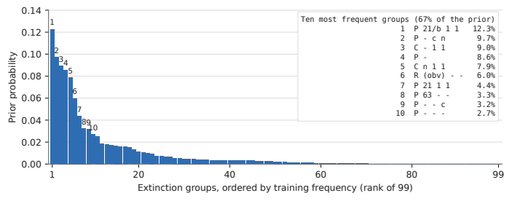
Figure 4 : Extinction-group imbalance in the ICSD-derived source distribution underlying the aggre- gate synthetic training prior used for calibration. Horizontal axis: all 99 extinction groups, ordered by training frequency; vertical axis: prior probability; the ten most frequent groups are numbered on the bars and named in the inset. Heavy class imbalance means a naive prior-frequency baseline can attain non-trivial Top-kaccuracy with no reference to the input.
원문 · CC BY 4.0 · Edward G Friedman, Elizabeth J. Baggett, Abhishek Shetty, Derrick Chan-Sew, Vanellsa Acha, Harshitha Dwaracherla, P. A. Kienzle, William Ratcliff · InformedXRD: Reproducible Benchmarks and Physics-Informed Evaluation for Powder Diffraction Symmetry Classification · 원문 그림 인용 · 원본 PDF 22쪽에서 그림 영역을 추출했습니다.라벨 순열 검정은 각 패턴의 Top-5 후보 집합을 고정한 채 벤치마크 라벨을 패턴들 사이에서 무작위로 재배치합니다. 이렇게 하면 라벨 빈도와 모델의 흔한 그룹 예측 경향은 유지되고, 개별 패턴과 정답 라벨의 연결만 깨집니다. 최종 보정 ViT의 RRUFF-473 Top-5는 50.74%이고 셔플 평균은 48.52%였으므로 +2.22포인트이며, 단측 p값은 0.0131입니다. 따라서 이 모델은 입력 무관 기준선을 넘는 패턴별 근거를 보이지만, 그 차이는 작습니다.
평탄한 지표와 계층 지표의 불일치
네 번째 변경은 정확도 하나 대신 계층 인식 DAG 지표를 함께 쓰는 것입니다. 잘못된 Top-1 예측에 대해 최단 경로 거리, 하위 대칭 후손·상위 대칭 조상·분기 점프의 방향, 2-hop 이내 지역성을 계산하고, 균등 null, 모델 맞춤 null, 빈도 맞춤 null과 비교합니다. RRUFF-325의 다섯 모델에서 평탄 Top-1 순위와 평균 DAG 거리 순위는 서로 다르게 나타납니다. preferred-orientation-only ViT는 Top-1 13.54%로 최종 보정 체크포인트의 10.46%보다 높지만, 평균 거리 기준에서는 최종 보정 체크포인트가 더 낫습니다. 1D 잔차 CNN 대조군은 분기 점프 비율이 53.8%로 ViT 계열과 다른 실패 양상을 보입니다.

Table 1 : Five-model comparison on RRUFF-325: Top-1, ≤2 -hop locality, mean DAG distance, and branch-jump fraction, with the implied ranks under flat Top-1 versus mean DAG distance. The two ranking columns disagree on the preferred-orientation-only and final mixed-data calibrated ViT checkpoints; the 1D CNN baseline is set apart from the ViT family by its 53.8% branch-jump rate. Hierarchy columns are over wrong Top-1 predictions; matched nulls for the preferred-orientation-only and final mixed-data calibrated ViTs and the CNN are given in Table 9. Boldface marks the best value in each column and does not denote statistical significance.
원문 · CC BY 4.0 · Edward G Friedman, Elizabeth J. Baggett, Abhishek Shetty, Derrick Chan-Sew, Vanellsa Acha, Harshitha Dwaracherla, P. A. Kienzle, William Ratcliff · InformedXRD: Reproducible Benchmarks and Physics-Informed Evaluation for Powder Diffraction Symmetry Classification · 원문 그림 인용 · 원본 PDF 7쪽에서 그림 영역을 추출했습니다.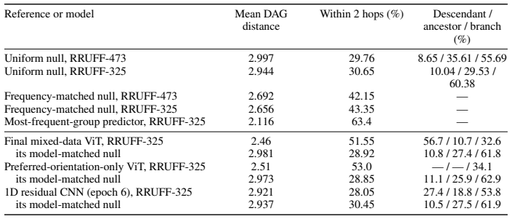
Table 9 : Reference distributions for the hierarchy-aware metric and three RRUFF-325 case-study models. Direction is the descendant / ancestor / branch-jump split over wrong predictions.
원문 · CC BY 4.0 · Edward G Friedman, Elizabeth J. Baggett, Abhishek Shetty, Derrick Chan-Sew, Vanellsa Acha, Harshitha Dwaracherla, P. A. Kienzle, William Ratcliff · InformedXRD: Reproducible Benchmarks and Physics-Informed Evaluation for Powder Diffraction Symmetry Classification · 원문 그림 인용 · 원본 PDF 20쪽에서 그림 영역을 추출했습니다.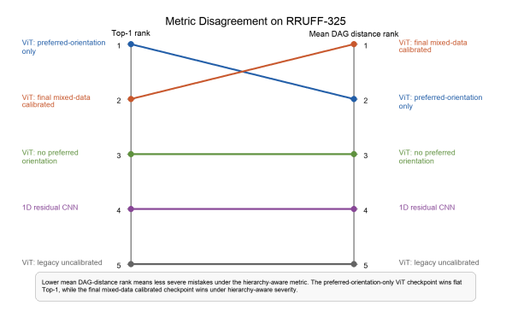
Figure 3 : Flat accuracy and hierarchy-aware severity rank the same five models differently. Each line is one model; its left endpoint is its Top-1 rank, and its right endpoint is its mean-DAG-distance rank on the condensed t-subgroup graph. Lower mean DAG distance is better. The preferred-orientation- only ViT checkpoint wins under flat Top-1, while the final mixed-data calibrated ViT checkpoint has the best raw mean-DAG-distance rank. The 1D CNN baseline remains worse on both metrics and, more importantly for this paper, demonstrates that the hierarchy-aware metric distinguishes a separate branch-jump-heavy failure regime that flat Top-1 alone would compress into a single score.
원문 · CC BY 4.0 · Edward G Friedman, Elizabeth J. Baggett, Abhishek Shetty, Derrick Chan-Sew, Vanellsa Acha, Harshitha Dwaracherla, P. A. Kienzle, William Ratcliff · InformedXRD: Reproducible Benchmarks and Physics-Informed Evaluation for Powder Diffraction Symmetry Classification · 원문 그림 인용 · 원본 PDF 21쪽에서 그림 영역을 추출했습니다.표준 쌍체 검정에서도 같은 예측이 다른 결론을 낳습니다. 정확한 McNemar 검정에서 preferred-orientation-only 체크포인트는 Top-1에서 우세하고(13.54% 대 10.46%, p=0.002), 최종 보정 체크포인트는 Top-5에서 우세합니다(43.69% 대 40.92%, p=0.012). 여섯 XRDBench 아키텍처에서도 CNN10, CNN11, PatchTST 사이의 쌍체 검정은 Top-1, Top-3, Top-5 차이를 해소하지 못하지만, 계층 요약은 오차 거리와 방향의 차이를 드러냅니다. 일반 Transformer는 RRUFF-473에서 2-hop 이내 비율이 16.71%로 자체 null의 32.54%보다 낮고, 오류의 95.8%가 하위 대칭 후손 방향입니다.
다만 거리 차이는 빈도 맞춤 null과 가까워서, 저자들은 방향 대비를 더 확실한 결과로 해석합니다.
품질 층과 라벨 집중도 분해
마지막 변경은 벤치마크를 데이터 품질 축과 라벨 공간 엔트로피 축으로 나누어 층별 정확도를 보고하는 것입니다. RRUFF-473의 패턴은 Rietveld 적합 뒤 잔차 불일치에 따라 recoverable, usable-or-better, poor, catastrophic으로 나뉩니다. 최종 보정 ViT의 원자료 Top-1은 11.05%, 9.80%, 10.81%, 6.76%이지만, 공통 extinction group 분포로 재가중하면 13.18%, 10.61%, 10.71%, 10.80%가 됩니다. 따라서 라벨 공간 구성 차이가 recoverable과 catastrophic 사이 차이의 약 45%를 설명합니다.
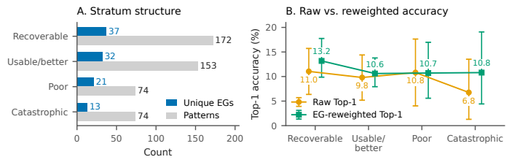
Figure 2 : Decomposition of the catastrophic paradox on RRUFF-473. Left: the severity strata differ strongly in label-space structure, with the catastrophic stratum spanning far fewer unique extinction groups than the recoverable stratum. Right: classical profile-fit quality and neural classification difficulty do not align monotonically, and extinction-group reweighting removes about 45% of the recoverable-versus-catastrophic gap.
원문 · CC BY 4.0 · Edward G Friedman, Elizabeth J. Baggett, Abhishek Shetty, Derrick Chan-Sew, Vanellsa Acha, Harshitha Dwaracherla, P. A. Kienzle, William Ratcliff · InformedXRD: Reproducible Benchmarks and Physics-Informed Evaluation for Powder Diffraction Symmetry Classification · 원문 그림 인용 · 원본 PDF 10쪽에서 그림 영역을 추출했습니다.이 결과는 고전 적합 품질이 신경망의 분류 난이도를 단조롭게 예측하지 않는다는 점을 보여 줍니다. catastrophic 층은 13개 extinction group만 포함하고 recoverable 층은 37개를 포함하므로, 집계 정확도는 라벨 집중도, 내재적 난이도, 층 크기에 따른 집계 편향을 구분하지 못합니다. 재가중 뒤에도 남는 차이는 층별 모델 상호작용의 결과로 해석되고, 사라진 차이는 라벨 분포의 효과로 해석됩니다.
적용 범위와 한계
이 프로토콜의 결론은 포함된 범위 안에서만 읽어야 합니다. RRUFF-473과 RRUFF-325는 99개 extinction group 중 46개와 45개만 포함하므로, 포함되지 않은 그룹에 결과를 확장하지 않습니다. 두 세트는 Cu-Kα 실험실 데이터와 RRUFF의 주요 상 라벨로 제한됩니다. DAG는 가중치 없이 translationengleiche 부분군 관계만 사용하며, 아키텍처 사이의 거리 비교는 암시적인 결과로 다뤄야 합니다. 최종 보정 모델은 집계 수준에서 오라클 prior 기준선과 같거나 그 아래에 있고, 패턴별 근거는 작지만 검출 가능한 수준입니다. 임계값 민감도는 확인했지만 다른 정제 절차에 대한 안정성은 확인하지 않았습니다.

Table 5 : Local one-at-a-time sensitivity of the family-coherence curation defaults. Reported variants are the only tested perturbations that changed benchmark composition beyond the baseline 471/473 core match.
원문 · CC BY 4.0 · Edward G Friedman, Elizabeth J. Baggett, Abhishek Shetty, Derrick Chan-Sew, Vanellsa Acha, Harshitha Dwaracherla, P. A. Kienzle, William Ratcliff · InformedXRD: Reproducible Benchmarks and Physics-Informed Evaluation for Powder Diffraction Symmetry Classification · 원문 그림 인용 · 원본 PDF 18쪽에서 그림 영역을 추출했습니다.opXRD-98은 98개 기록의 작은 예시이므로 벤치마크로 쓰기 어렵습니다. 저자들은 opXRD와 RRUFF를 하나로 합치지 않고 따로 보고하는 것이 더 적절하다고 설명합니다. 재채점이 가능한 모델은 네 개의 ViT 체크포인트와 저자들의 모델로 제한됩니다.
논문 정보
- 저자
- Edward G Friedman, Elizabeth J. Baggett, Abhishek Shetty, Derrick Chan-Sew, Vanellsa Acha, Harshitha Dwaracherla, P. A. Kienzle, William Ratcliff
- 학회·저널
- arXiv · 프리프린트
- 최초 공개일
- 2026년 11월 1일
- 등록일
- 2026년 11월 4일
- 수정일
- 2026년 11월 1일
- 버전
- v1
- arXiv
- 2611.01525
- 분류
- cs.LG · cond-mat.mtrl-sci
- 원문 이용 조건
- CC BY 4.0
- 제공 범위
- 논문 정보, 해설, 허용된 원문 그림
AI 해설은 논문 원문과 별개의 설명이며 오류가 있을 수 있습니다. 원문과 그림은 각 출처의 이용 조건과 따로 표시된 권리를 따릅니다.
초록
Machine learning for powder diffraction (PXRD) symmetry classification is being trained at scale, yet the field lacks a common evaluation standard: papers report results on different subsets of experimental archives, with different target taxonomies, preprocessing, and metrics, and published models are rarely released in a form that permits rescoring. We present InformedXRD, an evaluation framework with three parts: (i) a machine-readable mapping from 230 space groups to 99 extinction groups, the finest classes powder diffraction can identify from systematic absences alone; (ii) a benchmark-construction method whose inclusion rules are specified as code and reproduce from a frozen snapshot, instantiated as RRUFF-473, RRUFF-325, and, as a small example, opXRD-98; (iii) a reporting protocol with prior-only frequency baselines, a label-permutation test, a hierarchy-aware error metric on the condensed translationengleiche subgroup graph, and stratified evaluation. We build on the mapping, RRUFF benchmarks, subgroup graph, and four ViT checkpoints released in our earlier work (Baggett et al., 2026). Using these checkpoints, a 1D residual CNN, and six architectures trained under the XRDBench recipe (Cao et al., 2025), we show that evaluation design changes what conclusions are justified: paired tests point in different directions at Top-1 and Top-5; paired Top-k tests do not separate the three leading XRDBench models, while hierarchy-aware analysis describes error distance and direction across all six; an input-blind frequency predictor matches the models on aggregate Top-k, yet a label-permutation test still detects pattern-specific evidence; and stratified analysis exposes a label-entropy confound that aggregate accuracy hides. All mapping tables, benchmark code, scripts, and checkpoints are released as shared infrastructure for PXRD-ML evaluation.
원문 인용
Edward G Friedman, Elizabeth J. Baggett, Abhishek Shetty, Derrick Chan-Sew, Vanellsa Acha, Harshitha Dwaracherla, P. A. Kienzle, William Ratcliff (2026). InformedXRD: Reproducible Benchmarks and Physics-Informed Evaluation for Powder Diffraction Symmetry Classification. arXiv:2611.01525v1. https://arxiv.org/abs/2611.01525v1
BibTeX
@misc{friedman2026informedxrd,
  title = {{InformedXRD: Reproducible Benchmarks and Physics-Informed Evaluation for Powder Diffraction Symmetry Classification}},
  author = {Edward G Friedman and Elizabeth J. Baggett and Abhishek Shetty and Derrick Chan-Sew and Vanellsa Acha and Harshitha Dwaracherla and P. A. Kienzle and William Ratcliff},
  year = {2026},
  eprint = {2611.01525},
  archivePrefix = {arXiv},
  url = {https://arxiv.org/abs/2611.01525v1}
}