논문 해설
RAFT: Reasoning-Aligned Fine-Tuning Improves Robustness of VLA Post-Training
RAFT: 추론 정렬 미세 조정이 VLA post-training의 견고성을 향상시킨다
- 연구 문제 로봇 정책을 소규모 시연으로 후학습하면 학습 분포에서는 성능이 오르지만 시각·물체·지시문 변화에 약해질 수 있습니다.
- 연구 방법 RAFT는 먼저 과제 관련 추론 주석으로 LoRA 어댑터를 학습하고, 이 어댑터를 고정한 채 행동 시연으로 정책을 미세조정합니다.
- 주요 결과 시뮬레이션 pick and place 평균 성공률은 RAFT 83.2%, Plain FT 79.6%였으며, 실물 DROID의 OOD 성공률은 RAFT 75.0%, Plain FT 27.9%로 보고되었습니다.
로봇 정책 post-training의 강건성 문제
일반화된 시각-언어-행동(VLA) 정책은 사전학습된 비전-언어 모델과 대규모 로봇 데이터 위에 만들어지지만, 실제 목표 과제에 배포하려면 여전히 적응이 필요합니다. 이때 수집이 비싼 소규모 시연 데이터로 미세조정하면 학습 환경에서의 성공률은 오를 수 있으나, 시연에 없던 시각, 물체, 지시문의 변화에 대한 강건성은 떨어질 수 있습니다. 원문은 이 문제를 해결하기 위해 기존에는 파라미터 병합이나 적응 중 정규화가 주로 쓰였다고 설명합니다. 이 논문은 이와 다른 방향으로, 행동을 학습하기 전에 과제 관련 추론 감독을 먼저 정책에 정렬하는 접근을 다룹니다.
RAFT의 두 단계 학습 구조
RAFT는 두 단계로 구성됩니다. 1단계에서는 사전학습된 파라미터를 고정한 채 언어 모델과 비전 인코더에 LoRA 어댑터만 학습하며, 이때 목표는 관측과 지시문으로부터 만든 추론 주석을 자기회귀 교차 엔트로피로 예측하는 것입니다. 2단계에서는 학습된 어댑터를 고정하고 언어 모델, 행동 전문가, 투영 계층을 행동 시연으로 미세조정합니다. 따라서 행동 그래디언트는 추론 어댑터의 가중치를 직접 갱신하지 않습니다. 원문은 추론 감독을 행동과 공동 학습하는 방식이 평범한 fine-tuning보다 낮았다고 보고하며, 이 점이 두 단계 분리의 동기로 제시됩니다.
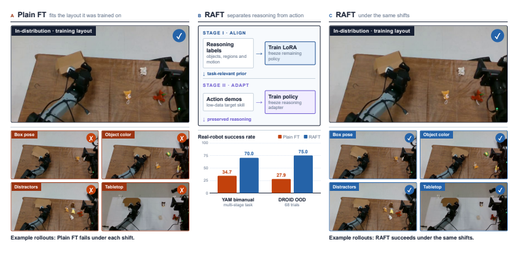
Figure 1 | Reasoning-aligned fine-tuning for robust VLA adaptation.(a) Plain FT, fine-tuned only on actions, succeeds in the training layout but fails under small scene changes. (b)RAFTfirst learns task-relevant reasoning through LoRA adapters, then freezes them while fine-tuning the policy on action demonstrations. (c) With the same demonstrations,RAFTsucceeds under these shifts. On physical robots,RAFTraises success over Plain FT from34.7%to70.0%on YAM and from27.9%to75.0%on out-of-distribution DROID trials.
원문 · CC BY 4.0 · Shresth Grover, Andrey Kolobov, Dhruv Shah · RAFT: Reasoning-Aligned Fine-Tuning Improves Robustness of VLA Post-Training · 원문 그림 인용 · 원본 PDF 2쪽에서 그림 영역을 추출했습니다.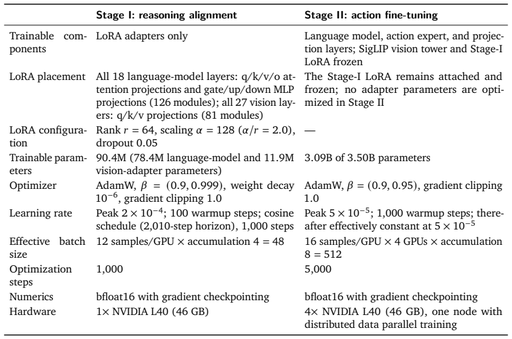
Table 1 |Training configuration for the two stages of RAFT.
원문 · CC BY 4.0 · Shresth Grover, Andrey Kolobov, Dhruv Shah · RAFT: Reasoning-Aligned Fine-Tuning Improves Robustness of VLA Post-Training · 원문 그림 인용 · 원본 PDF 15쪽에서 그림 영역을 추출했습니다.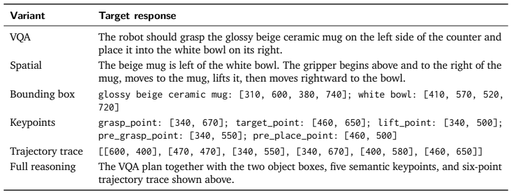
Table 2 | Modality-specific Stage-I targets for a mug-into-bowl pick-and-place example.Coordinates use the normalized[0,1000]image frame.
원문 · CC BY 4.0 · Shresth Grover, Andrey Kolobov, Dhruv Shah · RAFT: Reasoning-Aligned Fine-Tuning Improves Robustness of VLA Post-Training · 원문 그림 인용 · 원본 PDF 17쪽에서 그림 영역을 추출했습니다.
Table 3 |Stage-II reasoning-adapter ablation on pick and place.Success rate (%) when the Stage-I reasoning LoRA is applied without Stage II, updated during Stage II, or frozen during Stage II (RAFT). Each split contains 106 episodes.
원문 · CC BY 4.0 · Shresth Grover, Andrey Kolobov, Dhruv Shah · RAFT: Reasoning-Aligned Fine-Tuning Improves Robustness of VLA Post-Training · 원문 그림 인용 · 원본 PDF 19쪽에서 그림 영역을 추출했습니다.시뮬레이션과 실물 로봇에서의 분포 변화 평가
시뮬레이션 pick and place와 open drawer 과제는 MolmoSpaces 시뮬레이터에서 평가되었으며, 분할마다 106회 시행이 사용되었습니다. 시뮬레이션 pick and place에서 RAFT는 다섯 분할의 평균 성공률이 83%로 Plain FT의 80%보다 높았습니다. 실물 DROID에서는 50회 시연으로 MolmoBot을 후학습한 뒤 여러 OOD 축에서 평가했으며, OOD 평균 성공률은 RAFT 75.0%, Plain FT 27.9%로 보고되었습니다. YAM 이중팔 과제에서는 RAFT가 전체 순서를 70.0% 완료했고, 가장 강한 기준선은 36%였습니다. 이들 수치는 각 실험의 과제, 분할, 학습 시연 수가 다르므로 하나의 공통 조건으로 묶어 읽지 않습니다.
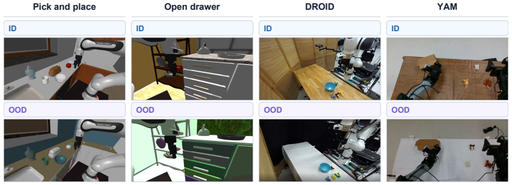
Figure 4 | Evaluation scenes.Representative in-distribution (ID) and out-of-distribution (OOD) observations, left to right: simulated pick and place, simulated open drawer, physical DROID pick and place, and the physical YAM two-stage task. The OOD panels show texture changes in simulation and background changes on the physical robots. The full set of evaluated shifts is shown in Fig. 20.
원문 · CC BY 4.0 · Shresth Grover, Andrey Kolobov, Dhruv Shah · RAFT: Reasoning-Aligned Fine-Tuning Improves Robustness of VLA Post-Training · 원문 그림 인용 · 원본 PDF 5쪽에서 그림 영역을 추출했습니다.
Figure 5 | Simulation results under distribution shift.Success rates for pick and place (left) and open drawer (right), with 106 trials per split.RAFTuses full reasoning for pick and place and bounding-box supervision for open drawer (Sec. C.1).RAFThas the highest mean success on both tasks:83%versus80%for Plain FT on pick and place, and39%versus29%on open drawer.
원문 · CC BY 4.0 · Shresth Grover, Andrey Kolobov, Dhruv Shah · RAFT: Reasoning-Aligned Fine-Tuning Improves Robustness of VLA Post-Training · 원문 그림 인용 · 원본 PDF 6쪽에서 그림 영역을 추출했습니다.
Figure 6 | Real-robot results under distribution shift.Left: DROID pick and place. Right: YAM box opening and place inside box.RAFThas the highest success on both platforms:75%versus28%for Plain FT on out-of-distribution DROID trials, and70%versus35%on YAM.
원문 · CC BY 4.0 · Shresth Grover, Andrey Kolobov, Dhruv Shah · RAFT: Reasoning-Aligned Fine-Tuning Improves Robustness of VLA Post-Training · 원문 그림 인용 · 원본 PDF 7쪽에서 그림 영역을 추출했습니다.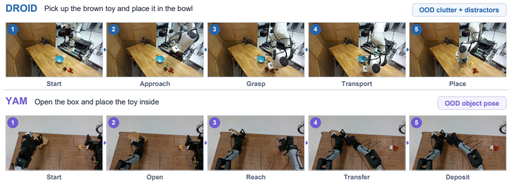
Figure 7 | Successful physical-robot rollouts.Ordered frames show DROID picking up the brown toy and placing it in the bowl (top) and YAM opening the box and placing the toy inside (bottom). Numbers indicate temporal order; circles and arrows mark the manipulated object and motion.
원문 · CC BY 4.0 · Shresth Grover, Andrey Kolobov, Dhruv Shah · RAFT: Reasoning-Aligned Fine-Tuning Improves Robustness of VLA Post-Training · 원문 그림 인용 · 원본 PDF 7쪽에서 그림 영역을 추출했습니다.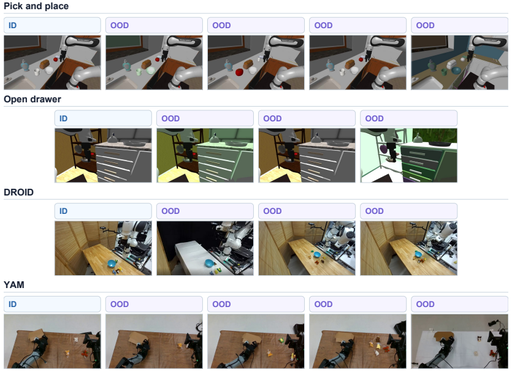
Figure 20 | Evaluation setup across the four robot tasks.Each row begins with an in-distribution observation, followed by its OOD variants. Pick and place varies lighting, target object, instruction, and scene texture; the open drawer task varies lighting, instruction, and scene texture; DROID varies background, clutter, and object appearance; and YAM varies box pose, object color, clutter, and background. Instruction shifts reuse the ID image because only the task prompt changes.
원문 · CC BY 4.0 · Shresth Grover, Andrey Kolobov, Dhruv Shah · RAFT: Reasoning-Aligned Fine-Tuning Improves Robustness of VLA Post-Training · 원문 그림 인용 · 원본 PDF 24쪽에서 그림 영역을 추출했습니다.학습 방식 대조와 표현 분석
통제 실험에서 시뮬레이션 pick and place의 평균 성공률은 Plain FT 79.6%, 어댑터를 학습 가능하게 둔 경우 74.0%, 공동 학습 63.2%, RAFT 83.2%였습니다. 이는 어댑터를 행동 학습 동안 고정하는 설계가 이 설정에서 가장 높은 값을 낸다는 관찰입니다. 표현 분석에서는 14–17층의 객체 정체성 선형 프로브 균형 정확도가 RAFT에서 0.51–0.53으로, Plain FT의 0.45보다 높았습니다. 또한 11층의 주의 집중 enrichment는 주석 영역에서 RAFT 3.2–3.4, Plain FT 1.9–2.1이었습니다. 저자들은 이것이 과제 관련 정보가 후기 층에 더 잘 남아 있다는 해석을 낳는다고 설명하지만, 이 분석이 성공률 향상의 인과를 증명한다고 보지는 않습니다.
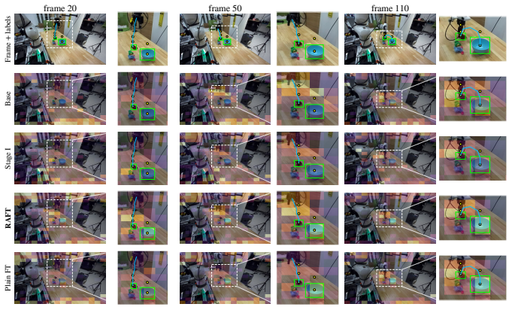
Figure 8 | Attention maps along one trajectory.Columns show successive observations; rows compare Base, Stage I,RAFT, and Plain FT. Overlays identify annotated task regions, and color scales are shared within each column.RAFTplaces more attention on the annotated regions than Plain FT; Fig. 10 quantifies this across layers.
원문 · CC BY 4.0 · Shresth Grover, Andrey Kolobov, Dhruv Shah · RAFT: Reasoning-Aligned Fine-Tuning Improves Robustness of VLA Post-Training · 원문 그림 인용 · 원본 PDF 8쪽에서 그림 영역을 추출했습니다.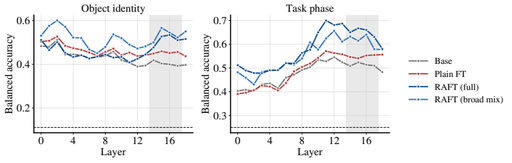
Figure 9 | Layer-wise linear probes.Balanced accuracy for object identity (left; chance1/7) and episode-time quartile (right; chance1/4). Policies use the same 414 frames; episodes are held out from probe fitting, not policy training. Shading marks layers 14–17. In these layers,RAFTreaches 0.51–0.53 object-identity accuracy versus 0.45 for Plain FT, and 0.62–0.65 quartile accuracy versus 0.55.
원문 · CC BY 4.0 · Shresth Grover, Andrey Kolobov, Dhruv Shah · RAFT: Reasoning-Aligned Fine-Tuning Improves Robustness of VLA Post-Training · 원문 그림 인용 · 원본 PDF 8쪽에서 그림 영역을 추출했습니다.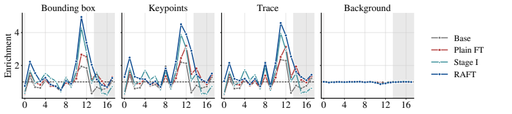
Figure 10 | Layer-wise attention enrichment.Enrichment for object boxes, keypoints, traces, and background; values above one indicate attention exceeding a region’s image-area share. Curves compare Base, Plain FT, Stage I, andRAFT; shading marks layers 14–17. At layer 11,RAFTgives task regions 3.2–3.4 times their area share, versus 1.9–2.1 for Plain FT, while background attention stays near uniform.
원문 · CC BY 4.0 · Shresth Grover, Andrey Kolobov, Dhruv Shah · RAFT: Reasoning-Aligned Fine-Tuning Improves Robustness of VLA Post-Training · 원문 그림 인용 · 원본 PDF 9쪽에서 그림 영역을 추출했습니다.
Table 4 | Co-training and frozen-vision controls on simulated pick and place.Success rate (%) on five matched evaluation splits (𝑛=106per cell).
원문 · CC BY 4.0 · Shresth Grover, Andrey Kolobov, Dhruv Shah · RAFT: Reasoning-Aligned Fine-Tuning Improves Robustness of VLA Post-Training · 원문 그림 인용 · 원본 PDF 20쪽에서 그림 영역을 추출했습니다.적용 범위와 남은 질문
원문은 여러 추론 모달리티의 효과가 과제마다 달라 최적 모달리티 선택이 아직 열린 질문이라고 밝힙니다. 주 결과는 시뮬레이션 두 과제와 실물 두 플랫폼에서 얻어졌으며, 설정표와 부록에 따라 과제별 평가 조건과 시드 집계가 다르므로 한 설정의 결과를 모든 실험으로 확대하지 않아야 합니다. 원문은 RAFT가 RETAIN 병합과 결합할 수 있음을 별도 실험으로 보였지만, 그 결합 실험도 Franka 서랍 과제라는 제한된 조건에서 보고되었습니다.

Table 5 | RETAIN applied to Plain FT and RAFT on the Franka open drawer task.Success rate (%) for each axis. RETAIN applied toRAFToutperforms RETAIN applied to Plain FT.
원문 · CC BY 4.0 · Shresth Grover, Andrey Kolobov, Dhruv Shah · RAFT: Reasoning-Aligned Fine-Tuning Improves Robustness of VLA Post-Training · 원문 그림 인용 · 원본 PDF 21쪽에서 그림 영역을 추출했습니다.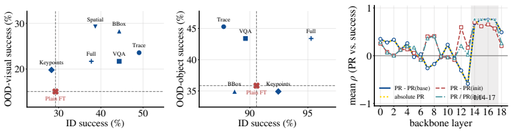
Figure 19 | Effect of reasoning modality on success and representation dimensionality.Left:ID and OOD-visual success on the open drawer task for six reasoning modalities.Center:ID and OOD-object success on pick and place for five modalities. Red crosses denote no-reasoning controls, and dashed lines mark Plain FT. Each policy is evaluated on 106 trials per axis.Right:Layer-wise mean Spearman correlation between participation ratio and success, pooled over three task-matched evaluation axes and six reasoning variants, for four participation-ratio measures. Filled markers denote significance after FDR correction; shading marks layers 14–17.
원문 · CC BY 4.0 · Shresth Grover, Andrey Kolobov, Dhruv Shah · RAFT: Reasoning-Aligned Fine-Tuning Improves Robustness of VLA Post-Training · 원문 그림 인용 · 원본 PDF 23쪽에서 그림 영역을 추출했습니다.논문 정보
- 저자
- Shresth Grover, Andrey Kolobov, Dhruv Shah
- 학회·저널
- arXiv · 프리프린트
- 최초 공개일
- 2026년 11월 3일
- 등록일
- 2026년 11월 5일
- 수정일
- 2026년 11월 3일
- 버전
- v1
- arXiv
- 2611.04368
- 분류
- cs.RO · cs.CV
- 원문 이용 조건
- CC BY 4.0
- 제공 범위
- 논문 정보, 해설, 허용된 원문 그림
AI 해설은 논문 원문과 별개의 설명이며 오류가 있을 수 있습니다. 원문과 그림은 각 출처의 이용 조건과 따로 표시된 권리를 따릅니다.
초록
Adapting a generalist vision-language-action (VLA) policy to a target task with limited demonstrations can improve nominal task success while reducing robustness to variations in appearance, objects, and instructions. We introduce reasoning-aligned fine-tuning (RAFT), a two-stage post-training procedure: RAFT first trains low-rank adapters on task-relevant reasoning annotations, then freezes them while fine-tuning the policy on action demonstrations. On a physical DROID robot, RAFT achieves $75.0\%$ out-of-distribution success, compared with $27.9\%$ for plain fine-tuning; on a multi-stage bimanual YAM task, it reaches $70.0\%$ mean success, compared with $36.0\%$ for the strongest baseline. RAFT also improves success under visual, object, and instruction shifts in simulated pick-and-place and open-drawer tasks. Compared with plain fine-tuning, RAFT policies place more attention on annotated task regions and yield higher linear-probe accuracy for object identity in later layers. A broader reasoning-data mixture further improves downstream success across demonstration budgets.
원문 인용
Shresth Grover, Andrey Kolobov, Dhruv Shah (2026). RAFT: Reasoning-Aligned Fine-Tuning Improves Robustness of VLA Post-Training. arXiv:2611.04368v1. https://arxiv.org/abs/2611.04368v1
BibTeX
@misc{grover2026raft,
  title = {{RAFT: Reasoning-Aligned Fine-Tuning Improves Robustness of VLA Post-Training}},
  author = {Shresth Grover and Andrey Kolobov and Dhruv Shah},
  year = {2026},
  eprint = {2611.04368},
  archivePrefix = {arXiv},
  url = {https://arxiv.org/abs/2611.04368v1}
}