논문 해설
Investigating Bi-Level Optimization for Learning and Vision from a Unified Perspective: A Survey and Beyond
통합된 관점에서 본 학습과 비전을 위한 이중 수준 최적화 연구: 서베이와 그 너머
- 연구 문제 학습과 비전의 여러 복합 문제가 BLO로 표현될 수 있는지, 그리고 gradient 기반 BLO 방법들을 하나의 틀에서 이해할 수 있는지를 다룹니다.
- 연구 방법 하위 해집합의 정식화(singleton, optimistic, pessimistic)에 따라 최적 응답 사상을 정의하고, 이를 상위 가치함수 F(x,y*(x))의 단일 수준 재구성으로 바꾼 뒤 BR Jacobian 계산 방식으로 기존 방법을 분류합니다.
- 주요 결과 원문은 최적 응답 기반 단일 수준 재구성과 통일 gradient 틀을 제시하고, 주어진 가정 아래 수렴 정리와 방법별 시간·공간 복잡도 비교를 제공합니다. LLS가 성립하지 않는 경우에는 BDA와 BVFIM 같은 별도 방법이 소개됩니다.
여러 학습·비전 문제를 BLO로 묶는 이유
BLO(Bi-Level Optimization)는 한 최적화 문제의 실행 가능 영역이 다른 최적화 문제의 해집합에 의해 제한되는 계층적 수학 프로그램입니다. 상위 문제(UL)와 하위 문제(LL)가 변수를 나누어 가지며, 하위 문제가 상위 문제의 제약으로 중첩되어 있습니다. 원문은 하이퍼파라미터 최적화, 다중 작업·메타 학습, 신경망 구조 탐색, 적대적 학습, 심층 강화학습이 모두 중첩된 하위 문제를 포함한다고 지적합니다. 이 논문은 이런 문제들이 서로 다른 동기와 메커니즘을 가지더라도 공통적으로 BLO로 표현될 수 있는지를 묻습니다.
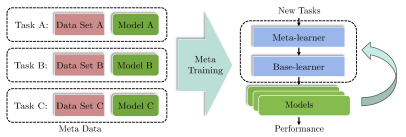
Fig. 3 . Illustrating the training process of meta learning. The whole process is visualized to learn new tasks quickly by drawing upon related tasks on corresponding data sets. It can be decomposed into two parts: the “base-learner” trained for operating a given task and the “meta- learner” trained to learn how to optimize the base-learner.
원문 · CC BY 4.0 · Risheng Liu, Jiaxin Gao, Jin Zhang, Deyu Meng, Zhouchen Lin · Investigating Bi-Level Optimization for Learning and Vision from a Unified Perspective: A Survey and Beyond · 원문 그림 인용 · 원본 PDF 4쪽에서 그림 영역을 추출했습니다.기존 BLO 조사는 주로 수리계획법의 정식화, 최적성 조건, 고전적 해법에 초점을 맞추었습니다. 반면 이 논문은 학습과 비전 응용을 중심에 두고, 그중 gradient 기반 BLO 방法을 하나의 틀에서 비교하는 것을 목표로 합니다.
하위 해집합 문제와 최적 응답 사상
하위 문제의 해집합 S(x)가 여러 원소를 가질 수 있으므로, 상위 목적 F를 어떤 해에 대해 평가할지 정해야 합니다. 원문은 이를 singleton, optimistic, pessimistic 세 관점으로 나눕니다. singleton은 모든 x에서 S(x)가 단일원소인 LLS 조건이며, optimistic 정식화는 추종자가 상위 목적을 최소화하는 하위 해를 고른다고 봅니다. pessimistic 정식화는 상위 목적을 최대화하는 하위 해를 고려합니다.
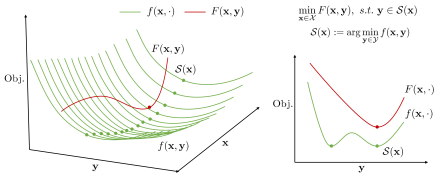
Fig. 1 . Illustrating the problem of BLO. (a) first shows a standard BLO problem with the situation of multiple solutions off. Green curves denote LL objectives denoted byf, and their corresponding minimizers given byS(x) were shown as green dots. The red curve represents the UL objective F , whose minimizer is shown as the red dot. (b) further illustrates that, in general, not all points (green dots) in S(x) could minimize the UL objective denoted byF .
원문 · CC BY 4.0 · Risheng Liu, Jiaxin Gao, Jin Zhang, Deyu Meng, Zhouchen Lin · Investigating Bi-Level Optimization for Learning and Vision from a Unified Perspective: A Survey and Beyond · 원문 그림 인용 · 원본 PDF 3쪽에서 그림 영역을 추출했습니다.이 논문은 최적 응답 사상 y*(x)를 세 경우에 대해 정의합니다. singleton에서는 하위 문제의 유일한 해를, optimistic과 pessimistic에서는 ISB 부문제 min 또는 max F(x,y) over y∈S(x)의 해집합을 사용합니다. 이렇게 정의된 y*(x)를 상위 목적에 대입하면 ϕ(x)=F(x,y*(x)) 형태의 단일 수준 재구성이 얻어집니다.
gradient 기반 BLO의 통일 틀과 BR Jacobian
상위 가치함수 ϕ(x)의 gradient는 직접 항 ∂F(x,y*(x))/∂x와 간접 항 G(x)의 합으로 쓰입니다. 간접 항은 BR Jacobian (∂y*(x)/∂x)′와 상위 목적의 하위 변수 gradient의 곱으로 나타납니다. 따라서 여러 gradient 기반 방법의 차이는 주로 BR Jacobian을 어떻게 계산하는지에서 생깁니다. 원문의 Alg. 1은 BR Jacobian을 계산한 뒤 확률적 경사하강으로 x를 갱신하는 일반 절차입니다.
LLS 조건에서 방법은 명시적 미분(EGBR)과 암묵적 미분(IGBR)으로 나뉩니다. EGBR은 하위 동역학 시스템을 통해 자동 미분을 적용하며, 전진 모드와 역방향 모드, 절단·단일 단계 단순화를 포함합니다. 전진 모드 AD는 Z_t=A_tZ_{t-1}+B_t 형태의 재귀로 BR Jacobian을 계산하고, 역방향 모드 AD는 gradient를 뒤에서 앞으로 전파합니다. IGBR은 최적성 조건의 암묵적 함수 정리로 간접 gradient를 얻으며, 선형계 풀이나 Neumann 급수로 Hessian 역행렬을 근사합니다.
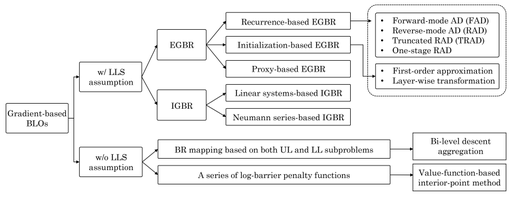
Fig. 8 . Summary of the mainstream gradient-based BLOs. We categorize these existing approaches into two main groups, i.e., w/ and w/o LLS assumptions. When solving BLOs with LLS assumption, these methods can be further divided into two categories: EGBR and IGBR. As for EGBRs, they can be solved by different Automatic Differentiation (AD) techniques (as denoted by the dashed rectangle). Very recently, two algorithms have also been proposed to address BLOs without the LLS assumption. In particular, they actually introduce a bi-level gradient aggregation or a value-function-based interior-point method to calculate the indirect gradient.
원문 · CC BY 4.0 · Risheng Liu, Jiaxin Gao, Jin Zhang, Deyu Meng, Zhouchen Lin · Investigating Bi-Level Optimization for Learning and Vision from a Unified Perspective: A Survey and Beyond · 원문 그림 인용 · 원본 PDF 11쪽에서 그림 영역을 추출했습니다.LLS 가정의 적용 범위와 비-singleton 확장
대부분의 명시적·암묵적 gradient 방법은 LLS 가정에 의존합니다. 원문은 이 가정이 성립하지 않으면 해의 정확성이 보장되지 않는다고 설명하며, 해당 연구들이 반례를 제시했다고 보고합니다. 따라서 IGBR 계열의 적용은 LLS가 성립하는 설정을 전제로 읽어야 합니다.
LLS가 성립하지 않는 경우 원문은 BDA(bi-level descent aggregation)와 BVFIM(value-function 기반 내부점 방법)을 소개합니다. BDA는 상위와 하위 gradient를 가중 합산한 방향을 쓰고, BVFIM은 log-barrier로 정규화된 가치함수를 사용하는 단일 수준 재구성을 제안합니다. 이들 결과는 해당 논문의 가정 아래에서 수렴 성질을 보이며, 이 논문은 이를 통합 틀의 한 갈래로 정리합니다.
수렴성과 계산 복잡도 비교
원문은 gradient 기반 BLO의 수렴 성질을 두 종류로 나눕니다. 하나는 UL 가치함수의 정상점 수렴이고, 다른 하나는 T→∞일 때 전역·지역 최소점으로의 수렴입니다. 정리 1은 하위 궤적 {y_T(x)}가 두 가지 기본 성질, 즉 하위 해에 대한 균일 근사와 ISB 해에 대한 점별 근사를 만족하면 상위 가치함수의 최소점으로 수렴함을 보입니다. 이 정리는 주어진 가정 아래의 결과이며, 모든 BLO에 대한 보편 결론이 아닙니다.
복잡도 분석에서 RAD와 TRAD는 Hessian 행렬을 직접 곱하지 않아 IGBR보다 시간 비용이 작을 수 있다고 정리됩니다. VFBR인 BVFIM은 하위 차원이 클 때 EGBR보다 메모리 비용이 작다고 분석됩니다. 이 비교는 저자가 제시한 점근 분석이며, 실제 실행 시간 측정과 구분해야 합니다.
pessimistic BLO와 남은 과제
pessimistic BLO에 대해서는 실용적인 gradient 기반 방법이 아직 부족하다고 원문은 밝힙니다. 이 논문은 상위와 하위 gradient의 부호를 바꾼 집계 방향을 예시로 제시하지만, 이는 알고리즘 설계의 가능성을 보이는 예이며 엄밀한 이론 분석과 평가는 범위 밖이라고 명시합니다.
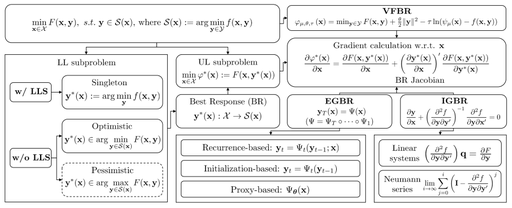
Fig. 9 . Illustrating the roadmap of different categories of gradient-based BLOs. In the left bottom region, the formulations in the solid rectangles (i.e., singleton and optimistic) have been widely studied. In contrast, since gradient-based methods for pessimistic BLOs have not been properly investigated in existing literature, we denote this category of formulation by a dashed rectangle. In Section 9, we demonstrate that we can also obtain a practical pessimistic BLO scheme within our general algorithmic platform.
원문 · CC BY 4.0 · Risheng Liu, Jiaxin Gao, Jin Zhang, Deyu Meng, Zhouchen Lin · Investigating Bi-Level Optimization for Learning and Vision from a Unified Perspective: A Survey and Beyond · 원문 그림 인용 · 원본 PDF 11쪽에서 그림 영역을 추출했습니다.또한 원문의 조사 범위는 주로 학습·비전 응용과 gradient 기반 방법에 있으며, 실험 평가는 제한적으로 소개됩니다. 향후 과제로는 pessimistic BLO, 복잡한 제약, 다중 추종자, 가속 기법, 최신 학습 패러다임 적용이 제시됩니다.
논문 정보
- 저자
- Risheng Liu, Jiaxin Gao, Jin Zhang, Deyu Meng, Zhouchen Lin
- 학회·저널
- arXiv · 프리프린트
- 최초 공개일
- 2021년 1월 27일
- 등록일
- 2026년 11월 6일
- 수정일
- 2021년 9월 28일
- 버전
- v3
- arXiv
- 2101.11517
- 분류
- cs.LG · cs.CV · math.DS · math.OC
- 원문 이용 조건
- CC BY 4.0
- 제공 범위
- 논문 정보, 해설, 허용된 원문 그림
AI 해설은 논문 원문과 별개의 설명이며 오류가 있을 수 있습니다. 원문과 그림은 각 출처의 이용 조건과 따로 표시된 권리를 따릅니다.
초록
Bi-Level Optimization (BLO) is originated from the area of economic game theory and then introduced into the optimization community. BLO is able to handle problems with a hierarchical structure, involving two levels of optimization tasks, where one task is nested inside the other. In machine learning and computer vision fields, despite the different motivations and mechanisms, a lot of complex problems, such as hyper-parameter optimization, multi-task and meta-learning, neural architecture search, adversarial learning and deep reinforcement learning, actually all contain a series of closely related subproblms. In this paper, we first uniformly express these complex learning and vision problems from the perspective of BLO. Then we construct a best-response-based single-level reformulation and establish a unified algorithmic framework to understand and formulate mainstream gradient-based BLO methodologies, covering aspects ranging from fundamental automatic differentiation schemes to various accelerations, simplifications, extensions and their convergence and complexity properties. Last but not least, we discuss the potentials of our unified BLO framework for designing new algorithms and point out some promising directions for future research.
원문 인용
Risheng Liu, Jiaxin Gao, Jin Zhang, Deyu Meng, Zhouchen Lin (2021). Investigating Bi-Level Optimization for Learning and Vision from a Unified Perspective: A Survey and Beyond. arXiv:2101.11517v3. https://arxiv.org/abs/2101.11517v3
BibTeX
@misc{liu2021investigating,
  title = {{Investigating Bi-Level Optimization for Learning and Vision from a Unified Perspective: A Survey and Beyond}},
  author = {Risheng Liu and Jiaxin Gao and Jin Zhang and Deyu Meng and Zhouchen Lin},
  year = {2021},
  eprint = {2101.11517},
  archivePrefix = {arXiv},
  url = {https://arxiv.org/abs/2101.11517v3}
}