논문 해설
Scaling Laws For Data-Constrained Dense Retrieval
데이터가 제한된 밀집 검색을 위한 스케일링 법칙
- 연구 문제 데이터가 제한된 밀집 검색 fine-tuning에서 최적 성능이 모델 크기와 고유 데이터 양에 따라 어떻게 변하는지 정리합니다.
- 연구 방법 학습 중 최소 평가 손실인 MAEL을 측정 대상으로 삼고, 곱셈형 스케일링 법칙으로 MAEL을 적합합니다.
- 주요 결과 곱셈형 법칙은 관찰 격자에서 가법형 법칙보다 높은 적합도를 보였고, MAEL은 검색 지표와 강하게 음의 상관을 보였습니다.
데이터가 제한된 밀집 검색 fine-tuning의 문제
밀집 검색 모델은 대개 pre-training 언어 모델을 지도 검색 데이터로 파인튜닝해 만듭니다. 그런데 고품질 검색 데이터는 pre-training 말뭉치보다 몇 자릿수 작고, 같은 데이터를 여러 epoch에 걸쳐 반복해 쓰는 것이 일반적입니다. 기존 스케일링 법칙은 대체로 고유 데이터가 충분한 compute-optimal 설정을 전제로 세워졌기 때문에, 이 데이터 제약 환경에서 모델 크기와 고유 데이터 양이 달성 가능한 검색 성능을 어떻게 바꾸는지는 분명하지 않습니다.
이 논문은 학습 전체 궤적보다 고정된 모델 크기와 데이터 예산에서 도달할 수 있는 최선의 성능에 관심을 둡니다. 이를 위해 학습 중 도달한 최소 평가 손실인 MAEL을 측정 대상으로 삼습니다. 이 지표를 쓰면 학습 레시피의 세부 선택이 결과에 주는 영향을 분리하는 데 도움이 됩니다.
학습률이 MAEL을 바꾸는지 확인하는 방법
연구진은 BERT-Medium에서 고유 데이터 예산을 5K부터 320K까지 바꾸고, 학습률을 3.125e-7부터 2e-5까지 바꾸어 학습했습니다. 모든 실험은 학습률을 감쇠 없이 일정하게 유지합니다. 서로 다른 학습률의 최적화 궤적을 비교하기 위해 실제 step에 학습률 비율을 곱한 재스케일 step을 사용합니다.
이렇게 정렬한 학습 곡선은 같은 고유 데이터 예산에서 거의 같은 최소 평가 손실로 수렴합니다. 원문 표에서 MAEL 표준편차 평균은 0.008, 최대-최소 범위 평균은 0.021로 보고됩니다. 같은 실험에서 CKA로 본 표현 유사도도 같은 데이터 예산의 체크포인트 사이에서 높게 나타납니다. 저자들은 이를 바탕으로 학습률이 주로 최적화 시간을 재매개변수화하고 도달 가능한 성능 자체를 바꾸지는 않는다고 해석합니다.
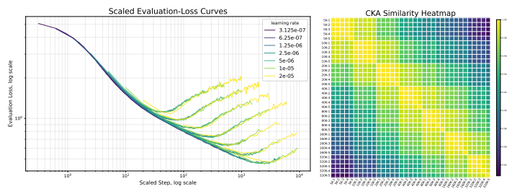
Figure 1 : Evaluation loss versus scaled optimization steps (left) and CKA similarity heatmap (right). The left panel shows that, across different data budgets, the evaluation loss curves align well after normalizing the optimization steps, indicating that the scaled dynamics are largely insensitive to the choice of learning rate. The right panel exhibits a series of distinct (5 × 5) high-similarity blocks along the diagonal, where each block corresponds to a fixed data budget. This suggests that models trained with different learning rates but the same data budget learn highly similar internal representations.
원문 · CC BY 4.0 · Bowen Fu, Jingtao Zhan · Scaling Laws For Data-Constrained Dense Retrieval · 원문 그림 인용 · 원본 PDF 3쪽에서 그림 영역을 추출했습니다.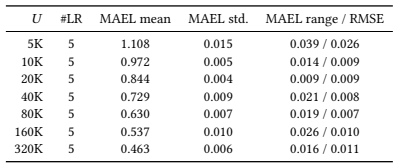
Table 1 : Learning-rate invariance on BERT-Medium. For each unique-sample budget𝑈 , we report the mean, standard devi- ation, and max–min range of MAEL across the five learning rates that reach MAEL:1 .25× 10−6,2.5× 10−6,5× 10−6,1× 10−5, and2× 10−5. Alignment RMSE is computed after interpolat- ing the evaluation-loss curves on their common scaled-step interval.
원문 · CC BY 4.0 · Bowen Fu, Jingtao Zhan · Scaling Laws For Data-Constrained Dense Retrieval · 원문 그림 인용 · 원본 PDF 3쪽에서 그림 영역을 추출했습니다.곱셈형 스케일링 법칙과 가법형 비교
MAEL은 비임베딩 파라미터 수 N과 고유 샘플 수 U에 대해 곱셈형 법칙 MAEL(N,U)=A1 N^α1 U^β+δ로 적합됩니다. 로그-로그 축에서 모델 크기 방향과 데이터 방향의 선이 대체로 평행하게 나타나며, 저자들은 이를 두 요인이 손실 감소에 비례적으로 상호작용한다고 해석합니다.
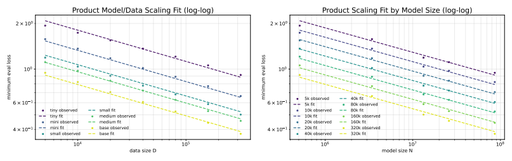
Figure 2 : MAEL scaling with unique data and model size. The left panel shows MAEL as a function of the number of unique MS MARCO training samples for each BERT model size, while the right panel shows MAEL as a function of non-embedding parameter count for each data budget. The approximately linear and parallel trends in both log–log views motivate the multiplicative model–data scaling law in Eq.(3).
원문 · CC BY 4.0 · Bowen Fu, Jingtao Zhan · Scaling Laws For Data-Constrained Dense Retrieval · 원문 그림 인용 · 원본 PDF 4쪽에서 그림 영역을 추출했습니다.같은 35개 구성에 대해 pre-training 문헌의 가법형 법칙인 Kaplan형과 Chinchilla형도 적합합니다. 원문 표 2에서 곱셈형 법칙은 R2 0.99와 RMSE 0.035를 보이고, Chinchilla형은 R2 0.96과 RMSE 0.076, Kaplan형은 R2 0.88과 RMSE 0.133입니다. 세 적합 모두 δ는 0으로 나타납니다. 이 결과는 관찰된 격자 안에서의 적합 비교이며, 곱셈형 구조가 모든 조건에서 항상 옳다는 증명은 아닙니다.
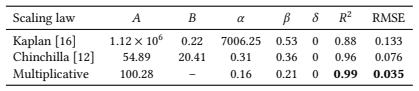
Table 2 : Joint fitting results of different scaling law formula- tions. “Kaplan” refers to Kaplan style scaling law as shown in Eq. (5), “Chinchilla” refers to Chinchilla style scaling law as shown in Eq.(4)and “Multiplicative” is shown in Eq.(3).
원문 · CC BY 4.0 · Bowen Fu, Jingtao Zhan · Scaling Laws For Data-Constrained Dense Retrieval · 원문 그림 인용 · 원본 PDF 5쪽에서 그림 영역을 추출했습니다.held-out과 외삽 검증의 범위
적합의 높은 설명력이 예측 능력을 보장하지는 않으므로, 저자들은 held-out 검증을 추가로 수행했습니다. 모델 크기 하나를 통째로 제외하면 RMSE는 0.0471, 평균 상대오차는 3.28%입니다. 데이터 예산 하나를 통째로 제외하면 RMSE는 0.0407, 평균 상대오차는 2.77%입니다. Tiny, Mini, Small의 작은 격자에서만 적합하고 Medium과 Base의 160K 및 320K 코너를 예측한 경우 RMSE는 0.0207, 평균 상대오차는 4.45%입니다.
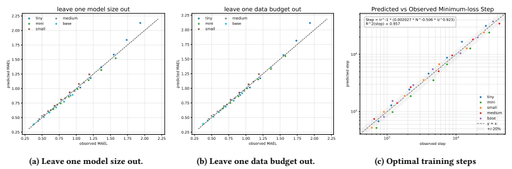
Figure 3 : (a)–(b) Held-out predictions from the multiplicative MAEL scaling law. Each panel fits Eq. (3) without the shown held-out axis value and compares predicted MAEL against observed MAEL. The dashed diagonal indicates perfect prediction. (c) Predicted versus observed optimal training steps. The proposed step scaling law achieves an 𝑅2 of 0.95 across different learning rates, model sizes, and unique sample budgets.
원문 · CC BY 4.0 · Bowen Fu, Jingtao Zhan · Scaling Laws For Data-Constrained Dense Retrieval · 원문 그림 인용 · 원본 PDF 5쪽에서 그림 영역을 추출했습니다.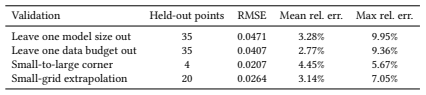
Table 3 : Held-out and extrapolation validation of the mul- tiplicative MAEL scaling law. Relative errors are absolute relative prediction errors in MAEL.
원문 · CC BY 4.0 · Bowen Fu, Jingtao Zhan · Scaling Laws For Data-Constrained Dense Retrieval · 원문 그림 인용 · 원본 PDF 5쪽에서 그림 영역을 추출했습니다.이 결과는 관찰된 BERT 계열과 MS MARCO 부분집합 안에서 얻은 것입니다. 원문은 실험 전체 MAEL 범위가 0.375에서 1.936이라는 맥락에서 이 오차를 해석합니다. 따라서 이 검증은 해당 조건의 외삽 성능을 보여 주며, 다른 데이터셋이나 다른 모델 계열에 그대로 적용되었다는 뜻은 아닙니다.
MAEL과 검색 지표의 관계
MAEL이 스케일링 대상으로 유용하려면 실제 검색 품질과 연결되어야 합니다. 저자들은 35개 구성에서 각 MAEL 도달 체크포인트를 MS MARCO 검증 설정으로 평가했습니다. MRR@10, Recall@100, nDCG@10, MAP@10 모두 MAEL과 강한 음의 상관을 보입니다. 낮은 MAEL은 더 높은 검색 지표와 함께 나타나므로 지표 방향은 손실과 검색 점수가 반대입니다.
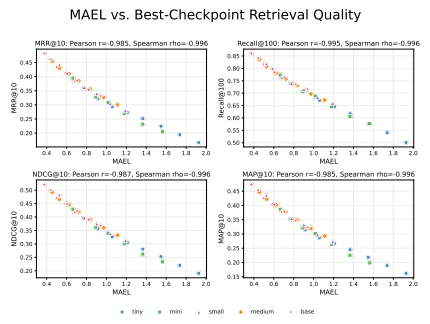
Figure 4 : Relationship between MAEL and downstream re- trieval metrics across the 35 model-size and unique-data- budget configurations. Lower MAEL consistently corre- sponds to higher MRR@10, Recall@100, nDCG@10, and MAP@10.
원문 · CC BY 4.0 · Bowen Fu, Jingtao Zhan · Scaling Laws For Data-Constrained Dense Retrieval · 원문 그림 인용 · 원본 PDF 6쪽에서 그림 영역을 추출했습니다.이 상관은 MS MARCO 인도메인 검증 설정에서 본 결과입니다. 외부 BEIR 평가는 가중치 감쇠 절에서 BERT-Small의 별도 비교로 다루어지며, 이 상관 결과를 모든 외부 과제로 확장하지 않습니다.
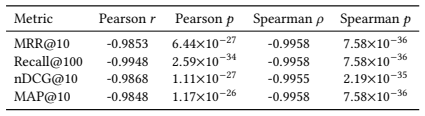
Table 4 : Correlation between MAEL and MS MARCO in- domain retrieval metrics across 35 configurations. Since MAEL is lower-is-better and retrieval metrics are higher-is- better, stronger retrieval quality should appear as a negative correlation.
원문 · CC BY 4.0 · Bowen Fu, Jingtao Zhan · Scaling Laws For Data-Constrained Dense Retrieval · 원문 그림 인용 · 원본 PDF 6쪽에서 그림 영역을 추출했습니다.최적 학습 step과 가중치 감쇠
최적 학습 step은 학습률에 반비례하는 형태의 스케일링 법칙으로 적합되며, 원문은 R2 0.95를 보고합니다. 모델 크기가 커지면 필요한 step이 줄고, 고유 샘플 수가 늘면 필요한 step이 늘어납니다.
가중치 감쇠는 AdamW의 분리된 가중치 감쇠 형식으로 실험했습니다. BERT-Small에서 고유 데이터 예산별로 가중치 감쇠를 스윕하고, 설정값 λ를 EMA 시간척도 τepoch=B/(ηλU)로 바꾸면 최소 MAEL이 여러 예산에서 비슷한 τepoch 근처에 모입니다. 따라서 원시 가중치 감쇠 계수보다 EMA 시간척도가 더 일관된 최적화 조건으로 보입니다. 이 최적값은 BERT-Small과 탐색한 예산 범위에 대한 결과입니다.
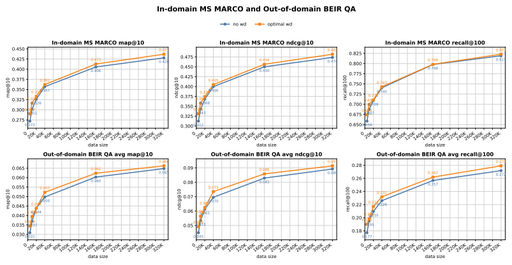
Figure 5 : Effect of optimal weight decay on downstream retrieval performance. We compare BERT-Small checkpoints trained with no weight decay and with the scaled optimal weight decay across unique-sample budgets. The top row reports in-domain MS MARCO performance, and the bottom row reports macro-averaged out-of-domain BEIR QA performance over NQ, HotpotQA, and FiQA; columns show MAP@10, nDCG@10, and Recall@100.
원문 · CC BY 4.0 · Bowen Fu, Jingtao Zhan · Scaling Laws For Data-Constrained Dense Retrieval · 원문 그림 인용 · 원본 PDF 7쪽에서 그림 영역을 추출했습니다.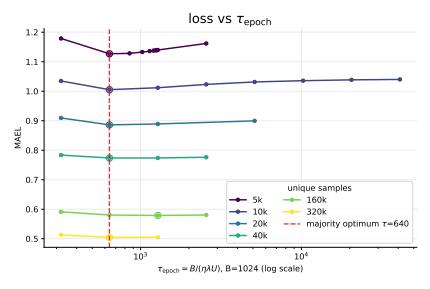
Figure 6 : MAEL as a function of the AdamW EMA timescale 𝜏epoch for BERT-Small under different unique-sample budgets. Each curve corresponds to a weight-decay sweep after con- verting the configured weight decay to 𝜏epoch =𝐵/(𝜂𝜆𝑈) . Hol- low markers indicate the minimum MAEL on each curve, and the dashed vertical line marks the majority optimal timescale across data budgets.
원문 · CC BY 4.0 · Bowen Fu, Jingtao Zhan · Scaling Laws For Data-Constrained Dense Retrieval · 원문 그림 인용 · 원본 PDF 7쪽에서 그림 영역을 추출했습니다.계산 할당 비교
연구진은 적합된 step 법칙과 MAEL 법칙을 결합해 고정 fine-tuning 계산량에서 모델 크기와 고유 데이터의 효율을 비교합니다. 계산량은 약 6N과 학습 step의 곱으로 근사합니다. 곱셈형 법칙에서 모델 크기 지수는 0.161017이고 계산 지수로 나누면 효율 지수는 0.3262, 데이터 효율 지수는 0.2234입니다. 이에 따라 더 큰 pre-training 모델을 쓰는 것이 고유 데이터를 늘리는 것보다 약 1.46배 계산 효율적이라고 예측됩니다.
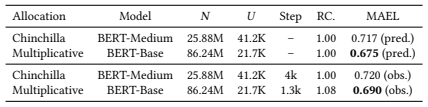
Table 5 : Comparison between the additive compute-optimal allocation and a larger-model allocation under a fixed com- pute budget. RC. denotes relative compute. Predicted results are obtained from the scaling laws, while observed results correspond to the nearest available experimental configura- tions.
원문 · CC BY 4.0 · Bowen Fu, Jingtao Zhan · Scaling Laws For Data-Constrained Dense Retrieval · 원문 그림 인용 · 원본 PDF 8쪽에서 그림 영역을 추출했습니다.관찰 비교에서는 BERT-Medium이 4000 step에서 MAEL 0.720에 도달했고, BERT-Base는 1300 step에서 0.690에 도달했습니다. 두 설정의 실제 계산 비용은 약 8% 차이입니다. 이 결과는 비교적 가까운 계산량에서 얻은 관찰이며, 원문은 모델 크기가 하드웨어나 체크포인트 가용성에 제약되면 고유 데이터 증가가 다음 효과적인 선택이라고 설명합니다.
논문 정보
- 저자
- Bowen Fu, Jingtao Zhan
- 학회·저널
- arXiv · 프리프린트
- 최초 공개일
- 2026년 11월 3일
- 등록일
- 2026년 11월 5일
- 수정일
- 2026년 11월 3일
- 버전
- v1
- arXiv
- 2611.04979
- 분류
- cs.IR
- 원문 이용 조건
- CC BY 4.0
- 제공 범위
- 논문 정보, 해설, 허용된 원문 그림
AI 해설은 논문 원문과 별개의 설명이며 오류가 있을 수 있습니다. 원문과 그림은 각 출처의 이용 조건과 따로 표시된 권리를 따릅니다.
초록
Dense retrieval models are typically obtained by fine-tuning pretrained language models on supervised retrieval data, where high-quality annotations or interaction logs are often limited and reused across many epochs. This data-constrained regime differs from the abundant-data setting assumed by standard scaling laws, making it unclear how the best attainable retrieval performance changes with model size and unique fine-tuning data. We study this question through the minimum achievable evaluation loss (MAEL), defined as the lowest evaluation loss reached during training under fixed model-size and data-budget constraints. We first show that learning-rate choices strongly affect optimization trajectories but have little effect on the final attainable MAEL: after rescaling the optimization-step axis, learning curves collapse across learning rates, and CKA analysis shows that checkpoints reaching MAEL learn highly similar representations. We then fine-tune 35 BERT-family dense retrievers on MS MARCO subsets and find that MAEL is accurately described by a simple multiplicative power law over non-embedding parameters and unique samples, outperforming commonly used additive scaling formulations. We further derive a scaling law for the training step at which MAEL is reached and show that optimal weight decay follows an approximately invariant EMA timescale, yielding lower MAEL and stronger retrieval performance on both in-domain and out-of-domain benchmarks. Finally, combining loss and step scaling suggests that, in our observed regime, increasing pretrained model size is approximately 1.46 times as fine-tuning-compute-efficient as increasing unique in-domain data for reducing MAEL.
원문 인용
Bowen Fu, Jingtao Zhan (2026). Scaling Laws For Data-Constrained Dense Retrieval. arXiv:2611.04979v1. https://arxiv.org/abs/2611.04979v1
BibTeX
@misc{fu2026scaling,
  title = {{Scaling Laws For Data-Constrained Dense Retrieval}},
  author = {Bowen Fu and Jingtao Zhan},
  year = {2026},
  eprint = {2611.04979},
  archivePrefix = {arXiv},
  url = {https://arxiv.org/abs/2611.04979v1}
}