논문 해설
Large Language Model-Based Uncertainty-Adjusted Label Extraction for Artificial Intelligence Model Development in Upper Extremity Radiography
상지 방사선 촬영에서 인공지능 모델 개발을 위한 대형 언어 모델 기반 불확실성 보정 라벨 추출
- 연구 문제 자유 텍스트 방사선 보고서에서 구조화된 진단 라벨을 자동 추출하고, 그 라벨의 불확실성 처리가 다중 라벨 분류 성능에 미치는 영향을 확인하는 문제입니다.
- 연구 방법 GPT-4o를 제로샷으로 사용해 부위별 JSON 템플릿을 채우고, 불확실 라벨을 학습 세트에서 참 또는 거짓으로 바꾼 두 ResNet50 기반 다중 라벨 분류 모델을 학습합니다.
- 주요 결과 라벨 수준 추출 정확도는 98.1%에서 99.0%였고, 포함 모델과 배타 모델 사이에는 유의한 AUC 차이가 관찰되지 않았습니다. 불확실 라벨 탐지는 수동 확인 사례의 일부만 찾았습니다.
연구 문제와 배경
의료 영상 AI는 라벨이 붙은 데이터가 부족하다는 문제를 자주 겪습니다. 영상과 짝을 이루는 방사선 보고서는 많지만, 이를 사람이 일일이 주석 달기는 노동 집약적이고 비용이 큽니다. 기존 자동 라벨 추출은 규칙 기반 NLP나 전통적 기계학습 방식이 주로 쓰였으며, 복잡한 용어와 부정·불확실 표현에서 라벨 오류가 생길 수 있다고 원문은 보고합니다.
이 연구는 GPT-4o를 제로샷 방식으로 사용해 쇄골, 팔꿈치, 엄지의 자유 텍스트 보고서에서 참, 거짓, 불확실 상태의 구조화된 라벨을 추출하는 것을 다룹니다. 핵심 질문은 두 가지입니다. 첫째, 추출된 라벨이 얼마나 정확한지입니다. 둘째, 보고서에 담긴 불확실성을 학습 때 양성으로 볼지 음성으로 볼지가 다중 라벨 분류 모델의 성능에 영향을 주는지입니다.
GPT-4o 기반 라벨 추출과 불확실 표시
보고서는 먼저 환자 이름, 의사 정보, 날짜, 환자 ID 등 식별자가 제거되어 익명화됩니다. 이후 GPT-4o는 부위별로 미리 정의된 JSON 템플릿을 채웁니다. 각 소견은 참(존재), 거짓(부재), 불확실 중 하나로 표시됩니다. 불확실은 보고서에 의심이나 완곡한 표현이 있을 때 부여되며, 독일어 보고서에 맞춰 독일어 표현 예시도 함께 제공되었습니다.
추출 뒤에는 의학생이 원문 보고서와 대조해 라벨을 검증하고 수정합니다. 테스트 세트에서는 불확실 라벨이 허용되지 않아, 후속 영상 검토를 통해 각 불확실 라벨을 참 또는 거짓으로 확정했습니다. 즉 학습에 쓰는 라벨과 평가 기준이 되는 라벨의 처리 방식이 다릅니다.
포함 모델과 배타 모델의 학습 설계
각 부위마다 두 모델 변형을 학습했습니다. 포함 모델은 불확실 라벨을 모두 참으로 바꾸고, 배타 모델은 모두 거짓으로 바꿉니다. 두 변형의 차이는 학습과 검증 세트의 불확실 라벨 처리뿐이며, 나머지 파라미터와 구조는 같습니다. 테스트 세트에는 확정 라벨만 들어갑니다.
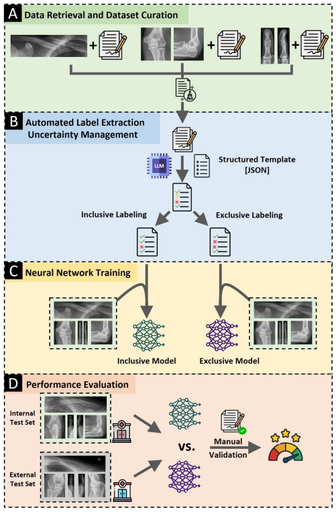
Figure 2 : Study Workflow. A) Radiography series of the clavicle, elbow, and thumb and corre- sponding radiologic reports were collected and curated. B) The LLM filled out a region-specific structured template containing relevant conditions based on the radiologic reports. Individual la- bels were either “true,” false,” or “uncertain.” The template was machine-readable and available in the JavaScript Object Notation (JSON) format. For subsequent model training, “uncertain” labels of the training/validation sets were automatically converted into “true” (inclusive labeling) or “false” (exclusive labeling) using Python. C) The JSON files were paired with the radiography series to train the image classification models as inclusive and exclusive versions using the respec- tive labels. D) Both models were tested on internal and external test datasets containing manually corrected labels (ground truth).
원문 · CC BY 4.0 · Hanna Kreutzer, Anne-Sophie Caselitz, Thomas Dratsch, Daniel Pinto dos Santos, Christiane Kuhl, Daniel Truhn, Sven Nebelung · Large Language Model-Based Uncertainty-Adjusted Label Extraction for Artificial Intelligence Model Development in Upper Extremity Radiography · 원문 그림 인용 · 원본 PDF 4쪽에서 그림 영역을 추출했습니다.모델 백본은 수정된 ResNet50입니다. 원래 1,000개 클래스 출력층을 각 소견의 이진 분류를 위한 새 완전연결층으로 바꾸었고, 로짓은 시그모이드를 거쳐 확률이 됩니다. 팔꿈치와 엄지 데이터는 정면과 측면 투영을 각각 별도의 ResNet50 네트워크에 넣고, 얻은 특징 벡터를 이어 붙인 뒤 최종 완전연결층에 입력합니다. 최적화는 AdamW(학습률 0.001)와 StepLR을 사용하며, 결정 임계값은 검증 세트에서 Youden index로 정합니다.
AUC 비교와 통계 검정의 적용 범위
성능은 라벨별 AUC를 비가중 방식으로 평균한 거시 평균 AUC로 보고합니다. 평가 대상은 내부 및 외부 테스트 세트에서 양성 사례가 10개 이상인 라벨입니다. 포함 모델과 배타 모델의 비교, 그리고 내부와 외부 테스트 세트의 비교에는 DeLong test를 사용했고, 다중 비교는 Benjamini–Hochberg 보정으로 조정했습니다. 신뢰구간은 1,000회 부트스트랩으로 구했습니다.
쇄골의 거시 평균 AUC는 포함 모델 0.80, 배타 모델 0.81이었고, 팔꿈치는 두 모델 모두 0.80, 엄지는 포함 0.76과 배타 0.78이었습니다. 원문은 포함과 배타 사이 및 내부와 외부 사이에서 유의한 차이가 없었다고 보고하며, 이 결과는 본 연구의 세 부위와 이 데이터셋 조건에서 얻은 것입니다.
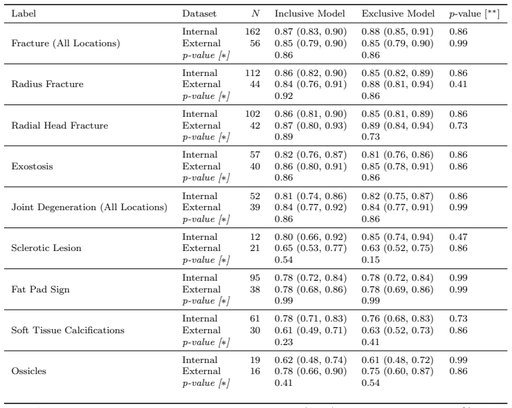
Table 3 : Performance of the Image Classification Models Trained with Automatically Extracted Labels for Radiographs of the Elbow.
원문 · CC BY 4.0 · Hanna Kreutzer, Anne-Sophie Caselitz, Thomas Dratsch, Daniel Pinto dos Santos, Christiane Kuhl, Daniel Truhn, Sven Nebelung · Large Language Model-Based Uncertainty-Adjusted Label Extraction for Artificial Intelligence Model Development in Upper Extremity Radiography · 원문 그림 인용 · 원본 PDF 11쪽에서 그림 영역을 추출했습니다.라벨 추출 정확도와 불확실 탐지의 한계
라벨 수준 정확도는 내부 테스트에서 쇄골 98.8%, 팔꿈치 98.6%, 엄지 99.0%였고, 외부 테스트에서는 쇄골 98.6%, 팔꿈치 98.4%, 엄지 98.1%였습니다. 보고서 수준 정확도는 내부 테스트에서 쇄골 78.5%, 팔꿈치 74.4%, 엄지 85.5%였습니다. 이 수치는 모든 라벨이 정확해야 하므로 라벨 수준보다 낮게 나타납니다.
불확실 라벨 탐지는 상대적으로 약했습니다. 내부 쇄골 보고서에서 수동으로 불확실 소견이 확인된 것은 9건이었으나 자동 탐지는 2건이었습니다. 팔꿈치는 78건 중 48건, 엄지는 38건 중 21건이 탐지되었습니다. 저자들은 이를 LLM이 수동 검토보다 적은 불확실 표현을 찾은 결과로 해석합니다.
결과의 해석과 적용 범위
포함과 배타 모델 사이의 차이가 통계적으로 유의하지 않았다는 결과는 두 가지로 읽을 수 있습니다. 저자들은 불확실 라벨의 비율이 작아 검정력이 부족했을 가능성과, 분류기가 적은 수준의 라벨 불확실성을 어느 정도 허용한다는 가능성을 함께 제시합니다. 이 두 해석은 본 연구에서 직접 증명된 것이 아니라 저자의 해석입니다.
한계도 분명합니다. 엄격한 포함 기준으로 환자 수가 많지 않았고, 일부 라벨은 10건 미만이어서 평가에서 제외되었습니다. 이는 넓은 신뢰구간과 유의하지 않은 DeLong 결과로 이어졌을 수 있습니다. 또한 독일어 보고서만 사용했고, 자동 추출 라벨로 학습한 모델을 사람이 만든 참조 라벨로 학습한 모델과 비교하지 않았습니다. LLM 출력은 본질적으로 비결정적이어서 재현에도 어려움이 있습니다.
논문 정보
- 저자
- Hanna Kreutzer, Anne-Sophie Caselitz, Thomas Dratsch, Daniel Pinto dos Santos, Christiane Kuhl, Daniel Truhn, Sven Nebelung
- 학회·저널
- arXiv · 프리프린트
- 최초 공개일
- 2025년 10월 7일
- 등록일
- 2026년 11월 6일
- 수정일
- 2025년 10월 7일
- 버전
- v1
- arXiv
- 2510.05664
- 분류
- cs.AI
- 원문 이용 조건
- CC BY 4.0
- 제공 범위
- 논문 정보, 해설, 허용된 원문 그림
AI 해설은 논문 원문과 별개의 설명이며 오류가 있을 수 있습니다. 원문과 그림은 각 출처의 이용 조건과 따로 표시된 권리를 따릅니다.
초록
Objectives: To evaluate GPT-4o's ability to extract diagnostic labels (with uncertainty) from free-text radiology reports and to test how these labels affect multi-label image classification of musculoskeletal radiographs. Methods: This retrospective study included radiography series of the clavicle (n=1,170), elbow (n=3,755), and thumb (n=1,978). After anonymization, GPT-4o filled out structured templates by indicating imaging findings as present ("true"), absent ("false"), or "uncertain." To assess the impact of label uncertainty, "uncertain" labels of the training and validation sets were automatically reassigned to "true" (inclusive) or "false" (exclusive). Label-image-pairs were used for multi-label classification using ResNet50. Label extraction accuracy was manually verified on internal (clavicle: n=233, elbow: n=745, thumb: n=393) and external test sets (n=300 for each). Performance was assessed using macro-averaged receiver operating characteristic (ROC) area under the curve (AUC), precision recall curves, sensitivity, specificity, and accuracy. AUCs were compared with the DeLong test. Results: Automatic extraction was correct in 98.6% (60,618 of 61,488) of labels in the test sets. Across anatomic regions, label-based model training yielded competitive performance measured by macro-averaged AUC values for inclusive (e.g., elbow: AUC=0.80 [range, 0.62-0.87]) and exclusive models (elbow: AUC=0.80 [range, 0.61-0.88]). Models generalized well on external datasets (elbow [inclusive]: AUC=0.79 [range, 0.61-0.87]; elbow [exclusive]: AUC=0.79 [range, 0.63-0.89]). No significant differences were observed across labeling strategies or datasets (p>=0.15). Conclusion: GPT-4o extracted labels from radiologic reports to train competitive multi-label classification models with high accuracy. Detected uncertainty in the radiologic reports did not influence the performance of these models.
원문 인용
Hanna Kreutzer, Anne-Sophie Caselitz, Thomas Dratsch, Daniel Pinto dos Santos, Christiane Kuhl, Daniel Truhn, Sven Nebelung (2025). Large Language Model-Based Uncertainty-Adjusted Label Extraction for Artificial Intelligence Model Development in Upper Extremity Radiography. arXiv:2510.05664v1. https://arxiv.org/abs/2510.05664v1
BibTeX
@misc{kreutzer2025large,
  title = {{Large Language Model-Based Uncertainty-Adjusted Label Extraction for Artificial Intelligence Model Development in Upper Extremity Radiography}},
  author = {Hanna Kreutzer and Anne-Sophie Caselitz and Thomas Dratsch and Daniel Pinto dos Santos and Christiane Kuhl and Daniel Truhn and Sven Nebelung},
  year = {2025},
  eprint = {2510.05664},
  archivePrefix = {arXiv},
  url = {https://arxiv.org/abs/2510.05664v1}
}