논문 해설
AdsorbML: A Leap in Efficiency for Adsorption Energy Calculations using Generalizable Machine Learning Potentials
AdsorbML: 일반화 가능한 머신러닝 포텐셜을 이용한 흡착 에너지 계산의 효율성 도약
- 연구 문제 흡착 에너지의 전역 최소를 찾는 데 DFT 완전 탐색은 비용이 지나치게 큽니다.
- 연구 방법 ML 포텐셜로 여러 초기 흡착 구성을 완화하고 상위 k개를 DFT 단일점 계산 또는 완전 완화로 검증하는 AdsorbML을 제안합니다.
- 주요 결과 OC20-Dense 테스트 세트에서 eSCN-MD-Large는 ML+SP k=3에서 87.36% 성공률과 2296x 속도 향상을 보고합니다.
흡착 에너지 탐색의 어려움
흡착 에너지는 흡착물과 촉매 표면 구성들 가운데 전역 최소 에너지로 정의되며, 흡착 에너지 계산의 출발점이 됩니다. 문제는 흡착 자리와 흡착물 방향이 많아 모든 구성을 DFT로 완전 완화하기에는 계산 비용이 지나치게 크다는 점입니다. 원문은 DFT 완전 완화 하나에 약 24시간이 걸릴 수 있다고 보고하며, 100,000개 물질 규모의 탐색은 약 4.5십억 CPU-일이 필요하다고 추정합니다.
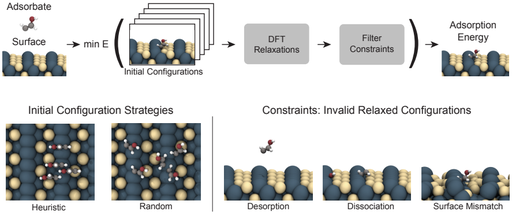
FIG. 1 . An overview of the steps involved in identifying the adsorption energy for an adsorbate-surface combination. First, an adsorbate and surface combination are selected, then numerous configurations are enumerated heuristically and/or randomly. For each configuration, DFT relaxations are performed and systems are filtered based on physical constraints that ensure valid adsorption energies (i.e. desorption, dissociation, surface mismatch). The minimum energy across all configurations is identified as the adsorption energy.
원문 · CC BY 4.0 · Lan, Janice, Palizhati, Aini, Shuaibi, Muhammed, Wood, Brandon M., Wander, Brook, Das, Abhishek, Uyttendaele, Matt, Zitnick, C. Lawrence, Ulissi, Zachary W. · AdsorbML: A Leap in Efficiency for Adsorption Energy Calculations using Generalizable Machine Learning Potentials · 원문 그림 인용 · 원본 PDF 2쪽에서 그림 영역을 추출했습니다.기존 OC20 데이터셋은 흡착 에너지를 많이 담고 있지만 흡착물-표면 조합마다 하나의 구성만 샘플링하므로, 그 구성이 전역 최소라는 보장이 없습니다. 이 논문은 이 한계를 해결하기 위해 밀집 샘플링 기준 데이터셋인 OC20-Dense를 구축하고, ML 포텐셜로 여러 구성을 빠르게 걸러 내는 AdsorbML 알고리즘을 제안합니다.
AdsorbML의 ML 순위화와 DFT 후속 계산
AdsorbML은 먼저 휴리스틱 방법과 표면 위 무작위 배치로 많은 초기 흡착 구성을 만듭니다. 각 구성은 GNN 기반 ML 포텐셜로 완화되고, 완화 후 에너지가 낮은 순서로 순위가 매겨집니다. 이 단계에서 ML 에너지는 순위를 정하는 데만 쓰이며, 최종 흡착 에너지는 DFT 계산에서 얻습니다.
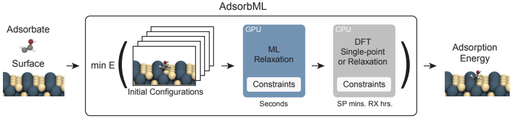
FIG. 2 . The AdsorbML algorithm. Initial configurations are generated via heuristic and random strategies. ML relaxations are performed on GPUs and ranked in order of lowest to highest energy. The best k systems are passed on to DFT for either a single-point (SP) evaluation or a full relaxation (RX) from the ML relaxed structure. Systems not satisfying constraints are filtered at each stage a relaxation is performed. The minimum is taken across all DFT outputs for the final adsorption energy.
원문 · CC BY 4.0 · Lan, Janice, Palizhati, Aini, Shuaibi, Muhammed, Wood, Brandon M., Wander, Brook, Das, Abhishek, Uyttendaele, Matt, Zitnick, C. Lawrence, Ulissi, Zachary W. · AdsorbML: A Leap in Efficiency for Adsorption Energy Calculations using Generalizable Machine Learning Potentials · 원문 그림 인용 · 원본 PDF 6쪽에서 그림 영역을 추출했습니다.상위 k개 구성은 두 전략 중 하나로 처리됩니다. ML+SP는 ML이 완화한 구조에 DFT 단일점 계산을 적용하고, ML+RX는 ML 완화 구조를 출발점으로 DFT 완전 완화를 수행합니다. 최종 흡착 에너지는 상위 k개 DFT 후속 계산 결과의 최솟값입니다. 탈착, 해리, 표면 불일치에 해당하는 구성은 제약 조건으로 걸러 내며, 이 필터는 각 완화 단계마다 적용됩니다.
OC20-Dense 테스트 세트에서의 성공률과 속도 향상
검증 지표는 DFT 기준 흡착 에너지의 0.1 eV 이내 또는 그보다 낮은 값을 찾은 시스템의 비율인 성공률과, DFT-Heur+Rand의 DFT 전자 자기일관 단계 수 대비 제안 전략의 단계 수 비율인 DFT 속도 향상입니다. 이 속도 향상은 ML 계산 시간을 포함하지 않으며, 원문은 ML 시간이 대체로 DFT보다 작다고 보고합니다.
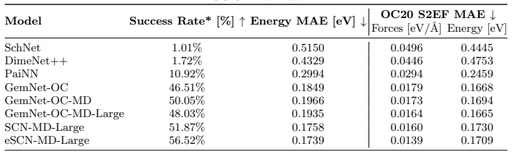
원문 그림 TABLE I. Success rates evaluated using ML predicted energies. ML predictions are only considered if their predicted energies are within 0.1 eV of its DFT evaluation. Energy MAE is also computed between predicted ML and DFT energy minima. We also show OC20 S2EF Val-ID results, with metrics correlating well with success rates and energy MAE.
원문 · CC BY 4.0 · Lan, Janice, Palizhati, Aini, Shuaibi, Muhammed, Wood, Brandon M., Wander, Brook, Das, Abhishek, Uyttendaele, Matt, Zitnick, C. Lawrence, Ulissi, Zachary W. · AdsorbML: A Leap in Efficiency for Adsorption Energy Calculations using Generalizable Machine Learning Potentials · 원문 그림 인용 · 원본 PDF 4쪽에서 그림 영역을 추출했습니다.ML+SP에서 eSCN-MD-Large는 k=3일 때 87.36% 성공률과 2296x 속도 향상을 보입니다. GemNet-OC-MD-Large는 k=3에서 84.43% 성공률과 2299x 속도 향상을 보입니다. ML+RX에서는 k=5에서 eSCN-MD-Large가 90.60%, GemNet-OC-MD-Large가 91.61%의 성공률을 보이며, 속도 향상은 각각 215x와 172x로 낮아집니다. 이는 ML+RX가 DFT 완전 완화를 추가하기 때문에 나타나는 절충입니다.
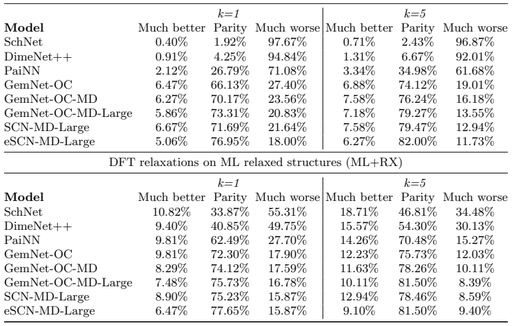
원문 그림 TABLE III. Distribution of success rates for the proposed ML+SP and ML+RX strategies on the OC20-Dense test set. “Parity” corresponds to being within 0.1 eV of the DFT adsorption energy; “Much better” corresponds to being less than 0.1 eV than DFT; and “Much worse” being higher than 0.1 eV of DFT.
원문 · CC BY 4.0 · Lan, Janice, Palizhati, Aini, Shuaibi, Muhammed, Wood, Brandon M., Wander, Brook, Das, Abhishek, Uyttendaele, Matt, Zitnick, C. Lawrence, Ulissi, Zachary W. · AdsorbML: A Leap in Efficiency for Adsorption Energy Calculations using Generalizable Machine Learning Potentials · 원문 그림 인용 · 원본 PDF 7쪽에서 그림 영역을 추출했습니다.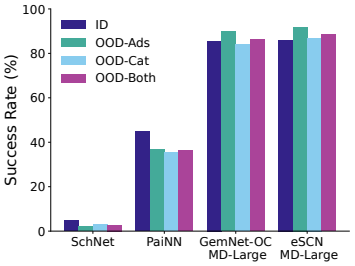
FIG. 4 . ML+SP success rate at k = 5 across the different sub- splits of the OC20-Dense test set and several baseline mod- els. Top performing models show marginal differences across the different distribution splits, suggesting good generaliza- tion performance to out-of-domain adsorbates and catalysts not contained in the OC20 training dataset.
원문 · CC BY 4.0 · Lan, Janice, Palizhati, Aini, Shuaibi, Muhammed, Wood, Brandon M., Wander, Brook, Das, Abhishek, Uyttendaele, Matt, Zitnick, C. Lawrence, Ulissi, Zachary W. · AdsorbML: A Leap in Efficiency for Adsorption Energy Calculations using Generalizable Machine Learning Potentials · 원문 그림 인용 · 원본 PDF 7쪽에서 그림 영역을 추출했습니다.휴리스틱 기준선과 설정 조건
커뮤니티에서 흔히 쓰는 DFT-Heur 기준선은 휴리스틱 구성만 DFT로 계산하며, 테스트 세트에서 87.76% 성공률과 1.81x 속도 향상을 보고합니다. 반면 DFT-Heur+Rand는 휴리스틱과 무작위 구성을 모두 포함한 더 철저한 기준이며, 이 논문의 주요 지표 기준으로 사용됩니다.
따라서 ML+SP의 높은 성공률은 DFT-Heur 기준선과 같은 조건에서 비교할 때 해석해야 합니다. 원문은 검증 세트에서 DFT-Heur의 속도 향상이 2.87x이며, 테스트 세트와 달라지는 이유를 휴리스틱 구성 생성 방식의 개선으로 설명합니다.
정확도 한계와 성공률 지표의 주의점
ML 완화 구조만으로는 실제 응용에 필요한 정확도에 이르지 않는다고 저자들은 보고합니다. 원문은 ML 완화 구조의 평균 최대 힘이 eSCN-MD-Large에서 0.15 eV/Å, GemNet-OC-MD-Large에서 0.21 eV/Å이어서 유효한 완화 구조 기준인 0.05 eV/Å보다 크다고 설명합니다. 이 때문에 ML 결과를 DFT로 검증하는 단계가 필요합니다.
또한 성공률은 DFT 기준보다 낮은 에너지를 예측하면 조작될 수 있으므로, 검증 세트에서는 DFT 단일점 평가를 함께 보고하는 것이 권장됩니다. 저자들은 ML 구성의 깊은 최소를 찾는 효과가 불완전한 힘 예측에서 나올 수 있다고 해석하지만, 이것이 확정된 메커니즘이라고 단정하지는 않습니다.
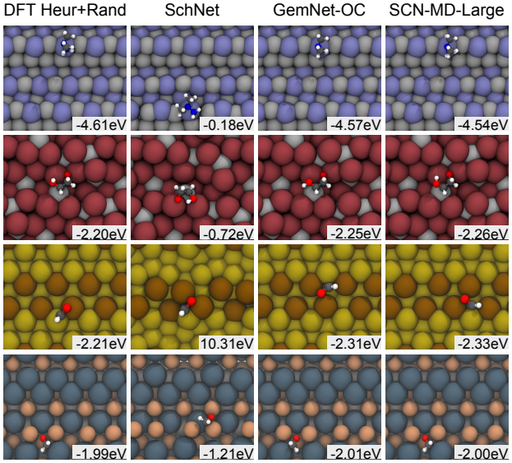
FIG. 5 . Illustration of the lowest energy configurations as found by DFT-Heur+Rand, SchNet, GemNet-OC, and SCN- MD-Large on the OC20-Dense validation set. Corresponding adsorption energies are shown in the bottom right corner of each snapshot. ML relaxed structures have energies calculated with a DFT single-point, ML+SP. A variety of systems are shown including ones where ML finds lower, higher, and comparable adsorption energies to DFT. Notice that several of the configurations in the third and fourth systems are symmetrically equivalent, and that SchNet induces a large surface reconstruction in the third system resulting in the extremely large DFT energy (10.31 eV).
원문 · CC BY 4.0 · Lan, Janice, Palizhati, Aini, Shuaibi, Muhammed, Wood, Brandon M., Wander, Brook, Das, Abhishek, Uyttendaele, Matt, Zitnick, C. Lawrence, Ulissi, Zachary W. · AdsorbML: A Leap in Efficiency for Adsorption Energy Calculations using Generalizable Machine Learning Potentials · 원문 그림 인용 · 원본 PDF 8쪽에서 그림 영역을 추출했습니다.무작위 구성과 휴리스틱 구성의 역할
SCN-MD-Large를 사용한 검증 세트 절제 실험에서, ML+SP 전략의 k=5 성공률은 두 구성을 모두 쓸 때 87.77%였습니다. 무작위 구성만 사용하면 82.94%로 떨어지고, 휴리스틱 구성만 사용하면 62.18%로 더 크게 떨어집니다. 원문은 이 결과가 무작위 구성의 영향이 더 크다는 것을 시사한다고 보고합니다.
이 결과는 SCN-MD-Large와 검증 세트, ML+SP 전략이라는 조건에서 얻은 것입니다. 다른 모델이나 ML+RX 전략까지 같은 크기의 효과가 확인된 것은 아닙니다.
논문 정보
- 저자
- Lan, Janice, Palizhati, Aini, Shuaibi, Muhammed, Wood, Brandon M., Wander, Brook, Das, Abhishek, Uyttendaele, Matt, Zitnick, C. Lawrence, Ulissi, Zachary W.
- 학회·저널
- arXiv · 프리프린트
- 최초 공개일
- 2022년 11월 29일
- 등록일
- 2026년 11월 6일
- 수정일
- 2023년 9월 15일
- 버전
- v3
- arXiv
- 2211.16486
- DOI
- 10.1038/s41524-023-01121-5
- 분류
- cond-mat.mtrl-sci · cs.LG
- 원문 이용 조건
- CC BY 4.0
- 제공 범위
- 논문 정보, 해설, 허용된 원문 그림
AI 해설은 논문 원문과 별개의 설명이며 오류가 있을 수 있습니다. 원문과 그림은 각 출처의 이용 조건과 따로 표시된 권리를 따릅니다.
초록
Computational catalysis is playing an increasingly significant role in the design of catalysts across a wide range of applications. A common task for many computational methods is the need to accurately compute the adsorption energy for an adsorbate and a catalyst surface of interest. Traditionally, the identification of low energy adsorbate-surface configurations relies on heuristic methods and researcher intuition. As the desire to perform high-throughput screening increases, it becomes challenging to use heuristics and intuition alone. In this paper, we demonstrate machine learning potentials can be leveraged to identify low energy adsorbate-surface configurations more accurately and efficiently. Our algorithm provides a spectrum of trade-offs between accuracy and efficiency, with one balanced option finding the lowest energy configuration 87.36% of the time, while achieving a 2000x speedup in computation. To standardize benchmarking, we introduce the Open Catalyst Dense dataset containing nearly 1,000 diverse surfaces and 100,000 unique configurations.
원문 인용
Lan, Janice, Palizhati, Aini, Shuaibi, Muhammed, Wood, Brandon M., Wander, Brook, Das, Abhishek, Uyttendaele, Matt, Zitnick, C. Lawrence, Ulissi, Zachary W. (2022). AdsorbML: A Leap in Efficiency for Adsorption Energy Calculations using Generalizable Machine Learning Potentials. arXiv:2211.16486v3. https://doi.org/10.1038/s41524-023-01121-5
BibTeX
@article{janice2022adsorbml,
  title = {{AdsorbML: A Leap in Efficiency for Adsorption Energy Calculations using Generalizable Machine Learning Potentials}},
  author = {Lan, Janice and Palizhati, Aini and Shuaibi, Muhammed and Wood, Brandon M. and Wander, Brook and Das, Abhishek and Uyttendaele, Matt and Zitnick, C. Lawrence and Ulissi, Zachary W.},
  year = {2022},
  eprint = {2211.16486},
  archivePrefix = {arXiv},
  doi = {10.1038/s41524-023-01121-5},
  url = {https://arxiv.org/abs/2211.16486v3}
}