논문 해설
Efficient Annotation and Learning for 3D Hand Pose Estimation: A Survey
3D 손 자세 추정을 위한 효율적인 주석 및 학습: 서베이
- 연구 문제 3D 손 자세 추정은 정확한 3D 주석이 많이 필요하지만, 주석 방법마다 비용·가려짐·환경 편향 문제가 있어 데이터 구축이 어렵습니다.
- 연구 방법 이 서베이는 주석 방법을 수동, 합성, 손 마커, 계산 방식으로 나누어 장단점을 비교하고, 레이블이 적을 때 쓰는 자기지도 pre-training, 준지도 학습, 도메인 적응을 함께 정리합니다.
- 주요 결과 수동 주석은 손가락 끝 중심으로 제한되고 합성 주석은 질감과 상호작용을 잘 모사하지 못하며, 마커는 손 외형을 바꿉니다. 다중 카메라 삼각측량은 시점 수에 따라 대규모 주석을 만들 수 있고, 특징 단위 집계는 8대 카메라 설정에서 평균 4.20 mm 오차를 보고합니다.
3D 손 자세 추정의 주석 병목
3D 손 자세 추정의 성능은 학습에 쓰는 3D 손 자세 주석의 양과 품질에 크게 좌우됩니다. 그런데 단일 RGB 영상만으로는 3D 위치를 정확히 정하는 것이 본질적으로 불완전한 문제이며, 가려짐과 데이터셋 편향이 주석을 더 어렵게 만듭니다. 이 논문은 이런 상황에서 주석을 효율적으로 얻는 방법과 레이블이 부족할 때 학습하는 방법을 함께 정리하는 서베이입니다.
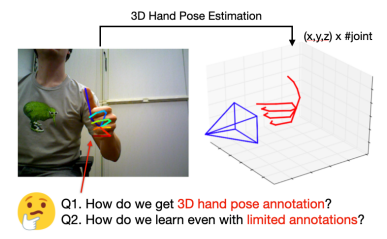
Fig. 1 Our survey on 3D hand pose estimation is orga- nized from two aspects: (i) obtaining 3D hand pose anno- tation and (ii) learning even with a limited amount of annotated data. These two issues will be considered in the scenarios of practical applications where we work on dataset construction and model development with limited resources. The figure is adapted from [109].
원문 · CC BY 4.0 · Takehiko Ohkawa, Ryosuke Furuta, Yoichi Sato · Efficient Annotation and Learning for 3D Hand Pose Estimation: A Survey · 원문 그림 인용 · 원본 PDF 2쪽에서 그림 영역을 추출했습니다.주석 방법은 수동 주석, 합성 모델 기반 주석, 손 마커 기반 주석, 계산 주석으로 나뉩니다. 수동 주석은 손이 완전히 보이는 경우에 합리적인 주석을 제공하지만 프레임 수가 제한되고 가려진 관절에 취약합니다. 합성 모델 기반 주석은 대규모 데이터를 저비용으로 만들 수 있으나 손 질감과 손-물체 상호작용을 충분히 모사하지 못합니다. 따라서 이 논문은 주석 방법의 장단점을 데이터셋 구축의 제약과 함께 읽도록 구성되어 있습니다.
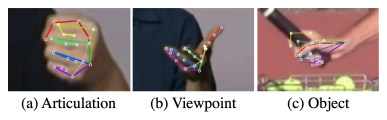
Fig. 3 Difficulty of hand pose annotation in a single RGB image [81]. Occlusion of hand joints is caused by (a) articulation, (b) viewpoint bias, and (c) grasping objects.
원문 · CC BY 4.0 · Takehiko Ohkawa, Ryosuke Furuta, Yoichi Sato · Efficient Annotation and Learning for 3D Hand Pose Estimation: A Survey · 원문 그림 인용 · 원본 PDF 4쪽에서 그림 영역을 추출했습니다.주석 방법별 기술적 차이와 한계
손 마커 기반 주석은 손에 부착한 센서의 6자유도 정보를 이용해 손 관절을 계산합니다. BigHand2.2M과 FPHA는 이런 센서로 21개 손 관절 주석을 제공합니다. 원문은 이 방식에서 역운동학을 사용해 마커 위치와 사용자별 뼈 길이 제약을 만족하는 골격을 맞춘다고 설명합니다. 이 방식은 가려짐에 강하지만 센서가 손 외형을 바꾸고 자연스러운 움직임을 방해합니다.
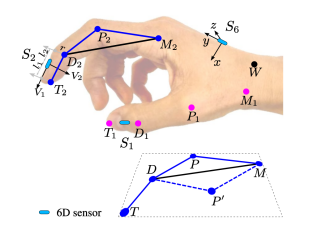
Fig. 6 Calculation of joint positions from tracked mark- ers [105]. Si denotes the position of the markers, and W , Mi, Pi, Di, and Ti are the positions of hand joints listed from the wrist to the fingertips.
원문 · CC BY 4.0 · Takehiko Ohkawa, Ryosuke Furuta, Yoichi Sato · Efficient Annotation and Learning for 3D Hand Pose Estimation: A Survey · 원문 그림 인용 · 원본 PDF 6쪽에서 그림 영역을 추출했습니다.합성 모델 기반 주석은 렌더링 엔진으로 정확한 키포인트를 얻습니다. 그러나 조명과 질감이 잘 모사되지 않으며 손-물체 상호작용의 시뮬레이션이 고려되지 않는다는 한계가 있습니다. 계산 주석은 모델 피팅 또는 다중 카메라 삼각측량으로 주석을 만들어 손의 자연스러운 움직임을 포착할 수 있으나 카메라 장비가 필요합니다.
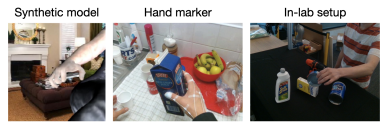
Fig. 4 Example of major data collection setups. The syn- thetic image on the left (ObMan [31]) can be generated inexpensively, but they exhibit unrealistic hand texture. The hand markers on the middle (FPHA [21]) enable auto- matic tracking of hand joints, although the markers distort the appearance of hands. The in-lab setup on the right (DexYCB [9]) uses a black background to make it easier to recognize hands and objects, but it limits data variation in environments.
원문 · CC BY 4.0 · Takehiko Ohkawa, Ryosuke Furuta, Yoichi Sato · Efficient Annotation and Learning for 3D Hand Pose Estimation: A Survey · 원문 그림 인용 · 원본 PDF 4쪽에서 그림 영역을 추출했습니다.다중 카메라 삼각측량의 규모와 정확도
InterHand2.6M은 6개 시점에서 키포인트를 주석하고, 삼각측량한 3D 점을 100개 이상의 다른 시점에 재투영합니다. 원문에 따르면 이 설정은 주석 한 번으로 100장 이상의 학습 이미지를 만들며, 이 데이터셋은 수백만 규모의 학습 데이터를 갖습니다. 다만 이 수치는 해당 다중 카메라 스튜디오 설정에 해당합니다.
AssemblyHands처럼 8대의 정적 카메라만 있는 경우에는 손-물체 가려짐 때문에 점 단위 삼각측량의 2D 입력이 불안정해집니다. 이 논문이 소개하는 특징 단위 삼각측량은 2D 키포인트 검출기의 다중 시점 특징을 집계하고 3D 볼륨 특징에서 좌표를 계산합니다. 이 방식의 평균 키포인트 오차는 4.20 mm로 보고되며, 원문은 이를 Assembly101 원래 주석 오차보다 85% 낮다고 설명합니다.
레이블이 적을 때의 학습 방법
자기지도 pre-training은 레이블이 없는 손 이미지로 인코더를 먼저 학습한 뒤 지도 학습으로 미세 조정합니다. 원문에 소개된 연구들은 MoCo나 SimCLR 같은 대비 학습을 사용해 유사한 손 이미지 쌍을 임베딩 공간에서 가깝게 만듭니다. 준지도 학습은 소량의 레이블 데이터와 많은 레이블 없는 데이터를 함께 사용하며, 예측 결과를 의사 레이블로 쓰되 공간적·시간적 제약을 만족하는 경우에만 학습에 반영합니다.
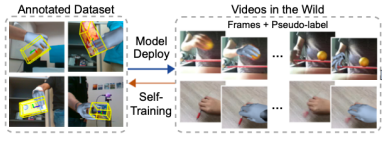
Fig. 11 Semi-supervised learning of 3D hand pose estima- tion [47]. The model is trained jointly on annotated data and unlabeled data with pseudo-labels.
원문 · CC BY 4.0 · Takehiko Ohkawa, Ryosuke Furuta, Yoichi Sato · Efficient Annotation and Learning for 3D Hand Pose Estimation: A Survey · 원문 그림 인용 · 원본 PDF 9쪽에서 그림 영역을 추출했습니다.도메인 적응은 레이블이 있는 원본 데이터와 레이블이 제한된 대상 데이터의 차이를 줄입니다. 합성 이미지에서 실제 이미지로 옮기는 문제와 깊이 영상에서 RGB 영상으로 지식을 옮기는 모달리티 전이 문제가 대표적입니다. 이 설명은 선행 연구를 소개한 것이며, 각 방법의 세부 성능은 원문 본문의 해당 인용에서 확인해야 합니다.
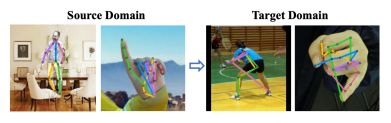
Fig. 12 Poor generalization to an unknown domain [41]. The models trained on synthetic images (source) exhibit a limited capacity for inferring poses on real images (target).
원문 · CC BY 4.0 · Takehiko Ohkawa, Ryosuke Furuta, Yoichi Sato · Efficient Annotation and Learning for 3D Hand Pose Estimation: A Survey · 원문 그림 인용 · 원본 PDF 10쪽에서 그림 영역을 추출했습니다.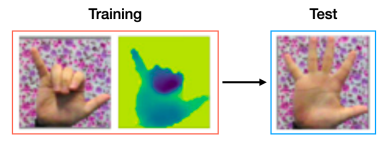
Fig. 13 Example of modality transfer. During training, RGB and depth images are accessible and RGB images are given in the test phase. The training aims to utilize the support of depth information to improve RGB-based hand pose estimation.
원문 · CC BY 4.0 · Takehiko Ohkawa, Ryosuke Furuta, Yoichi Sato · Efficient Annotation and Learning for 3D Hand Pose Estimation: A Survey · 원문 그림 인용 · 원본 PDF 10쪽에서 그림 영역을 추출했습니다.남은 과제와 적용 범위
이 논문은 주석 방법과 학습 방법을 서베이로 정리하며, 여러 방법을 같은 조건에서 새로 비교한 실험을 제시하지 않습니다. 따라서 장단점은 원문이 인용한 데이터셋과 연구의 보고에 근거합니다. 원문은 향후 과제로 유연한 카메라 구성, 활동 다양성 확대, 주석과 학습의 결합, 일반화와 적응을 제시합니다.
특히 여러 데이터셋에서 학습한 모델이 다른 데이터셋에 잘 일반화되지 않는다는 점은 주석 편향이 실제 적용을 제한함을 보여 줍니다. 이 점은 실외 AR 응용처럼 다른 환경으로 옮겨야 하는 경우에 중요한 과제입니다.
논문 정보
- 저자
- Takehiko Ohkawa, Ryosuke Furuta, Yoichi Sato
- 학회·저널
- arXiv · 프리프린트
- 최초 공개일
- 2022년 6월 5일
- 등록일
- 2026년 11월 6일
- 수정일
- 2023년 4월 26일
- 버전
- v3
- arXiv
- 2206.02257
- 분류
- cs.CV
- 원문 이용 조건
- CC BY 4.0
- 제공 범위
- 논문 정보, 해설, 허용된 원문 그림
AI 해설은 논문 원문과 별개의 설명이며 오류가 있을 수 있습니다. 원문과 그림은 각 출처의 이용 조건과 따로 표시된 권리를 따릅니다.
초록
In this survey, we present a systematic review of 3D hand pose estimation from the perspective of efficient annotation and learning. 3D hand pose estimation has been an important research area owing to its potential to enable various applications, such as video understanding, AR/VR, and robotics. However, the performance of models is tied to the quality and quantity of annotated 3D hand poses. Under the status quo, acquiring such annotated 3D hand poses is challenging, e.g., due to the difficulty of 3D annotation and the presence of occlusion. To reveal this problem, we review the pros and cons of existing annotation methods classified as manual, synthetic-model-based, hand-sensor-based, and computational approaches. Additionally, we examine methods for learning 3D hand poses when annotated data are scarce, including self-supervised pretraining, semi-supervised learning, and domain adaptation. Based on the study of efficient annotation and learning, we further discuss limitations and possible future directions in this field.
원문 인용
Takehiko Ohkawa, Ryosuke Furuta, Yoichi Sato (2022). Efficient Annotation and Learning for 3D Hand Pose Estimation: A Survey. arXiv:2206.02257v3. https://arxiv.org/abs/2206.02257v3
BibTeX
@misc{ohkawa2022efficient,
  title = {{Efficient Annotation and Learning for 3D Hand Pose Estimation: A Survey}},
  author = {Takehiko Ohkawa and Ryosuke Furuta and Yoichi Sato},
  year = {2022},
  eprint = {2206.02257},
  archivePrefix = {arXiv},
  url = {https://arxiv.org/abs/2206.02257v3}
}