논문 해설
TimeDART: A Diffusion Autoregressive Transformer for Self-Supervised Time Series Representation
TimeDART: 자기지도 시계열 표현을 위한 확산 자기회귀 트랜스포머
- 연구 문제 장기 동역학과 세부 지역 패턴을 함께 포착하는 자기지도 시계열 표현 학습이 기존 방법으로 어렵습니다.
- 연구 방법 패치 단위 인과 Transformer 인코더와 확산 잡음 제거 디코더를 결합하고, MSE 대신 확산 손실로 자기회귀 목적을 최적화합니다.
- 주요 결과 예측 과제에서 24개 지표 중 83.3%에서 최고 결과를 얻었고, 분류 과제에서는 무작위 초기화 대비 평균 정확도를 약 5.7% 높였습니다.
자기지도 시계열 학습의 두 가지 과제
시계열 자기지도 학습은 레이블이 부족한 상황에서 표현을 미리 학습하려는 시도입니다. 그러나 기존 방법은 장기적인 동역학 변화와 세부 지역 패턴을 하나의 틀에서 함께 포착하기 어렵습니다. 저자들은 마스크 복원, 대조 학습, 자기회귀 예측이 각각 이 가운데 일부에 치우친다고 정리합니다. 특히 자기회귀 방식은 좌에서 우로 이어지는 시간 구조와 잘 맞지만, 제곱오차 목표를 쓸 때 현재 값의 예측이 과거 값을 중심으로 한 고정 분산의 가우시안 분포로 수렴하는 경향이 있다고 지적됩니다. 이 논문은 이러한 한계를 자기회귀 최적화 안에 확산 잡음 제거 과정을 넣어 함께 다루려는 시도입니다.
패치 임베딩, 인과 인코더, 확산 디노이징
TimeDART는 다변량 시계열을 먼저 인스턴스 정규화하고, 겹치지 않는 패치로 나눈 뒤 선형 임베딩으로 깨끗한 패치 표현을 만듭니다. 패치 길이 P와 스트라이드 S를 같게 두어 패치가 겹치지 않도록 하며, 이는 정보 누출을 막기 위한 선택입니다. 인코더는 시작 토큰을 앞에 붙이고 마지막 패치를 제외한 입력에 위치 인코딩을 더한 뒤, 인과 마스크를 적용한 Transformer 인코더를 통과시킵니다. 순방향 과정에서는 각 패치에 시간 단계 s마다 독립적으로 잡음을 더하며, 잡음 비율은 코사인 스케줄러로 정합니다. 디노이징 디코더는 인코더 출력을 키와 값으로, 잡음이 더해진 패치 임베딩을 질의로 사용하고 self-only mask로 j번째 입력이 j번째 인코더 출력에만 주의하게 합니다.
따라서 j번째 인코더 출력은 1부터 j−1까지의 깨끗한 패치 정보를 집약하고, 이것이 자기회귀 최적화의 근거가 됩니다.
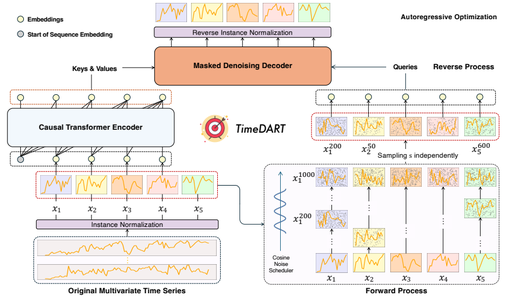
Figure 2 : The overall architecture of TimeDART, which employs patch-level modeling, enhances the power of the autoregressive self-supervised method through a diffusion denoising process. It captures both long-term dynamics evolution and subtle local patterns to strengthen consistent and effective representation learning.
원문 · CC BY 4.0 · Wang, Daoyu, Cheng, Mingyue, Liu, Zhiding, Liu, Qi · TimeDART: A Diffusion Autoregressive Transformer for Self-Supervised Time Series Representation · 원문 그림 인용 · 원본 PDF 4쪽에서 그림 영역을 추출했습니다.MSE에서 확산 손실로의 목적 함수 변경
기존 자기회귀 pre-training은 예측값과 실제 패치의 차이를 줄이는 평균제곱오차 목표를 씁니다. 저자들은 이 목표가 데이터 분포를 가우시안으로 가정하는 최대우도 관점과 연결된다고 설명합니다. TimeDART는 이 MSE 목표를 확산 손실로 대체하여 여러 봉우리를 가진 분포를 표현하도록 합니다. 확산 손실은 각 j에 대해 원래 패치 x0j와 g(잡음 패치 임베딩, 인코더 출력)의 차이 제곱을 더한 형태로 제시되며, 저자들은 이를 변분 하한(ELBO)과 형식적으로 같다고 설명합니다. 이 연결은 원문 부록의 유도에 근거하지만, 실제 학습 효과는 이후 실험으로 확인해야 합니다.
pre-training 후 전이 방식
pre-training이 끝나면 디노이징 디코더는 버리고 임베딩 층과 인코더만 다운스트림 과제로 옮깁니다. 예측 과제에서는 평탄화 헤드를 붙이고 MSE 손실로 미세조정하며, 분류 과제에서는 풀링 헤드와 교차 엔트로피 손실을 사용합니다. 따라서 확산 디코더는 pre-training 중에만 쓰이고 최종 예측·분류 모델에는 포함되지 않습니다.
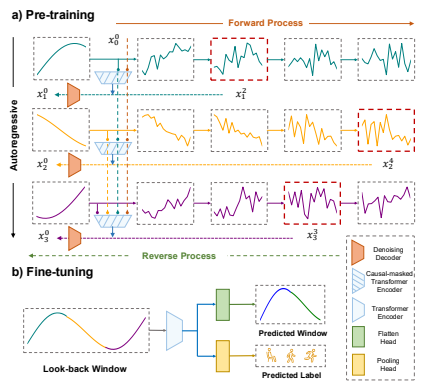
Figure 1 : Two-stage pre-training and fine-tuning process. a): TimeDART teaches an encoder to learn temporal rep- resentations through a noising process and autoregressive denoising. b): The pre-trained encoder is adapted with task- specific heads for downstream applications.
원문 · CC BY 4.0 · Wang, Daoyu, Cheng, Mingyue, Liu, Zhiding, Liu, Qi · TimeDART: A Diffusion Autoregressive Transformer for Self-Supervised Time Series Representation · 원문 그림 인용 · 원본 PDF 1쪽에서 그림 영역을 추출했습니다.예측 과제의 주 비교 결과
예측 실험은 ETT, Electricity, Traffic, Weather, Exchange, PEMS 데이터셋에서 수행되며, 인도메인 설정에서 look-back L=336과 예측 길이 {96, 192, 336, 720}을 사용합니다. PEMS는 L=96과 {12, 24, 36, 48}을 사용합니다. 보고 지표는 4개 예측 창의 평균 MSE와 MAE입니다. 저자들은 TimeDART가 24개 평가 지표 가운데 83.3%에서 최고 결과를 얻었고, 무작위 초기화 대비 MSE를 6.8% 줄이며 최신 기준 모델 대비 3% 줄였다고 보고합니다. 이 수치는 이 설정과 기준선 집합에서의 결과이며, 다른 데이터나 백본에 그대로 일반화되지 않습니다.
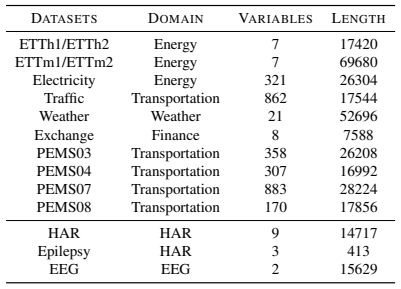
Table 1 : Dataset Statistics: The top part shows forecasting datasets, bottom part shows classification datasets.
원문 · CC BY 4.0 · Wang, Daoyu, Cheng, Mingyue, Liu, Zhiding, Liu, Qi · TimeDART: A Diffusion Autoregressive Transformer for Self-Supervised Time Series Representation · 원문 그림 인용 · 원본 PDF 5쪽에서 그림 영역을 추출했습니다.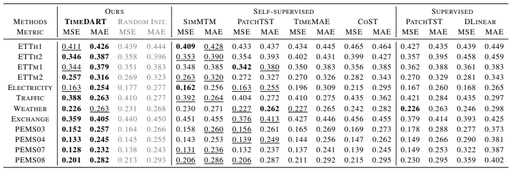
Table 2 : Multivariate time series forecasting results. All results are averaged MSE and Mean Absolute Error (MAE) from 4 different predicted windows of {12, 24, 36, 48} for PEMS datasets and {96, 192, 336, 720} for others. The best results are in bold and the second best are underlined. Full results are detailed in Appendix D.
원문 · CC BY 4.0 · Wang, Daoyu, Cheng, Mingyue, Liu, Zhiding, Liu, Qi · TimeDART: A Diffusion Autoregressive Transformer for Self-Supervised Time Series Representation · 원문 그림 인용 · 원본 PDF 6쪽에서 그림 영역을 추출했습니다.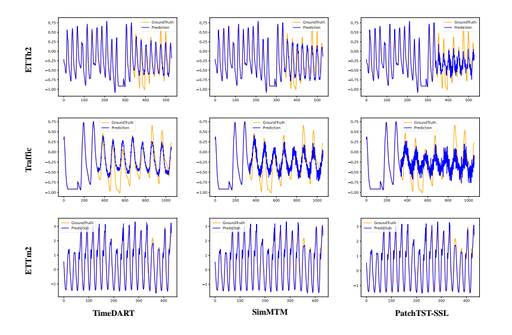
Figure 7 : Illustration of forecasting showcases comparing TimeDART and baseline models. The look-back window is set to 336 and the predicted window is set to 192, 96, 720 for the ETTh2, Traffic, and ETTm2 dataset respectively.
원문 · CC BY 4.0 · Wang, Daoyu, Cheng, Mingyue, Liu, Zhiding, Liu, Qi · TimeDART: A Diffusion Autoregressive Transformer for Self-Supervised Time Series Representation · 원문 그림 인용 · 원본 PDF 19쪽에서 그림 영역을 추출했습니다.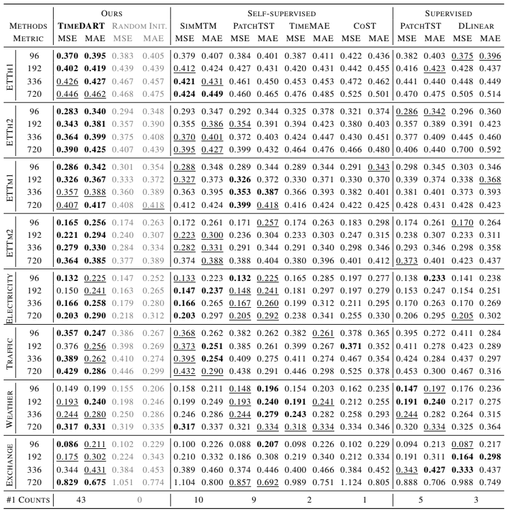
Table 10 : Multivariate time series forecasting full results with look-back window L = 336. All results are MSE and MAE from 4 different predicted windows of {96, 192, 336, 720}. The best results are in bold and the second best are underlined. “#1 Counts” represents the number of times the method achieves the best results.
원문 · CC BY 4.0 · Wang, Daoyu, Cheng, Mingyue, Liu, Zhiding, Liu, Qi · TimeDART: A Diffusion Autoregressive Transformer for Self-Supervised Time Series Representation · 원문 그림 인용 · 원본 PDF 20쪽에서 그림 영역을 추출했습니다.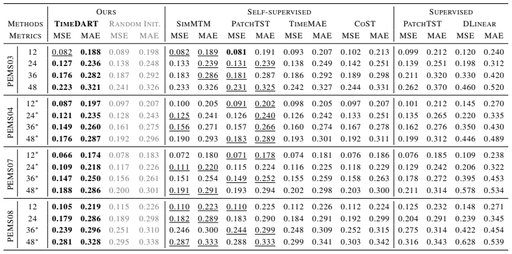
Table 11 : Multivariate time series forecasting full results on PEMS datasets. All results are MSE and MAE from 4 different predicted windows of {12, 24, 36, 48}. The best results are in bold and the second best are underlined. ∗ means we doesn’t apply instance normalization on both pre-training and fine-tuning.
원문 · CC BY 4.0 · Wang, Daoyu, Cheng, Mingyue, Liu, Zhiding, Liu, Qi · TimeDART: A Diffusion Autoregressive Transformer for Self-Supervised Time Series Representation · 원문 그림 인용 · 원본 PDF 21쪽에서 그림 영역을 추출했습니다.분류 과제와 pre-training 효과
분류 실험은 HAR과 Epilepsy, EEG 데이터셋에서 정확도와 Macro-F1을 보고합니다. 저자들은 pre-training 후 TimeDART가 무작위 초기화 대비 평균 정확도를 약 5.7% 높인다고 보고합니다. 이 비교는 분류 과제의 미세조정 설정에서 얻은 결과이며, 다른 분류 설정의 성능을 보장하지 않습니다.

Table 4 : Multivariate time series classification results. Results are are reported as Accuracy (Acc.) and Macro-F1 (F1). The best results are in bold and the second best are underlined.
원문 · CC BY 4.0 · Wang, Daoyu, Cheng, Mingyue, Liu, Zhiding, Liu, Qi · TimeDART: A Diffusion Autoregressive Transformer for Self-Supervised Time Series Representation · 원문 그림 인용 · 원본 PDF 7쪽에서 그림 영역을 추출했습니다.자기회귀 메커니즘과 확산 과정의 절제
절제 실험은 자기회귀 메커니즘(w/o AR)과 디노이징 확산 과정(w/o diff), 둘 다 제거한 설정(w/o AR-diff)을 비교합니다. w/o AR에서는 인코더의 인과 마스크와 디코더의 마스크를 함께 제거합니다. 저자들은 w/o AR이 무작위 초기화보다 낮은 성능을 보인다고 보고하며, 이는 자기회귀 구조가 장기 동역학 학습에 중요하다는 해석으로 이어집니다. 노이즈 스케줄러 비교에서는 코사인 방식이 선형 방식보다 크게 나았고, 자기-전용 마스크가 디노이징에 필요한 정보를 이미 담고 있다고 보고됩니다.
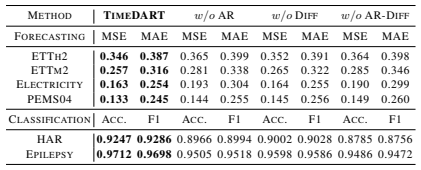
Table 6 : The results of ablation study. Average MSE and MAE from 4 different predicted windows for forecasting while Accuracy and Macro-F1 for classification task.
원문 · CC BY 4.0 · Wang, Daoyu, Cheng, Mingyue, Liu, Zhiding, Liu, Qi · TimeDART: A Diffusion Autoregressive Transformer for Self-Supervised Time Series Representation · 원문 그림 인용 · 원본 PDF 7쪽에서 그림 영역을 추출했습니다.
Table 7 : Hyperparameter sensitivity analysis of noise steps and noise schedulers. Average MSE and MAE from 4 different predicted windows for forecasting while Accuracy and Macro-F1 for classification task. See Appendix F.1 for full results.
원문 · CC BY 4.0 · Wang, Daoyu, Cheng, Mingyue, Liu, Zhiding, Liu, Qi · TimeDART: A Diffusion Autoregressive Transformer for Self-Supervised Time Series Representation · 원문 그림 인용 · 원본 PDF 8쪽에서 그림 영역을 추출했습니다.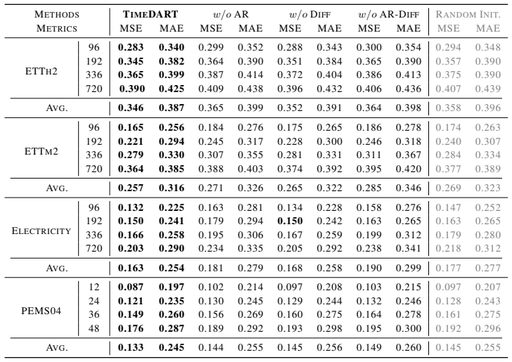
Table 14 : Full result of the ablation study on datasets for forecasting. The best results are in bold.
원문 · CC BY 4.0 · Wang, Daoyu, Cheng, Mingyue, Liu, Zhiding, Liu, Qi · TimeDART: A Diffusion Autoregressive Transformer for Self-Supervised Time Series Representation · 원문 그림 인용 · 원본 PDF 22쪽에서 그림 영역을 추출했습니다.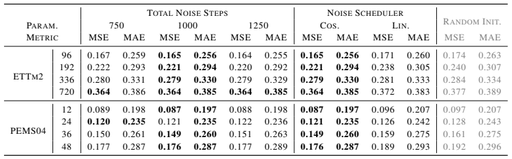
Table 16 : Full result of hyperparameter analysis of noise steps and noise schedulers. The best results are in bold.
원문 · CC BY 4.0 · Wang, Daoyu, Cheng, Mingyue, Liu, Zhiding, Liu, Qi · TimeDART: A Diffusion Autoregressive Transformer for Self-Supervised Time Series Representation · 원문 그림 인용 · 원본 PDF 23쪽에서 그림 영역을 추출했습니다.백본 변경과 적용 범위
백본을 인과 TCN으로 바꾼 실험에서 TCN은 예측 과제에서 Transformer 인코더보다 약간 낮은 성능을 보입니다. 저자들은 이를 pre-training에 쓴 Transformer 디노이징 디코더와의 불일치로 해석합니다. 분류 과제에서는 TCN이 무작위 초기화된 Transformer 인코더보다 경쟁력 있는 결과를 보입니다. 또한 도메인 간 pre-training에서 Weather 데이터셋은 도메인 내 설정보다 성능이 약간 떨어지며, 저자들은 여러 도메인에서 같은 모델별 파라미터를 쓴 점을 가능한 원인으로 제시합니다.
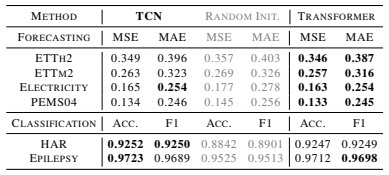
Table 5 : Performance of TCN as backbone. Average MSE and MAE from 4 different predicted windows for forecast- ing while Accuracy and Macro-F1 for classification task.
원문 · CC BY 4.0 · Wang, Daoyu, Cheng, Mingyue, Liu, Zhiding, Liu, Qi · TimeDART: A Diffusion Autoregressive Transformer for Self-Supervised Time Series Representation · 원문 그림 인용 · 원본 PDF 7쪽에서 그림 영역을 추출했습니다.소량 데이터와 입력 길이 분석
소량 데이터 실험은 학습 데이터의 5% 또는 10%만으로 미세조정한 뒤 전체 테스트 세트에서 평가합니다. 저자들은 TimeDART가 대부분의 경우 무작위 초기화 상태에서 전체 데이터로 지도 미세조정한 결과보다 나은 성능을 보인다고 보고합니다. 선형 프로빙은 pre-training 인코더를 고정하고 마지막 투영층만 학습하는 설정입니다. 입력 길이 분석에서는 look-back 창을 늘릴수록 예측 성능이 개선되는 것으로 보고됩니다. 이 결과는 해당 데이터와 평가 설정에서 관찰된 것입니다.

Table 8 : Fine-tuning under few-shot and linear probing settings. Average MSE and MAE from 4 different predicted windows for forecasting while Accuracy and Macro-F1 for classification task. See Appendix G for full results.
원문 · CC BY 4.0 · Wang, Daoyu, Cheng, Mingyue, Liu, Zhiding, Liu, Qi · TimeDART: A Diffusion Autoregressive Transformer for Self-Supervised Time Series Representation · 원문 그림 인용 · 원본 PDF 9쪽에서 그림 영역을 추출했습니다.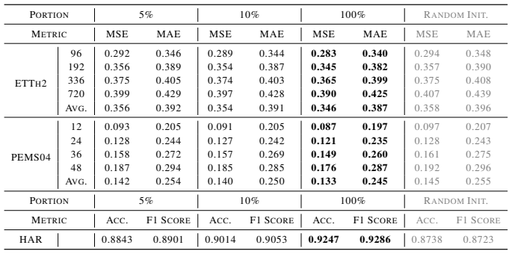
Table 20 : Full result of few-shot fine-tuning.
원문 · CC BY 4.0 · Wang, Daoyu, Cheng, Mingyue, Liu, Zhiding, Liu, Qi · TimeDART: A Diffusion Autoregressive Transformer for Self-Supervised Time Series Representation · 원문 그림 인용 · 원본 PDF 25쪽에서 그림 영역을 추출했습니다.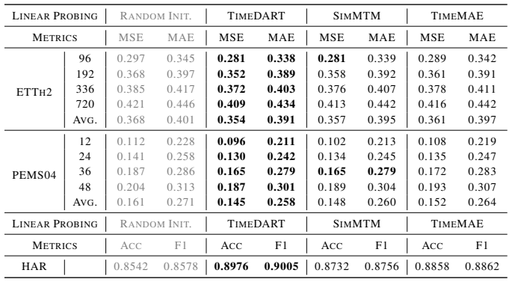
Table 21 : Full result of linear probing fine-tuning.
원문 · CC BY 4.0 · Wang, Daoyu, Cheng, Mingyue, Liu, Zhiding, Liu, Qi · TimeDART: A Diffusion Autoregressive Transformer for Self-Supervised Time Series Representation · 원문 그림 인용 · 원본 PDF 25쪽에서 그림 영역을 추출했습니다.논문 정보
- 저자
- Wang, Daoyu, Cheng, Mingyue, Liu, Zhiding, Liu, Qi
- 학회·저널
- arXiv · 프리프린트
- 최초 공개일
- 2024년 10월 8일
- 등록일
- 2026년 10월 29일
- 수정일
- 2025년 6월 11일
- 버전
- v5
- arXiv
- 2410.05711
- 원문 이용 조건
- CC BY 4.0
- 제공 범위
- 논문 정보, 해설, 허용된 원문 그림
AI 해설은 논문 원문과 별개의 설명이며 오류가 있을 수 있습니다. 원문과 그림은 각 출처의 이용 조건과 따로 표시된 권리를 따릅니다.
초록
Self-supervised learning has garnered increasing attention in time series analysis for benefiting various downstream tasks and reducing reliance on labeled data. Despite its effectiveness, existing methods often struggle to comprehensively capture both long-term dynamic evolution and subtle local patterns in a unified manner. In this work, we propose \textbf{TimeDART}, a novel self-supervised time series pre-training framework that unifies two powerful generative paradigms to learn more transferable representations. Specifically, we first employ a causal Transformer encoder, accompanied by a patch-based embedding strategy, to model the evolving trends from left to right. Building on this global modeling, we further introduce a denoising diffusion process to capture fine-grained local patterns through forward diffusion and reverse denoising. Finally, we optimize the model in an autoregressive manner. As a result, TimeDART effectively accounts for both global and local sequence features in a coherent way. We conduct extensive experiments on public datasets for time series forecasting and classification. The experimental results demonstrate that TimeDART consistently outperforms previous compared methods, validating the effectiveness of our approach. Our code is available at https://github.com/Melmaphother/TimeDART.
원문 인용
Wang, Daoyu, Cheng, Mingyue, Liu, Zhiding, Liu, Qi (2024). TimeDART: A Diffusion Autoregressive Transformer for Self-Supervised Time Series Representation. arXiv:2410.05711v5. https://arxiv.org/abs/2410.05711v5
BibTeX
@misc{daoyu2024timedart,
  title = {{TimeDART: A Diffusion Autoregressive Transformer for Self-Supervised Time Series Representation}},
  author = {Wang, Daoyu and Cheng, Mingyue and Liu, Zhiding and Liu, Qi},
  year = {2024},
  eprint = {2410.05711},
  archivePrefix = {arXiv},
  url = {https://arxiv.org/abs/2410.05711v5}
}