논문 해설
Categorical Flow Maps
범주형 흐름 맵
- 연구 문제 이산 데이터의 few-step 생성을 위해 단순체 위의 끝점 예측으로 flow map을 학습하는 문제입니다.
- 연구 방법 속도장 대신 끝점 예측 π_{s,t}로 flow map을 정의하고, VFM 교차엔트로피와 Lagrangian 자기 증류 손실을 함께 사용합니다.
- 주요 결과 분자 그래프에서 1 NFE validity 95.8%와 93.5%를 보고하며, 이미지와 텍스트 실험에서도 few-step 비교 결과를 제시합니다.
이산 데이터에서 few-step 생성이 어려운 이유
분자 그래프, 이진 이미지, 텍스트 토큰 같은 이산 데이터는 확산이나 흐름 기반 생성 모델에서 많은 샘플링 단계를 요구하는 경우가 많습니다. 연속 데이터에서는 flow map이 두 시각 사이의 상태 이동을 직접 학습하여 적은 단계로 샘플을 만들 수 있게 했습니다. 그러나 이산 데이터를 이산 마르코프 체인으로 다루면 궤적 자체가 이산적이고 확률적이어서, flow map의 자기 증류 목적함수를 그대로 적용하기 어렵습니다. 이 논문은 이산 데이터를 단순체(simplex) 위의 연속 보간으로 다루면 연속 영역에서 쓰던 자기 증류 기법을 적용할 수 있다는 점에 착안하여, 범주형 데이터를 위한 Categorical Flow Maps를 제안합니다.
끝점 예측 기반 flow map의 구성
Categorical Flow Maps는 flow map을 속도장으로 정의하지 않고 끝점 예측 π_{s,t}로 정의합니다. 식으로는 X_{s,t}(x_s)=x_s+(t−s)(π_{s,t}(x_s)−x_s)/(1−s)이며, π_{s,t}의 값은 데이터 지원 Ω=Δ_K, 즉 단순체 위에 놓입니다. 이 형태는 X_{t,t}가 항등 사상이 되는 경계 조건을 자동으로 만족하고, 극한 s→t에서 순간 속도 b_t가 (π_{t,t}(x_t)−x_t)/(1−t)로 복원된다는 접선 조건을 보존합니다. 학습은 두 부분으로 나뉩니다. 대각선 s=t에서는 변분 흐름 매칭(Variational Flow Matching, VFM)의 교차엔트로피 손실을 계산하고, s<t 구간에서는 Lagrangian 조건을 이용한 자기 증류 손실 L_CSD를 계산합니다.
자기 증류 항에서는 w_t≡1을 사용했으며, 저자들은 w_t=(1−t)^{-2}가 t가 1에 가까울 때 불안정했다고 보고합니다. 따라서 두 손실 모두 끝점 예측 위에서 정의되어, 손실 크기가 서로 가까운 교차엔트로피 항으로 결합됩니다.
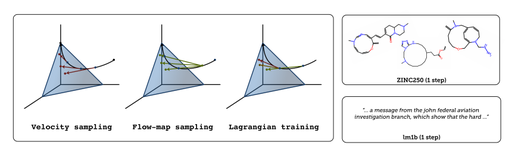
Figure 1 .Overview of our method: CFM instantaneous velocity sampling (left), CFM flow-map sampling (middle), and Lagrangian training (right), plus their corresponding paths on a probability simplex. The red arrows denote the instantaneous velocity induced by πt,t, the green arrows denote the flow map induced byπ s,t, and the yellow arrow denotes the time derivative of the flow map.
원문 · CC BY 4.0 · Daan Roos, Oscar Davis, Floor Eijkelboom, Michael Bronstein, Max Welling, İsmail İlkan Ceylan, Luca Ambrogioni, Jan-Willem van de Meent · Categorical Flow Maps · 원문 그림 인용 · 원본 PDF 2쪽에서 그림 영역을 추출했습니다.ECLD 손실과 Lagrangian residual 상한
ECLD는 Endpoint-Consistent Lagrangian Distillation의 약자로, 전이된 상태 X_{s,t}(x_s)에서 교사의 끝점 예측 π_{t,t}와 학생의 끝점 예측 π_{s,t}가 얼마나 어긋나는지를 재는 끝점 일관성 항과, 끝점 예측이 시간 t에 따라 변하는 정도를 재는 시간 drift 항을 결합합니다. 명제 3.1은 선형 VFM 디코더와 식 (10)으로 유도된 flow map을 가정할 때 L_CSD ≤ 4L_EC + 2L_TD가 성립한다고 주장합니다. 여기서 L_EC는 KL 형태의 끝점 일관성 항이고 L_TD는 γ_{s,t}^2 가중 시간 drift 항입니다. 이어지는 따름정리 3.2는 KL을 교차엔트로피로 바꿔도 기울기가 같아 경계가 유지된다고 제시하며, 실제 학습에서는 L_ECLD=4L_CE-EC+2L_TD를 사용합니다.
이 상한은 위 가정 아래의 조건부 결과이며, 모든 flow map이나 모든 디코더에 대한 보편적 보장이 아닙니다.
테스트 시점 보상 유도
학습된 flow map은 현재 상태 X_{t,1}에서 궤적 끝을 가깝게 예측하므로, 이를 보상 r(x)의 lookahead로 사용할 수 있습니다. 보상으로 기울인 분포를 얻기 위해 점수에 t∇r(X_{t,1}(x_t)) 항을 더하고, 이 근사가 정확한 분포를 주지 않으므로 중요도 가중치로 재표집하는 sequential Monte-Carlo(SMC)를 사용합니다. 이산 보상을 평가할 때에는 STE(straight-through estimator)를 쓰는데, 순전파에서는 연속 상태를 이산화해 보상에 넣고 기울기는 연속 상태로 전파합니다. 저자들은 자신들의 실험에서 STE가 더 강한 유도를 일관되게 보였다고 보고합니다.
이 절의 결과는 binarised MNIST에서 숫자 0을 생성하도록 보상 R(x)=log p(y=0|x)를 준 실험입니다. 표 2에서 flow map lookahead는 FID 36.9와 정확도 84.7을 보였고, denoiser lookahead는 38.7과 82.5, lookahead가 없는 경우는 40.7과 83.1이었습니다. 세 방법의 차이는 하나의 과제, 하나의 보상, 10회 평균 설정에서 얻은 것입니다.
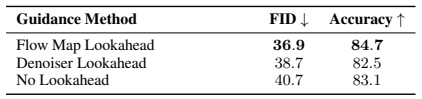
Table 2 .Test-time guidance results on binarised MNIST for gen- erating digit “0”. We compare three guidance strategies: using the flow map Xt,1 for lookahead, using the instantaneous denoiser πt,t, and standard guidance without lookahead.
원문 · CC BY 4.0 · Daan Roos, Oscar Davis, Floor Eijkelboom, Michael Bronstein, Max Welling, İsmail İlkan Ceylan, Luca Ambrogioni, Jan-Willem van de Meent · Categorical Flow Maps · 원문 그림 인용 · 원본 PDF 6쪽에서 그림 영역을 추출했습니다.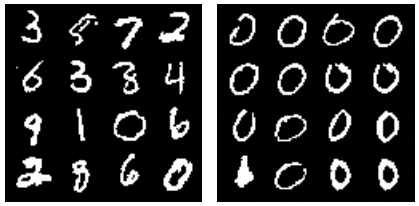
Figure 3 .Samples from our categorical flow map on binary MNIST: (left) unconditional (right) and tilted by the classifier reward towards zeroes.
원문 · CC BY 4.0 · Daan Roos, Oscar Davis, Floor Eijkelboom, Michael Bronstein, Max Welling, İsmail İlkan Ceylan, Luca Ambrogioni, Jan-Willem van de Meent · Categorical Flow Maps · 원문 그림 인용 · 원본 PDF 7쪽에서 그림 영역을 추출했습니다.분자 그래프 생성 결과
분자 실험은 QM9와 ZINC250k에서 NFE별 validity, uniqueness, FCD를 비교합니다. 같은 구조에서 비제약 속도를 쓰는 Naive Flow Map을 함께 학습하여 끝점 매개변수화의 효과를 분리했습니다. 1 NFE에서 ECLD는 QM9 validity 95.8%, ZINC validity 93.5%를 보였고, 같은 조건의 Naive Flow Map은 ZINC에서 59.5%였습니다. 다단계 기준선과 비교하면 ECLD의 2 NFE FCD 12.1–12.2는 CatFlow의 100 NFE 값 13.2와 GDSS의 1,000 NFE 값 14.7과 비슷하거나 낮습니다. 다만 QM9에서 1 NFE uniqueness는 ECLD가 89.2로 Naive Flow Map의 93.0보다 낮았습니다.
원문 표 1에서 PairFlow의 비율은 N=1,024 표본에서 계산된 값이며, 대시는 원 출처가 해당 지표를 보고하지 않았다는 뜻입니다.
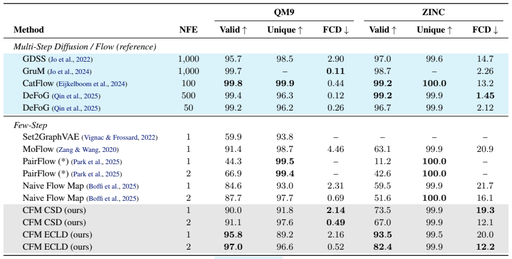
Table 1 .Molecular generation results on QM9 and ZINC. Top shaded rows indicate multi-step reference methods; our goal is to match their quality with far fewer sampling steps. A dash indicates that the metric was not reported by the corresponding source. In each sub-category (and for each NFE for few-step models), we make bold the best result. (*) PairFlow percentages derived from N= 1,024 samples. MoFlow results from Jo et al. (2024).
원문 · CC BY 4.0 · Daan Roos, Oscar Davis, Floor Eijkelboom, Michael Bronstein, Max Welling, İsmail İlkan Ceylan, Luca Ambrogioni, Jan-Willem van de Meent · Categorical Flow Maps · 원문 그림 인용 · 원본 PDF 6쪽에서 그림 영역을 추출했습니다.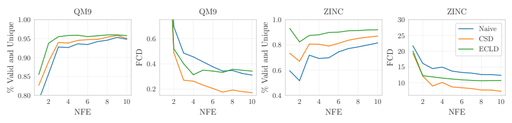
Figure 2 .Sample quality versus NFEs on QM9 (two leftmost panels) and ZINC (two rightmost panels), showing the fractions of valid and unique molecules (↑), and FCD (↓). We compare our methods (CSD, ECLD) against the unconstrained Flow Map baseline (Naive).
원문 · CC BY 4.0 · Daan Roos, Oscar Davis, Floor Eijkelboom, Michael Bronstein, Max Welling, İsmail İlkan Ceylan, Luca Ambrogioni, Jan-Willem van de Meent · Categorical Flow Maps · 원문 그림 인용 · 원본 PDF 7쪽에서 그림 영역을 추출했습니다.이미지와 텍스트 생성 결과
binarised MNIST에서 저자들은 Park et al. (2025)과 같은 실험 설정을 따랐으며, 1 step FID 10.1을 기존 보고값 12.9와 비교합니다. 2 step과 4 step에서는 8.7과 9.3, 7.8과 8.5를 비교합니다. 텍스트 실험에서 Text8은 DFM, LM1B는 UDLM과 비교되며, Duo는 OWT 체크포인트와 OWT 기준 Gen-PPL만 제공되어 같은 조건의 비교 대상으로 쓰지 않았습니다. Text8 NLL은 GPT-J-6B로 측정되었고, 저자들은 ECLD의 NLL이 모든 NFE에서 DFM보다 낮다고 보고합니다. LM1B에서는 공개된 평가 파이프라인으로 UDLM을 같은 조건에서 다시 평가했고, 저NFE 영역에서 CFM의 PPL이 최대 3.5배 낮다고 보고합니다.
이 텍스트 실험은 원 DiT 계열 구조에 JVP 커널, 컴파일 호환 재작성, 임베딩 층 변경을 적용한 모델에서 얻은 결과입니다.
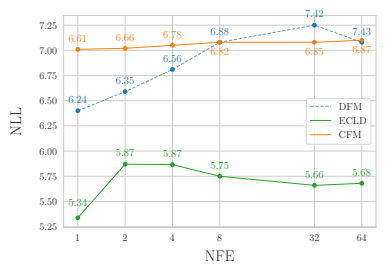
Figure 4 .Text8: NFE against NLL as measured by GPT-J-6B. The numbers above the points are the corresponding entropies on the token space of the GPT model.
원문 · CC BY 4.0 · Daan Roos, Oscar Davis, Floor Eijkelboom, Michael Bronstein, Max Welling, İsmail İlkan Ceylan, Luca Ambrogioni, Jan-Willem van de Meent · Categorical Flow Maps · 원문 그림 인용 · 원본 PDF 8쪽에서 그림 영역을 추출했습니다.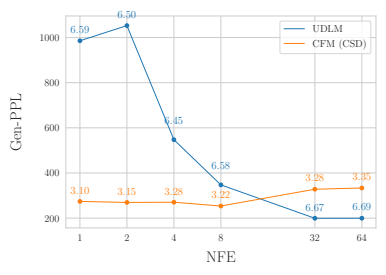
Figure 5 .LM1B: NFE against Gen-PPL as measured by GPT-2. The numbers above are the corresponding entropies on the token space of the GPT model.
원문 · CC BY 4.0 · Daan Roos, Oscar Davis, Floor Eijkelboom, Michael Bronstein, Max Welling, İsmail İlkan Ceylan, Luca Ambrogioni, Jan-Willem van de Meent · Categorical Flow Maps · 원문 그림 인용 · 원본 PDF 8쪽에서 그림 영역을 추출했습니다.적용 범위와 한계
ECLD는 저NFE 영역에서 강점을 보이지만, 저자들은 큰 스텝 크기에서 flow map과 Euler 적분 사이에 차이가 있어 Euler 샘플링이 비슷하거나 더 좋은 FCD를 보였다고 밝힙니다. LM1B에서 CFM 샘플의 엔트로피는 현저히 낮았으며, 저자들은 모드 붕괴를 관찰하지 않았고 하이퍼파라미터와 구조 조정, 더 긴 학습이 이를 완화할 수 있다고 해석합니다. 명제 3.1의 상한은 선형 VFM 디코더와 식 (10)의 flow map을 가정한 조건부 결과이므로, 실험에서 관찰된 개선이 이 상한만으로 증명된 것은 아닙니다. 분자, 이미지, 텍스트의 결과는 서로 다른 백본, 학습 예산, 평가 설정에서 얻어졌으므로 하나의 공통 설정으로 일반화할 수 없습니다.
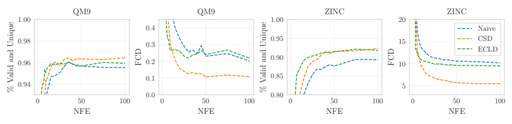
Figure 7 .Sample quality versus NFEs on QM9 (two leftmost panels) and ZINC (two rightmost panels), showing the fractions of valid and unique molecules (↑), and FCD (↓). Dashed lines indicate results of samples obtained using Euler sampling of the learned instantaneous velocity field.
원문 · CC BY 4.0 · Daan Roos, Oscar Davis, Floor Eijkelboom, Michael Bronstein, Max Welling, İsmail İlkan Ceylan, Luca Ambrogioni, Jan-Willem van de Meent · Categorical Flow Maps · 원문 그림 인용 · 원본 PDF 19쪽에서 그림 영역을 추출했습니다.논문 정보
- 저자
- Daan Roos, Oscar Davis, Floor Eijkelboom, Michael Bronstein, Max Welling, İsmail İlkan Ceylan, Luca Ambrogioni, Jan-Willem van de Meent
- 학회·저널
- arXiv · 프리프린트
- 최초 공개일
- 2026년 2월 12일
- 등록일
- 2026년 10월 29일
- 수정일
- 2026년 2월 12일
- 버전
- v1
- arXiv
- 2602.12233
- 분류
- cs.LG
- 원문 이용 조건
- CC BY 4.0
- 제공 범위
- 논문 정보, 해설, 허용된 원문 그림
AI 해설은 논문 원문과 별개의 설명이며 오류가 있을 수 있습니다. 원문과 그림은 각 출처의 이용 조건과 따로 표시된 권리를 따릅니다.
초록
We introduce Categorical Flow Maps, a flow-matching method for accelerated few-step generation of categorical data via self-distillation. Building on recent variational formulations of flow matching and the broader trend towards accelerated inference in diffusion and flow-based models, we define a flow map towards the simplex that transports probability mass toward a predicted endpoint, yielding a parametrisation that naturally constrains model predictions. Since our trajectories are continuous rather than discrete, Categorical Flow Maps can be trained with existing distillation techniques, as well as a new objective based on endpoint consistency. This continuous formulation also automatically unlocks test-time inference: we can directly reuse existing guidance and reweighting techniques in the categorical setting to steer sampling toward downstream objectives. Empirically, we achieve state-of-the-art few-step results on images, molecular graphs, and text, with strong performance even in single-step generation.
원문 인용
Daan Roos, Oscar Davis, Floor Eijkelboom, Michael Bronstein, Max Welling, İsmail İlkan Ceylan, Luca Ambrogioni, Jan-Willem van de Meent (2026). Categorical Flow Maps. arXiv:2602.12233v1. https://arxiv.org/abs/2602.12233v1
BibTeX
@misc{roos2026categorical,
  title = {{Categorical Flow Maps}},
  author = {Daan Roos and Oscar Davis and Floor Eijkelboom and Michael Bronstein and Max Welling and İsmail İlkan Ceylan and Luca Ambrogioni and Jan-Willem van de Meent},
  year = {2026},
  eprint = {2602.12233},
  archivePrefix = {arXiv},
  url = {https://arxiv.org/abs/2602.12233v1}
}