논문 해설
Heteroscedastic Gaussian Process Q-learning for Sample Efficient Experimentation
샘플 효율적인 실험을 위한 이분산 Gaussian Process Q-learning
- 연구 문제 자율 실험실처럼 실험 수가 적은 상황에서 GP 기반 Q-learning은 학습률을 문제마다 튜닝해야 하는 부담이 있습니다.
- 연구 방법 Q-함수를 GP로 직접 학습하고, 칼만 이득을 학습률로 쓰며 타깃별 잡음 분산을 이질적 GP로 추정합니다.
학습률 튜닝의 어려움
자율 실험실은 비싼 실험을 수십에서 수백 번만 수행할 수 있어, 심층 강화학습이 쓰기에는 샘플이 너무 적습니다. 이 논문은 Q-함수를 GP로 직접 학습하면서 학습률을 별도로 튜닝하지 않는 방법을 다룹니다. 기존 Q-learning은 각 Bellman 타깃을 향해 학습률만큼 값을 옮기는데, 이 학습률은 문제마다 튜닝해야 합니다. 칼만 TD 계열은 학습률을 칼만 이득으로 두지만, 타깃의 잡음 분산을 학습률 대신 튜닝해야 한다는 문제가 남습니다.
칼만 이득과 타깃별 분산 추정
HGPQ는 각 Bellman 타깃을 Q-함수에 대한 잡음 측정으로 보고, 칼만 이득을 학습률로 사용합니다. 타깃 yt,i는 보상과 다음 상태에서 GP 평균의 최댓값으로 만들어지며, 이를 칼만 갱신으로 적용하면 모든 전이를 한꺼번에 처리하는 GP 회귀와 같아진다고 논문은 보입니다. 타깃별 분산 λt,i는 σr² 바닥값과 이질적 GP가 추정한 잡음 ωt(zi)의 합으로 정해집니다. ωt는 타깃의 leave-one-out 잔차를 두 번째 GP로 회귀해 얻습니다. 이 분산은 독립적인 오차만 잡고, 다음 단계 추정의 공유된 오차는 편향으로 남겨 둡니다.
균일 수렴 상한과 적용 조건
정리 1은 고정 커널과 타깃 생성 시 할당된 분산 조건에서, 사후평균 µnt가 Q*t에 공간 전체에 걸쳐 균일하게 수렴하는 상한을 제시합니다. 이 결과는 Algorithm 1에서 분산이 재추정되거나 커널이 재학습되는 경우를 다루지 않습니다. 또한 보상이 [0,1]에 있고 입력 최대화가 정확하며 N0=0이라는 단순화 조건 아래에서 성립합니다. 상한은 정규화 계수 (1−ζ)θ 아래에서 연결된 β 항들의 합으로 표현됩니다.
벤치마크 샘플 효율 비교
다섯 벤치마크를 합쳐 정규화된 후회를 15개 임계값에서 측정했습니다. 각 임계값에서 실행이 처음으로 기준 아래로 떨어진 에피소드를 셌습니다. HGPQ는 300 에피소드, KOVI와 GPTD는 750 에피소드, KTD와 심층 RL은 2000 에피소드의 예산을 사용했습니다. 저자들은 이 예산 차이가 커널과 심층 RL 베이스라인에 유리하게 설계되었다고 밝힙니다.
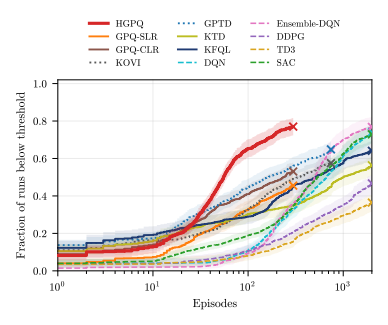
Figure 3 : Fraction of runs whose normalised regret is below each of 15 thresholds from 0.5 to 0.01,
원문 · CC BY 4.0 · Maximilian Bloor, Max Mowbray, Calvin Tsay, Ehecatl Antonio del Rio Chanona · Heteroscedastic Gaussian Process Q-learning for Sample Efficient Experimentation · 원문 그림 인용 · 원본 PDF 8쪽에서 그림 영역을 추출했습니다.정확한 GP 재적합의 비용
정확한 GP 재적합은 시간 단계마다 O(n³) 비용이 들기 때문에 HGPQ의 실험 예산은 300 에피소드로 제한되었습니다. 이 한계를 보완하기 위해 저자들은 희소 변분 GP를 쓴 Sparse HGPQ를 제안하고, 재적합 비용을 에피소드 수에 대해 선형으로 낮췄습니다. 정리 1의 적용 범위 자체도 재추정 분산과 재학습 커널을 포함하지 않는다는 한계가 있습니다.
논문 정보
- 저자
- Maximilian Bloor, Max Mowbray, Calvin Tsay, Ehecatl Antonio del Rio Chanona
- 학회·저널
- arXiv · 프리프린트
- 최초 공개일
- 2026년 11월 16일
- 등록일
- 2026년 11월 18일
- 수정일
- 2026년 11월 16일
- 버전
- v1
- arXiv
- 2611.21249
- 분류
- cs.LG · eess.SY
- 원문 이용 조건
- CC BY 4.0
- 제공 범위
- 논문 정보, 해설, 허용된 원문 그림
AI 해설은 논문 원문과 별개의 설명이며 오류가 있을 수 있습니다. 원문과 그림은 각 출처의 이용 조건과 따로 표시된 권리를 따릅니다.
초록
Self-driving laboratories must learn to control a process from tens to hundreds of expensive experiments, too few for deep reinforcement learning (RL). We learn the Q-function directly with a Gaussian process (GP), which avoids learning the dynamics, and show that the GP posterior supplies the learning rate of Q-learning. If each Bellman target is treated as a noisy measurement of the Q-function, the learning rate that minimises the mean squared error is the Kalman gain, and applying it to every observed transition is equivalent to GP regression. Heteroscedastic Gaussian Process Q-learning (HGPQ) sets the noise variance of each target with a heteroscedastic GP, which learns how unreliable the targets are across the states and inputs. Targets from noisy operating conditions, or from regions where the value function has large gradients, then move the estimate less than targets from low-noise regions, so HGPQ learns quickly where the data are reliable without being misled where they are not. For kernel value iteration with per-target variances that are assigned when a target is collected, we prove a high-probability bound on the error of the value estimate, uniform over the explored region. Pooled over five simulated benchmarks, which include a chemical reactor and a bioprocess, HGPQ approaches the best return found by any method in fewer episodes than GP, kernel and deep RL baselines.
원문 인용
Maximilian Bloor, Max Mowbray, Calvin Tsay, Ehecatl Antonio del Rio Chanona (2026). Heteroscedastic Gaussian Process Q-learning for Sample Efficient Experimentation. arXiv:2611.21249v1. https://arxiv.org/abs/2611.21249v1
BibTeX
@misc{bloor2026heteroscedastic,
  title = {{Heteroscedastic Gaussian Process Q-learning for Sample Efficient Experimentation}},
  author = {Maximilian Bloor and Max Mowbray and Calvin Tsay and Ehecatl Antonio del Rio Chanona},
  year = {2026},
  eprint = {2611.21249},
  archivePrefix = {arXiv},
  url = {https://arxiv.org/abs/2611.21249v1}
}