논문 해설
UniGraph: A Unified Graph-based Index for Dynamic Hybrid Dense-Sparse Vector Retrieval
UniGraph: 동적 하이브리드 밀집-희소 벡터 검색을 위한 통합 그래프 기반 인덱스
- 연구 문제 두 경로 검색은 후보를 나눠 찾아 합치므로 결합 뒤 상위 항목을 놓칠 수 있고, 고정 가중치 그래프는 질의별 α에 맞지 않습니다.
- 연구 방법 여러 α에서 얻은 하이브리드 이웃을 빈도 기준으로 병합해 하나의 출차 제한 그래프를 만들고, α에 따라 sparse 또는 dense 가이드로 시작점을 고릅니다.
- 주요 결과 Recall@100≥0.95 조건의 혼합 α 설정에서 가장 빠른 베이스라인보다 27.6%∼52.3% 높은 QPS를 기록했습니다.
두 경로 검색의 한계
하이브리드 dense-sparse 검색은 질의마다 dense 신호와 sparse 신호의 비중 α를 다르게 둡니다. 흔한 방식은 dense 인덱스와 sparse 인덱스를 따로 검색한 뒤 두 후보 집합을 합쳐 하이브리드 거리로 다시 정렬하는 것입니다. 이 방식은 후보 수를 늘리면 비용이 커지고, 줄이면 두 신호를 결합한 뒤에야 상위에 오르는 항목을 놓칩니다. 반대로 특정 α로 만든 하이브리드 그래프는 α가 바뀌면 이웃 관계가 달라져 질의별 가중치를 제대로 지원하지 못합니다.
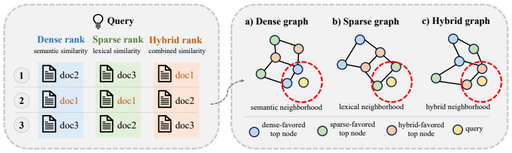
Fig. 1 . Motivating example for unified dense-sparse hybrid retrieval. The left panel shows that dense, sparse, and hybrid retrieval can produce different top-ranked results for the same query. In this example, doc1 is not ranked first by either dense or sparse retrieval, but becomes the top result under hybrid ranking. The right panel shows three graph neighborhoods built from dense, sparse, and hybrid similarities. Although the three neighborhoods have different highest-ranked nodes, their top-neighbor sets still overlap substantially.
원문 · CC BY 4.0 · Keyu Chen, Xiaoyao Zhong, Jiabao Jin, Peng Cheng, Wangze Ni, Jingkuan Song, Heng Tao Shen · UniGraph: A Unified Graph-based Index for Dynamic Hybrid Dense-Sparse Vector Retrieval · 원문 그림 인용 · 원본 PDF 2쪽에서 그림 영역을 추출했습니다.이 논문은 이 문제를 질의별 α를 인덱스 재구성 없이 지원하면서 Recall-QPS 절충을 높이는 문제로 설정합니다. 하이브리드 거리 D_h(q,x;α)=α·D_d+(1−α)·D_s에서 α는 질의 시점에 정해집니다.
α-cover 그래프 구성
UniGraph의 핵심은 여러 α 값에서 얻은 이웃을 하나의 그래프로 합치는 것입니다. α를 0부터 1까지 δ=0.1 간격으로 이산화하고, 각 α마다 중심 항목 x_i의 하이브리드 거리 기준 top-k_g 이웃 N_i^α를 구합니다. 이 집합들의 합집합을 U_i로 두고, 각 후보가 여러 α에서 선택된 횟수 f_i를 셉니다.
최종 이웃 집합은 |U_i|와 M 중 작은 값만큼 빈도가 높은 후보를 고릅니다. 그래서 출차수는 최대 M으로 제한되며, 여러 가중치에서 반복해서 중요한 이웃이 남습니다. 저자들은 이산 샘플링이 효과적인 이유로, 두 후보의 상대 순서가 바뀌는 교차점이 제한적이라는 점을 듭니다.
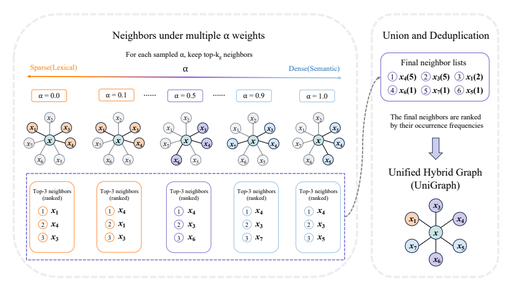
Fig. 3 . Overview of UniGraph construction for one center base vector pairx. Across sampledαvalues ranging from the sparse (lexical) endpoint to the dense (semantic) endpoint, the construction retains the top-k g hybrid neighbors ofxat each weight; the illustration usesk g = 3. The per-αlists are merged and deduplicated, and the number in parentheses indicates each candidate’s occurrence frequency. Ranking the candidates by this frequency produces a single UniGraph neighborhood that favors neighbors selected across multiple dense-sparse trade-offs.
원문 · CC BY 4.0 · Keyu Chen, Xiaoyao Zhong, Jiabao Jin, Peng Cheng, Wangze Ni, Jingkuan Song, Heng Tao Shen · UniGraph: A Unified Graph-based Index for Dynamic Hybrid Dense-Sparse Vector Retrieval · 원문 그림 인용 · 원본 PDF 5쪽에서 그림 영역을 추출했습니다.α-적응 탐색과 dense-first 가지치기
질의 시점에는 α≤0.5이면 sparse 가이드 인덱스, α>0.5이면 dense 가이드 인덱스에서 entry point를 얻습니다. 이후 UniGraph 위에서 하이브리드 거리로 beam search를 수행합니다. 가이드 인덱스는 단일 성분 거리 기준의 coarse 검색 역할을 합니다.
가지치기에서는 dense 거리를 먼저 계산하고, sparse 벡터 노름으로 얻은 하한 L_h를 이용해 정확한 sparse 거리 계산을 건너뛸지 판단합니다. γ=1이면 추정값이 하한이 되어 Lemma III.1에 따라 안전하게 제외할 수 있습니다. 저자들은 실험에서 γ=0.3을 사용했으며, 이때는 하한 보장이 없어 탐색 경로와 재현율에 영향을 줄 수 있다고 설명합니다.
혼합 α 설정의 QPS 결과
α를 [0.3,0.7] 구간에서 균등하게 두고 Recall@100≥0.95 조건에서 비교했을 때, UniGraph는 다섯 데이터셋 모두에서 가장 빠른 베이스라인보다 27.6%∼52.3% 높은 QPS를 기록했습니다. DBpedia-Entity에서는 Recall@100≈0.95에서 LADR보다 약 2.3배였습니다.
이 결과는 질의 가중치가 바뀌는 혼합 설정에서 얻은 것입니다. 고정 α 결과는 별도 설정으로 보고됩니다.
가지치기 ablation
혼합 α 설정에서 ef_s=300으로 가지치기 적용과 미적용을 비교했습니다. 가지치기를 적용했을 때 QPS는 모든 데이터셋에서 올랐고, 평균 향상은 10.3%였습니다. Recall@100 감소는 최대 0.055 percentage points로 보고되었습니다. 이 비교는 가지치기 효과를 분리하기 위해 같은 UniGraph와 같은 α 라우팅 정책을 사용했습니다.
한계
논문은 실험을 BEIR의 다섯 공개 데이터셋과 BGE-M3 임베딩으로 수행했습니다. 가지치기에서 γ<1은 안전한 하한을 보장하지 않으며, 저자들은 γ=0.3을 주 실험에 사용했습니다. 그래프 구축은 여러 α 샘플링과 빈도 병합 때문에 Opt Hybrid보다는 시간이 길었지만 Naive Hybrid보다는 짧았습니다.
논문 정보
- 저자
- Keyu Chen, Xiaoyao Zhong, Jiabao Jin, Peng Cheng, Wangze Ni, Jingkuan Song, Heng Tao Shen
- 학회·저널
- arXiv · 프리프린트
- 최초 공개일
- 2026년 11월 16일
- 등록일
- 2026년 11월 17일
- 수정일
- 2026년 11월 16일
- 버전
- v1
- arXiv
- 2611.20758
- 분류
- cs.IR · cs.DB
- 원문 이용 조건
- CC BY 4.0
- 제공 범위
- 논문 정보, 해설, 허용된 원문 그림
AI 해설은 논문 원문과 별개의 설명이며 오류가 있을 수 있습니다. 원문과 그림은 각 출처의 이용 조건과 따로 표시된 권리를 따릅니다.
초록
Hybrid dense-sparse vector retrieval combines semantic signals from dense representations with lexical signals from sparse representations, typically ranking items by a query-dependent weighted sum of dense and sparse vector distances. Existing systems commonly search separate dense and sparse vector indexes and rerank the union of their candidates, incurring two retrieval passes and potentially discarding items that rank highly only after the semantic and lexical signals are combined. Constructing a graph-based index directly under a hybrid distance can mitigate this premature candidate loss. However, because varying the hybrid weight alters the underlying neighborhood relationships, a single static graph built at a fixed weight cannot accommodate dynamic query-specific weights. Therefore, we propose a Unified Hybrid Graph (UniGraph), which merges neighbor sets computed at multiple hybrid weights into a single bounded-degree graph index, enabling hybrid vector retrieval with different query-specific weights without index reconstruction. We further develop an adaptive weight-guided search framework that chooses between sparse- and dense-guided entry points according to the query weight, together with a dense-first hybrid distance pruning strategy that avoids unnecessary exact sparse distance computations. Extensive experiments show that UniGraph provides a favorable Recall-QPS trade-off across different query weights. In the mixed-weight setting, UniGraph delivers 27.6%~52.3% higher QPS than the fastest baseline on each dataset at Recall@100 greater than or equal to 0.95. UniGraph has been deployed at scale in Ant Group's production environment, where hybrid retrieval with query-dependent weights is in strong demand.
원문 인용
Keyu Chen, Xiaoyao Zhong, Jiabao Jin, Peng Cheng, Wangze Ni, Jingkuan Song, Heng Tao Shen (2026). UniGraph: A Unified Graph-based Index for Dynamic Hybrid Dense-Sparse Vector Retrieval. arXiv:2611.20758v1. https://arxiv.org/abs/2611.20758v1
BibTeX
@misc{chen2026unigraph,
  title = {{UniGraph: A Unified Graph-based Index for Dynamic Hybrid Dense-Sparse Vector Retrieval}},
  author = {Keyu Chen and Xiaoyao Zhong and Jiabao Jin and Peng Cheng and Wangze Ni and Jingkuan Song and Heng Tao Shen},
  year = {2026},
  eprint = {2611.20758},
  archivePrefix = {arXiv},
  url = {https://arxiv.org/abs/2611.20758v1}
}