논문 해설
A Memetic Algorithm with Reinforcement Learning for Sociotechnical Production Scheduling
사회기술적 생산 일정 계획을 위한 강화학습 기반 메메틱 알고리즘
- 연구 문제 사람과 기계가 함께 유연하게 배정되는 생산 일정계획에서 기존 모델은 작업자 역량, 순서 의존 준비 시간, DAG 작업 경로를 충분히 담지 못합니다.
- 연구 방법 GA 기반 메메틱 알고리즘에 PPO로 학습한 DRL 에이전트를 DES 평가 안에 넣어 대기열 정렬과 할당 결정을 개선하고, 세대별 최적 개체를 SA로 정제합니다.
- 주요 결과 GBRT01-08 평균 비교에서 GASA+RL은 대부분의 지표에서 기준선보다 낫게 보고되며, 실제 데이터에서는 TT가 개선되고 MS는 그렇지 않다고 보고됩니다.
사회기술 생산 일정계획의 어려움
이 논문이 다루는 문제는 사람과 기계가 함께 유연하게 배정되는 생산 현장의 일정계획입니다. 기존의 JSSP나 FJSSP 모델은 순차적인 작업과 기계 중심의 자원 배정을 가정하므로, 작업자 역량에 따라 준비와 처리 작업을 나눠 맡기는 현장이나 BOM 제조처럼 병렬 작업 경로가 있는 상황을 충분히 담지 못합니다. 저자들은 이러한 요구를 DRC-FJSSP라는 이중 자원 제약 유연 작업장 문제로 정리합니다.
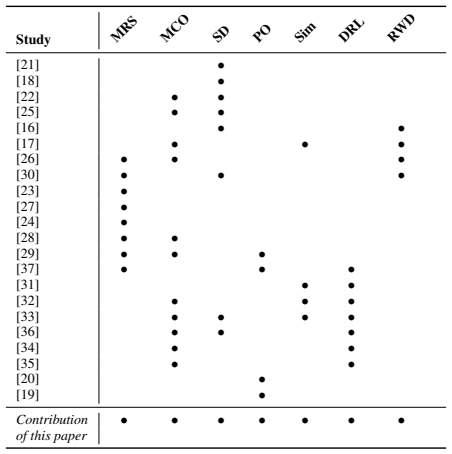
TABLE 1 : Related work matrix of the reviewed literature. For a better overview, the studies are clustered according to their content. Includes the contribution of the current paper. (MRS: Multi resource scheduling, MCO: Multi criteria optimization, SD: Sequence-dependencies, PO: Parallel operations (=com- plex BOM job paths), Sim: Simulation/Simheuristic, RWD: Real-world data)
원문 · CC BY 4.0 · Felix Grumbach, Nour Eldin Alaa Badr, Pascal Reusch, Sebastian Trojahn · A Memetic Algorithm with Reinforcement Learning for Sociotechnical Production Scheduling · 원문 그림 인용 · 원본 PDF 4쪽에서 그림 영역을 추출했습니다.이 문제를 풀기 위해 저자들은 정확한 MILP 해법을 먼저 시험했지만, 문제 규모가 커지면 계산 시간이 급격히 늘어나 실용적이지 않다고 보고합니다. 따라서 휴리스틱이 필요하며, 특히 메타휴리스틱과 DRL을 결합하는 접근이 검토됩니다. 다만 기존 DRL 연구는 대체로 단순한 환경에 머물렀다고 저자들은 지적합니다.

TABLE 8 : MILP Solver environment
원문 · CC BY 4.0 · Felix Grumbach, Nour Eldin Alaa Badr, Pascal Reusch, Sebastian Trojahn · A Memetic Algorithm with Reinforcement Learning for Sociotechnical Production Scheduling · 원문 그림 인용 · 원본 PDF 14쪽에서 그림 영역을 추출했습니다.DRL을 주입한 메메틱 알고리즘
제안 방법은 GA를 기반으로 전체 최적화 과정을 제어하고, 각 세대의 최적 개체를 SA로 추가 개선하는 메메틱 알고리즘입니다. 각 유전체는 자원 할당 하위 유전체와 분배 규칙 하위 유전체로 나뉘며, 작업 DAG의 위상 그룹을 이용해 후속 작업 관계를 표현합니다. 교차에는 Job Order Crossover가 적용되고, 변이는 자원 교체와 분배 규칙 교체 중 하나를 선택해 수행됩니다.
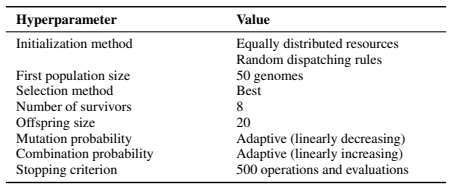
TABLE 7 : GA hyperparameters
원문 · CC BY 4.0 · Felix Grumbach, Nour Eldin Alaa Badr, Pascal Reusch, Sebastian Trojahn · A Memetic Algorithm with Reinforcement Learning for Sociotechnical Production Scheduling · 원문 그림 인용 · 원본 PDF 14쪽에서 그림 영역을 추출했습니다.평가는 SimPy 기반의 이산 사건 시뮬레이션으로 이루어집니다. 이 과정에서 DRL 에이전트는 각 작업장 대기열의 정렬 규칙과 작업의 기계 또는 작업자 변경 같은 할당 결정을 고르며, 행동 공간은 SPT, LPT, MTWR, STR 중 하나와 기계 전환, 작업자 전환, 변경 없음 중 하나로 구성됩니다. 에이전트는 PPO로 학습되며, 보상은 중간 보상과 최종 다목적 목적값에 기반한 최종 보상을 함께 사용합니다.

TABLE 9 : DRL hyperparameters for the training process and for the actor-crititic PPO network
원문 · CC BY 4.0 · Felix Grumbach, Nour Eldin Alaa Badr, Pascal Reusch, Sebastian Trojahn · A Memetic Algorithm with Reinforcement Learning for Sociotechnical Production Scheduling · 원문 그림 인용 · 원본 PDF 14쪽에서 그림 영역을 추출했습니다.기준선 비교와 실제 데이터 결과
검증은 두 개의 합성 데이터셋 GBRT01-02와 산업 파트너의 실제 데이터 GBRT03-08에서 수행됩니다. MS와 TT는 가중치 0.5로 동일하게 설정되었고, 각 방법은 논리적으로 같은 500개의 연산과 평가를 사용했습니다. GBRT03에서 학습한 에이전트는 GBRT04-08에 재사용되었으며, 이는 입력만 바뀌고 기본 시나리오는 같다는 가정에 따른 것입니다.
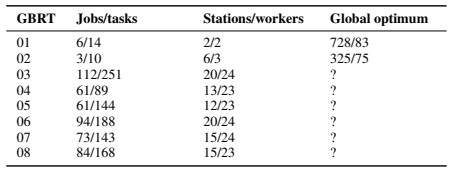
TABLE 3 : Benchmark datasets used (GBRT01-02: Synthetic data, GBRT03-08: Real-world data from our industry part- ner). GBRT03-08 global optimum could not be computed in a reasonable time. The global optimum is represented as MS/TT (both objectives considered synchronously with equal weights).
원문 · CC BY 4.0 · Felix Grumbach, Nour Eldin Alaa Badr, Pascal Reusch, Sebastian Trojahn · A Memetic Algorithm with Reinforcement Learning for Sociotechnical Production Scheduling · 원문 그림 인용 · 원본 PDF 10쪽에서 그림 영역을 추출했습니다.평균 결과에서 GASA+RL은 대부분의 지표에서 STR, MTWR, TS, SARS, GA, GASA보다 낫게 보고됩니다. 예를 들어 GBRT02에서 GASA+RL의 MS/TT 평균은 333.0 / 83.7입니다. 실제 데이터 GBRT03-08에서는 TT 개선이 두드러지지만 MS에서는 그렇지 않다고 보고됩니다. GBRT01에서는 최선 해도 전역 최적과 30% 이상의 차이가 남아 있다고 저자들은 밝힙니다.

TABLE 4 : Achieved MS and TT mean values for datasets GBRT01-08 by the different heuristics STR, MTWR, TS, SARS, GA, GASA and GASA+RL. The proposed approach GASA+RL outperforms traditional methods in most metrics. All metaheuristics have the same logical runtime (500 operations and evaluations to create neighbor solutions). The physical runtime may vary depending on the dataset and due to various hardware effects (approx. 30-150 seconds).
원문 · CC BY 4.0 · Felix Grumbach, Nour Eldin Alaa Badr, Pascal Reusch, Sebastian Trojahn · A Memetic Algorithm with Reinforcement Learning for Sociotechnical Production Scheduling · 원문 그림 인용 · 원본 PDF 11쪽에서 그림 영역을 추출했습니다.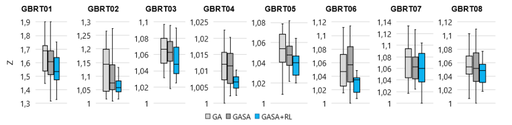
FIGURE 6 : Result comparison between GA, GASA and GASA+RL for GBRT01-08 considering the achieved multicriterial objective value Z (see Eq. 22). On average, GASA+RL generates the best schedules and clearly outperforms GA and GASA.
원문 · CC BY 4.0 · Felix Grumbach, Nour Eldin Alaa Badr, Pascal Reusch, Sebastian Trojahn · A Memetic Algorithm with Reinforcement Learning for Sociotechnical Production Scheduling · 원문 그림 인용 · 원본 PDF 11쪽에서 그림 영역을 추출했습니다.병렬화와 반복당 계산 시간
병렬화 실험은 배치 단위로 개체군을 나눠 여러 프로세스에서 시뮬레이션 평가를 수행할 때 반복당 계산 시간이 어떻게 변하는지 측정합니다. 저자들은 병렬 프로세스 수와 평균 반복 시간 사이에 유의한 상관이 있었다고 보고하며, 프로세스 4개를 사용하면 GA, GASA, GASA+RL 모두 병렬화하지 않은 경우의 약 절반 수준으로 시간이 줄었다고 설명합니다.
이 결과는 계산 시간 개선에 관한 것이며, 원문은 병렬화가 해의 품질을 바꾸지 않았다고 설명합니다. 다만 이 측정은 특정 하드웨어와 입력 규모에서 얻은 결과이므로, 클라우드 환경의 일반적 성능을 보장하는 근거로 읽어서는 안 됩니다.
적용 범위와 남은 질문
논문은 결정론적 일정계획을 전제로 하며, 불확실한 파라미터나 확률적 사건을 직접 다루지 않습니다. MS와 TT는 동일 가중치로 고정되었고, 가중치 변화에 따른 분석은 없습니다. 또한 작업자의 피로, 동기, 선호 같은 인간 요인은 모델에 포함되지 않았습니다.
DRL 하이퍼파라미터는 여러 시나리오에 공통으로 맞출 수 없다고 저자들은 밝힙니다. 학습된 정책의 일반화 역시 완전히 확인된 문제가 아니며, 다른 생산 환경에서 성능이 낮아질 수 있다고 보고됩니다.
논문 정보
- 저자
- Felix Grumbach, Nour Eldin Alaa Badr, Pascal Reusch, Sebastian Trojahn
- 학회·저널
- arXiv · 프리프린트
- 최초 공개일
- 2022년 12월 21일
- 등록일
- 2026년 11월 6일
- 수정일
- 2023년 7월 7일
- 버전
- v4
- arXiv
- 2212.10936
- DOI
- 10.1109/access.2023.3292548
- 분류
- cs.LG · cs.AI
- 원문 이용 조건
- CC BY 4.0
- 제공 범위
- 논문 정보, 해설, 허용된 원문 그림
AI 해설은 논문 원문과 별개의 설명이며 오류가 있을 수 있습니다. 원문과 그림은 각 출처의 이용 조건과 따로 표시된 권리를 따릅니다.
초록
The following interdisciplinary article presents a memetic algorithm with applying deep reinforcement learning (DRL) for solving practically oriented dual resource constrained flexible job shop scheduling problems (DRC-FJSSP). From research projects in industry, we recognize the need to consider flexible machines, flexible human workers, worker capabilities, setup and processing operations, material arrival times, complex job paths with parallel tasks for bill of material (BOM) manufacturing, sequence-dependent setup times and (partially) automated tasks in human-machine-collaboration. In recent years, there has been extensive research on metaheuristics and DRL techniques but focused on simple scheduling environments. However, there are few approaches combining metaheuristics and DRL to generate schedules more reliably and efficiently. In this paper, we first formulate a DRC-FJSSP to map complex industry requirements beyond traditional job shop models. Then we propose a scheduling framework integrating a discrete event simulation (DES) for schedule evaluation, considering parallel computing and multicriteria optimization. Here, a memetic algorithm is enriched with DRL to improve sequencing and assignment decisions. Through numerical experiments with real-world production data, we confirm that the framework generates feasible schedules efficiently and reliably for a balanced optimization of makespan (MS) and total tardiness (TT). Utilizing DRL instead of random metaheuristic operations leads to better results in fewer algorithm iterations and outperforms traditional approaches in such complex environments.
원문 인용
Felix Grumbach, Nour Eldin Alaa Badr, Pascal Reusch, Sebastian Trojahn (2022). A Memetic Algorithm with Reinforcement Learning for Sociotechnical Production Scheduling. arXiv:2212.10936v4. https://doi.org/10.1109/access.2023.3292548
BibTeX
@article{grumbach2022memetic,
  title = {{A Memetic Algorithm with Reinforcement Learning for Sociotechnical Production Scheduling}},
  author = {Felix Grumbach and Nour Eldin Alaa Badr and Pascal Reusch and Sebastian Trojahn},
  year = {2022},
  eprint = {2212.10936},
  archivePrefix = {arXiv},
  doi = {10.1109/access.2023.3292548},
  url = {https://arxiv.org/abs/2212.10936v4}
}