논문 해설
Science Prediction Universe
과학 예측 우주
- 연구 문제 실험 결과 순위를 실험 전에 예측하는 능력은 과학 이론의 신뢰를 가르지만, 측정으로만 답이 정해지는 문제는 기존 평가로 재기 어렵습니다.
- 연구 방법 측정값을 숨긴 wet-lab 실험 후보의 순위를 에이전트가 제출하게 하고, 격리된 채점으로 Spearman 상관을 계산합니다.
- 주요 결과 공개 과제에서 최고의 과제 보정 평균은 0.478이었고, 비공개 16개 과제에서는 13개 설정 중 12개가 무작위보다 유의하게 높았습니다.
실험 결과를 예측하는 문제
과학 연구에서 실험 결과를 실험 전에 예측하는 능력은 이론의 신뢰를 가르는 기준입니다. 그러나 전기화학이나 효소 공학처럼 답이 계산으로 정해지지 않고 측정으로만 정해지는 문제는, 문헌 검색과 계산 도구를 갖춘 에이전트에게도 여전히 어렵습니다. 이 논문은 이 공백을 메우기 위해 측정값이 숨겨진 상태에서 실험 후보의 순위를 맞히는 벤치마크를 만듭니다. 각 과제는 실험 설정, 익명화된 실험 식별자, 비교 그룹과 측정 정의를 주고, 에이전트는 측정값이 낮은 순서부터 높은 순서로 정렬한 rankings.json을 제출합니다.
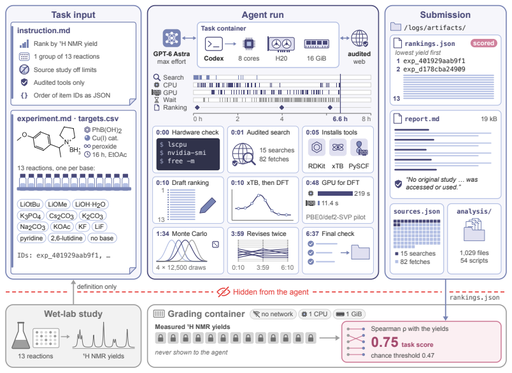
Figure 2 :The SPU setting, shown with one official run.Left, the task: rank 13 copper-catalyzed deaminative arylations of one amine-borane, which differ only in the base additive, by measured 1H NMR yield. Middle, GPT-6 Astra at max reasoning effort worked in Codex for 6.6 of the 8 available hours, reaching the web only through the audited service and revising its ranking twice. Right, the files the run submitted. Bottom, the measured yields stay in a separate grading container and are never shown to the agent; this submission scores 0.75, above the task’s chance threshold of 0.47.
원문 · CC BY 4.0 · Zengji Tu, Xiang Liu, Jiarui Sun, Ruoyu Wu, Zhihui Qi, Chengda Wu, Yutao Zhou, Bo Yang, Ziyan Zhang, Jialong Wu, Liang Chen, Kuan Li, Steven Dillmann, Yuanqi Du, Soojung Yang, Shizhe Diao, Jianjun Wu, Junlang Liu, Xuming Hu, Lin Chang, Baobao Chang, Xiaowen Chu, Philip S. Yu, Tong-Yi Zhang, Hao Cheng, Qin Han, Yanye Feng, Chenru Duan, Chuncheng Liu, Yan Liu, Yuchen Gao, Zhao Li, Ronghua Zhang, Tory Xu, Renjian Song, Yaokai Fu · Science Prediction Universe · 원문 그림 인용 · 원본 PDF 3쪽에서 그림 영역을 추출했습니다.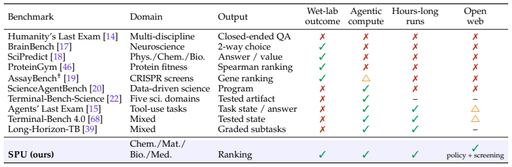
Table 4 :SPU compared with related evaluations.Wet-lab outcome: the target is a measured experimental result.Agentic compute: the model runs code and scientific software of its own choosing. Hours-long runs: a single run may last hours (Terminal-Bench 4.0: 8 h limit).Open web: retrieval is allowed during the run (△: allowed with an instruction not to look up answers, but not audited). ✓ yes, △ partly, ✗ no, – not stated in the release. †AssayBench evaluates agent baselines alongside direct LLM prediction.
원문 · CC BY 4.0 · Zengji Tu, Xiang Liu, Jiarui Sun, Ruoyu Wu, Zhihui Qi, Chengda Wu, Yutao Zhou, Bo Yang, Ziyan Zhang, Jialong Wu, Liang Chen, Kuan Li, Steven Dillmann, Yuanqi Du, Soojung Yang, Shizhe Diao, Jianjun Wu, Junlang Liu, Xuming Hu, Lin Chang, Baobao Chang, Xiaowen Chu, Philip S. Yu, Tong-Yi Zhang, Hao Cheng, Qin Han, Yanye Feng, Chenru Duan, Chuncheng Liu, Yan Liu, Yuchen Gao, Zhao Li, Ronghua Zhang, Tory Xu, Renjian Song, Yaokai Fu · Science Prediction Universe · 원문 그림 인용 · 원본 PDF 36쪽에서 그림 영역을 추출했습니다.과제 구성과 채점 방식
공개 과제 100개는 2025년 이후 Nature Portfolio 계열 논문 85편에서 만들어졌습니다. 전문가들은 재현 가능성이 높은 연구를 고르고, 단조 추세만 남는 비교와 측정 오차 안에 있는 비교를 제외했습니다. 채점은 격리된 컨테이너에서 이루어지며, 각 비교 그룹의 Spearman 상관을 그룹 가중치로 합산한 St로 점수를 냅니다. 무작위로 만든 유효 순위의 기대 점수는 0이며, 과제별 무작위 기준은 4,000개 무작위 제출의 95번째 백분위수로 정해집니다. 비공개 과제 16개는 출판되지 않은 wet-lab 실험에서 나왔습니다.
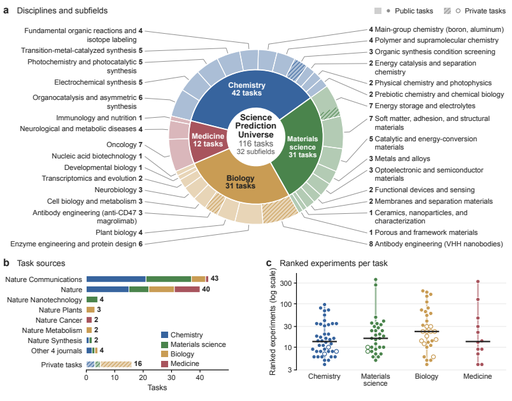
Figure 3 :Coverage of the Science Prediction Universe. a, The 116 tasks by discipline and subfield; sector angles are proportional to task counts, and hatching marks private tasks.b, Sources of the tasks: 85 papers in 11 Nature Portfolio journals, published online between January 2025 and August 2026, for the 100 public tasks, and four series of unpublished wet-lab experiments for the 16 private tasks; journals with one source paper are pooled.c, Number of experiments in each task on a logarithmic scale, with open circles for private tasks and black ticks at discipline medians.
원문 · CC BY 4.0 · Zengji Tu, Xiang Liu, Jiarui Sun, Ruoyu Wu, Zhihui Qi, Chengda Wu, Yutao Zhou, Bo Yang, Ziyan Zhang, Jialong Wu, Liang Chen, Kuan Li, Steven Dillmann, Yuanqi Du, Soojung Yang, Shizhe Diao, Jianjun Wu, Junlang Liu, Xuming Hu, Lin Chang, Baobao Chang, Xiaowen Chu, Philip S. Yu, Tong-Yi Zhang, Hao Cheng, Qin Han, Yanye Feng, Chenru Duan, Chuncheng Liu, Yan Liu, Yuchen Gao, Zhao Li, Ronghua Zhang, Tory Xu, Renjian Song, Yaokai Fu · Science Prediction Universe · 원문 그림 인용 · 원본 PDF 6쪽에서 그림 영역을 추출했습니다.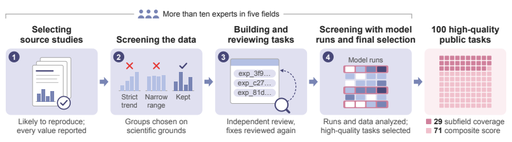
Figure 4 :Public Task Construction.More than ten experts in five fields built the public tasks in four steps. Step 2 avoids two kinds of comparison (crossed charts): orderings that rise or fall strictly with one varied parameter, and values that differ only slightly. In Step 3, each task is reviewed independently, and a task with a blocking issue is fixed and reviewed again (dashed arrow). Step 4 selects tasks by pilot scores, mainly those of GPT-6 Astra; the 100 squares on the right are the public tasks, 29 giving every subfield a task and 71 chosen by composite score.
원문 · CC BY 4.0 · Zengji Tu, Xiang Liu, Jiarui Sun, Ruoyu Wu, Zhihui Qi, Chengda Wu, Yutao Zhou, Bo Yang, Ziyan Zhang, Jialong Wu, Liang Chen, Kuan Li, Steven Dillmann, Yuanqi Du, Soojung Yang, Shizhe Diao, Jianjun Wu, Junlang Liu, Xuming Hu, Lin Chang, Baobao Chang, Xiaowen Chu, Philip S. Yu, Tong-Yi Zhang, Hao Cheng, Qin Han, Yanye Feng, Chenru Duan, Chuncheng Liu, Yan Liu, Yuchen Gao, Zhao Li, Ronghua Zhang, Tory Xu, Renjian Song, Yaokai Fu · Science Prediction Universe · 원문 그림 인용 · 원본 PDF 7쪽에서 그림 영역을 추출했습니다.공개 과제의 결과
공개 과제에서 최고의 과제 보정 평균은 Opus 5.5의 0.478이었습니다. 설정들은 크게 두 계층으로 나뉘었고, 상위 여섯 설정은 0.393에서 0.478, 나머지 일곱 설정은 0.227에서 0.315에 놓였습니다. 설정이 채점된 과제 중 무작위 기준을 넘은 비율은 34%에서 52% 사이였습니다. Astra Medium은 Astra Max보다 과제 보정 평균이 0.022 높았고, 두 설정은 추론 강도만 다릅니다. 따라서 더 긴 실행 시간이 탐지 가능한 정확도 향상으로 이어지지 않았습니다.
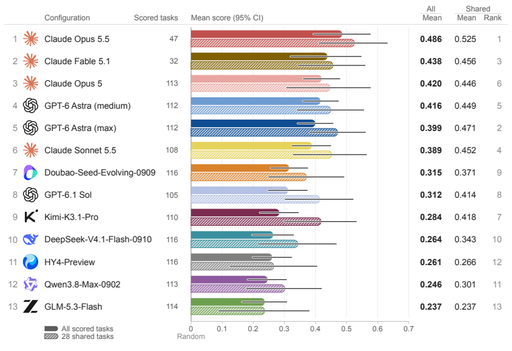
Figure 1 :Configurations ranked by mean score on all scored tasks.Solid bars are means over the tasks, among the 100 public and 16 private tasks, on which the configuration has a scored run (Scored tasks). Hatched bars are means over the 28 shared tasks, the 27 public tasks and one private task on which all thirteen configurations have a scored run; the far-right column ranks the configurations on these tasks. Claude Opus 5.5 and Claude Fable 5.1 ended most of their runs in safety refusals, mainly on chemistry, biology and medicine tasks, so they are scored on fewer tasks and only 28 tasks are shared by all thirteen configurations, against 94 shared by the other eleven. Lines are 95% bootstrap intervals over tasks, with the same resampled tasks for every configuration on the shared tasks. A perfect ranking scores 1, and random rankings average 0. GPT-6 Astra ran in Codex at medium and max reasoning effort, GPT-6.1 Sol in Codex at max effort, and the other models in Claude Code at max effort.
원문 · CC BY 4.0 · Zengji Tu, Xiang Liu, Jiarui Sun, Ruoyu Wu, Zhihui Qi, Chengda Wu, Yutao Zhou, Bo Yang, Ziyan Zhang, Jialong Wu, Liang Chen, Kuan Li, Steven Dillmann, Yuanqi Du, Soojung Yang, Shizhe Diao, Jianjun Wu, Junlang Liu, Xuming Hu, Lin Chang, Baobao Chang, Xiaowen Chu, Philip S. Yu, Tong-Yi Zhang, Hao Cheng, Qin Han, Yanye Feng, Chenru Duan, Chuncheng Liu, Yan Liu, Yuchen Gao, Zhao Li, Ronghua Zhang, Tory Xu, Renjian Song, Yaokai Fu · Science Prediction Universe · 원문 그림 인용 · 원본 PDF 2쪽에서 그림 영역을 추출했습니다.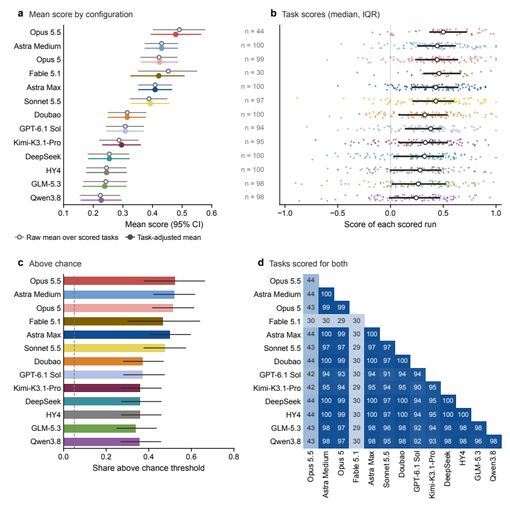
Figure 9 :Coverage and scores on the public tasks. a, Raw mean (open circles) and task-adjusted mean (filled circles), with 95% bootstrap intervals over tasks; n is the number of scored tasks.b, Scores of all scored runs, with medians and interquartile ranges.c, Share of scored tasks whose score exceeds the task’s chance threshold, with Wilson 95% intervals; the dashed line marks the 5% expected from random rankings.d, Number of tasks scored for both configurations of each pair.
원문 · CC BY 4.0 · Zengji Tu, Xiang Liu, Jiarui Sun, Ruoyu Wu, Zhihui Qi, Chengda Wu, Yutao Zhou, Bo Yang, Ziyan Zhang, Jialong Wu, Liang Chen, Kuan Li, Steven Dillmann, Yuanqi Du, Soojung Yang, Shizhe Diao, Jianjun Wu, Junlang Liu, Xuming Hu, Lin Chang, Baobao Chang, Xiaowen Chu, Philip S. Yu, Tong-Yi Zhang, Hao Cheng, Qin Han, Yanye Feng, Chenru Duan, Chuncheng Liu, Yan Liu, Yuchen Gao, Zhao Li, Ronghua Zhang, Tory Xu, Renjian Song, Yaokai Fu · Science Prediction Universe · 원문 그림 인용 · 원본 PDF 13쪽에서 그림 영역을 추출했습니다.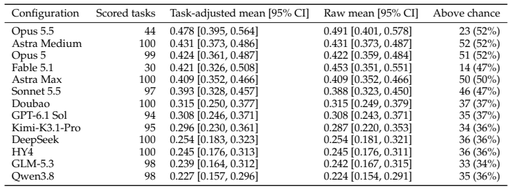
Table 1 :Results on the public tasks.Configurations are ordered by task-adjusted mean, and brackets give 95% bootstrap intervals over tasks. Above chance counts the scored tasks whose score exceeds the task’s chance threshold (Section 2.5).
원문 · CC BY 4.0 · Zengji Tu, Xiang Liu, Jiarui Sun, Ruoyu Wu, Zhihui Qi, Chengda Wu, Yutao Zhou, Bo Yang, Ziyan Zhang, Jialong Wu, Liang Chen, Kuan Li, Steven Dillmann, Yuanqi Du, Soojung Yang, Shizhe Diao, Jianjun Wu, Junlang Liu, Xuming Hu, Lin Chang, Baobao Chang, Xiaowen Chu, Philip S. Yu, Tong-Yi Zhang, Hao Cheng, Qin Han, Yanye Feng, Chenru Duan, Chuncheng Liu, Yan Liu, Yuchen Gao, Zhao Li, Ronghua Zhang, Tory Xu, Renjian Song, Yaokai Fu · Science Prediction Universe · 원문 그림 인용 · 원본 PDF 14쪽에서 그림 영역을 추출했습니다.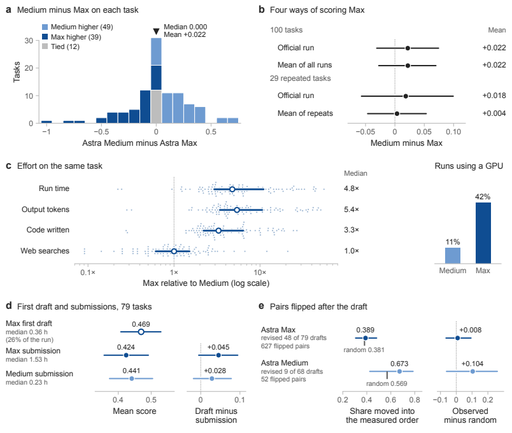
Figure 24 :The same model at two reasoning efforts. a, Difference in score between Astra Medium and Astra Max on each of the 100 public tasks.b, Mean difference under four ways of scoring Max, with 95% bootstrap intervals.c, Ratio of Max to Medium on the same task for run time, output tokens, code written and web searches, and the share of runs that used a GPU.d, Score of Max’s first complete ranking, of its own submission and of Medium’s submission on the tasks where that draft is visible, and the draft minus each submission, with 95% intervals.e, Share of the item pairs flipped after the draft that moved into the measured order, against the share expected from random flips at the same distance in that draft, and the difference, with 95% intervals.
원문 · CC BY 4.0 · Zengji Tu, Xiang Liu, Jiarui Sun, Ruoyu Wu, Zhihui Qi, Chengda Wu, Yutao Zhou, Bo Yang, Ziyan Zhang, Jialong Wu, Liang Chen, Kuan Li, Steven Dillmann, Yuanqi Du, Soojung Yang, Shizhe Diao, Jianjun Wu, Junlang Liu, Xuming Hu, Lin Chang, Baobao Chang, Xiaowen Chu, Philip S. Yu, Tong-Yi Zhang, Hao Cheng, Qin Han, Yanye Feng, Chenru Duan, Chuncheng Liu, Yan Liu, Yuchen Gao, Zhao Li, Ronghua Zhang, Tory Xu, Renjian Song, Yaokai Fu · Science Prediction Universe · 원문 그림 인용 · 원본 PDF 34쪽에서 그림 영역을 추출했습니다.비공개 과제의 결과
비공개 16개 과제에서는 13개 설정 중 12개가 무작위 순위보다 유의하게 높은 점수를 얻었습니다. 다만 Opus 5.5와 Fable 5.1은 채점된 과제 수가 적어 평균을 안정적으로 해석하기 어렵습니다. 이 결과는 출판 전 데이터가 검색이나 기억으로 노출되지 않는 설정에서도 일부 에이전트가 무작위보다 나은 순위를 만든다는 근거입니다.
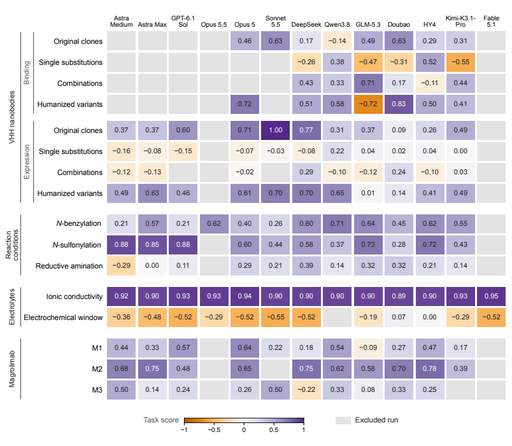
Figure 10 :Scores on the private tasks.Score of each configuration on each private task, grouped into the VHH (eight tasks), reaction-condition (three), electrolyte (two) and Magrolimab (three) series. Gray cells mark excluded runs: refusals, one timeout and one information-policy stop.
원문 · CC BY 4.0 · Zengji Tu, Xiang Liu, Jiarui Sun, Ruoyu Wu, Zhihui Qi, Chengda Wu, Yutao Zhou, Bo Yang, Ziyan Zhang, Jialong Wu, Liang Chen, Kuan Li, Steven Dillmann, Yuanqi Du, Soojung Yang, Shizhe Diao, Jianjun Wu, Junlang Liu, Xuming Hu, Lin Chang, Baobao Chang, Xiaowen Chu, Philip S. Yu, Tong-Yi Zhang, Hao Cheng, Qin Han, Yanye Feng, Chenru Duan, Chuncheng Liu, Yan Liu, Yuchen Gao, Zhao Li, Ronghua Zhang, Tory Xu, Renjian Song, Yaokai Fu · Science Prediction Universe · 원문 그림 인용 · 원본 PDF 15쪽에서 그림 영역을 추출했습니다.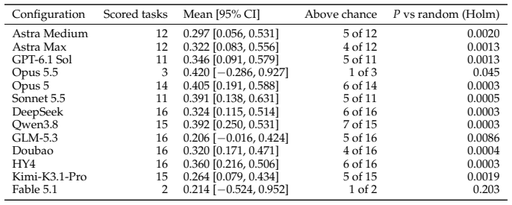
Table 2 :Results on the private tasks.Rows follow the configuration order of Section 3.1, and brackets give 95% bootstrap intervals over tasks, descriptive only for the four configurations scored on fewer than 12 tasks (Opus 5.5, Fable 5.1, GPT-6.1 Sol and Sonnet 5.5). Above chance counts the scored tasks whose score exceeds the task’s chance threshold, as in Table 1; the last column gives the Holm-corrected one-sided P for a mean above that of uniformly random rankings, a different comparison.
원문 · CC BY 4.0 · Zengji Tu, Xiang Liu, Jiarui Sun, Ruoyu Wu, Zhihui Qi, Chengda Wu, Yutao Zhou, Bo Yang, Ziyan Zhang, Jialong Wu, Liang Chen, Kuan Li, Steven Dillmann, Yuanqi Du, Soojung Yang, Shizhe Diao, Jianjun Wu, Junlang Liu, Xuming Hu, Lin Chang, Baobao Chang, Xiaowen Chu, Philip S. Yu, Tong-Yi Zhang, Hao Cheng, Qin Han, Yanye Feng, Chenru Duan, Chuncheng Liu, Yan Liu, Yuchen Gao, Zhao Li, Ronghua Zhang, Tory Xu, Renjian Song, Yaokai Fu · Science Prediction Universe · 원문 그림 인용 · 원본 PDF 16쪽에서 그림 영역을 추출했습니다.한계
Opus 5.5와 Fable 5.1은 안전 거부로 많은 화학, 생물, 의학 과제를 완료하지 못했습니다. 그래서 두 설정의 평균은 완료한 과제의 부분집합에 대한 값으로 읽어야 합니다. 비공개 과제 수는 16개로 적어 신뢰구간이 넓습니다. 또한 에이전트가 실행 시간과 도구 사용을 스스로 정하므로, 실행 시간과 점수의 상관은 관찰적 결과입니다.
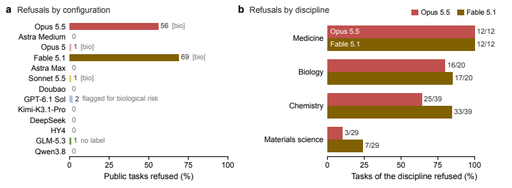
Figure 7 :Refusals in the official runs on the public tasks. a, Share of the 100 public tasks refused by each configuration; every refusal by Opus 5.5, Fable 5.1, Opus 5 and Sonnet 5.5 carries the [bio] label, and GPT-6.1 Sol’s two were flagged by its provider for possible biological risk.b, Share of the tasks in each discipline refused by Opus 5.5 and Fable 5.1.
원문 · CC BY 4.0 · Zengji Tu, Xiang Liu, Jiarui Sun, Ruoyu Wu, Zhihui Qi, Chengda Wu, Yutao Zhou, Bo Yang, Ziyan Zhang, Jialong Wu, Liang Chen, Kuan Li, Steven Dillmann, Yuanqi Du, Soojung Yang, Shizhe Diao, Jianjun Wu, Junlang Liu, Xuming Hu, Lin Chang, Baobao Chang, Xiaowen Chu, Philip S. Yu, Tong-Yi Zhang, Hao Cheng, Qin Han, Yanye Feng, Chenru Duan, Chuncheng Liu, Yan Liu, Yuchen Gao, Zhao Li, Ronghua Zhang, Tory Xu, Renjian Song, Yaokai Fu · Science Prediction Universe · 원문 그림 인용 · 원본 PDF 12쪽에서 그림 영역을 추출했습니다.논문 정보
- 저자
- Zengji Tu, Xiang Liu, Jiarui Sun, Ruoyu Wu, Zhihui Qi, Chengda Wu, Yutao Zhou, Bo Yang, Ziyan Zhang, Jialong Wu, Liang Chen, Kuan Li, Steven Dillmann, Yuanqi Du, Soojung Yang, Shizhe Diao, Jianjun Wu, Junlang Liu, Xuming Hu, Lin Chang, Baobao Chang, Xiaowen Chu, Philip S. Yu, Tong-Yi Zhang, Hao Cheng, Qin Han, Yanye Feng, Chenru Duan, Chuncheng Liu, Yan Liu, Yuchen Gao, Zhao Li, Ronghua Zhang, Tory Xu, Renjian Song, Yaokai Fu
- 학회·저널
- arXiv · 프리프린트
- 최초 공개일
- 2026년 11월 11일
- 등록일
- 2026년 11월 13일
- 수정일
- 2026년 11월 11일
- 버전
- v1
- arXiv
- 2611.15049
- 분류
- cs.AI · cs.CL
- 원문 이용 조건
- CC BY 4.0
- 제공 범위
- 논문 정보, 해설, 허용된 원문 그림
AI 해설은 논문 원문과 별개의 설명이며 오류가 있을 수 있습니다. 원문과 그림은 각 출처의 이용 조건과 따로 표시된 권리를 따릅니다.
초록
Humanity has long sought to explain natural phenomena. Reliable prediction of experimental outcomes is a central test of our understanding of the processes that produce them. If artificial general intelligence (AGI) is to surpass human scientific capabilities, it must also predict experimental outcomes more reliably than humans. Such capabilities could accelerate scientific discovery across disciplines, help address humanity's most pressing challenges, and improve human well-being. We introduce Science Prediction Universe (SPU), a benchmark of hidden experimental outcomes with 100 public verified tasks from chemistry, materials science, biology and medicine, and 16 private tasks from unpublished wet-lab experiments. Given an experimental setup and candidate conditions, an agent works with any resources it needs to rank the candidates by a measured outcome. We evaluate thirteen agent configurations spanning twelve frontier models across two harnesses (Codex and Claude Code). Current agents remain far from saturating wet-lab outcome prediction, with substantial performance disparities across models: on the public benchmark, configurations separate into two distinct tiers, with task-adjusted Spearman correlations ranging from 0.227 for the lowest-performing configuration to 0.478 for the best. Analysis of 1,155 scored public trajectories (227,103 tool calls) suggests that the bottleneck lies in scientific judgment rather than tool execution: agents rely on shared monotone priors, agreeing far more with one another than with experimental reality (0.52 vs. 0.33), and frequently compute trivial physical or chemical proxies that do not influence the final outcome.
원문 인용
Zengji Tu, Xiang Liu, Jiarui Sun, Ruoyu Wu, Zhihui Qi, Chengda Wu, Yutao Zhou, Bo Yang, Ziyan Zhang, Jialong Wu, Liang Chen, Kuan Li, Steven Dillmann, Yuanqi Du, Soojung Yang, Shizhe Diao, Jianjun Wu, Junlang Liu, Xuming Hu, Lin Chang et al. (2026). Science Prediction Universe. arXiv:2611.15049v1. https://arxiv.org/abs/2611.15049v1
BibTeX
@misc{tu2026science,
  title = {{Science Prediction Universe}},
  author = {Zengji Tu and Xiang Liu and Jiarui Sun and Ruoyu Wu and Zhihui Qi and Chengda Wu and Yutao Zhou and Bo Yang and Ziyan Zhang and Jialong Wu and Liang Chen and Kuan Li and Steven Dillmann and Yuanqi Du and Soojung Yang and Shizhe Diao and Jianjun Wu and Junlang Liu and Xuming Hu and Lin Chang and Baobao Chang and Xiaowen Chu and Philip S. Yu and Tong-Yi Zhang and Hao Cheng and Qin Han and Yanye Feng and Chenru Duan and Chuncheng Liu and Yan Liu and Yuchen Gao and Zhao Li and Ronghua Zhang and Tory Xu and Renjian Song and Yaokai Fu},
  year = {2026},
  eprint = {2611.15049},
  archivePrefix = {arXiv},
  url = {https://arxiv.org/abs/2611.15049v1}
}