논문 해설
Hybrid actor-critic algorithm for quantum reinforcement learning at CERN beam lines
CERN 빔라인에서의 양자 강화학습을 위한 하이브리드 액터-크리틱 알고리즘
- 연구 문제 기존 FERL은 이산 상태-행동 환경에서 고전 Q-learning보다 학습 효율이 높다고 보고되었지만, 연속 상태-행동 제어 문제에는 적용되지 않았습니다.
- 연구 방법 이 논문은 FERL을 연속 상태 공간으로 확장하고, DDPG의 비평가를 클램프된 QBM으로 바꾼 하이브리드 액터-비평가 방법을 제안합니다.
- 주요 결과 TT24-T4 연구에서 FERL은 DQN보다 적은 단계로 최적 정책에 도달했고, AWAKE 시뮬레이션에서 하이브리드 A-C는 고전 A-C보다 약 30 % 적은 상호작용으로 학습되었습니다. 실제 빔 라인에서도 학습된 정책이 과제를 해결했습니다.
연구 문제: 이산 행동 FERL을 연속 공간으로
입자 가속기 빔 제어는 제어 변수와 관측값이 연속적인 값으로 정의되며, 샘플 효율이 높은 강화학습이 빔 시간을 줄이는 데 필요합니다. 기존 자유 에너지 기반 강화학습(FERL)은 양자 볼츠만 머신(QBM)을 Q-함수 근사기로 사용하여 고전 Q-learning보다 학습 효율을 높였지만, 이산 상태-행동 공간의 환경에만 적용되었습니다. 이 논문은 이 제약을 두 단계로 다룹니다. 첫 번째 단계에서는 행동은 이산적이고 상태는 연속적인 TT24-T4 일차원 표적 조향 환경에서 FERL을 확장합니다. 두 번째 단계에서는 연속 행동 공간을 다루기 위해 DDPG 구조의 액터-비평가 방법에 QBM 기반 비평가를 결합합니다.
FERL의 Q-함수와 클램프된 QBM
강화학습에서 Q-함수는 상태 s에서 행동 a를 택한 뒤 따르는 할인된 보상의 기댓값입니다. FERL은 이 Q-함수를 신경망 대신 에너지 기반 모델로 근사합니다. 클램프된 QBM에서 가시 변수 v는 상태-행동 쌍 (s,a)로 구성되며, 가시 노드는 은닉 노드에 대한 편향 항과 결합 강도로만 에너지 함수에 들어갑니다. 횡자기장 Ising 해밀토니안을 복제 적층으로 고전 Ising 모델로 바꾸면 유효 에너지를 계산할 수 있고, 음의 자유 에너지 −F(v)가 Q(v)의 근사값으로 쓰입니다. 이 논문은 이 확장에서 상태 입력이 편향 항으로 들어가므로 연속 상태를 받을 수 있다는 점을 설명합니다.
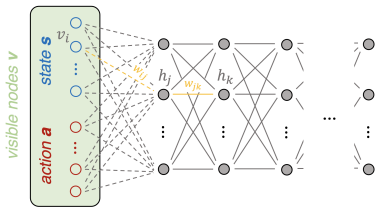
Figure 3 : Clamped BM with topology typically used for FERL applications. Visible nodes are given by the state- action pair (green box). Hidden nodes are shown in grey. Visible-hidden and hidden-hidden couplings are il- lustrated by dashed and solid lines, respectively.
원문 · CC BY 4.0 · Michael Schenk, Elías F. Combarro, Michele Grossi, Verena Kain, Kevin Shing Bruce Li, Mircea-Marian Popa, Sofia Vallecorsa · Hybrid actor-critic algorithm for quantum reinforcement learning at CERN beam lines · 원문 그림 인용 · 원본 PDF 4쪽에서 그림 영역을 추출했습니다.하이브리드 액터-비평가의 학습 구조
하이브리드 액터-비평가는 DDPG와 같은 틀을 유지하지만, 비평가 네트워크를 클램프된 QBM으로 대체합니다. 액터 네트워크는 현재 상태에서 연속 행동을 제안하고, QBM 비평가는 그 상태-행동 쌍의 Q-값을 평가합니다. 비평가의 시간차 갱신은 FERL 방식의 QBM 가중치 갱신을 따르며, 정책 기울기는 Q의 행동에 대한 미분과 액터 가중치에 대한 미분의 곱으로 계산됩니다. 이 논문은 엔트로피 항의 해석적 미분이 쉽지 않다고 보고 유한 차분 수치 미분을 사용합니다. 학습이 끝난 뒤에는 정책이 고전 액터 네트워크로 표현되므로 추론 시 QBM 비평가가 필요하지 않습니다.
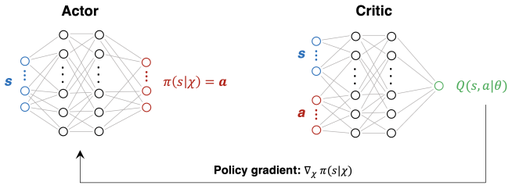
Figure 2 : RL actor-critic scheme: the policy- or actor-network proposes actiona given a states, while the critic network estimates the Q-value of the proposed state-action pair. The actor network is trained through the policy gradient rule.
원문 · CC BY 4.0 · Michael Schenk, Elías F. Combarro, Michele Grossi, Verena Kain, Kevin Shing Bruce Li, Mircea-Marian Popa, Sofia Vallecorsa · Hybrid actor-critic algorithm for quantum reinforcement learning at CERN beam lines · 원문 그림 인용 · 원본 PDF 3쪽에서 그림 영역을 추출했습니다.연구 A: TT24-T4 표적 조향 결과
연구 A의 TT24-T4 환경에서 상태는 BPM 하나의 빔 위치이고, 행동은 첫 번째 편향 자석 각도를 15 µrad씩 늘리거나 줄이는 두 개의 이산 행동입니다. 보상은 빔과 표적의 중첩 적분으로 정의됩니다. 최적성 지표는 목표에 최소 단계로 도달하는 행동을 취하는 상태 공간의 비율입니다. 경험 재생을 켠 경우 100 % 최적성에 도달하는 데 FERL은 10 단계, DQN은 약 380 단계가 필요했습니다. 이 수치는 은닉층 두 개와 층당 128개 노드를 가진 DQN 기준선과 1×2 단위 셀 Chimera QBM 조건에서 얻은 것입니다. 경험 재생을 끄면 FERL의 학습 단계는 더 늘어나지만 학습 자체는 가능했습니다.
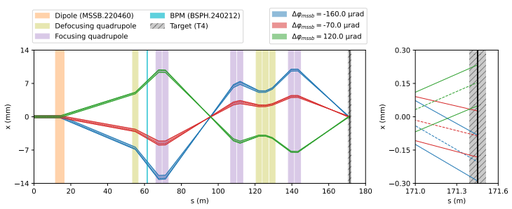
Figure 4 : One-dimensional beam target steering task at the CERN TT24-T4 beam line. Left: Horizontal beam trajectories obtained from tracking simulations are shown for three different settings of the main deflecting dipole (orange). Right: Zoomed view on the target (grey, hatched) region showing the horizontal position of impact of the beam for the three settings of the main dipole.
원문 · CC BY 4.0 · Michael Schenk, Elías F. Combarro, Michele Grossi, Verena Kain, Kevin Shing Bruce Li, Mircea-Marian Popa, Sofia Vallecorsa · Hybrid actor-critic algorithm for quantum reinforcement learning at CERN beam lines · 원문 그림 인용 · 원본 PDF 8쪽에서 그림 영역을 추출했습니다.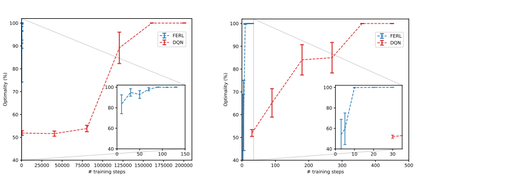
Figure 5 : One-dimensional beam target steering environment with a continuous state and discrete action space: convergence study for agent optimality vs the number of training stepswithout (left) and with (right) experience replay for a classical DQN (red) and an FERL (blue) agent shown on a log-log scale.
원문 · CC BY 4.0 · Michael Schenk, Elías F. Combarro, Michele Grossi, Verena Kain, Kevin Shing Bruce Li, Mircea-Marian Popa, Sofia Vallecorsa · Hybrid actor-critic algorithm for quantum reinforcement learning at CERN beam lines · 원문 그림 인용 · 원본 PDF 9쪽에서 그림 영역을 추출했습니다.시뮬레이션 양자 어닐링과 실제 QPU 비교
연구 A의 FERL 에이전트는 SQA와 D-Wave Advantage QA에서 학습되었습니다. 두 경우 모두 방문한 상태는 15개였고, 학습된 Q-함수의 값은 달랐지만 탐욕 정책은 100 % 최적이었습니다. 하이퍼파라미터는 SQA에서 조정한 값을 QA에 그대로 사용했습니다. 이 결과는 해당 일차원 환경에서 실제 QPU 학습이 가능함을 보여 주지만, 여러 환경이나 여러 시드에 대한 일반화를 주장하는 것은 아닙니다.
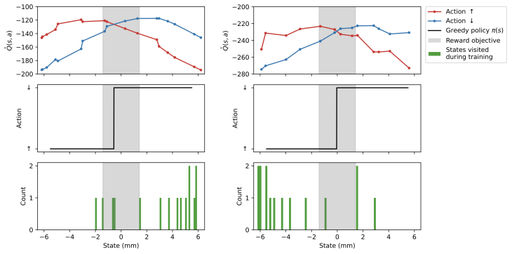
Figure 7 : Q-value estimates after training (top), derived greedy policies (middle), and histograms of visited states during training (bottom) on the one-dimensional beam steering environment with continuous state space. The training was performed using SQA (left) and running on the D-Wave QA (right).
원문 · CC BY 4.0 · Michael Schenk, Elías F. Combarro, Michele Grossi, Verena Kain, Kevin Shing Bruce Li, Mircea-Marian Popa, Sofia Vallecorsa · Hybrid actor-critic algorithm for quantum reinforcement learning at CERN beam lines · 원문 그림 인용 · 원본 PDF 10쪽에서 그림 영역을 추출했습니다.연구 B: AWAKE 시뮬레이션 비교
연구 B의 AWAKE 전자 빔 라인 환경은 열 개의 상태 차원과 열 개의 행동 차원을 가집니다. 상태는 기준 궤적에 대한 수평 BPM 차이이고, 행동은 보정 자석 킥 각이며, 보상은 모든 BPM에서 측정한 궤적의 음의 rms입니다. SQA로 학습한 하이브리드 A-C와 고전 A-C(DDPG)는 각각 15개 인스턴스로 학습되었고 500개의 무작위 에피소드로 평가되었습니다. 저자들은 하이브리드 A-C가 약 30 % 높은 샘플 효율을 보이며, 50번의 상호작용 후 거의 완벽한 행동을 얻었다고 보고합니다. 고전 A-C는 약 70번의 상호작용이 필요했습니다. 다만 고전 A-C가 50번에서는 아직 수렴하지 않았고, 70번에서는 하이브리드와 최종 보상 차이가 통계적 변동 안에 있어 명확한 결론이 어렵다고 원문은 설명합니다.
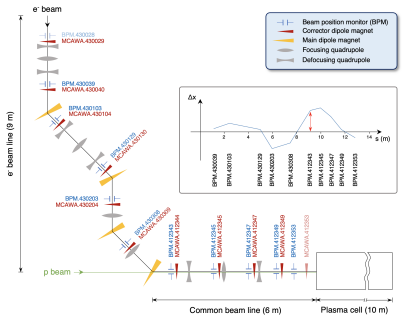
Figure 8 : Schematic of the electron beam line of the CERN AWAKE experiment with10 trajectory correctors and 10 beam position readings along the line.
원문 · CC BY 4.0 · Michael Schenk, Elías F. Combarro, Michele Grossi, Verena Kain, Kevin Shing Bruce Li, Mircea-Marian Popa, Sofia Vallecorsa · Hybrid actor-critic algorithm for quantum reinforcement learning at CERN beam lines · 원문 그림 인용 · 원본 PDF 11쪽에서 그림 영역을 추출했습니다.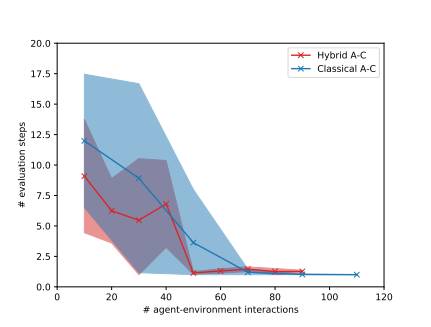
Figure 9 : Comparison of the classical (blue) and hybrid (red) A-C algorithms in terms of the number of required agent-environment interactions, i.e. sample efficiency, to reach optimal agent behaviour. These are results after extensive hyperparameter tuning. The hybrid A-C has been trained using SQA.
원문 · CC BY 4.0 · Michael Schenk, Elías F. Combarro, Michele Grossi, Verena Kain, Kevin Shing Bruce Li, Mircea-Marian Popa, Sofia Vallecorsa · Hybrid actor-critic algorithm for quantum reinforcement learning at CERN beam lines · 원문 그림 인용 · 원본 PDF 11쪽에서 그림 영역을 추출했습니다.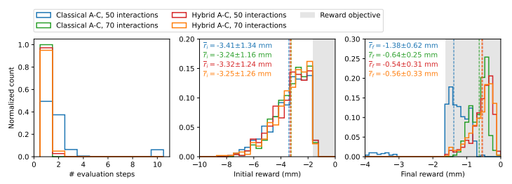
Figure 10 : Evaluation of the RL agents trained with a classical A-C algorithm (DDPG) and the hybrid A-C (SQA), respectively, after 50 and 70 interactions between agent and environment. Shown are the number of steps taken (left), the distribution of initial rewards (middle), and the distribution of the final rewards at the end of an episode (right). The evaluation has been performed with500 randomly initialised episodes.
원문 · CC BY 4.0 · Michael Schenk, Elías F. Combarro, Michele Grossi, Verena Kain, Kevin Shing Bruce Li, Mircea-Marian Popa, Sofia Vallecorsa · Hybrid actor-critic algorithm for quantum reinforcement learning at CERN beam lines · 원문 그림 인용 · 원본 PDF 12쪽에서 그림 영역을 추출했습니다.D-Wave QA 학습과 실제 빔 라인 적용
D-Wave Advantage QA에서 학습한 하이브리드 에이전트는 보상 목표를 rms 2mm로 완화한 조건에서 평가되었습니다. 이 에이전트는 80 %의 경우 1단계, 18 %의 경우 2단계, 2 %의 경우 3단계 안에 목표에 도달했습니다. 실제 AWAKE 빔 라인에서는 SQA 에이전트와 QA 에이전트를 추가 학습 없이 평가했으며, 두 에이전트 모두 시뮬레이션과 실제 환경에서 과제를 해결했습니다. 다만 QA 에이전트는 초기 상태 하나에서 실제 환경의 과제를 해결하지 못했고, 원문은 제한된 QPU 시간 때문에 학습이 완전히 수렴하지 않았을 가능성을 제시합니다. 추론 시 정책은 고전 액터 네트워크만으로 실행됩니다.
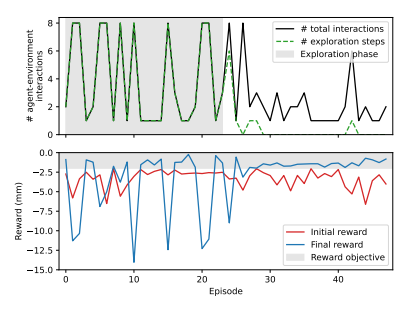
Figure 11 : Single RL agent training evolution on D- Wave Advantage Systems using the simulated AWAKE environment with a reward objective of−2mm.
원문 · CC BY 4.0 · Michael Schenk, Elías F. Combarro, Michele Grossi, Verena Kain, Kevin Shing Bruce Li, Mircea-Marian Popa, Sofia Vallecorsa · Hybrid actor-critic algorithm for quantum reinforcement learning at CERN beam lines · 원문 그림 인용 · 원본 PDF 12쪽에서 그림 영역을 추출했습니다.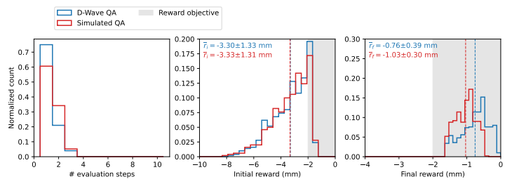
Figure 12 : Evaluation of the RL agent trained on D-Wave quantum annealing hardware (blue) and simulated quantum annealing (red) using identical hyperparameters. Shown are the distributions of the number of steps required to reach the reward objective from random initial states (left), as well as the initial (middle) and final (right) rewards.
원문 · CC BY 4.0 · Michael Schenk, Elías F. Combarro, Michele Grossi, Verena Kain, Kevin Shing Bruce Li, Mircea-Marian Popa, Sofia Vallecorsa · Hybrid actor-critic algorithm for quantum reinforcement learning at CERN beam lines · 원문 그림 인용 · 원본 PDF 13쪽에서 그림 영역을 추출했습니다.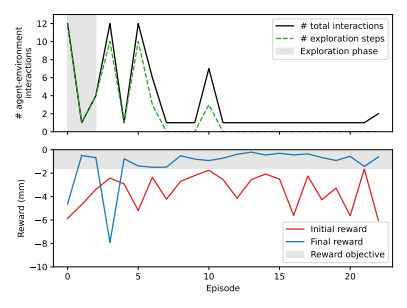
Figure 13 : Training of RL agent (SQA) on the simulated AWAKE environment for deployment on the real beam line.
원문 · CC BY 4.0 · Michael Schenk, Elías F. Combarro, Michele Grossi, Verena Kain, Kevin Shing Bruce Li, Mircea-Marian Popa, Sofia Vallecorsa · Hybrid actor-critic algorithm for quantum reinforcement learning at CERN beam lines · 원문 그림 인용 · 원본 PDF 13쪽에서 그림 영역을 추출했습니다.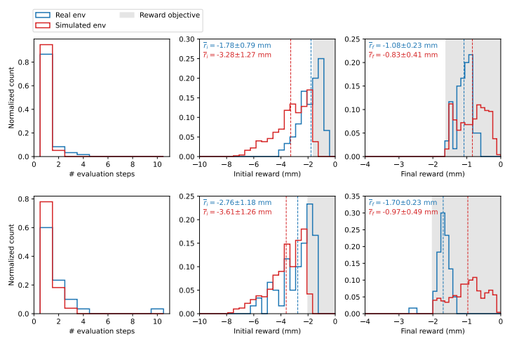
Figure 14 : Top: evaluation of an SQA-trained agent on the simulated and real AWAKE environments (reward objective: −1.6mm). Bottom: evaluation of the D-Wave QA-trained agent in the simulated and real AWAKE environments (reward objective:−2.0mm). Shown are the distributions of the number of steps required to reach the reward objective from random initial states (left), as well as the initial (middle) and final (right) rewards.
원문 · CC BY 4.0 · Michael Schenk, Elías F. Combarro, Michele Grossi, Verena Kain, Kevin Shing Bruce Li, Mircea-Marian Popa, Sofia Vallecorsa · Hybrid actor-critic algorithm for quantum reinforcement learning at CERN beam lines · 원문 그림 인용 · 원본 PDF 14쪽에서 그림 영역을 추출했습니다.적용 범위와 남은 질문
이 논문의 샘플 효율 향상은 이산 행동 공간 문제에서 보인 것만큼 크지 않았습니다. 저자들은 이 결과가 선형 동역학을 가진 이 문제에 한정되는지 추가 연구가 필요하다고 밝힙니다. 또한 연구 B의 샘플 효율 개선은 하나의 AWAKE 환경과 SQA 학습 조건에서 관찰된 것이며, QA 학습은 QPU 시간 제약 때문에 수렴 여부를 완전히 확인하지 못했습니다. 따라서 이 결과를 모든 연속 제어 문제나 모든 양자 하드웨어로 넓히는 것은 근거가 부족합니다.
논문 정보
- 저자
- Michael Schenk, Elías F. Combarro, Michele Grossi, Verena Kain, Kevin Shing Bruce Li, Mircea-Marian Popa, Sofia Vallecorsa
- 학회·저널
- arXiv · 프리프린트
- 최초 공개일
- 2022년 9월 22일
- 등록일
- 2026년 11월 6일
- 수정일
- 2022년 9월 22일
- 버전
- v1
- arXiv
- 2209.11044
- DOI
- 10.1088/2058-9565/ad261b
- 분류
- quant-ph
- 원문 이용 조건
- CC BY 4.0
- 제공 범위
- 논문 정보, 해설, 허용된 원문 그림
AI 해설은 논문 원문과 별개의 설명이며 오류가 있을 수 있습니다. 원문과 그림은 각 출처의 이용 조건과 따로 표시된 권리를 따릅니다.
초록
Free energy-based reinforcement learning (FERL) with clamped quantum Boltzmann machines (QBM) was shown to significantly improve the learning efficiency compared to classical Q-learning with the restriction, however, to discrete state-action space environments. In this paper, the FERL approach is extended to multi-dimensional continuous state-action space environments to open the doors for a broader range of real-world applications. First, free energy-based Q-learning is studied for discrete action spaces, but continuous state spaces and the impact of experience replay on sample efficiency is assessed. In a second step, a hybrid actor-critic scheme for continuous state-action spaces is developed based on the Deep Deterministic Policy Gradient algorithm combining a classical actor network with a QBM-based critic. The results obtained with quantum annealing, both simulated and with D-Wave quantum annealing hardware, are discussed, and the performance is compared to classical reinforcement learning methods. The environments used throughout represent existing particle accelerator beam lines at the European Organisation for Nuclear Research (CERN). Among others, the hybrid actor-critic agent is evaluated on the actual electron beam line of the Advanced Plasma Wakefield Experiment (AWAKE).
원문 인용
Michael Schenk, Elías F. Combarro, Michele Grossi, Verena Kain, Kevin Shing Bruce Li, Mircea-Marian Popa, Sofia Vallecorsa (2022). Hybrid actor-critic algorithm for quantum reinforcement learning at CERN beam lines. arXiv:2209.11044v1. https://doi.org/10.1088/2058-9565/ad261b
BibTeX
@article{schenk2022hybrid,
  title = {{Hybrid actor-critic algorithm for quantum reinforcement learning at CERN beam lines}},
  author = {Michael Schenk and Elías F. Combarro and Michele Grossi and Verena Kain and Kevin Shing Bruce Li and Mircea-Marian Popa and Sofia Vallecorsa},
  year = {2022},
  eprint = {2209.11044},
  archivePrefix = {arXiv},
  doi = {10.1088/2058-9565/ad261b},
  url = {https://arxiv.org/abs/2209.11044v1}
}