논문 해설
SELFormer: Molecular Representation Learning via SELFIES Language Models
SELFormer: SELFIES 언어 모델을 통한 분자 표현 학습
- 연구 문제 SMILES 기반 화학 언어 모델은 유효성·유일성·강건성 문제가 있어, SELFIES를 입력으로 쓴 트랜스포머 모델이 더 나은 분자 표현을 학습하는지가 핵심 질문입니다.
- 연구 방법 ChEMBL 분자를 SELFIES로 변환해 RoBERTa 구조 트랜스포머를 MLM으로 사전학습하고, 분류·회귀 헤드를 붙여 과제별로 미세조정합니다.
- 주요 결과 SIDER와 ESOL 등 일부 과제에서 경쟁 방법보다 높은 성능을 보였지만, HIV와 Tox21에서는 그래프 기반 방법보다 낮았고 일부 절제 비교는 기대와 다른 결과를 보였습니다.
SMILES 표기의 한계와 연구 질문
분자를 문자열로 표현하는 SMILES는 화학 언어 모델에서 가장 널리 쓰이지만, 원문은 하나의 분자가 여러 방식으로 쓰일 수 있어 유일성이 떨어지고, 유효하지 않은 문자열이 생길 수 있으며, 입체 정보와 구문·의미의 강건성이 부족하다고 지적합니다. 이 논문은 SMILES 대신 SELFIES를 입력으로 사용하면 더 표현력 있고 학습에 적합한 분자 표현을 얻을 수 있는지를 묻습니다. SELFIES는 원문에서 모든 문자열이 유효한 분자를 가리키는 표기로 설명됩니다.
SELFormer의 pre-training과 fine-tuning 구조
SELFormer는 ChEMBL의 약물 유사 화합물을 SMILES에서 SELFIES로 변환한 뒤, 바이트 수준 BPE로 토큰화하여 RoBERTa 구조의 트랜스포머 인코더를 마스크 언어 모델링 목표로 사전학습합니다. pre-training 후에는 인코더 위에 두 개의 선형 층으로 된 분류 또는 회귀 헤드를 붙여 과제별로 미세조정합니다. 분류 과제에서는 확률 분포를, 회귀 과제에서는 연속값을 출력합니다.
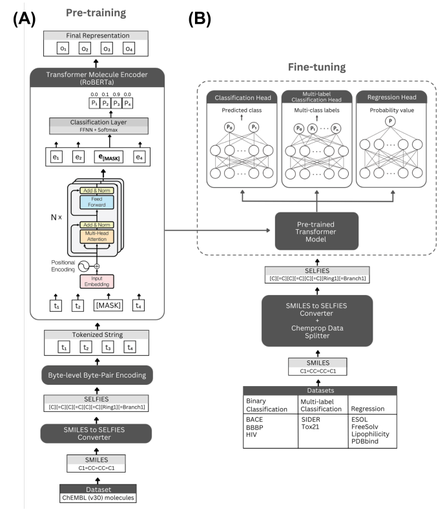
Figure 1 : The schematic representation of the SELFormer architecture and the experiments conducted. (A) the self-supervised pre-training utilizes the transformer encoder module via masked language modeling for learning concise and informative representations of small molecules encoded by their SELFIES notation. (B) the pre-trained model has been fine-tuned independently on numerous molecular property-based classification and regression tasks.
원문 · CC BY 4.0 · Atakan Yüksel, Erva Ulusoy, Atabey Ünlü, Tunca Doğan · SELFormer: Molecular Representation Learning via SELFIES Language Models · 원문 그림 인용 · 원본 PDF 6쪽에서 그림 영역을 추출했습니다.하이퍼파라미터 설정과 절제 비교
두 pre-training 후보인 SELFormer-Lite와 SELFormer는 배치 크기 16, 학습률 5e-5, 가중치 감쇠 0.01이라는 공통 설정을 가지지만 어텐션 헤드와 은닉층 수가 다릅니다. SELFormer-Lite는 어텐션 헤드 12와 은닉층 8이고, SELFormer는 어텐션 헤드 4와 은닉층 12입니다. 검증 손실은 SELFormer-Lite에서 0.328, SELFormer에서 0.306으로 보고되었습니다. 절제 연구에서는 두 pre-training 모델을 fine-tuning 전후로 비교하며, 학습 에폭을 25와 50으로 제한한 설정을 사용했습니다.
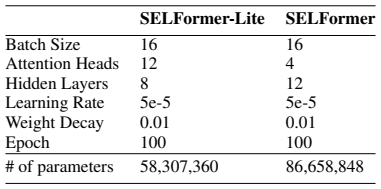
Table 2 : Hyperparameter configurations of the chosen SELFormer models.
원문 · CC BY 4.0 · Atakan Yüksel, Erva Ulusoy, Atabey Ünlü, Tunca Doğan · SELFormer: Molecular Representation Learning via SELFIES Language Models · 원문 그림 인용 · 원본 PDF 8쪽에서 그림 영역을 추출했습니다.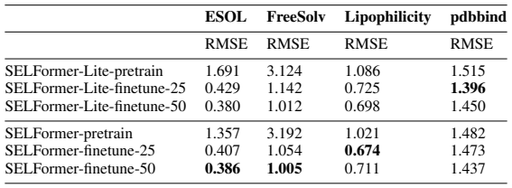
Table 4 : The ablation study results. Performance of pre-trained and fine-tuned (for 25 and 50 epochs) SELFormer models on regression-based molecular property prediction tasks, using the random split datasets. Results are presented in terms of the Root Mean Square Error (RMSE) metric.
원문 · CC BY 4.0 · Atakan Yüksel, Erva Ulusoy, Atabey Ünlü, Tunca Doğan · SELFormer: Molecular Representation Learning via SELFIES Language Models · 원문 그림 인용 · 원본 PDF 9쪽에서 그림 영역을 추출했습니다.분류와 회귀 과제에서의 결과
분류 과제에서 SELFormer는 SIDER에서 ROC 0.745를 기록했고, 본문은 최고 경쟁 방법인 MolCLR 대비 약 10% 높다고 설명합니다. 같은 절제 연구에서 SIDER의 pre-training 모델 ROC는 0.723, fine-tuning 모델은 0.711로, 기본 설정의 fine-tuning이 오히려 낮았습니다. 저자들은 이를 SIDER에 최적이 아닌 하이퍼파라미터 때문일 수 있다고 해석합니다. 회귀 과제에서 SELFormer는 ESOL RMSE 0.682로 scaffold 분할 결과 중 가장 낮았습니다. HIV와 Tox21에서는 SELFormer가 모든 그래프 기반 방법보다 낮았으며, 원문은 탐색 가능한 하이퍼파라미터 공간이 제한되었기 때문일 수 있다고 설명합니다.
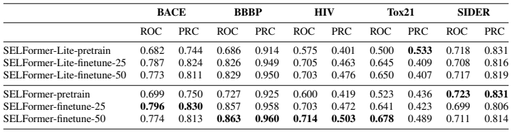
Table 3 : The ablation study results. Performance of pre-trained and fine-tuned (for 25 and 50 epochs) SELFormer models on classification-based molecular property prediction tasks, using the random split datasets. Results are presented in terms of the area under receiver operating characteristic curve (ROC) and the area under the precision-recall curve (PRC) metrics.
원문 · CC BY 4.0 · Atakan Yüksel, Erva Ulusoy, Atabey Ünlü, Tunca Doğan · SELFormer: Molecular Representation Learning via SELFIES Language Models · 원문 그림 인용 · 원본 PDF 9쪽에서 그림 영역을 추출했습니다.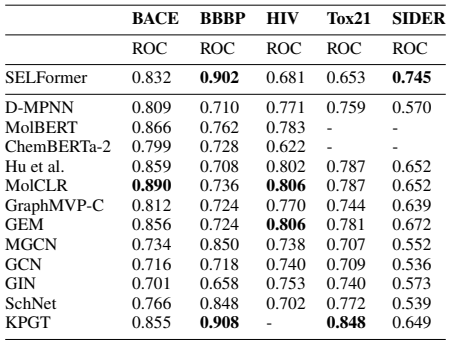
Table 5 : Classification-based molecular property prediction task (i.e., BACE, BBBP, HIV , Tox21 and SIDER) performance results of SELFormer and competing methods, on scaffold split datasets. Scores are given in terms of the area under receiver operating characteristic curve (ROC) metric (higher is better). Best scores for each task are shown in bold (multiple methods are marked if the difference in-between is less than 1%). Scores were not available for the method-task combinations that are denoted with “-”. Results for D-MPNN are taken from Fang et al. (2022), and results for Hu et al., MGCN, GCN, GIN, and SchNet are taken from Wang et al. (2022b). The HIV result provided for ChemBERTa-2 was adopted from Chithrananda et al. (2020), which is the previous study of the same authors (i.e., ChemBERTa), as there were no results provided in the ChemBERTa-2 article.
원문 · CC BY 4.0 · Atakan Yüksel, Erva Ulusoy, Atabey Ünlü, Tunca Doğan · SELFormer: Molecular Representation Learning via SELFIES Language Models · 원문 그림 인용 · 원본 PDF 10쪽에서 그림 영역을 추출했습니다.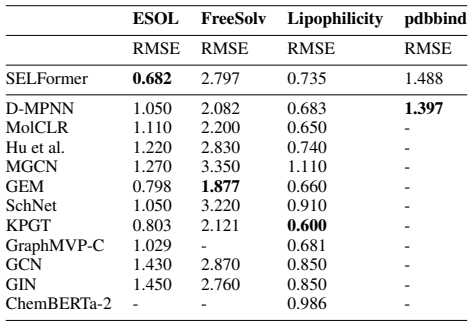
Table 7 : Regression-based molecular property prediction task (i.e., ESOL, FreeSolv, Lipophilicity, and pdbbind) performance results of SELFormer and competing methods, on scaffold split datasets. Scores are given in terms of the root mean squared error (RMSE) metric (lower is better). Best scores for each task are shown in bold. Scores were not available for the method-task combinations that are denoted with “-”.
원문 · CC BY 4.0 · Atakan Yüksel, Erva Ulusoy, Atabey Ünlü, Tunca Doğan · SELFormer: Molecular Representation Learning via SELFIES Language Models · 원문 그림 인용 · 원본 PDF 12쪽에서 그림 영역을 추출했습니다.적용 범위와 한계
이 결과는 ChEMBL 약 2백만 개 분자로 사전학습한 SELFormer와 MoleculeNet 기반 과제에서 얻은 것입니다. 저자들은 SELFormer의 규모가 크지 않다고 설명하며, ZINC 같은 더 큰 데이터와 더 많은 파라미터가 결과를 개선할 수 있을지는 추가 실험이 필요하다고 밝힙니다. 사용자 정의 UMAP 시각화는 차원 축소 그림으로, 의미 있는 구조를 보여 주는 정성적 관찰로 읽어야 하며 본 논문의 정량 주장과 구분됩니다.
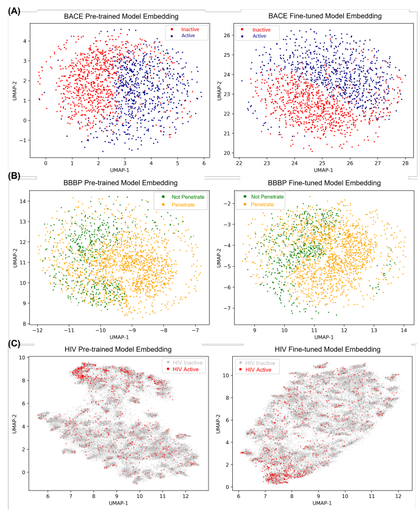
Figure 3 : Visualization of SELFormer representations (via UMAP projection) considering the pre-trained (left) and task specific fine-tuned (right) SELFormer models trained on classification-based molecular property prediction benchmarks: (A) BACE, (B) the blood–brain barrier penetration (BBBP), and (C) HIV .
원문 · CC BY 4.0 · Atakan Yüksel, Erva Ulusoy, Atabey Ünlü, Tunca Doğan · SELFormer: Molecular Representation Learning via SELFIES Language Models · 원문 그림 인용 · 원본 PDF 15쪽에서 그림 영역을 추출했습니다.논문 정보
- 저자
- Atakan Yüksel, Erva Ulusoy, Atabey Ünlü, Tunca Doğan
- 학회·저널
- arXiv · 프리프린트
- 최초 공개일
- 2023년 4월 10일
- 등록일
- 2026년 11월 6일
- 수정일
- 2023년 5월 25일
- 버전
- v2
- arXiv
- 2304.04662
- 분류
- q-bio.QM · cs.LG
- 원문 이용 조건
- CC BY 4.0
- 제공 범위
- 논문 정보, 해설, 허용된 원문 그림
AI 해설은 논문 원문과 별개의 설명이며 오류가 있을 수 있습니다. 원문과 그림은 각 출처의 이용 조건과 따로 표시된 권리를 따릅니다.
초록
Automated computational analysis of the vast chemical space is critical for numerous fields of research such as drug discovery and material science. Representation learning techniques have recently been employed with the primary objective of generating compact and informative numerical expressions of complex data. One approach to efficiently learn molecular representations is processing string-based notations of chemicals via natural language processing (NLP) algorithms. Majority of the methods proposed so far utilize SMILES notations for this purpose; however, SMILES is associated with numerous problems related to validity and robustness, which may prevent the model from effectively uncovering the knowledge hidden in the data. In this study, we propose SELFormer, a transformer architecture-based chemical language model that utilizes a 100% valid, compact and expressive notation, SELFIES, as input, in order to learn flexible and high-quality molecular representations. SELFormer is pre-trained on two million drug-like compounds and fine-tuned for diverse molecular property prediction tasks. Our performance evaluation has revealed that, SELFormer outperforms all competing methods, including graph learning-based approaches and SMILES-based chemical language models, on predicting aqueous solubility of molecules and adverse drug reactions. We also visualized molecular representations learned by SELFormer via dimensionality reduction, which indicated that even the pre-trained model can discriminate molecules with differing structural properties. We shared SELFormer as a programmatic tool, together with its datasets and pre-trained models. Overall, our research demonstrates the benefit of using the SELFIES notations in the context of chemical language modeling and opens up new possibilities for the design and discovery of novel drug candidates with desired features.
원문 인용
Atakan Yüksel, Erva Ulusoy, Atabey Ünlü, Tunca Doğan (2023). SELFormer: Molecular Representation Learning via SELFIES Language Models. arXiv:2304.04662v2. https://arxiv.org/abs/2304.04662v2
BibTeX
@misc{yksel2023selformer,
  title = {{SELFormer: Molecular Representation Learning via SELFIES Language Models}},
  author = {Atakan Yüksel and Erva Ulusoy and Atabey Ünlü and Tunca Doğan},
  year = {2023},
  eprint = {2304.04662},
  archivePrefix = {arXiv},
  url = {https://arxiv.org/abs/2304.04662v2}
}