논문 해설
DPODv2: Dense Correspondence-Based 6 DoF Pose Estimation
DPODv2: 밀집 대응 기반 6 DoF 자세 추정
- 연구 문제 DPODv2는 RGB와 깊이 입력을 하나의 밀집 대응 네트워크로 처리하고, 알려진 상대 카메라 변환을 가진 다중 뷰에서 미분 가능 렌더링 기반으로 자세를 정제하는 6 DoF 객체 자세 추정 방법입니다.
- 연구 방법 DPODv2는 YOLOv3로 2D 객체를 검출하고, CENet으로 NOCS 대응을 예측한 뒤 PnP+RANSAC 또는 Kabsch+RANSAC으로 자세를 계산합니다. 선택적으로 다중 뷰 정제를 적용합니다.
- 주요 결과 Linemod 합성 데이터 RGB 방식은 평균 ADD 81.20에서 4개 보정 뷰 정제 시 99.70으로 보고되며, BOP 데이터셋에서도 여러 조건에서 높은 AR을 보입니다.
6 DoF 자세 추정의 문제와 RGB·깊이 비교
객체의 6 DoF 자세 추정은 증강현실, 로봇, 자율주행 등에서 중요하지만, 최근 딥러닝 방법은 주로 RGB 영상에 의존하는 경향이 있습니다. 저자들은 RGB 기반 방법이 관점 모호성과 외형 변화에 취약하며, 깊이 정보나 다중 뷰 정제로 이를 보완할 수 있다고 설명합니다. 또한 기존 방법은 보통 특정 모달리티에 맞춰 구조가 달라서, 성능 차이가 모달리티 때문인지 학습 데이터 때문인지 구분하기 어렵다고 지적합니다. DPODv2는 이 문제를 해결하기 위해 RGB와 깊이 입력을 같은 밀집 대응 네트워크로 처리하고, 합성 데이터와 실제 데이터를 모두 사용하여 비교하는 것을 목표로 합니다.
세 단계 파이프라인과 CENet의 대응 표현
DPODv2는 2D 객체 검출, 밀집 대응 추정, 자세 추정의 세 단계와 선택적 정제 단계로 구성됩니다. 첫 단계에서 YOLOv3가 RGB 영상에서 2D 바운딩 박스를 추정하고, 두 번째 단계에서 CENet이 검출된 패치를 128×128 입력으로 받아 전경 마스크와 세 차원의 이산화된 NOCS 좌표를 예측합니다. NOCS는 각 차원이 객체를 [0, 1] 범위로 스케일한 좌표 공간이며, 정점 v에 대해 π_M(v)는 각 차원에서 최소값과 최대값으로 정규화한 값으로 정의됩니다. CENet은 공통 인코더와 네 개의 디코더 헤드를 가지며, 세 좌표 헤드는 연속 회귀 대신 256개 구간의 분류로 학습됩니다. 학습 손실은 전경 분할의 Dice 손실과 전경 픽셀에 대한 NOCS 분류 교차 엔트로피의 합으로 구성되며, 분할 항의 가중치 α는 5로 설정됩니다.
RGB 경로와 깊이 경로의 자세 계산
RGB만 사용할 때는 CENet이 예측한 2D-3D 대응에 PnP와 RANSAC을 적용하여 자세를 구합니다. 깊이 정보를 사용할 수 있으면 예측된 대응을 3D로 투영하여 Kabsch 알고리즘과 RANSAC으로 3D-3D 자세를 계산합니다. 깊이 맵을 RGB 대신 직접 입력하여 분할 마스크와 3D-3D 대응을 예측하는 경로도 함께 비교됩니다. 이처럼 입력 모달리티와 자세 계산 방식이 함께 바뀌므로, 결과를 읽을 때 어떤 경로인지 구분해야 합니다.
알려진 상대 카메라 변환 기반 다중 뷰 정제
다중 뷰 정제는 여러 뷰의 상대 카메라 변환이 알려져 있다는 가정에서 동작합니다. 기준 프레임을 정하고 각 프레임에서 PnP+RANSAC으로 얻은 초기 자세 가설을 기준 좌표계로 옮긴 뒤, 미분 가능 렌더러로 모델을 렌더링하여 예측 NOCS와 렌더링 NOCS의 픽셀 차이를 계산합니다. 손실은 전경 교집합에 대해 자세 갱신 T_Δ를 최적화하는 형태이며, 기준 프레임 선택에는 IoU로 정규화한 항을 사용합니다. 저자들은 이 정제가 객체 모델별 재학습을 요구하지 않는다고 설명합니다. 다만 상대 카메라 변환을 얻는 방법은 마커보드, 로봇 팔, SLAM 등으로 제시될 뿐이며, 변환 자체의 추정은 이 방법의 범위 밖입니다.
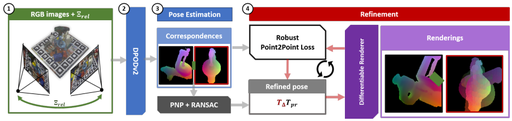
Fig. 2 : Multi-view pose optimization: The algorithm takes the output of DPODv2 from several views with known relative camera transformations as input. An initial pose hypothesis is iteratively refined until it converges to a pose, which is consistent with predicted correspondences in all frames. The proposed loss function penalizes pixel-wise distance between a predicted correspondence and a correspondence corresponding to the current pose hypothesis. The loss function is implemented using a differentiable renderer.
원문 · CC BY 4.0 · Ivan Shugurov, Sergey Zakharov, Slobodan Ilic · DPODv2: Dense Correspondence-Based 6 DoF Pose Estimation · 원문 그림 인용 · 원본 PDF 3쪽에서 그림 영역을 추출했습니다.데이터 준비와 합성 데이터 학습
실제 데이터에서는 GT 자세로 객체 패치를 추출하고 MSCOCO 배경에 합성하며, 합성 데이터에서는 BOP가 제공한 PBR 영상을 사용합니다. CENet은 실제 데이터에서 한 객체만 삽입하고 무작위 크기 변화와 평면 내 회전을 적용하며, 가림 패치를 추가합니다. 깊이 데이터는 빈 값을 최근접 이웃으로 채우고 평균 깊이와의 차이로 정규화합니다. 대칭 객체는 일관된 NOCS를 만들기 위해 축 대칭에 맞춘 자세 정규화를 적용합니다. 학습 설정은 실험과 모델에 따라 다르며, YOLO와 CENet의 학습률과 에폭은 각각 구현 설명에 제시된 값으로 읽어야 합니다.
Linemod에서의 자세 정확도
Linemod 실험은 ADD 재현율로 평가됩니다. 합성 데이터로 학습한 RGB 방식의 평균 ADD는 81.20이며, 2개 보정 뷰 정제 시 98.95, 4개 보정 뷰 정제 시 99.70으로 보고됩니다. 같은 표에서 DPOD의 합성 데이터 평균은 50.00으로 표시되어, 제안 방법은 합성 학습 RGB 설정에서 큰 개선을 보입니다. 다만 이 수치는 Linemod의 ADD 조건과 제시된 정제 설정에서 얻은 것이며, 다른 데이터셋의 결과로 확대할 수 없습니다.
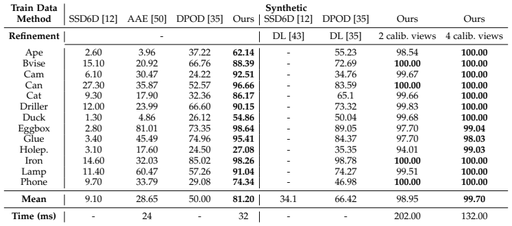
TABLE 2 : Pose estimation performance on Linemod on RGB images of methods trained on synthetic data : The table reports the percentages of correctly estimated poses w.r.t. the ADD score. Our approach sets the new state of the art both among the methods trained on real data and the methods trained on synthetic data. Our refiner outperforms other RGB refiners. Run times are provided as they are reported in the original papers using non-identical hardware.
원문 · CC BY 4.0 · Ivan Shugurov, Sergey Zakharov, Slobodan Ilic · DPODv2: Dense Correspondence-Based 6 DoF Pose Estimation · 원문 그림 인용 · 원본 PDF 10쪽에서 그림 영역을 추출했습니다.Occlusion, Homebrewed, TLESS의 BOP 평가
Occlusion, Homebrewed, TLESS는 Average Recall로 평가됩니다. Occlusion에서는 제안 방법이 CosyPose를 제외한 다른 밀집 대응 방법보다 높게 보고되며, PBR 학습과 정제 없음 조건에서는 CosyPose가 더 높습니다. TLESS에서는 YOLO를 실제 데이터로, CENet을 합성 데이터로 학습한 조합이 최고 성능으로 보고되며, CosyPose를 제외한 다른 방법보다 전체 AR이 높다고 설명됩니다. 이 비교는 각 표에 제시된 학습 데이터, 모달리티, 정제 조건을 함께 읽어야 합니다.
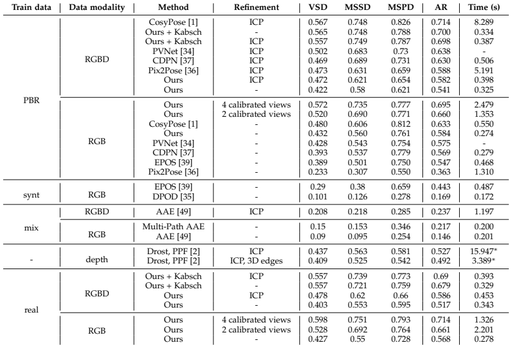
TABLE 6 : Pose estimation performance comparison on the Occlusion dataset : Results are reported in terms of the Average Recall score. The results prove the effectiveness of the proposed approach on all used data modalities. Run times are provided as they are reported in the BOP challenge [14] using non-identical hardware. PPF-based methods, labeled with∗ in the Time column, use only CPU.
원문 · CC BY 4.0 · Ivan Shugurov, Sergey Zakharov, Slobodan Ilic · DPODv2: Dense Correspondence-Based 6 DoF Pose Estimation · 원문 그림 인용 · 원본 PDF 12쪽에서 그림 영역을 추출했습니다.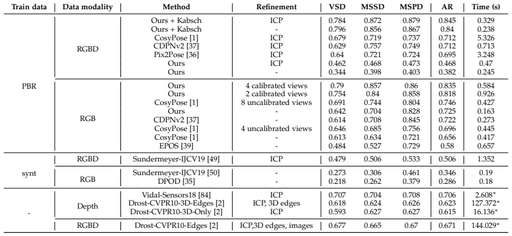
TABLE 7 : Pose estimation performance comparison on the Homebrewed dataset : Results are reported in terms of the Average Recall score [14]. The results prove the effectiveness of the proposed approach on all used data modalities. Run times are provided as they are reported in the BOP challenge [14] using non-identical hardware. PPF-based methods, labeled with∗ in the Time column, use only CPU.
원문 · CC BY 4.0 · Ivan Shugurov, Sergey Zakharov, Slobodan Ilic · DPODv2: Dense Correspondence-Based 6 DoF Pose Estimation · 원문 그림 인용 · 원본 PDF 13쪽에서 그림 영역을 추출했습니다.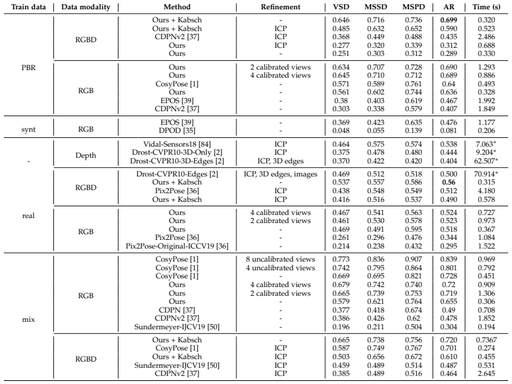
TABLE 8 : Pose estimation performance comparison on the BOP images of the TLESS dataset : Results are reported in terms of the Average Recall score [14]. The results prove the effectiveness of the proposed approach on all used data modalities. Run times are provided as they are reported in the BOP challenge [14] using non-identical hardware. PPF-based methods, labeled with∗ in the Time column, use only CPU.
원문 · CC BY 4.0 · Ivan Shugurov, Sergey Zakharov, Slobodan Ilic · DPODv2: Dense Correspondence-Based 6 DoF Pose Estimation · 원문 그림 인용 · 원본 PDF 14쪽에서 그림 영역을 추출했습니다.RGB와 깊이의 대응 품질 차이
논문은 모달리티별 결과를 해석하면서 RGB가 대응 추정에 더 강하고, 깊이는 Kabsch 기반 3D-3D 자세에서 기여한다고 정리합니다. 단순한 깊이 입력 경로는 가림과 카메라 각도가 큰 장면에서 분할과 대응 품질이 떨어지는 것으로 보고됩니다. 반면 RGB로 대응을 예측하고 깊이를 Kabsch에 사용하는 경로는 깊이 정보를 활용해 성능을 높입니다. 이 결과는 해당 데이터셋과 구성에서 관찰된 것이며, 깊이가 항상 불리하다는 일반 결론으로 읽으면 안 됩니다.
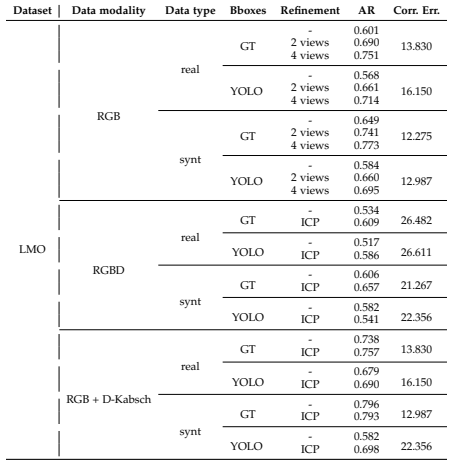
TABLE 10 : Pose estimation performance on the Occlusion dataset on different data modalities and type of train data: The table reports in terms of the AR score [14]. An AR score for each data modality and train data type is provided separately on ground truth 2D detections and on YOLO de- tections. Symmetry-aware median L2 correspondence error demonstrates the quality of predicted correspondences.
원문 · CC BY 4.0 · Ivan Shugurov, Sergey Zakharov, Slobodan Ilic · DPODv2: Dense Correspondence-Based 6 DoF Pose Estimation · 원문 그림 인용 · 원본 PDF 15쪽에서 그림 영역을 추출했습니다.절제 실험과 뷰 선택의 영향
절제 실험은 프레임 선택 전략을 비교합니다. 가장 가까운 뷰 선택은 기하 제약이 약해 가장 낮은 성능을 보이며, 무작위 선택과 가장 먼 뷰 선택은 대체로 비슷하게 보고됩니다. 이 실험은 다중 뷰 정제의 효과가 뷰 구성에 따라 달라짐을 보여 줍니다. 원문은 이 결과를 특정 설정의 비교로 제시하므로, 다른 뷰 수나 다른 장면에서의 일반화는 별도로 확인해야 합니다.
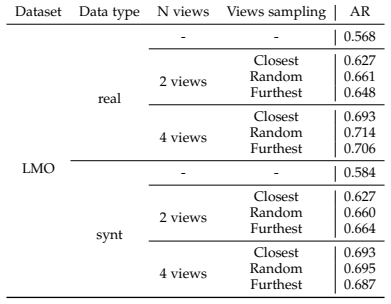
TABLE 14 : Different view sampling strategies for the multi- view refiner on the Occlusion [83] dataset.
원문 · CC BY 4.0 · Ivan Shugurov, Sergey Zakharov, Slobodan Ilic · DPODv2: Dense Correspondence-Based 6 DoF Pose Estimation · 원문 그림 인용 · 원본 PDF 17쪽에서 그림 영역을 추출했습니다.적용 범위와 한계
저자들은 다중 뷰 정제가 상대 카메라 변환을 알고 있다는 가정에 의존한다고 밝힙니다. CENet은 큰 가림이나 비슷한 객체가 있는 패치에서 대응이 부정확해질 수 있으며, 원문은 이를 실패 사례로 보고합니다. 또한 TLESS에서는 깊이 맵이 평면과 물체 가장자리에서 비어 있어 깊이 기반 성능 향상이 제한됩니다. 이 한계들은 본문에서 보고된 데이터셋과 조건 안에서 읽어야 합니다.
논문 정보
- 저자
- Ivan Shugurov, Sergey Zakharov, Slobodan Ilic
- 학회·저널
- arXiv · 프리프린트
- 최초 공개일
- 2022년 7월 6일
- 등록일
- 2026년 11월 6일
- 수정일
- 2022년 7월 6일
- 버전
- v1
- arXiv
- 2207.02805
- DOI
- 10.1109/tpami.2021.3118833
- 분류
- cs.CV
- 원문 이용 조건
- CC BY 4.0
- 제공 범위
- 논문 정보, 해설, 허용된 원문 그림
AI 해설은 논문 원문과 별개의 설명이며 오류가 있을 수 있습니다. 원문과 그림은 각 출처의 이용 조건과 따로 표시된 권리를 따릅니다.
초록
We propose a three-stage 6 DoF object detection method called DPODv2 (Dense Pose Object Detector) that relies on dense correspondences. We combine a 2D object detector with a dense correspondence estimation network and a multi-view pose refinement method to estimate a full 6 DoF pose. Unlike other deep learning methods that are typically restricted to monocular RGB images, we propose a unified deep learning network allowing different imaging modalities to be used (RGB or Depth). Moreover, we propose a novel pose refinement method, that is based on differentiable rendering. The main concept is to compare predicted and rendered correspondences in multiple views to obtain a pose which is consistent with predicted correspondences in all views. Our proposed method is evaluated rigorously on different data modalities and types of training data in a controlled setup. The main conclusions is that RGB excels in correspondence estimation, while depth contributes to the pose accuracy if good 3D-3D correspondences are available. Naturally, their combination achieves the overall best performance. We perform an extensive evaluation and an ablation study to analyze and validate the results on several challenging datasets. DPODv2 achieves excellent results on all of them while still remaining fast and scalable independent of the used data modality and the type of training data
원문 인용
Ivan Shugurov, Sergey Zakharov, Slobodan Ilic (2022). DPODv2: Dense Correspondence-Based 6 DoF Pose Estimation. arXiv:2207.02805v1. https://doi.org/10.1109/tpami.2021.3118833
BibTeX
@article{shugurov2022dpodv2,
  title = {{DPODv2: Dense Correspondence-Based 6 DoF Pose Estimation}},
  author = {Ivan Shugurov and Sergey Zakharov and Slobodan Ilic},
  year = {2022},
  eprint = {2207.02805},
  archivePrefix = {arXiv},
  doi = {10.1109/tpami.2021.3118833},
  url = {https://arxiv.org/abs/2207.02805v1}
}