논문 해설
Offline robot programming assisted by task demonstration: an AutomationML interoperable solution for glass adhesive application and welding
작업 시연으로 지원되는 오프라인 로봇 프로그래밍: 유리 접착제 도포 및 용접을 위한 AutomationML 상호운용 솔루션
- 연구 문제 로봇은 제조 현장에 널리 쓰이지만 비전문가가 경로와 공정 파라미터를 만들기 어렵고, 오프라인 프로그래밍에서는 방향과 속도 같은 제조 기술이 빠지기 쉽습니다.
- 연구 방법 숙련 작업자의 단일 샷 시연에서 magnetic tracker로 방향과 속도를 얻고 CAD/CAM 위치와 결합한 뒤, 좌표 변환과 PathML 교환을 거쳐 시뮬레이션에서 검증된 로봇 프로그램을 생성합니다.
- 주요 결과 접착 적용과 용접 두 공정에서 생성된 경로의 위치 오차는 최대 4 mm와 2 mm이고 방향 오차는 1º에서 3º로 보고되며, 저자들은 이를 기능 허용 범위 안이라고 해석합니다.
로봇 프로그래밍의 진입 장벽
로봇은 제조 공정에 널리 쓰이지만 비전문가가 이를 프로그래밍하기는 어렵습니다. 특히 중소기업은 로봇과 공정 양쪽의 전문성을 갖춘 인력이 부족해 생산 시스템이 바뀔 때마다 재프로그래밍 부담을 크게 느낍니다. 오프라인 로봇 프로그래밍(Offline robot programming)은 가상 환경에서 경로를 만들 수 있지만, 로봇 방향과 속도처럼 제조 기술을 나타내는 파라미터가 경로에 충분히 담기지 않는다는 한계가 있습니다. 이 논문은 이 공백을 숙련 작업자의 시연으로 메우는 문제를 다룹니다.
시연 데이터와 CAD/CAM 위치의 결합
제안 시스템은 숙련 작업자가 수동 접착 건이나 용접 토치에 부착한 magnetic tracker로 도구의 방향과 속도를 기록합니다. 위치 값은 magnetic tracker에서 직접 쓰지 않고 CAD/CAM 도면에서 추출합니다. magnetic tracker의 방향은 Euler 각도로 기록되며, 센서의 방향은 \( {}^{S}_{E}R = R_{Z'Y'X'}(\psi,\theta,\phi) \) 식으로 회전 행렬에 대응됩니다. 로봇은 고정축 X-Y-Z 각도를 입력으로 받으므로 같은 회전을 \( R_{XYZ}(\phi,\theta,\psi)=R_{Z'Y'X'}(\psi,\theta,\phi) \)로 맞춰 사용합니다.
추적기 정보에는 외란 가능성이 있는 단일 샷 데이터에 표준 이상치 필터를 적용하며, 생성된 경로는 OLP 시뮬레이션에서 검토하고 필요하면 조정한 뒤 로봇 프로그램으로 변환됩니다.
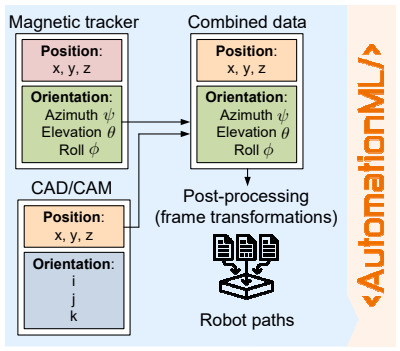
Figure 3 . Positional data extracted from CAD/CAM combined with orientation data from the magnetic tracker. The post-processing outputs Euler angles following the x-y-z static convention applied to the robot ´s models in use.
원문 · CC BY 4.0 · M. Babcinschi, F. Cruz, N. Duarte, S. Santos, S. Alves, P. Neto · Offline robot programming assisted by task demonstration: an AutomationML interoperable solution for glass adhesive application and welding · 원문 그림 인용 · 원본 PDF 6쪽에서 그림 영역을 추출했습니다.좌표계 변환과 PathML 데이터 교환
magnetic tracker 데이터와 CAD/CAM 데이터는 서로 다른 기준틀에 있어 그대로 로봇에 전달할 수 없습니다. 논문은 월드 F, 수신기 S, 로봇 R, 추적 센서 E의 기준틀을 구분하고 \( {}^{R}_{E}T = {}^{R}_{F}T\,{}^{F}_{S}T\,{}^{S}_{E}T \)로 센서 프레임을 로봇 프레임에 옮깁니다. 각 기준틀의 관계는 위치와 방향으로 정해집니다. 데이터 교환은 PathML 파일이 맡으며, 이 파일은 AutomationML 기반의 중립 교환 형식으로 PathML Generator에서 생성되고 CAEX 계층 구조를 C# 클래스 모델로 반영합니다. PathML은 로봇 경로와 접착제 유량, 용접 와이어 공급 속도 같은 공정 파라미터를 CAD/CAM, 추적기, 공정 데이터, RoboDK 기반 OLP 사이에서 함께 저장합니다.
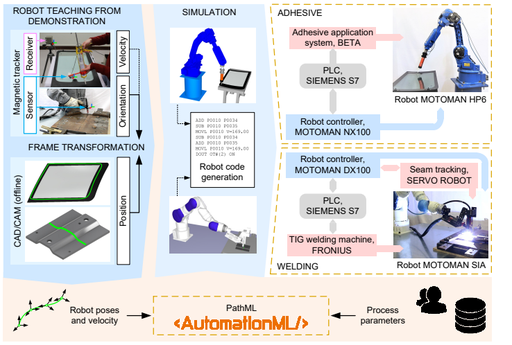
Figure 1 . Architecture of the integrated system for intuitive robot programming from human demonstra- tions and CAD/CAM data. Robot path orientations and velocities are captured through a single-shot human demonstration using magnetic tracking, while positional data are obtained from CAD/CAM. AutomationML- based PathML collects robot data, including poses and velocity, as well as parameters related to glass adhesive application and welding.
원문 · CC BY 4.0 · M. Babcinschi, F. Cruz, N. Duarte, S. Santos, S. Alves, P. Neto · Offline robot programming assisted by task demonstration: an AutomationML interoperable solution for glass adhesive application and welding · 원문 그림 인용 · 원본 PDF 4쪽에서 그림 영역을 추출했습니다.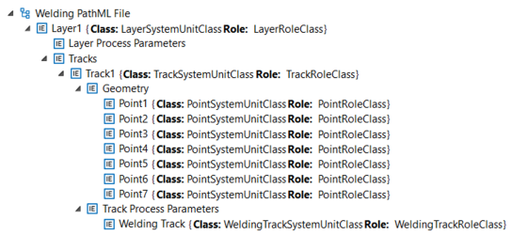
Figure 5 . PathML file containing the welding path data (visualized in the AML Editor software), presented in a CAEX hierarchy tree structure. The hierarchy is organized in a top-down approach, with Layers being the highest level, followed by Tracks and Points. The Points contain the robot pose (position and orientation) data in Cartesian coordinates. The file also stores process parameters.
원문 · CC BY 4.0 · M. Babcinschi, F. Cruz, N. Duarte, S. Santos, S. Alves, P. Neto · Offline robot programming assisted by task demonstration: an AutomationML interoperable solution for glass adhesive application and welding · 원문 그림 인용 · 원본 PDF 8쪽에서 그림 영역을 추출했습니다.두 공정에서의 경로 검증 결과
검증은 자동차 리어 사이드 유리의 접착 적용과 TIG 용접 두 공정에서 수행되었습니다. 접착 실험에서는 6 DOF 로봇과 공압 접착 건이, 용접 실험에서는 7 DOF 로봇과 TIG 용접기 및 시임 추적 시스템이 사용되었습니다. 생성된 프로그램을 실제 로봇에서 실행한 결과, 위치 오차는 접착 적용에서 명목 경로 기준 최대 4 mm, 용접에서 최대 2 mm 편차로 보고됩니다. 방향 오차는 두 공정 모두 추정 범위 1º에서 3º입니다. 저자들은 이 오차들이 두 응용의 기능 허용 범위 안에 있어 의도된 기능에 큰 영향을 주지 않는다고 해석합니다. 용접은 다층 용접에서 첫 번째 패스만 시연해도 경로를 얻을 수 있다고 설명됩니다.
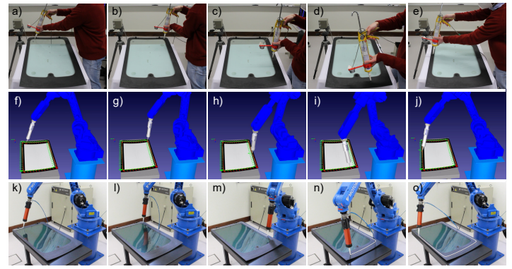
Figure 8 . A skilled operator demonstrates in a single shot the glass adhesive application. The orientations and velocity are acquired by the magnetic tracker sensor attached to the caulk gun (a-e). These data together with positional data from CAD/CAM are simulated in OLP to adjust, if necessary, the robot poses (f-j). The real robot performs the demonstrated task by applying glue on an automotive glass (k-o).
원문 · CC BY 4.0 · M. Babcinschi, F. Cruz, N. Duarte, S. Santos, S. Alves, P. Neto · Offline robot programming assisted by task demonstration: an AutomationML interoperable solution for glass adhesive application and welding · 원문 그림 인용 · 원본 PDF 11쪽에서 그림 영역을 추출했습니다.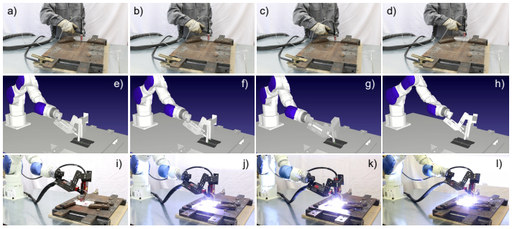
Figure 9 . A skilled operator demonstrates in a single shot the TIG-based welding task. The orientations and velocity are acquired by the magnetic tracker sensor attached to the welding torch (a-d). These data together with positional data from CAD/CAM are simulated in OLP to adjust, if necessary, the robot poses (e-h). The real robot performs the demonstrated welding task (i-l).
원문 · CC BY 4.0 · M. Babcinschi, F. Cruz, N. Duarte, S. Santos, S. Alves, P. Neto · Offline robot programming assisted by task demonstration: an AutomationML interoperable solution for glass adhesive application and welding · 원문 그림 인용 · 원본 PDF 11쪽에서 그림 영역을 추출했습니다.오차 원인과 적용 범위
magnetic tracker의 위치 값은 수신기와 센서 사이 거리가 커질수록 z 방향 오차가 증가하여 최대 60 mm에 이르며, 이 수준에서는 실제 사용에 부적합하다고 보고됩니다. 그래서 이 시스템은 방향만 신뢰하고 위치는 CAD/CAM에서 가져옵니다. 금속이나 자성 표면 근처에서는 추적 정확도가 낮아질 수 있어, 단일 샷 시연은 금속 요소가 없는 테이블 위의 사무실 환경에서 수행되었습니다. 접착 실험의 최대 위치 오차 4 mm 중 일부는 가상과 실제 환경 사이의 캘리브레이션 오차에서 비롯되며, 접착 구간의 물결 모양 편차는 접착 건 자동 시스템의 시동 중 오작동에서 비롯된다고 보고됩니다. 이 결과는 해당 두 공정과 이 작업장 설정에서 얻은 것입니다.
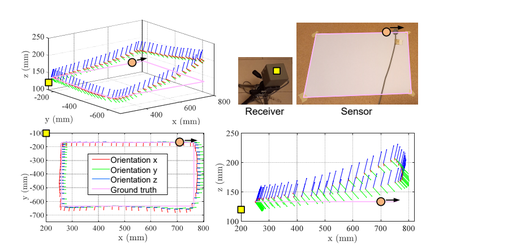
Figure 2 . Recorded poses from the magnetic tracker single-shot demonstration following a ground truth rectangular geometry in the x-y plane. The positional error is noticeable, particularly along the z-axis.
원문 · CC BY 4.0 · M. Babcinschi, F. Cruz, N. Duarte, S. Santos, S. Alves, P. Neto · Offline robot programming assisted by task demonstration: an AutomationML interoperable solution for glass adhesive application and welding · 원문 그림 인용 · 원본 PDF 6쪽에서 그림 영역을 추출했습니다.논문 정보
- 저자
- M. Babcinschi, F. Cruz, N. Duarte, S. Santos, S. Alves, P. Neto
- 학회·저널
- arXiv · 프리프린트
- 최초 공개일
- 2024년 5월 21일
- 등록일
- 2026년 11월 6일
- 수정일
- 2024년 5월 21일
- 버전
- v1
- arXiv
- 2405.13141
- DOI
- 10.1080/0951192x.2024.2358042
- 분류
- cs.RO
- 원문 이용 조건
- CC BY 4.0
- 제공 범위
- 논문 정보, 해설, 허용된 원문 그림
AI 해설은 논문 원문과 별개의 설명이며 오류가 있을 수 있습니다. 원문과 그림은 각 출처의 이용 조건과 따로 표시된 권리를 따릅니다.
초록
Robots have been successfully deployed in both traditional and novel manufacturing processes. However, they are still difficult to program by non-experts, which limits their accessibility to a wider range of potential users. Programming robots requires expertise in both robotics and the specific manufacturing process in which they are applied. Robot programs created offline often lack parameters that represent relevant manufacturing skills when executing a specific task. These skills encompass aspects like robot orientation and velocity. This paper introduces an intuitive robot programming system designed to capture manufacturing skills from task demonstrations performed by skilled workers. Demonstration data, including orientations and velocities of the working paths, are acquired using a magnetic tracking system fixed to the tools used by the worker. Positional data are extracted from CAD/CAM. Robot path poses are transformed into Cartesian space and validated in simulation, subsequently leading to the generation of robot programs. PathML, an AutomationML-based syntax, integrates robot and manufacturing data across the heterogeneous elements and stages of the manufacturing systems considered. Experiments conducted on the glass adhesive application and welding processes showcased the intuitive nature of the system, with path errors falling within the functional tolerance range.
원문 인용
M. Babcinschi, F. Cruz, N. Duarte, S. Santos, S. Alves, P. Neto (2024). Offline robot programming assisted by task demonstration: an AutomationML interoperable solution for glass adhesive application and welding. arXiv:2405.13141v1. https://doi.org/10.1080/0951192x.2024.2358042
BibTeX
@article{babcinschi2024offline,
  title = {{Offline robot programming assisted by task demonstration: an AutomationML interoperable solution for glass adhesive application and welding}},
  author = {M. Babcinschi and F. Cruz and N. Duarte and S. Santos and S. Alves and P. Neto},
  year = {2024},
  eprint = {2405.13141},
  archivePrefix = {arXiv},
  doi = {10.1080/0951192x.2024.2358042},
  url = {https://arxiv.org/abs/2405.13141v1}
}