논문 해설
Astraios: Parameter-Efficient Instruction Tuning Code Large Language Models
Astraios: 코드 대형 언어 모델의 매개변수 효율적 지시 튜닝
- 연구 문제 명령어 튜닝된 코드 LLM에서 어떤 PEFT 방법이 모델 규모에 따라 가장 좋은 성능과 비용 균형을 주는지 불분명합니다.
- 연구 방법 StarCoder 기반 1B에서 16B까지의 모델에 7가지 튜닝 방법을 적용해 28개의 ASTRAIOS 모델을 만들고, 손실과 다운스트림 과제, 강건성, 보안을 함께 평가합니다.
- 주요 결과 FFT가 대체로 가장 좋은 성능을 보였고, LoRA가 비용과 성능의 균형에서 유리하다고 보고됩니다. 코드 생성 성능은 규모에 따라 향상되지만 일부 이해 과제는 다른 패턴을 보입니다.
PEFT 방법 선택의 불확실성
대형 코드 언어 모델을 전체 파라미터로 미세조정(FFT)하면 비용이 크게 듭니다. 그래서 일부 파라미터만 갱신하는 파라미터 효율적 미세조정(PEFT)이 널리 쓰이지만, 명령어 튜닝된 코드 모델에서 어떤 PEFT 방법이 가장 좋은 비용 대비 성능을 주는지는 실증적으로 확인되지 않았습니다. 이 논문은 이 질문을 모델 규모에 따라 달라지는 문제로 다룹니다. 기존 분석은 주로 과제 특화 모델(패러다임 B)에 머물렀고, 명령어 튜닝 패러다임과 코드 도메인, 다양한 PEFT 방법, 강건성과 보안까지 포함한 평가, 그리고 1B에서 16B에 이르는 규모 확장은 충분히 다뤄지지 않았습니다. 저자들은 StarCoder 계열 기반의 ASTRAIOS 모델 스위트를 만들어 이 공백을 메웁니다.
ASTRAIOS 모델 스위트와 튜닝 설정
ASTRAIOS는 StarCoder 기반 1B, 3B, 7B, 16B 모델에 7가지 튜닝 방법을 적용해 만든 28개의 명령어 튜닝 OctoCoder 모델입니다. 방법은 어댑터 계열 4종(AdapterH, AdapterP, Parallel, (IA)3), 프롬프트 계열 1종(P-Tuning), 저랭크 계열 1종(LoRA)이며, 비교 기준으로 FFT를 각 규모에 포함합니다. 학습 데이터는 CommitPackFT+OASST이고, 시퀀스 길이 2048, 배치 크기 1, 워밍업 12스텝, 전체 200스텝으로 학습합니다. PEFT의 학습률은 1×10⁻⁴, FFT는 1×10⁻⁶이며 두 경우 모두 코사인 스케줄러를 사용합니다.
PEFT 학습에는 8비트 양자화 모델을 사용하고 FFT는 양자화하지 않은 원본 모델을 씁니다. 원문 Table 1에 따르면 LoRA는 1B에서 3,588,096개, 16B에서 17,776,640개의 학습 파라미터를 가지며, FFT는 1B에서 1,137,207,296개, 16B에서 15,517,456,384개를 갱신합니다.
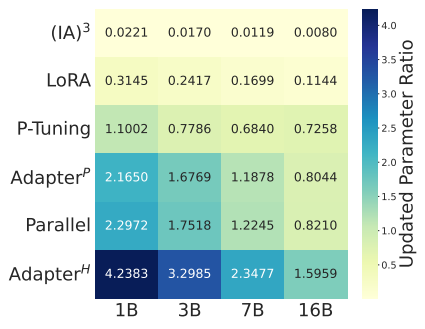
Figure 2 : Percentage (%) of total parameters updated for each PEFT method in A STRAIOS models.
원문 · CC BY 4.0 · Terry Yue Zhuo, Armel Zebaze, Nitchakarn Suppattarachai, Leandro von Werra, Harm de Vries, Qian Liu, Niklas Muennighoff · Astraios: Parameter-Efficient Instruction Tuning Code Large Language Models · 원문 그림 인용 · 원본 PDF 3쪽에서 그림 영역을 추출했습니다.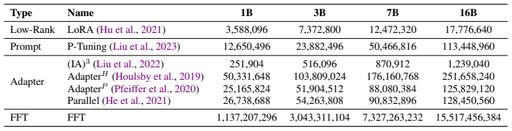
Table 1 : Summary of tuning methods and the trainable parameters of different model scales.
원문 · CC BY 4.0 · Terry Yue Zhuo, Armel Zebaze, Nitchakarn Suppattarachai, Leandro von Werra, Harm de Vries, Qian Liu, Niklas Muennighoff · Astraios: Parameter-Efficient Instruction Tuning Code Large Language Models · 원문 그림 인용 · 원본 PDF 3쪽에서 그림 영역을 추출했습니다.손실 곡선으로 본 규모와 학습 시간의 효과
이 논문은 먼저 교차 엔트로피 손실을 예비 지표로 사용해 튜닝 방법을 비교합니다. 모델 규모를 1B에서 16B까지 바꿨을 때 학습 손실과 테스트 손실은 대체로 함께 감소하며, 두 값이 잘 맞아 과적합이 두드러지지 않았다고 보고됩니다. 다만 FFT는 PEFT 방법인 LoRA와 Parallel Adapter보다 약간 더 낮은 손실을 보이고, 갱신 파라미터가 많은 방법이 대체로 더 낮은 최종 손실을 보였습니다. 학습 시간 측면에서는 손실이 200스텝까지 계속 감소하지만 PEFT 방법은 뚜렷한 감소 추세를 보이지 않는 반면 FFT는 200스텝 이후에도 감소하는 경향이 보고됩니다. P-Tuning은 손실이 비단조적으로 변동해 상대적으로 불안정했습니다.
저자들은 갱신 파라미터 수가 많을수록 손실이 낮아지는 이유를 파라미터 수 자체의 효과로 해석합니다.
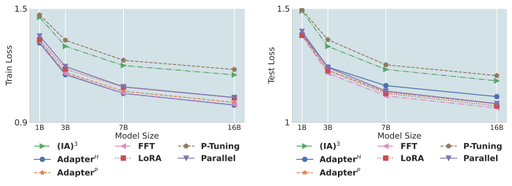
Figure 3 : Final loss across model sizes.
원문 · CC BY 4.0 · Terry Yue Zhuo, Armel Zebaze, Nitchakarn Suppattarachai, Leandro von Werra, Harm de Vries, Qian Liu, Niklas Muennighoff · Astraios: Parameter-Efficient Instruction Tuning Code Large Language Models · 원문 그림 인용 · 원본 PDF 5쪽에서 그림 영역을 추출했습니다.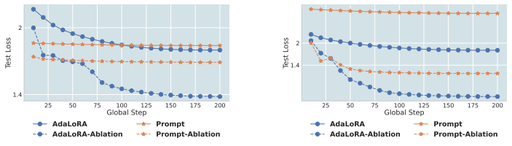
Figure 10 : Test loss of selected models across training time measured by Global Step.
원문 · CC BY 4.0 · Terry Yue Zhuo, Armel Zebaze, Nitchakarn Suppattarachai, Leandro von Werra, Harm de Vries, Qian Liu, Niklas Muennighoff · Astraios: Parameter-Efficient Instruction Tuning Code Large Language Models · 원문 그림 인용 · 원본 PDF 20쪽에서 그림 영역을 추출했습니다.과제별 성능과 규모 효과
다운스트림 성능은 코드 이해 과제와 코드 생성 과제에서 다르게 나타납니다. 전체 평균에서 FFT가 가장 좋고 LoRA와 Parallel Adapter가 FFT와 비교 가능한 수준이라고 보고됩니다. 그러나 16B에서는 Parallel Adapter와 LoRA가 FFT와 가장 경쟁적이고, 1B에서는 P-Tuning과 (IA)3가 Parallel Adapter와 LoRA를 약간 앞섭니다. 코드 생성 과제에서는 HumanEvalPack의 Python과 Java 분할에서 Pass@1을 측정하며, 모델 크기가 커질수록 FFT의 성능이 대체로 향상됩니다. 반면 Defect Detection과 Clone Detection에서는 모델이 커져도 생성 과제와 같은 확장 패턴이 나타나지 않으며, 저자들은 이 두 과제에서 역 스케일링에 가까운 패턴을 보고합니다.
이 해석은 학습 데이터가 결함 탐지와 클론 탐지 과제를 충분히 포괄하지 않았을 가능성과 연결됩니다.
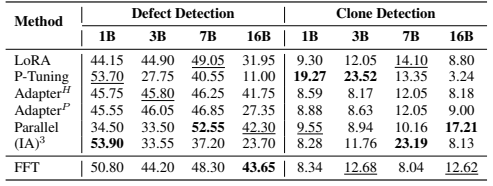
Table 2 : Results of ASTRAIOS models on Defect Detection and Clone Detection. The best perfor- mance is highlighted in bold. The second best performance is underlined.
원문 · CC BY 4.0 · Terry Yue Zhuo, Armel Zebaze, Nitchakarn Suppattarachai, Leandro von Werra, Harm de Vries, Qian Liu, Niklas Muennighoff · Astraios: Parameter-Efficient Instruction Tuning Code Large Language Models · 원문 그림 인용 · 원본 PDF 7쪽에서 그림 영역을 추출했습니다.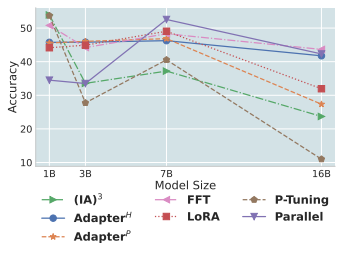
Figure 5 : Accuracy results of ASTRAIOS models on Defect Detection.
원문 · CC BY 4.0 · Terry Yue Zhuo, Armel Zebaze, Nitchakarn Suppattarachai, Leandro von Werra, Harm de Vries, Qian Liu, Niklas Muennighoff · Astraios: Parameter-Efficient Instruction Tuning Code Large Language Models · 원문 그림 인용 · 원본 PDF 7쪽에서 그림 영역을 추출했습니다.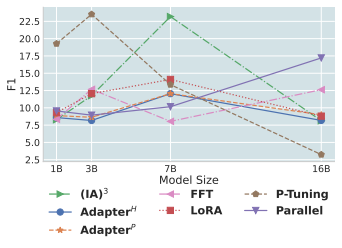
Figure 6 : F1 results of ASTRAIOS models on Clone Detection.
원문 · CC BY 4.0 · Terry Yue Zhuo, Armel Zebaze, Nitchakarn Suppattarachai, Leandro von Werra, Harm de Vries, Qian Liu, Niklas Muennighoff · Astraios: Parameter-Efficient Instruction Tuning Code Large Language Models · 원문 그림 인용 · 원본 PDF 7쪽에서 그림 영역을 추출했습니다.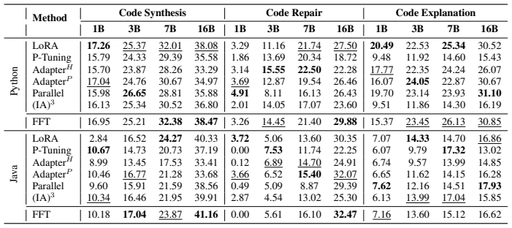
Table 3 : Pass@1 results of ASTRAIOS models on HumanEvalPack Python and Java splits. The best performance is highlighted in bold. The second best performance is underlined.
원문 · CC BY 4.0 · Terry Yue Zhuo, Armel Zebaze, Nitchakarn Suppattarachai, Leandro von Werra, Harm de Vries, Qian Liu, Niklas Muennighoff · Astraios: Parameter-Efficient Instruction Tuning Code Large Language Models · 원문 그림 인용 · 원본 PDF 8쪽에서 그림 영역을 추출했습니다.강건성과 보안의 결과
ReCode 평가에서 RC@1은 모델 크기가 커질수록 증가하는 경향을 보이며, 이는 큰 모델일수록 입력 변형에 덜 강건하다는 뜻으로 해석됩니다. 변형 유형 가운데 구문 변형에서 모든 모델의 성능이 가장 낮게 나타났습니다. RP@1은 규모가 커질수록 대체로 증가하며, FFT는 1B와 3B에서는 다른 PEFT 방법보다 불리하지만 16B에서는 가장 높은 RP@1을 보였습니다. 평균 RC@1 기준으로는 FFT와 LoRA가 강건성에서 두드러지지 않았고, 어댑터 계열이 상대적으로 더 강건하다고 보고됩니다. AATK 보안 평가에서는 valid rate가 모델 크기에 따라 일관되게 오르지 않았지만, insecure rate는 큰 모델에서 더 높게 나타났습니다.
FFT와 LoRA는 보안 수준에서 다른 방법보다 낫다고 보고되며, P-Tuning은 더 안전하지 않은 프로그램을 생성할 가능성이 상대적으로 높았습니다.
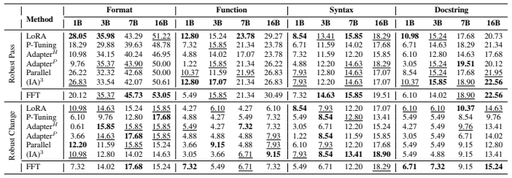
Table 4 : RP@1 and RC@1 results of ASTRAIOS models on ReCode. The best performance is highlighted in bold. The second best performance is underlined.
원문 · CC BY 4.0 · Terry Yue Zhuo, Armel Zebaze, Nitchakarn Suppattarachai, Leandro von Werra, Harm de Vries, Qian Liu, Niklas Muennighoff · Astraios: Parameter-Efficient Instruction Tuning Code Large Language Models · 원문 그림 인용 · 원본 PDF 8쪽에서 그림 영역을 추출했습니다.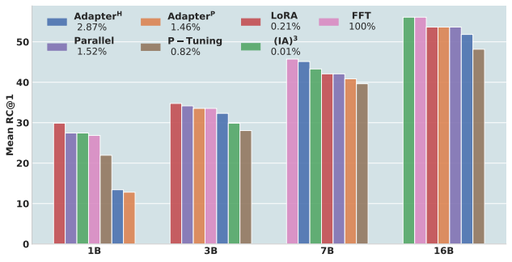
Figure 7 : Mean RC@1 of ASTRAIOS on ReCode. Lower RC@1 indicates better robustness. We indicate the percentage of total parameters updated for each PEFT method.
원문 · CC BY 4.0 · Terry Yue Zhuo, Armel Zebaze, Nitchakarn Suppattarachai, Leandro von Werra, Harm de Vries, Qian Liu, Niklas Muennighoff · Astraios: Parameter-Efficient Instruction Tuning Code Large Language Models · 원문 그림 인용 · 원본 PDF 9쪽에서 그림 영역을 추출했습니다.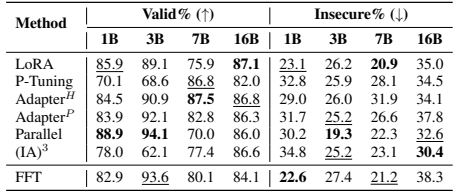
Table 5 : Valid and Insecure rates of ASTRAIOS models on AATK benchmark. We note that the insecure rate is calculated based on the valid programs. The best performance is highlighted in bold. The second best performance is underlined.
원문 · CC BY 4.0 · Terry Yue Zhuo, Armel Zebaze, Nitchakarn Suppattarachai, Leandro von Werra, Harm de Vries, Qian Liu, Niklas Muennighoff · Astraios: Parameter-Efficient Instruction Tuning Code Large Language Models · 원문 그림 인용 · 원본 PDF 9쪽에서 그림 영역을 추출했습니다.최종 손실과 다운스트림 성능의 관계
마지막 분석은 업데이트 파라미터 수, 교차 엔트로피 손실, 과제 성능의 관계를 살핍니다. 파라미터 수와 최종 손실의 상관은 모델 규모별로 일관되지 않았지만, 튜닝 방법 사이의 상대적 손실 순위는 규모가 달라도 비슷하게 유지된다고 보고됩니다. 이 때문에 작은 모델에서 얻은 손실이 큰 모델 성능의 예측 지표가 될 수 있다는 해석이 제시됩니다. 또한 모든 데이터 포인트를 합치면 최종 손실과 평균 다운스트림 성능 사이에 강한 상관이 나타나며, 테스트 손실이 학습 손실보다 더 강하게 상관됩니다. 저자들은 1B 모델이 명령어를 학습할 능력이 부족해 규모별 상관이 약하다고 해석합니다. 이 상관은 일반 명령어 데이터의 손실이 코드 과제의 대리 지표가 될 수 있다는 가능성을 보여 주지만, 데이터 규모와 아키텍처 변화는 이 연구에서 변수로 다루지 않았습니다.
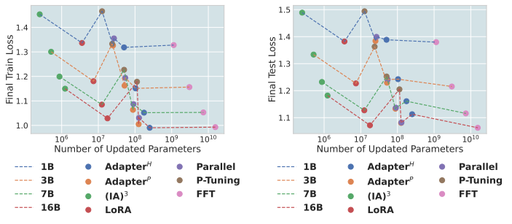
Figure 8 : Relationships between cross-entropy loss and the number of updated parameters.
원문 · CC BY 4.0 · Terry Yue Zhuo, Armel Zebaze, Nitchakarn Suppattarachai, Leandro von Werra, Harm de Vries, Qian Liu, Niklas Muennighoff · Astraios: Parameter-Efficient Instruction Tuning Code Large Language Models · 원문 그림 인용 · 원본 PDF 10쪽에서 그림 영역을 추출했습니다.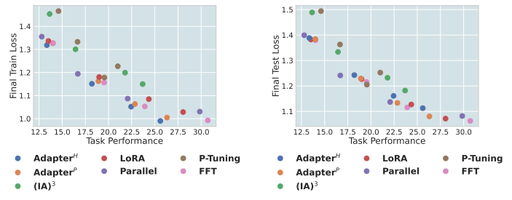
Figure 9 : Relationships between cross-entropy loss and overall task performance.
원문 · CC BY 4.0 · Terry Yue Zhuo, Armel Zebaze, Nitchakarn Suppattarachai, Leandro von Werra, Harm de Vries, Qian Liu, Niklas Muennighoff · Astraios: Parameter-Efficient Instruction Tuning Code Large Language Models · 원문 그림 인용 · 원본 PDF 11쪽에서 그림 영역을 추출했습니다.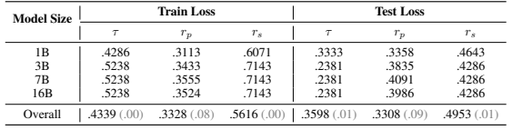
Table 7 : Correlations between trainable parameters and final loss. p-values are provided in gray.
원문 · CC BY 4.0 · Terry Yue Zhuo, Armel Zebaze, Nitchakarn Suppattarachai, Leandro von Werra, Harm de Vries, Qian Liu, Niklas Muennighoff · Astraios: Parameter-Efficient Instruction Tuning Code Large Language Models · 원문 그림 인용 · 원본 PDF 22쪽에서 그림 영역을 추출했습니다.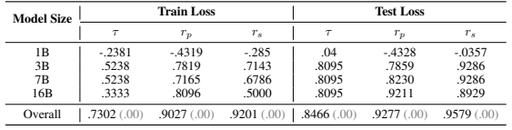
Table 8 : Correlations between final loss and overall task performance. p-values are provided in gray.
원문 · CC BY 4.0 · Terry Yue Zhuo, Armel Zebaze, Nitchakarn Suppattarachai, Leandro von Werra, Harm de Vries, Qian Liu, Niklas Muennighoff · Astraios: Parameter-Efficient Instruction Tuning Code Large Language Models · 원문 그림 인용 · 원본 PDF 23쪽에서 그림 영역을 추출했습니다.단일 실행과 적용 범위의 한계
이 연구의 결과는 과제별 단일 실행에 기반하며, 반복 실행을 통한 분산 평가는 수행되지 않았다고 명시됩니다. 그래서 작은 성능 차이는 실행 편차와 구분해서 읽어야 합니다. 또한 데이터 스케일링과 모델 아키텍처 변화는 이 연구의 변수가 아니며, 결과는 StarCoder 기반의 GPT 계열 구조와 CommitPackFT+OASST 데이터에서 얻은 것입니다. 전체 PEFT 방법 중 일부만 포함했다는 점도 범위를 제한합니다. 다른 아키텍처나 데이터 규모에서 같은 결론이 성립하는지는 이 논문에서 검증하지 않았습니다.
논문 정보
- 저자
- Terry Yue Zhuo, Armel Zebaze, Nitchakarn Suppattarachai, Leandro von Werra, Harm de Vries, Qian Liu, Niklas Muennighoff
- 학회·저널
- arXiv · 프리프린트
- 최초 공개일
- 2024년 1월 1일
- 등록일
- 2026년 11월 5일
- 수정일
- 2024년 1월 1일
- 버전
- v1
- arXiv
- 2401.00788
- 분류
- cs.CL · cs.AI · cs.SE
- 원문 이용 조건
- CC BY 4.0
- 제공 범위
- 논문 정보, 해설, 허용된 원문 그림
AI 해설은 논문 원문과 별개의 설명이며 오류가 있을 수 있습니다. 원문과 그림은 각 출처의 이용 조건과 따로 표시된 권리를 따릅니다.
초록
The high cost of full-parameter fine-tuning (FFT) of Large Language Models (LLMs) has led to a series of parameter-efficient fine-tuning (PEFT) methods. However, it remains unclear which methods provide the best cost-performance trade-off at different model scales. We introduce Astraios, a suite of 28 instruction-tuned OctoCoder models using 7 tuning methods and 4 model sizes up to 16 billion parameters. Through investigations across 5 tasks and 8 different datasets encompassing both code comprehension and code generation tasks, we find that FFT generally leads to the best downstream performance across all scales, and PEFT methods differ significantly in their efficacy based on the model scale. LoRA usually offers the most favorable trade-off between cost and performance. Further investigation into the effects of these methods on both model robustness and code security reveals that larger models tend to demonstrate reduced robustness and less security. At last, we explore the relationships among updated parameters, cross-entropy loss, and task performance. We find that the tuning effectiveness observed in small models generalizes well to larger models, and the validation loss in instruction tuning can be a reliable indicator of overall downstream performance.
원문 인용
Terry Yue Zhuo, Armel Zebaze, Nitchakarn Suppattarachai, Leandro von Werra, Harm de Vries, Qian Liu, Niklas Muennighoff (2024). Astraios: Parameter-Efficient Instruction Tuning Code Large Language Models. arXiv:2401.00788v1. https://arxiv.org/abs/2401.00788v1
BibTeX
@misc{zhuo2024astraios,
  title = {{Astraios: Parameter-Efficient Instruction Tuning Code Large Language Models}},
  author = {Terry Yue Zhuo and Armel Zebaze and Nitchakarn Suppattarachai and Leandro von Werra and Harm de Vries and Qian Liu and Niklas Muennighoff},
  year = {2024},
  eprint = {2401.00788},
  archivePrefix = {arXiv},
  url = {https://arxiv.org/abs/2401.00788v1}
}