논문 해설
Reinforcement Learning Enables Autonomous Microrobot Navigation and Intervention in Simulated Blood Capillaries
강화학습으로 모의 혈관 모세혈관에서 자율 미세로봇의 항법과 개입을 가능하게 하기
- 연구 문제 모세혈관처럼 유동과 적혈구 장애물이 있는 환경에서 강화학습 에이전트가 화학주성으로 이동하는 정책을 학습할 수 있는지 검증합니다.
- 연구 방법 분기 구조와 정상 상태 유동장, 적혈구 장애물을 포함한 모세혈관 시뮬레이션에서 PPO 기반 액터-크리틱 에이전트를 학습시킵니다.
- 주요 결과 로봇 반지름 1.4 µm, 2.5 body lengths per second 조건에서 최고 성공 확률 80 %가 관찰되었고, 학습된 Run-and-Rotate 정책은 재학습 없이 차단과 해제 과제에 적용되었습니다.
모세혈관에서 화학주성 항법이 필요한 이유
마이크로로봇이 혈관 안에서 치료 작업을 수행하려면 낮은 Reynolds 수 조건에서 추진하면서 유동과 잡음 속에서도 목표를 찾아야 합니다. 기존 강화학습 연구는 주로 이상화된 기하, 단순한 채널, 균일한 유동장에서 진행되었습니다. 이 논문은 분기하는 모세혈관 네트워크, 유동장, 적혈구(RBC) 장애물, [브라운 운동]이 함께 있는 환경을 물리적으로 근거 있게 모델링하고, 그 안에서 에이전트가 [화학주성]으로 이동하는 정책을 학습할 수 있는지 묻습니다.
이 질문에서 핵심 난점은 세 가지입니다. 첫째, 로봇의 추진력이 작을 때 브라운 운동과 모세혈관 유동이 이동을 방해합니다. 둘째, 분기 구조와 벽 경계 때문에 원천까지의 경로가 길고 굴곡집니다. 셋째, 적혈구 충돌이 로봇의 궤적을 계속 바꿉니다. 따라서 이 연구는 로봇 크기와 속도에 따른 항법 가능 영역을 함께 확인하는 것을 범위로 삼습니다.
모세혈관 환경과 학습 구조
환경은 200 µm 폭의 2차원 영역으로 구성되며, 높이는 184.13 µm입니다. 해부학적 모세혈관 그림을 이진화한 경계 위에서 Lattice-Boltzmann 방법으로 정상 상태 유동장을 계산합니다. 최고 속도는 평균 유속의 약 3.5배입니다. 화학 신호는 원천으로부터 경계를 따라 측정한 최단 경로 거리 \(d_s\)에 대해 \(f(\vec r)=1/d_s(\vec r)\)로 주어집니다. 이 정적 농도장은 모세혈관 내부에만 제한되어 분기 구조를 따릅니다.
에이전트의 관측값은 로봇 위치에서 농도 변화입니다. 논문은 \(o_i(t)=w\cdot[f(\vec r_i(t))-f(\vec r_i(t-\Delta t))]\)로 정의하고, 가중치 \(w=100\), 행동 간격 \(\Delta t=0.1\) s를 사용합니다. 보상은 \(r_i(t)=\max(0,o_i(t))\)로 잘라서, 원천에 가까워질 때만 보상을 받고 멀어질 때 벌점은 주지 않습니다. 행동은 이동, 시계 방향 회전, 반시계 방향 회전, 정지의 네 가지입니다.
학습은 PPO와 GAE를 쓰는 액터-크리틱 구조로 진행되며, 모든 에이전트가 하나의 액터와 크리틱을 공유하고 경험을 모아 갱신합니다. 목적함수에는 탐색을 장려하는 엔트로피 항이 더해지며, 이 논문에서 그 계수는 0.02입니다. 학습 중 모델은 보상이 이전 최고값을 넘을 때 저장되고, 성능이 가장 좋은 체크포인트가 재학습 없이 배치 평가에 쓰입니다.
로봇 크기·속도별 성공 영역과 전략 군집
로봇 반지름과 유영 속도를 바꾸어 각 조합마다 30개의 독립 학습 실행을 수행했습니다. 각 실행에서 10개의 로봇을 사용했고, 2시간 배치 실행에서 10개 가운데 8개 이상이 원천 20 µm 이내에 도달하면 성공으로 판정했습니다. 최고 성공 확률 80 %는 반지름 1.4 µm의 중간 크기 로봇이 2.5 body lengths per second의 중간 속도에서 얻은 값입니다. 작은 저속 로봇 영역에서는 브라운 운동과 유동 항력이 추진을 압도하는 금지 영역이 나타납니다.
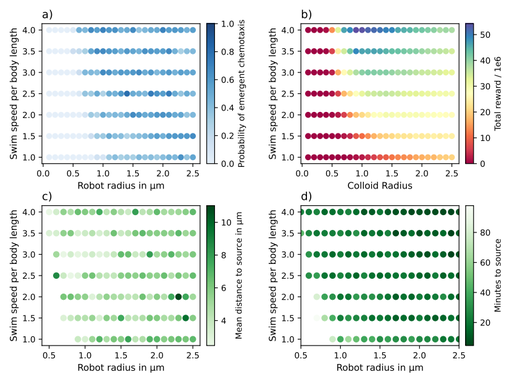
Figure 2 :Navigation performance across robot parameters. a)Probability of successful chemotaxis (opacity scales with success rate); success requires≥8of 10 robots reaching within 20µmof the source.b)Cumulative reward across all 30 training runs per parameter combination. c)Mean equilibrium distance from the source.d)Mean time to reach the equilibrium distance.
원문 · CC BY 4.0 · Jannik Drotleff, Samuel Tovey, Paul Hohenberger, Christoph Lohrmann, Julian Hoßbach, Konstantin Nikolaou, Christian Holm · Reinforcement Learning Enables Autonomous Microrobot Navigation and Intervention in Simulated Blood Capillaries · 원문 그림 인용 · 원본 PDF 5쪽에서 그림 영역을 추출했습니다.이 최고 성공 확률은 최고 성능이 가장 빠른 로봇이 아니라 중간 크기 로봇에서 나타난다는 점을 보여 줍니다. 한편 정책 임베딩을 t-SNE로 시각화하고 k-means로 군집화하면 k=11이 선택됩니다. 두 개의 큰 군집(1과 2)은 회전과 이동을 전환하는 Run-and-Rotate 전략으로 해석되었습니다. 군집 4와 그 변형들은 목표 근처에서 정지하고 유동에 밀려난 뒤 다시 접근하는 Search-and-Sit 형태를 보였습니다. 이 군집 구조는 로봇 반지름별로 여러 군집에 걸쳐 나타나므로, 전략이 로봇 물리 파라미터와 독립적이라는 저자들의 해석을 뒷받침합니다.
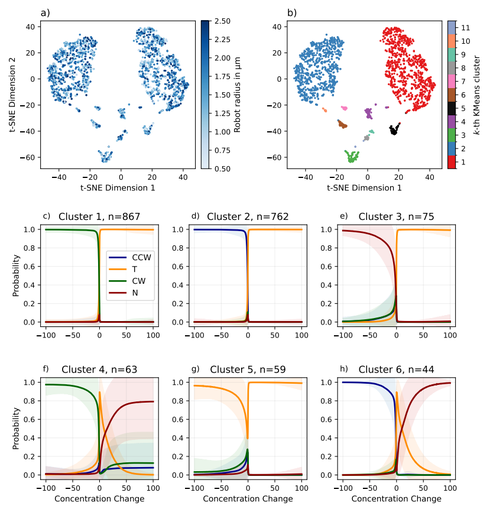
Figure 3 :Strategy analysis. a)t-SNE embedding of learned policies colored by robot radius.b) Sameembeddingcoloredbyk-meansclusterassignment(k= 11, selectedbysilhouetteanalysis[36]). c–h)Mean action probability distributions (bold lines) and standard deviation (shaded) for the six largest clusters as a function of sensed concentration change. Positive values indicate motion toward the source; amplitude reflects proximity. Remaining clusters shown in Section D.
원문 · CC BY 4.0 · Jannik Drotleff, Samuel Tovey, Paul Hohenberger, Christoph Lohrmann, Julian Hoßbach, Konstantin Nikolaou, Christian Holm · Reinforcement Learning Enables Autonomous Microrobot Navigation and Intervention in Simulated Blood Capillaries · 원문 그림 인용 · 원본 PDF 6쪽에서 그림 영역을 추출했습니다.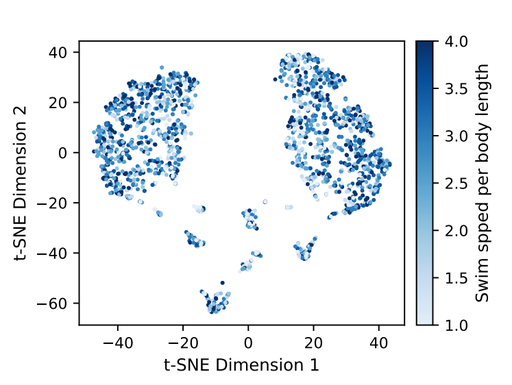
Figure 8 :t-SNE embedding colored by swimming speed.The color indicates swim speed in body lengths per second. Robots of all speeds appear across clusters, confirming that emergent strategies are velocity-independent.
원문 · CC BY 4.0 · Jannik Drotleff, Samuel Tovey, Paul Hohenberger, Christoph Lohrmann, Julian Hoßbach, Konstantin Nikolaou, Christian Holm · Reinforcement Learning Enables Autonomous Microrobot Navigation and Intervention in Simulated Blood Capillaries · 원문 그림 인용 · 원본 PDF 19쪽에서 그림 영역을 추출했습니다.학습된 전략을 재학습 없이 배치했을 때 평형 거리는 2 µm에서 11 µm 범위였고, 뚜렷한 크기 추세는 보이지 않았습니다. 도달 시간은 단순 브라운 운동 사례의 10 min에서 80 min보다 약 10배 길었으며, 이는 유동 반대 방향의 순속도 감소와 모세혈관 경로의 굴곡 때문이라고 저자들은 해석합니다. 차단 실험에서는 각 튜브에 y=90 µm 높이의 화학 소스를 두고 Run-and-Rotate 정책을 적용했습니다. 로봇이 클수록 적은 수로 완전한 폐색에 도달했고, 누출률은 에이전트 수에 따라 임계 밀도까지 선형으로 감소했습니다. 해제 실험에서는 20개의 로봇을 배치했으며, 해제 후 누출률이 자유 유동 기준선과 겹쳤습니다.
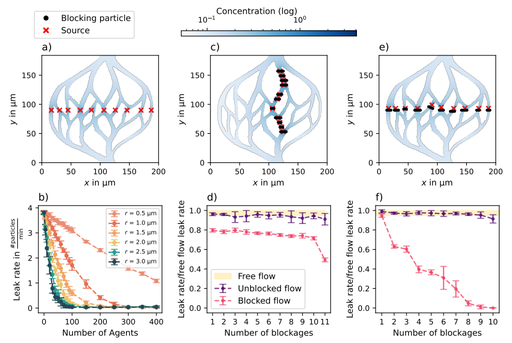
Figure 4 :Targeted capillary intervention. a)Blocking task setup: chemical sources (red crosses) placed aty= 90µmin each vessel branch.b)Measured leak rate versus number of agents for varying robot radii; larger agents achieve full occlusion with fewer robots.c,d)Vertical unblock- ing setup and normalized leak rates showing near-complete flow restoration (green) relative to free flow (blue) and blocked baseline (red).e,f)Horizontal unblocking setup and corresponding leak rates.
원문 · CC BY 4.0 · Jannik Drotleff, Samuel Tovey, Paul Hohenberger, Christoph Lohrmann, Julian Hoßbach, Konstantin Nikolaou, Christian Holm · Reinforcement Learning Enables Autonomous Microrobot Navigation and Intervention in Simulated Blood Capillaries · 원문 그림 인용 · 원본 PDF 8쪽에서 그림 영역을 추출했습니다.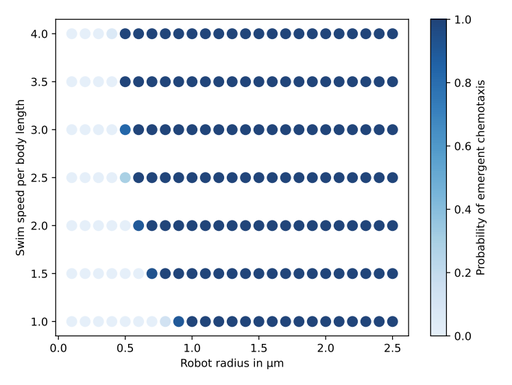
Figure 6 :Cross-parameter model transfer.A single successfully trained policy was deployed across all robot sizes and speeds (30 simulations per combination). Color indicates the probability of successful chemotaxis (≥8 of 10 agents within20µmof the source). The persistent forbidden region confirms a fundamental physical boundary rather than an algorithmic limitation.
원문 · CC BY 4.0 · Jannik Drotleff, Samuel Tovey, Paul Hohenberger, Christoph Lohrmann, Julian Hoßbach, Konstantin Nikolaou, Christian Holm · Reinforcement Learning Enables Autonomous Microrobot Navigation and Intervention in Simulated Blood Capillaries · 원문 그림 인용 · 원본 PDF 17쪽에서 그림 영역을 추출했습니다.모델링 단순화와 적용 범위
이 연구는 2차원 모델이며, 적혈구를 약 5 µm의 타원형 변형체가 아니라 효과적 지름 3 µm의 구형 입자로 근사합니다. 혈관 벽은 강체로 가정하고, Fåhræus-Lindqvist 효과는 명시적으로 모델링하지 않았습니다. 또한 유동장은 정상 상태이며 맥동성 혈류는 다루지 않았습니다.
유동 속도 역시 실제 생리적 값과 차이가 있습니다. 시뮬레이션 유동은 µm/s 수준이지만, 저자들이 인용한 모세혈관 혈류는 0.47 mm/s에서 0.84 mm/s 범위입니다. 저자들은 벽 근처 유속이 중심보다 느릴 수 있어 추진 요구가 완화될 수 있다고 논의하지만, 이는 저자들의 해석이며 이 시뮬레이션에서 검증된 결과는 아닙니다. 따라서 이 결과는 이 시뮬레이션 조건에서의 물리적 가능성과 정책 행동을 보여 주며, 실제 생체 내 치료 성능을 직접 입증하지는 않습니다.
논문 정보
- 저자
- Jannik Drotleff, Samuel Tovey, Paul Hohenberger, Christoph Lohrmann, Julian Hoßbach, Konstantin Nikolaou, Christian Holm
- 학회·저널
- arXiv · 프리프린트
- 최초 공개일
- 2026년 6월 23일
- 등록일
- 2026년 11월 6일
- 수정일
- 2026년 6월 23일
- 버전
- v1
- arXiv
- 2606.26154
- 분류
- cs.RO · cs.LG · physics.bio-ph
- 원문 이용 조건
- CC BY 4.0
- 제공 범위
- 논문 정보, 해설, 허용된 원문 그림
AI 해설은 논문 원문과 별개의 설명이며 오류가 있을 수 있습니다. 원문과 그림은 각 출처의 이용 조건과 따로 표시된 권리를 따릅니다.
초록
Autonomous microrobots navigating biological vasculature could enable targeted drug delivery and thrombolysis, yet training control policies for realistic environments remains an open challenge. Prior reinforcement learning (RL) studies of microrobotic navigation have been limited to idealized geometries that omit complex hydrodynamic flow fields, confined branching structures, and dense cellular obstacles found in vivo. Here, we develop a physically grounded simulation of a blood capillary network, incorporating realistic hydrodynamic flow fields, explicit red blood cell dynamics, and anatomically derived branching geometry, and train deep RL agents to navigate it via chemotaxis. We systematically map the physical limits of navigation across robot size and swimming speed, revealing a forbidden regime where Brownian motion and flow overcome propulsion. Successful agents independently discover multiple universal strategy types, including run-and-rotate and energy-efficient search-and-sit policies, regardless of robot parameters. Without retraining, these agents perform targeted blocking and unblocking of capillary flow, restoring throughput to healthy baseline levels. These results establish RL as a viable framework for developing autonomous microrobotic intervention strategies in complex biological environments.
원문 인용
Jannik Drotleff, Samuel Tovey, Paul Hohenberger, Christoph Lohrmann, Julian Hoßbach, Konstantin Nikolaou, Christian Holm (2026). Reinforcement Learning Enables Autonomous Microrobot Navigation and Intervention in Simulated Blood Capillaries. arXiv:2606.26154v1. https://arxiv.org/abs/2606.26154v1
BibTeX
@misc{drotleff2026reinforcement,
  title = {{Reinforcement Learning Enables Autonomous Microrobot Navigation and Intervention in Simulated Blood Capillaries}},
  author = {Jannik Drotleff and Samuel Tovey and Paul Hohenberger and Christoph Lohrmann and Julian Hoßbach and Konstantin Nikolaou and Christian Holm},
  year = {2026},
  eprint = {2606.26154},
  archivePrefix = {arXiv},
  url = {https://arxiv.org/abs/2606.26154v1}
}