논문 해설
PhysioWave-T: Token-Efficient Wavelet Foundation Models for Biosignals
PhysioWave-T: 생체신호를 위한 토큰 효율적 웨이블릿 파운데이션 모델
- 연구 문제 다중 스케일 웨이블릿 분해는 생체신호에 적합하지만, 서브밴드를 각각 토큰으로 펼치면 시퀀스가 분해 깊이와 채널 수에 비례해 길어집니다.
- 연구 방법 PhysioWave-T는 경로별 웨이블릿 프런트엔드가 J+1개 서브밴드를 동적 스케일 폴딩으로 하나의 C×T 신호로 접어 토큰 수를 CS로 유지합니다.
- 주요 결과 EEG 인코더는 여러 EEG 과제와 ECG·sEMG 벤치마크에서 기준 모델과 비교해 높은 값을 보고합니다. 스케일 폴딩은 네 EEG 경로에서 지연과 메모리를 크게 줄입니다.
다중 스케일 웨이블릿과 토큰 수의 충돌
웨이블릿 분해는 비정상(non-stationary) 생체신호의 시간-주파수 구조를 잘 포착합니다. 그러나 J단계 분해된 C개 채널과 S개 패치를 모두 Transformer 토큰으로 펼치면 (J+1)CS개의 토큰이 생기고, 채널 수·윈도우 길이·분해 깊이가 모두 시퀀스 길이를 늘립니다. 특히 EEG는 임상 montage가 데이터셋마다 다르고 전극 수가 많아 이 문제가 가장 심합니다. 이 논문은 이 긴장 관계를 해결하여 다중 스케일 정보를 유지하면서도 토큰 수가 늘어나지 않는 구조를 목표로 합니다.
경로별 프런트엔드와 동적 스케일 폴딩
PhysioWave-T는 채널 수와 샘플링 레이트로 정의되는 경로(route)마다 전용 웨이블릿 프런트엔드와 샘플링 레이트별 패치 임베딩을 둡니다. 이 프런트엔드는 J+1개 서브밴드를 만든 뒤 동적 스케일 폴딩으로 하나의 C×T 신호로 재결합합니다. 폴딩 가중치 α는 채널별, 시간 블록별 서브밴드 통계로 예측되며, 델타 초기화된 합성 필터와 균일 가중치에서 시작하므로 초기 폴딩은 서브밴드의 정확한 평균이 됩니다. 이 접힌 신호를 패치로 나누면 토큰은 CS개가 되어 분해 깊이와 무관해집니다. 채널 정체성은 이름 임베딩으로 더해지며, 폴딩 파라미터에는 채널 인덱스가 없어 몽타주 사이에 그대로 옮길 수 있습니다.
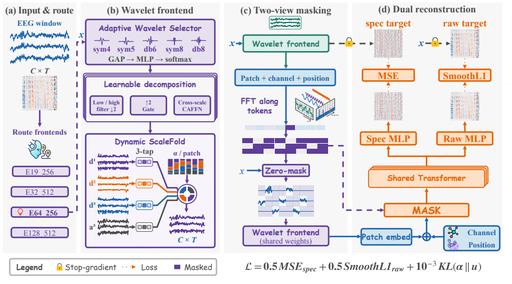
Fig. 1 . Overview of PhysioWave-T, shown for EEG. (a) Channel count and sampling rate select a route-specific front end. (b) Adaptive wavelet decomposition and dynamic scale folding produce one C × T signal. (c) Spectral importance of clean-view tokens selects masked patches, zeroed before the online front end. (d) A shared Transformer and two MLP heads reconstruct raw and folded-wavelet patches against stop-gradient targets.
원문 · CC BY 4.0 · Yanlong Chen, Simone Benatti, Luca Benini, Cuntai Guan, Yawei Li · PhysioWave-T: Token-Efficient Wavelet Foundation Models for Biosignals · 원문 그림 인용 · 원본 PDF 3쪽에서 그림 영역을 추출했습니다.EEG 인코더의 전이 성능과 적응 방식
EEG 인코더는 PhysioNet-P300, Sleep-EDFx, KaggleERN에서 BENDR, BIOT, LaBraM, EEGPT와 같은 교차 검증 프로토콜로 비교되었습니다. 미세 조정한 PhysioWave-T는 Table 2에서 9개 지표 중 8개에서 최고 값을 보고합니다. 결과 해석에서 KaggleERN은 프로브(동결)보다 fine-tuning이 필요했고, PhysioNet-P300에서는 동결 인코더도 기준선을 넘었습니다. 이 점수들은 원 논문과 같은 프로토콜로 인용된 기준선과 세 시드 평균 결과를 함께 놓은 것이므로, 모든 비교가 하나의 자체 측정으로 이루어졌다고 읽으면 안 됩니다.
ECG와 sEMG 전이 결과
ECG 평가는 PTB-XL Super와 Chapman–Shaoxing의 macro-F1에서 PhysioWave-T가 가장 높은 값을 보고합니다. PTB-XL Super의 macro-F1은 70.9%이고 Chapman–Shaoxing은 56.7%입니다. 다만 CPSC 2018의 macro-AUROC나 PTB-XL Super에서는 PhysioWave-L이 더 높은 값을 보였으므로, macro-F1과 macro-AUROC는 같은 우위를 뜻하지 않습니다. sEMG에서는 EPN-612와 GRABMyo에서 12M 파라미터 모델이 가장 높은 정확도와 macro-F1을 보고합니다. 이 결과는 각 벤치마크의 프로토콜에 묶여 있으며, 사용한 입력 구성에 따라 해석이 달라집니다.
신뢰도 인지 잠재 융합의 작동
RALF는 독립적으로 사전 학습된 EEG, ECG, sEMG 인코더를 고정하고, 각 인코더에서 네 개의 요약 토큰을 뽑습니다. 모달리티별 시그모이드 헤드가 샘플별 신뢰도 r_m을 예측하고, 이 값은 해당 모달리티의 어텐션 키·값을 게이팅하며 단위 모달 로짓의 잔차 기여를 가중합니다. 부재 모달리티는 어텐션 마스크로 제외됩니다. SeizeIT2에서 11 false alarms/h 기준 민감도는 PhysioWave-T 단독의 61.4%에서 RALF 융합 시 78.9%로 보고됩니다. 다만 원문은 이 값을 가중 로짓 융합의 설정과 함께 제시하며, 본 논문에서 이 수치가 모든 융합 방식에 공통으로 적용된다고 주장하지는 않습니다.
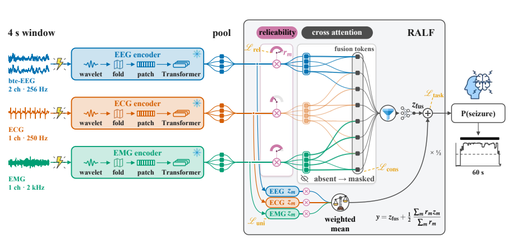
Fig. 6 . Reliability-aware latent fusion (RALF) of 4-s EEG, ECG, and EMG windows. Reliability scores gate tokens and weight unimodal predictions. Orange symbols denote training losses; the trace shows seizure probability over a 60-s test excerpt with a 0.5 threshold.
원문 · CC BY 4.0 · Yanlong Chen, Simone Benatti, Luca Benini, Cuntai Guan, Yawei Li · PhysioWave-T: Token-Efficient Wavelet Foundation Models for Biosignals · 원문 그림 인용 · 원본 PDF 7쪽에서 그림 영역을 추출했습니다.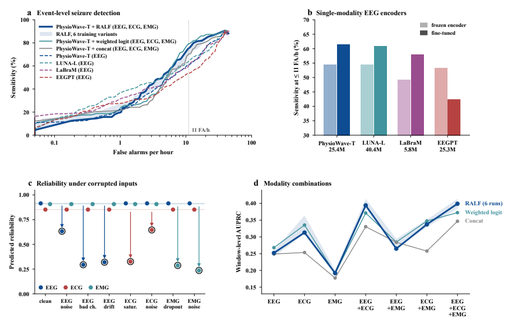
Fig. 7 . Seizure detection on SeizeIT2 (official split, 29 test patients, 2,912 h, 181 seizures). (a) Event-level sensitivity against false alarms per hour for the three fusion rules over the frozen PhysioWave-T encoders and for each EEG-only encoder at its better of frozen and fine-tuned; the dotted line is the 11 false alarms per hour of the dataset paper’s SVM. (b) Frozen and fine-tuned EEG encoders at≤11 false alarms per hour, with encoder size. (c) RALF’s predicted reliability on clean inputs and with one modality corrupted at severity 0.7; the ringed point is the corrupted modality. (d) Window-level AUPRC of every modality subset. The RALF line is the original training configuration; the shaded band in (a) and (d) is the min–max over six RALF training variants, the original and five learning-rate and schedule settings.
원문 · CC BY 4.0 · Yanlong Chen, Simone Benatti, Luca Benini, Cuntai Guan, Yawei Li · PhysioWave-T: Token-Efficient Wavelet Foundation Models for Biosignals · 원문 그림 인용 · 원본 PDF 10쪽에서 그림 영역을 추출했습니다.스케일 폴딩의 지연과 메모리 비용
스케일 확장과 비교하면 동적 스케일 폴딩은 A100에서 bf16으로 측정한 네 EEG 경로의 Transformer 지연을 4.0–7.2배, 피크 메모리를 6.8–12.7배 줄입니다. 메모리 절감이 FLOPs 절감보다 큰 이유는 어텐션 맵이 시퀀스 길이의 제곱으로 커지기 때문이며, 폴딩 자체 비용은 순전파의 1.5–2.6%에 그칩니다. 이 측정은 경로별로 맞춘 배치 크기를 사용했고, pre-training 메모리 보고와 조건이 다르므로 같은 값으로 읽으면 안 됩니다.
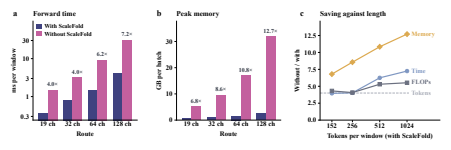
Fig. 8 . EEG encoder efficiency on one A100 in bf16, averaged over three seeds. (a) Latency per window. (b) Peak memory per batch. (c) Savings versus token count.
원문 · CC BY 4.0 · Yanlong Chen, Simone Benatti, Luca Benini, Cuntai Guan, Yawei Li · PhysioWave-T: Token-Efficient Wavelet Foundation Models for Biosignals · 원문 그림 인용 · 원본 PDF 11쪽에서 그림 영역을 추출했습니다.적용 범위와 남은 과제
저자는 본 논문의 손상 실험이 합성 손상(noise, drift, saturation, bad channel, dropout)이라고 밝힙니다. 자연적인 센서 실패를 가진 실제 기록, 다중모달 공동 pre-training, photoplethysmography 같은 새 경로는 이후 과제로 남겨 둡니다. 또한 sEMG에서 프로브가 EPN-612에서 기준보다 낮았던 것은 200 Hz 밴드와 pre-training 필터의 주파수 불일치와 관련된다고 저자들은 해석합니다. 이는 저자의 해석이며 별도의 인과 실험으로 확인된 결과가 아닙니다.
논문 정보
- 저자
- Yanlong Chen, Simone Benatti, Luca Benini, Cuntai Guan, Yawei Li
- 학회·저널
- arXiv · 프리프린트
- 최초 공개일
- 2026년 11월 6일
- 등록일
- 2026년 11월 9일
- 수정일
- 2026년 11월 6일
- 버전
- v1
- arXiv
- 2611.08969
- 분류
- cs.AI
- 원문 이용 조건
- CC BY 4.0
- 제공 범위
- 논문 정보, 해설, 허용된 원문 그림
AI 해설은 논문 원문과 별개의 설명이며 오류가 있을 수 있습니다. 원문과 그림은 각 출처의 이용 조건과 따로 표시된 권리를 따릅니다.
초록
We present PhysioWave-T, a token-efficient wavelet foundation model family for EEG, ECG, and sEMG. Dynamic scale folding recombines J+1 wavelet subbands prior to tokenization, compressing sequence length from (J+1)CS to CS tokens for J levels, C channels, and S temporal patches. Route-specific front ends and learned channel-name embeddings allow one Transformer per modality to handle diverse montages and sampling rates, while unseen setups reuse the backbone via lightweight adapters. We pre-train a 30M-parameter EEG model on over 15M windows (19--128 channels), alongside ECG (30M) and sEMG (12M) encoders. Across four EEG routes, scale folding cuts Transformer latency by 4.0--7.2x and peak memory by 6.8--12.7x over scale expansion without accuracy loss. Our EEG encoder leads 8 of 9 metrics against BENDR, BIOT, LaBraM, and EEGPT, and surpasses LUNA-L on wearable seizure detection with fewer parameters. Reliability-aware latent fusion (RALF) further integrates summary tokens from independently pre-trained encoders via sample-adaptive weights. On SeizeIT2, RALF raises event sensitivity at 11 false alarms/h from 61.4% to 74.4% and window AUPRC from 0.321 to 0.399 over the best unimodal baseline, outperforming weighted-logit and concatenation fusion across all variants. PhysioWave-T also achieves state-of-the-art sEMG accuracies and top macro-F1 on PTB-XL Super and Chapman-Shaoxing. Code and models: https://github.com/ForeverBlue816/PhysioWave.
원문 인용
Yanlong Chen, Simone Benatti, Luca Benini, Cuntai Guan, Yawei Li (2026). PhysioWave-T: Token-Efficient Wavelet Foundation Models for Biosignals. arXiv:2611.08969v1. https://arxiv.org/abs/2611.08969v1
BibTeX
@misc{chen2026physiowave,
  title = {{PhysioWave-T: Token-Efficient Wavelet Foundation Models for Biosignals}},
  author = {Yanlong Chen and Simone Benatti and Luca Benini and Cuntai Guan and Yawei Li},
  year = {2026},
  eprint = {2611.08969},
  archivePrefix = {arXiv},
  url = {https://arxiv.org/abs/2611.08969v1}
}