논문 해설
DreamBooth: Fine Tuning Text-to-Image Diffusion Models for Subject-Driven Generation
DreamBooth: 주제 기반 생성을 위한 텍스트-이미지 확산 모델 fine-tuning
- 연구 문제 기존 텍스트-이미지 모델은 프롬프트로 다양한 이미지를 만들 수 있지만, 몇 장의 참조 이미지에 나타난 특정 피사체의 외형을 유지하면서 새로운 장면에 배치하는 데 한계가 있습니다.
- 연구 방법 DreamBooth는 3-5장의 피사체 이미지와 고유 식별자가 포함된 프롬프트로 사전 학습된 확산 모델을 미세 조정합니다. 클래스별 사전 보존 손실은 모델이 생성한 같은 클래스 샘플로 감독하여 언어 표류와 출력 다양성 저하를 줄입니다.
- 주요 결과 Imagen 기반 DreamBooth는 표 1에서 DINO 0.696을 기록해 Textual Inversion(Stable Diffusion)의 0.569보다 높았습니다. 사용자 연구에서도 DreamBooth(Stable Diffusion)은 주체 충실도 68%, 프롬프트 충실도 81%의 선호를 받았으며, 이는 저자들의 30개 피사체 데이터셋과 해당 비교 설정에서 얻은 결과입니다.
개인 피사체를 재현하기 어려운 이유
텍스트-이미지 확산 모델은 텍스트 프롬프트만으로 다양하고 고품질인 이미지를 만들 수 있습니다. 그러나 참조 이미지 속 특정 피사체의 외형을 유지하면서 새로운 장면에 배치하는 능력은 부족합니다. 같은 'dog'라는 단어에도 모델은 서로 다른 외형의 개를 생성하므로, 특정 반려견이나 특정 가방처럼 개별 대상을 정확히 가리키기 어렵습니다. 텍스트 설명을 아무리 자세히 써도 출력 영역이 제한되어 같은 외형이 다시 나오지 않는다는 점이 이 문제의 핵심입니다.
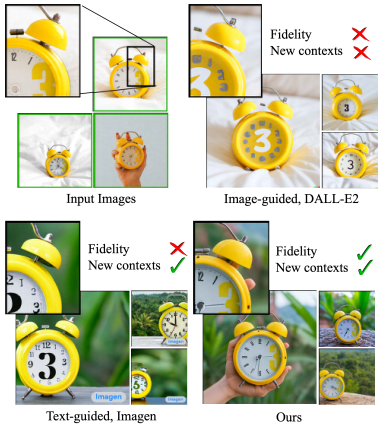
Figure 2 . Subject-driven generation. Given a particular clock (left), it is hard to generate it while maintaining high fidelity to its key visual features (second and third columns showing DALL- E2 [54] image-guided generation and Imagen [61] text-guided generation; text prompt used for Imagen:“retro style yellow alarm clock with a white clock face and a yellow number three on the right part of the clock face in the jungle” ). Our approach (right) can synthesize the clock with high fidelity and in new contexts (text prompt: “a [V] clock in the jungle”).
원문 · CC BY 4.0 · Nataniel Ruiz, Yuanzhen Li, Varun Jampani, Yael Pritch, Michael Rubinstein, Kfir Aberman · DreamBooth: Fine Tuning Text-to-Image Diffusion Models for Subject-Driven Generation · 원문 그림 인용 · 원본 PDF 2쪽에서 그림 영역을 추출했습니다.이 논문은 이 문제를 주체 기반 생성(subject-driven generation)으로 정의합니다. 목표는 보통 3-5장의 피사체 이미지만으로 모델을 개인화하여, 피사체의 핵심 시각 특징을 유지하면서 포즈, 조명, 장면을 바꾼 이미지를 생성하는 것입니다. 입력 이미지의 촬영 조건에 제한을 두지 않는다는 점도 이 문제 설정의 일부입니다.
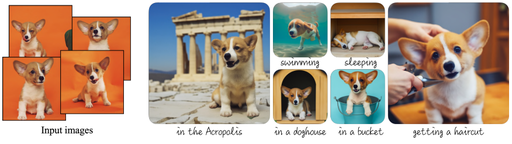
Figure 1 . With just a few images (typically 3-5) of a subject (left), DreamBooth—our AI-powered photo booth—can generate a myriad of images of the subject in different contexts (right), using the guidance of a text prompt. The results exhibit natural interactions with the environment, as well as novel articulations and variation in lighting conditions, all while maintaining high fidelity to the key visual features of the subject.
원문 · CC BY 4.0 · Nataniel Ruiz, Yuanzhen Li, Varun Jampani, Yael Pritch, Michael Rubinstein, Kfir Aberman · DreamBooth: Fine Tuning Text-to-Image Diffusion Models for Subject-Driven Generation · 원문 그림 인용 · 원본 PDF 1쪽에서 그림 영역을 추출했습니다.고유 식별자로 피사체를 모델에 연결하기
DreamBooth는 피사체의 입력 이미지 3-5장에 'a [identifier] [class noun]' 형식의 프롬프트를 쌍으로 붙여 사전 학습된 텍스트-이미지 확산 모델을 미세 조정합니다. 예를 들어 개라면 'A [V] dog'처럼 고유 식별자 뒤에 클래스 명을 붙입니다. 클래스 명은 사용자가 제공하거나 분류기로 얻을 수 있습니다. 클래스 명을 넣으면 모델이 그 클래스에 대해 이미 가진 사전 지식을 새 식별자와 함께 활용할 수 있습니다. 반대로 클래스 명을 틀리게 쓰거나 생략하면 학습 시간이 늘고 언어 표류가 생기며 성능이 낮아진다고 보고합니다.
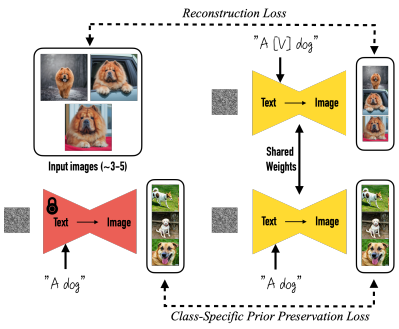
Figure 3 . Fine-tuning. Given ∼ 3−5 images of a subject we fine- tune a text-to-image diffusion model with the input images paired with a text prompt containing a unique identifier and the name of the class the subject belongs to (e.g., “A [V] dog”), in parallel, we apply a class-specific prior preservation loss, which leverages the semantic prior that the model has on the class and encourages it to generate diverse instances belong to the subject’s class using the class name in a text prompt (e.g., “A dog”).
원문 · CC BY 4.0 · Nataniel Ruiz, Yuanzhen Li, Varun Jampani, Yael Pritch, Michael Rubinstein, Kfir Aberman · DreamBooth: Fine Tuning Text-to-Image Diffusion Models for Subject-Driven Generation · 원문 그림 인용 · 원본 PDF 4쪽에서 그림 영역을 추출했습니다.고유 식별자는 영어 단어가 아니라 어휘에서 찾은 희귀 토큰을 문자열로 역변환하여 정합니다. 'unique'나 'special' 같은 일반 단어는 모델이 원래 뜻을 떼어 내고 다시 피사체에 묶는 과정을 거쳐야 하므로 적합하지 않다고 설명합니다. 무작위 문자열도 토크나이저가 글자 단위로 쪼개면 각 글자의 강한 사전 지식이 남을 수 있습니다. 그래서 Imagen에서는 공백 없이 3자 이하의 Unicode 문자에 대응하고 T5-XXL 토크나이저 범위 5000-10000에 속하는 토큰을 균등 무작위로 뽑는 방식을 씁니다.
fine-tuning은 텍스트 임베딩에 조건화된 층을 포함한 모든 층을 갱신할 때 피사체 충실도가 가장 높다고 보고합니다. 다만 이 과정에서 언어 표류가 생기므로, 다음 절의 사전 보존 손실이 함께 쓰입니다.
클래스 사전 보존 손실
fine-tuning 중에는 두 가지 문제가 생깁니다. 첫째는 모델이 클래스 명(예: dog)을 특정 피사체와 동일시하여 같은 클래스의 다른 개체를 더 이상 만들지 못하는 언어 표류입니다. 둘째는 적은 입력 이미지의 포즈나 시점에 맞춰지면서 출력 다양성이 줄어드는 현상입니다. 클래스별 사전 보존 손실은 모델이 자기 자신이 만든 같은 클래스 샘플로 감독받도록 하여 이 두 문제를 줄입니다.
구체적으로는 동결된 pre-training 확산 모델에 'a [class noun]' 조건 \(c_{pr}\)을 주고 ancestral sampler로 샘플 \(x_{pr}\)을 생성합니다. 학습 손실은 피사체 이미지 항에 이 샘플의 항을 더한 형태이며, 식은 다음과 같습니다.
\[ \mathbb{E}_{x,c,\epsilon,\epsilon',t}\big[ w_t\,\|\hat{x}_\theta(\alpha_t x+\sigma_t\epsilon,c)-x\|_2^2+\lambda\,w_{t'}\,\|\hat{x}_\theta(\alpha_{t'} x_{pr}+\sigma_{t'}\epsilon',c_{pr})-x_{pr}\|_2^2 \big] \]
여기서 두 번째 항이 사전 보존 항이며 \(\lambda\)는 그 상대 가중치입니다. 이 항은 피사체 이미지 항과 같은 확산 손실 형태를 쓰지만 대상은 모델이 생성한 클래스 샘플입니다. 따라서 피사체를 학습하는 동안에도 클래스의 사전 분포가 함께 유지됩니다.
실험 설정으로 \(\lambda=1\)을 쓰며, 학습률은 Imagen에서 \(10^{-5}\), Stable Diffusion에서 \(5\times10^{-6}\)입니다. 약 1000번의 반복과 약 1000개의 'a [class noun]' 샘플을 쓰며, 샘플은 더 적게 써도 된다고 보고합니다. 학습 시간은 Imagen에서 TPUv4 한 대로 약 5분, Stable Diffusion에서 NVIDIA A100으로 약 5분입니다.
데이터셋과 평가 지표
논문은 30개 피사체로 구성된 데이터셋을 구축했습니다. 이 중 21개는 물체이고 9개는 살아 있는 피사체나 반려동물입니다. 물체에는 recontextualization 프롬프트 20개와 property modification 프롬프트 5개가, 생물에는 recontextualization 10개, accessorization 10개, property modification 5개가 준비되었습니다. 평가 세트는 피사체와 프롬프트마다 4장씩 생성하여 총 3,000장입니다.
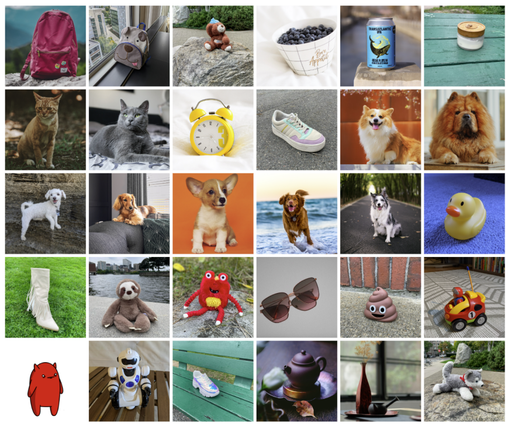
Figure 5 . Dataset. Example images for each subject in our proposed dataset.
원문 · CC BY 4.0 · Nataniel Ruiz, Yuanzhen Li, Varun Jampani, Yael Pritch, Michael Rubinstein, Kfir Aberman · DreamBooth: Fine Tuning Text-to-Image Diffusion Models for Subject-Driven Generation · 원문 그림 인용 · 원본 PDF 6쪽에서 그림 영역을 추출했습니다.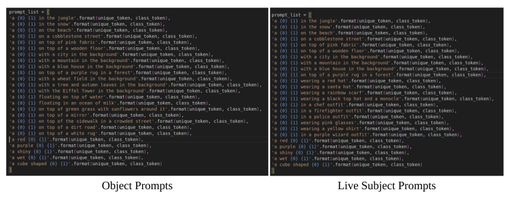
Figure 10 . Prompts. Evaluation prompts for both objects and live subjects.
원문 · CC BY 4.0 · Nataniel Ruiz, Yuanzhen Li, Varun Jampani, Yael Pritch, Michael Rubinstein, Kfir Aberman · DreamBooth: Fine Tuning Text-to-Image Diffusion Models for Subject-Driven Generation · 원문 그림 인용 · 원본 PDF 14쪽에서 그림 영역을 추출했습니다.주체 충실도는 DINO와 CLIP-I로 측정합니다. CLIP-I는 생성 이미지와 실제 이미지의 CLIP 임베딩 사이 쌍별 코사인 유사도 평균입니다. DINO는 ViT-S/16 DINO 임베딩 사이의 평균 코사인 유사도입니다. 저자들은 DINO를 선호하는 지표로 두며, DINO는 같은 클래스 안의 피사체 차이를 무시하도록 학습되지 않았기 때문이라고 설명합니다. 프롬프트 충실도는 프롬프트와 생성 이미지의 CLIP 임베딩 사이 코사인 유사도 평균인 CLIP-T로 측정합니다.
부록의 상관 분석에서 DINO는 정규화된 사람 선호 점수와 피어슨 상관계수 0.32를 보였습니다. 같은 분석에서 [20]에서 쓰인 CLIP-I는 0.27이었습니다.
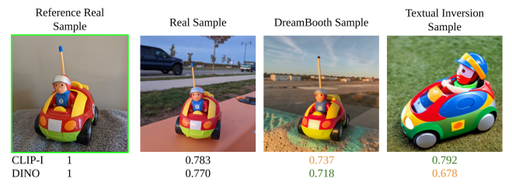
Figure 11 . CLIP-I vs. DINO Metrics. The DreamBooth CLIP-I similarity to the reference image is lower than that of the Textual Inversion sample, even though the DreamBooth subject looks more similar to the reference subject. The DINO metric more closely tracks human evaluation of subject fidelity here.
원문 · CC BY 4.0 · Nataniel Ruiz, Yuanzhen Li, Varun Jampani, Yael Pritch, Michael Rubinstein, Kfir Aberman · DreamBooth: Fine Tuning Text-to-Image Diffusion Models for Subject-Driven Generation · 원문 그림 인용 · 원본 PDF 15쪽에서 그림 영역을 추출했습니다.Textual Inversion과 비교한 결과
첫 번째 비교 대상은 Textual Inversion(Stable Diffusion)입니다. 표 1에서 DreamBooth(Imagen)의 DINO는 0.696, CLIP-I는 0.812, CLIP-T는 0.306입니다. DreamBooth(Stable Diffusion)의 값은 DINO 0.668, CLIP-I 0.803, CLIP-T 0.305입니다. Textual Inversion(Stable Diffusion)의 값은 DINO 0.569, CLIP-I 0.780, CLIP-T 0.255입니다. 실제 이미지의 DINO는 0.774, CLIP-I는 0.885입니다. 이 값들은 같은 데이터셋과 평가 프로토콜에서 측정된 결과입니다.
DreamBooth(Imagen)은 DreamBooth(Stable Diffusion)보다 주체 충실도와 프롬프트 충실도 모두에서 높은 값을 보입니다. 저자들은 이를 Imagen의 더 큰 표현력과 높은 출력 품질 때문이라고 해석합니다. 그림 4의 정성 비교에서도 DreamBooth가 주체 정체성을 더 잘 보존하고 프롬프트에 더 충실하다고 보고합니다.
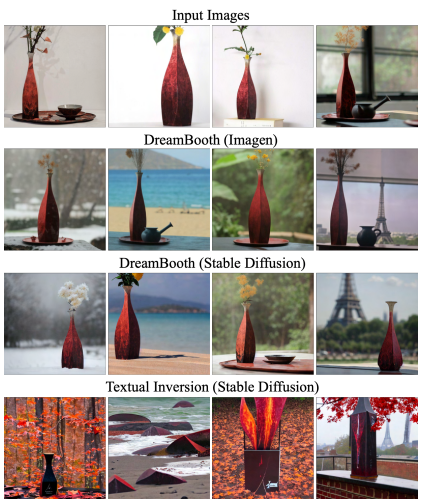
Figure 4 . Comparisons with Textual Inversion [20] Given 4 input images (top row), we compare: DreamBooth Imagen (2nd row), DreamBooth Stable Diffusion (3rd row), Textual Inversion (bottom row). Output images were created with the following prompts (left to right): “a [V] vase in the snow”, “a [V] vase on the beach”, “a [V] vase in the jungle”, “a [V] vase with the Eiffel Tower in the background”. DreamBooth is stronger in both subject and prompt fidelity.
원문 · CC BY 4.0 · Nataniel Ruiz, Yuanzhen Li, Varun Jampani, Yael Pritch, Michael Rubinstein, Kfir Aberman · DreamBooth: Fine Tuning Text-to-Image Diffusion Models for Subject-Driven Generation · 원문 그림 인용 · 원본 PDF 5쪽에서 그림 영역을 추출했습니다.두 번째 비교는 DreamBooth(Stable Diffusion)과 Textual Inversion(Stable Diffusion) 사이의 사용자 연구입니다. 72명의 사용자가 질문 25개에 답하여 총 1800개의 응답을 얻었고, 질문 하나당 3명이 답했습니다. 주체 충실도 선호는 DreamBooth 68%, Textual Inversion 22%, 판단 불가 10%입니다. 프롬프트 충실도 선호는 DreamBooth 81%, Textual Inversion 12%, 판단 불가 7%입니다. 저자들은 표 1의 DINO 차이 약 0.1과 CLIP-T 차이 약 0.05가 사용자 선호에서 의미 있는 차이라고 해석합니다.
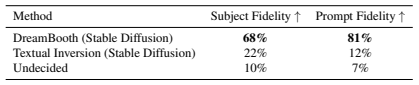
Table 2 . Subject fidelity and prompt fidelity user preference.
원문 · CC BY 4.0 · Nataniel Ruiz, Yuanzhen Li, Varun Jampani, Yael Pritch, Michael Rubinstein, Kfir Aberman · DreamBooth: Fine Tuning Text-to-Image Diffusion Models for Subject-Driven Generation · 원문 그림 인용 · 원본 PDF 5쪽에서 그림 영역을 추출했습니다.사전 보존 손실과 클래스 명 절제
PPL 절제 실험은 Imagen을 15개 피사체에 미세 조정하고 PPL 적용 여부만 바꿉니다. 표 3에서 PPL을 적용한 모델은 PRES 0.493, DIV 0.391, DINO 0.684, CLIP-I 0.815, CLIP-T 0.308입니다. 적용하지 않은 모델은 PRES 0.664, DIV 0.371, DINO 0.712, CLIP-I 0.828, CLIP-T 0.306입니다. PRES는 높을수록 무작위 클래스 피사체가 학습 피사체와 닮아 사전 지식이 무너졌음을 뜻하므로, 낮을수록 붕괴가 적습니다. DIV는 같은 피사체와 같은 프롬프트로 생성한 이미지들의 LPIPS 기반 다양성입니다. PPL을 적용하면 PRES는 낮아지고 DIV는 높아지며, DINO와 CLIP-I는 낮아지고 CLIP-T는 조금 높아집니다.
정성 결과에서도 PPL 모델은 참조 이미지의 환경에 덜 과적합되어 개를 더 다양한 포즈로 생성합니다.
클래스 명 절제 실험은 Imagen을 5개 피사체 부분집합에 미세 조정하며 클래스 명을 없음, 잘못된 명, 올바른 명으로 달리합니다. DINO는 올바른 명 0.744, 잘못된 명 0.454, 없음 0.303입니다. CLIP-I는 각각 0.853, 0.728, 0.607입니다. 잘못된 명의 예로 배낭(backpack)에 'can'을 쓰면 원통형 가방이나 형태가 어긋난 피사체가 생긴다고 보고합니다. 클래스 명을 생략하면 모델이 클래스 사전 지식을 활용하지 못해 피사체를 학습하고 수렴하는 데 어려움을 겪는다고 설명합니다.
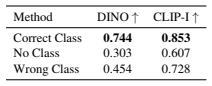
Table 4 . Class name ablation with subject fidelity metrics.
원문 · CC BY 4.0 · Nataniel Ruiz, Yuanzhen Li, Varun Jampani, Yael Pritch, Michael Rubinstein, Kfir Aberman · DreamBooth: Fine Tuning Text-to-Image Diffusion Models for Subject-Driven Generation · 원문 그림 인용 · 원본 PDF 7쪽에서 그림 영역을 추출했습니다.정성적 적용 사례
논문은 학습 후의 적용 사례를 정성적으로 보여 줍니다. 한 가지는 피사체를 다른 환경에 놓는 recontextualization이며, 포즈와 장면 구조가 달라져도 접촉, 그림자, 반사 같은 장면과의 상호작용을 포함합니다. 또 다른 사례는 'a painting of a [V] [class noun] in the style of [famous painter]' 형태의 예술 표현이며, 피사체 정체성을 유지하면서 양식 변화를 만듭니다. 새로운 시점 합성과 속성 변경도 같은 방식으로 제시됩니다. 예를 들어 특정 개와 다른 동물 종을 교배한 형태의 프롬프트에서 개의 얼굴 특징이 유지되는 예를 보여 줍니다.
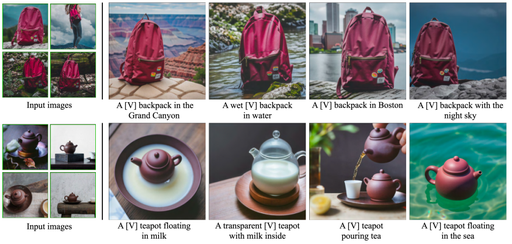
Figure 7 . Recontextualization. We generate images of the subjects in different environments, with high preservation of subject details and realistic scene-subject interactions. We show the prompts below each image.
원문 · CC BY 4.0 · Nataniel Ruiz, Yuanzhen Li, Varun Jampani, Yael Pritch, Michael Rubinstein, Kfir Aberman · DreamBooth: Fine Tuning Text-to-Image Diffusion Models for Subject-Driven Generation · 원문 그림 인용 · 원본 PDF 8쪽에서 그림 영역을 추출했습니다.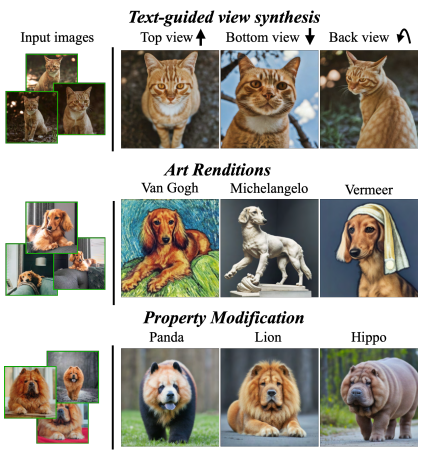
Figure 8 . Novel view synthesis, art renditions, and property modifications. We are able to generate novel and meaningful images while faithfully preserving subject identity and essence. More applications and examples in the supplementary material.
원문 · CC BY 4.0 · Nataniel Ruiz, Yuanzhen Li, Varun Jampani, Yael Pritch, Michael Rubinstein, Kfir Aberman · DreamBooth: Fine Tuning Text-to-Image Diffusion Models for Subject-Driven Generation · 원문 그림 인용 · 원본 PDF 8쪽에서 그림 영역을 추출했습니다.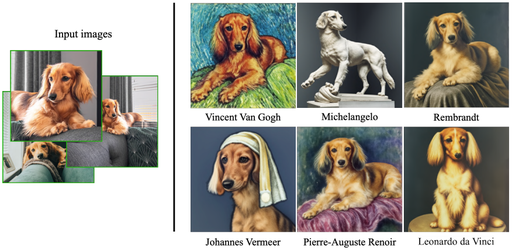
Figure 13 . Additional artistic renderings of a dog instance in the style of famous painters. We remark that many of the generated poses, e.g., the Michelangelo renditions, were not seen in the training set. We also note that some renditions seem to have novel compositions and faithfully imitate the style of the painter.
원문 · CC BY 4.0 · Nataniel Ruiz, Yuanzhen Li, Varun Jampani, Yael Pritch, Michael Rubinstein, Kfir Aberman · DreamBooth: Fine Tuning Text-to-Image Diffusion Models for Subject-Driven Generation · 원문 그림 인용 · 원본 PDF 19쪽에서 그림 영역을 추출했습니다.이 사례들은 정량 지표가 아니라 선택된 생성 이미지의 관찰입니다. 따라서 결과의 범위는 보여 준 피사체와 프롬프트에 한정된 예시로 읽어야 합니다.
실패 양상과 적용 범위
논문은 세 가지 실패 양상을 보고합니다. 첫째, 희귀한 프롬프트 문맥에서는 올바른 환경을 생성하지 못할 수 있습니다. 저자들은 이를 문맥에 대한 사전 지식이 약하거나 피사체와 문맥이 학습 데이터에서 함께 나타날 확률이 낮기 때문이라고 해석합니다. 둘째, 맥락과 외형이 얽히는 현상이 있어 프롬프트 문맥에 따라 피사체의 색 같은 외형이 바뀔 수 있습니다. 셋째, 원래 설정과 비슷한 프롬프트에서는 학습 이미지와 유사한 결과로 과적합이 나타날 수 있습니다.
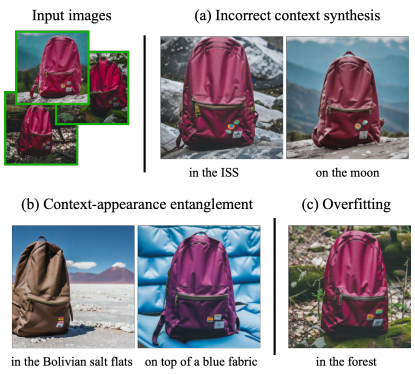
Figure 9 . Failure modes. Given a rare prompted context the model might fail at generating the correct environment (a). It is possible for context and subject appearance to become entangled (b). Finally, it is possible for the model to overfit and generate images similar to the training set, especially if prompts reflect the original environment of the training set (c).
원문 · CC BY 4.0 · Nataniel Ruiz, Yuanzhen Li, Varun Jampani, Yael Pritch, Michael Rubinstein, Kfir Aberman · DreamBooth: Fine Tuning Text-to-Image Diffusion Models for Subject-Driven Generation · 원문 그림 인용 · 원본 PDF 9쪽에서 그림 영역을 추출했습니다.또한 개나 고양이처럼 모델 분포에 자주 나타나는 피사체는 쉽게 학습되지만, 희귀한 피사체는 다양한 변형을 충분히 지원하지 못할 수 있습니다. 생성 이미지의 충실도도 고르지 않아, 모델 사전 지식의 강도와 의미 변경의 복잡도에 따라 환각된 주체 특징이 포함될 수 있습니다.
이 결과들은 저자들이 구축한 30개 피사체 데이터셋, 지정된 프롬프트, 그리고 Textual Inversion 및 Imagen·Stable Diffusion 설정에서 얻은 것입니다. 다른 피사체 분포나 다른 기반 모델에서의 일반화는 이 논문의 실험만으로 확인되지 않습니다.
논문 정보
- 저자
- Nataniel Ruiz, Yuanzhen Li, Varun Jampani, Yael Pritch, Michael Rubinstein, Kfir Aberman
- 학회·저널
- arXiv · 프리프린트
- 최초 공개일
- 2022년 8월 25일
- 등록일
- 2026년 10월 20일
- 수정일
- 2023년 3월 15일
- 버전
- v2
- arXiv
- 2208.12242
- 분류
- cs.CV · cs.GR · cs.LG
- 원문 이용 조건
- CC BY 4.0
- 제공 범위
- 논문 정보, 해설, 허용된 원문 그림
AI 해설은 논문 원문과 별개의 설명이며 오류가 있을 수 있습니다. 원문과 그림은 각 출처의 이용 조건과 따로 표시된 권리를 따릅니다.
초록
Large text-to-image models achieved a remarkable leap in the evolution of AI, enabling high-quality and diverse synthesis of images from a given text prompt. However, these models lack the ability to mimic the appearance of subjects in a given reference set and synthesize novel renditions of them in different contexts. In this work, we present a new approach for "personalization" of text-to-image diffusion models. Given as input just a few images of a subject, we fine-tune a pretrained text-to-image model such that it learns to bind a unique identifier with that specific subject. Once the subject is embedded in the output domain of the model, the unique identifier can be used to synthesize novel photorealistic images of the subject contextualized in different scenes. By leveraging the semantic prior embedded in the model with a new autogenous class-specific prior preservation loss, our technique enables synthesizing the subject in diverse scenes, poses, views and lighting conditions that do not appear in the reference images. We apply our technique to several previously-unassailable tasks, including subject recontextualization, text-guided view synthesis, and artistic rendering, all while preserving the subject's key features. We also provide a new dataset and evaluation protocol for this new task of subject-driven generation. Project page: https://dreambooth.github.io/
원문 인용
Nataniel Ruiz, Yuanzhen Li, Varun Jampani, Yael Pritch, Michael Rubinstein, Kfir Aberman (2022). DreamBooth: Fine Tuning Text-to-Image Diffusion Models for Subject-Driven Generation. arXiv:2208.12242v2. https://arxiv.org/abs/2208.12242v2
BibTeX
@misc{ruiz2022dreambooth,
  title = {{DreamBooth: Fine Tuning Text-to-Image Diffusion Models for Subject-Driven Generation}},
  author = {Nataniel Ruiz and Yuanzhen Li and Varun Jampani and Yael Pritch and Michael Rubinstein and Kfir Aberman},
  year = {2022},
  eprint = {2208.12242},
  archivePrefix = {arXiv},
  url = {https://arxiv.org/abs/2208.12242v2}
}