논문 해설
Roll the dice & look before you leap: Going beyond the creative limits of next-token prediction
주사위를 굴리고 뛰기 전에 살펴보라: 다음 토큰 예측의 창의적 한계를 넘어서
- 연구 문제 열린 창의적 과제에서 다음 토큰 예측이 다양하고 독창적인 출력을 충분히 만들지 못할 수 있는지 최소 알고리즘 과제로 검증합니다.
- 연구 방법 다음 토큰 학습과 teacherless 다중 토큰 학습을 비교하고, 출력 샘플링 대신 입력 접두 시드를 주입하는 seed-conditioning을 온도 샘플링과 비교합니다.
- 주요 결과 Gemma v1 (2B) 실험에서 다중 토큰 학습은 알고리즘 창의성을 높였고, seed-conditioning은 탐욕적 디코딩에서도 온도 샘플링에 준하는 창의성을 보였습니다. 다만 GPT-2 (86M)의 일부 격차는 top-K 샘플링에 의존합니다.
창의적 도약을 다음 토큰 예측이 놓치는 문제
이 논문은 열린 과제에서 요구되는 창의성이 다음 토큰 예측(NTP) 중심의 언어 모델링에서 얼마나 제한되는지 묻습니다. 저자들은 실제 세계의 창의적 과제가 생성 전에 암묵적인 계획 단계를 필요로 한다고 보고, 이를 측정할 수 있는 최소 알고리즘 과제를 설계합니다. 이때 창의성은 생성된 문자열이 일관적이고, 학습 데이터에 기억되지 않았으며, 서로 중복되지 않은 정도로 측정됩니다.
핵심 문제는 정답 여부가 아니라 다양성과 독창성입니다. 원문은 이 평가가 실제 세계 과제 전체를 대표하지 않는 축소된 시험장이라고 밝힙니다. 따라서 이 절의 질문은 최소 과제에서 다음 토큰 학습이 어떤 방식으로 실패할 수 있는지와, 그 결과가 어떤 범위까지 일반화되는지입니다.
다중 토큰 학습과 seed-conditioning
제안된 비교는 두 축으로 나뉩니다. 첫째는 학습 목표입니다. 다음 토큰 학습은 정답 접두를 입력으로 받아 다음 토큰을 예측하지만, teacherless 다중 토큰 학습은 정답 토큰을 입력으로 주지 않고 더미 토큰을 넣어 여러 위치를 동시에 예측합니다. 원문은 이 두 목표를 식 (2)와 식 (3)으로 구분하며, 실험의 teacherless 학습은 두 목표를 혼합한 방식으로 설명합니다.
둘째는 무작위성을 넣는 위치입니다. 온도 샘플링은 출력 계층의 분포를 조정하지만, seed-conditioning은 각 학습 예시와 테스트 입력 앞에 무작위 문자 접두 문자열을 붙입니다. 원문은 이 접두가 과제의 의미를 담지 않으며, 입력 잡음 주입의 효과를 확인하기 위한 장치라고 설명합니다.
다중 토큰 학습의 알고리즘 창의성 결과
Gemma v1 (2B) 모델의 네 가지 알고리즘 과제에서, teacherless 다중 토큰 미세조정은 알고리즘 창의성을 높였습니다. 원문은 발견형 과제에서 거의 5배 증가를 보고합니다. 이때 다음 토큰 학습의 학습률은 다중 토큰 학습보다 유리하게 선택된 값이며, 다중 토큰 학습을 위해 조정하면 추가 이득이 생긴다고 밝힙니다.
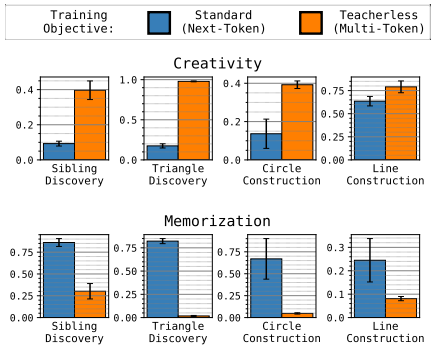
Figure 3 . Multi-token teacherless finetuning improves algorith- mic creativity (top; Eq 1) and reduces memorization (bottom; fraction of generations seen during training) on our four open- ended algorithmic tasks for a Gemma v1 (2B) model.
원문 · CC BY 4.0 · Vaishnavh Nagarajan, Chen Henry Wu, Charles Ding, Aditi Raghunathan · Roll the dice & look before you leap: Going beyond the creative limits of next-token prediction · 원문 그림 인용 · 원본 PDF 3쪽에서 그림 영역을 추출했습니다.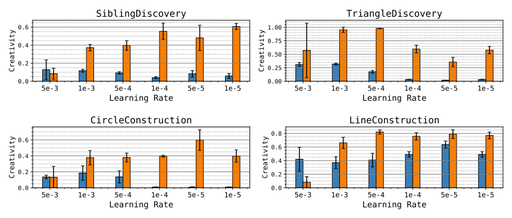
Figure 15 . Learning rate and algorithmic creativity for Gemma v1 (2B) : Algorithmic creativity increases under multi-token prediction across various learning rates.
원문 · CC BY 4.0 · Vaishnavh Nagarajan, Chen Henry Wu, Charles Ding, Aditi Raghunathan · Roll the dice & look before you leap: Going beyond the creative limits of next-token prediction · 원문 그림 인용 · 원본 PDF 27쪽에서 그림 영역을 추출했습니다.같은 실험에서 큰 모델은 다음 토큰 학습에서 학습 데이터를 외우는 경향이 강했고, 다중 토큰 학습은 기억화 비율을 낮췄습니다. 작은 모델에서는 절대 기억화 값이 낮았고 다중 토큰 목표의 효과도 일관되지 않았습니다. 따라서 이 결과는 Gemma v1 (2B) 설정에서 관찰된 것이며, 모든 모델 크기로 일반화되지는 않습니다.
seed-conditioning과 온도 샘플링의 비교
seed-conditioning은 Transformer에서 탐욕적 디코딩으로도 비자명한 알고리즘 창의성을 보였습니다. 원문은 이 효과가 학습 시 임의로 짝지어진 시드가 실제 무작위성으로 작동한다는 관찰이라고 설명합니다. 또한 시드 길이가 길수록 창의성이 증가하는 경향이 보고되었습니다.
GPT-2 (86M) 실험에서는 seed-conditioning이 온도 샘플링과 비슷한 창의성을 보였습니다. 그러나 Sibling Discovery와 Triangle Discovery에서 이 격차는 기본적으로 켜진 top-K 샘플링에 의존한다고 제한이 명시되어 있습니다. seed-conditioning은 확산 학습에서는 이점이 관찰되지 않았다고 보고됩니다.
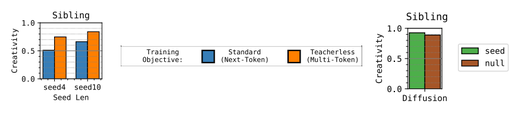
Figure 23 . GPT-2 (86M) Transformer achieves higher algorithmic creativity with longer seeds (top):We report algorithmic creativity with seeds of length 4 and 10, with bothNTP and teacherless MTP (with greedy decoding). We do not see gains of seed-conditioning when it comes to diffusion training (right): We report algorithmic creativity of the SEDD (90M) model with or without seed-conditioning.
원문 · CC BY 4.0 · Vaishnavh Nagarajan, Chen Henry Wu, Charles Ding, Aditi Raghunathan · Roll the dice & look before you leap: Going beyond the creative limits of next-token prediction · 원문 그림 인용 · 원본 PDF 33쪽에서 그림 영역을 추출했습니다.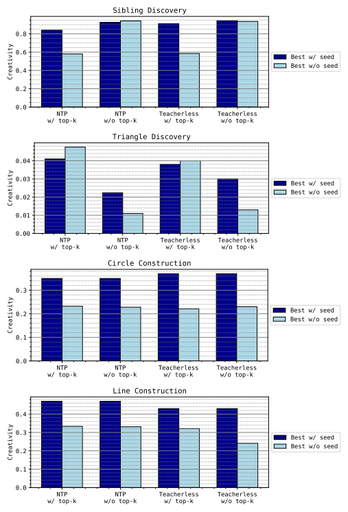
Figure 27 . Seed conditioning improves creativity. “Best with seed” and “best without seed” stand for the best creativity score in each setting after we tune the sampling temperature from {0, 0.5, 1, 2}.
원문 · CC BY 4.0 · Vaishnavh Nagarajan, Chen Henry Wu, Charles Ding, Aditi Raghunathan · Roll the dice & look before you leap: Going beyond the creative limits of next-token prediction · 원문 그림 인용 · 원본 PDF 35쪽에서 그림 영역을 추출했습니다.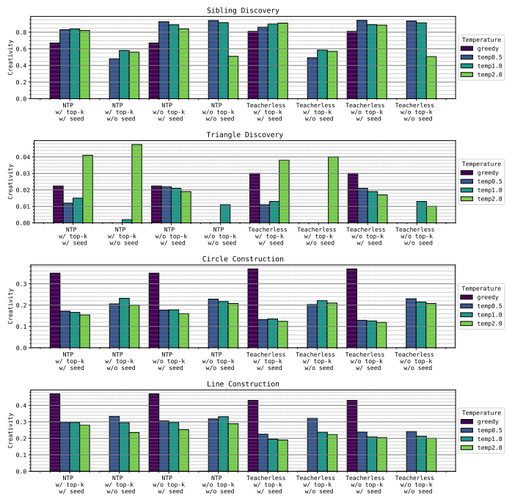
Figure 28 . Ablations on GPT-2 (86M) for (1) NTP vs teacherless MTP training, (2) effect of seed conditioning, (3) effect of top-K, and (4) effect of temperature sampling
원문 · CC BY 4.0 · Vaishnavh Nagarajan, Chen Henry Wu, Charles Ding, Aditi Raghunathan · Roll the dice & look before you leap: Going beyond the creative limits of next-token prediction · 원문 그림 인용 · 원본 PDF 36쪽에서 그림 영역을 추출했습니다.결과의 적용 범위와 한계
저자들은 최소 과제에서의 성공이 더 복잡한 과제의 성공을 보장하지 않으며, 다음 토큰 학습을 능가하는 과제가 존재할 수 있다고 밝힙니다. 다중 토큰 학습은 작은 모델에서 최적화가 어렵다고 보고되었고, seed-conditioning은 특수 학습이 필요하다는 제약이 있습니다.
또한 GPT-2 (86M)의 일부 비교에서는 top-K 샘플링이 결과의 중요한 조건이었으며, 실제 데이터에서 이 효과가 어떻게 나타날지는 확인되지 않았다고 밝힙니다. 따라서 이 논문의 결론은 제한된 알고리즘 과제와 특정 모델 설정에서 얻은 관찰로 읽어야 합니다.
논문 정보
- 저자
- Vaishnavh Nagarajan, Chen Henry Wu, Charles Ding, Aditi Raghunathan
- 학회·저널
- arXiv · 프리프린트
- 최초 공개일
- 2025년 4월 21일
- 등록일
- 2026년 10월 29일
- 수정일
- 2025년 8월 28일
- 버전
- v4
- arXiv
- 2504.15266
- 분류
- cs.LG · cs.AI · cs.CL
- 원문 이용 조건
- CC BY 4.0
- 제공 범위
- 논문 정보, 해설, 허용된 원문 그림
AI 해설은 논문 원문과 별개의 설명이며 오류가 있을 수 있습니다. 원문과 그림은 각 출처의 이용 조건과 따로 표시된 권리를 따릅니다.
초록
We design a suite of minimal algorithmic tasks that are a loose abstraction of open-ended real-world tasks. This allows us to cleanly and controllably quantify the creative limits of the present-day language model. Much like real-world tasks that require a creative, far-sighted leap of thought, our tasks require an implicit, open-ended stochastic planning step that either (a) discovers new connections in an abstract knowledge graph (like in wordplay, drawing analogies, or research) or (b) constructs new patterns (like in designing math problems or new proteins). In these tasks, we empirically and conceptually argue how next-token learning is myopic; multi-token approaches, namely teacherless training and diffusion models, comparatively excel in producing diverse and original output. Secondly, to elicit randomness without hurting coherence, we find that injecting noise at the input layer (dubbed seed-conditioning) works surprisingly as well as (and in some conditions, better than) temperature sampling from the output layer. Thus, our work offers a principled, minimal test-bed for analyzing open-ended creative skills, and offers new arguments for going beyond next-token learning and temperature sampling. We make part of the code available under https://github.com/chenwu98/algorithmic-creativity
원문 인용
Vaishnavh Nagarajan, Chen Henry Wu, Charles Ding, Aditi Raghunathan (2025). Roll the dice & look before you leap: Going beyond the creative limits of next-token prediction. arXiv:2504.15266v4. https://arxiv.org/abs/2504.15266v4
BibTeX
@misc{nagarajan2025roll,
  title = {{Roll the dice & look before you leap: Going beyond the creative limits of next-token prediction}},
  author = {Vaishnavh Nagarajan and Chen Henry Wu and Charles Ding and Aditi Raghunathan},
  year = {2025},
  eprint = {2504.15266},
  archivePrefix = {arXiv},
  url = {https://arxiv.org/abs/2504.15266v4}
}