논문 해설
Automatic Posture and Movement Tracking of Infants with Wearable Movement Sensors
웨어러블 움직임 센서를 이용한 영아의 자세 및 움직임 자동 추적
- 연구 문제 영아의 자발적 움직임을 가정 환경에서도 정량적으로 추적할 수 있는 자동 분석 방법이 필요합니다.
- 연구 방법 네 개의 센서를 장착한 스마트 점프슈트로 가속도계와 자이로스코프 신호를 기록하고, 반복 주석 정제와 CNN 분류기로 자세와 움직임을 자동 분류합니다.
- 주요 결과 CNN은 완전 합의 프레임에서 자세 정확도 99.1%, 움직임 정확도 90.7%를 보였으며, 사람 주석자 간 일치도와 비슷한 수준의 분류 일관성을 보고합니다.
영아 운동 조기 평가의 필요와 기존 방식의 한계
영아의 자발적 움직임은 중추신경계 여러 부위의 협응을 반영하므로, 비정상적인 운동 발달을 조기에 찾아내면 신경발달장애 위험이 있는 영아를 선별하는 데 도움이 될 수 있습니다. 그러나 기존 관찰 프로토콜은 정량적이지 않고 생후 4개월 이후의 종단 추적을 충분히 허용하지 않습니다. 이 연구는 가정에서도 사용할 수 있는 웨어러블 기록 장치와 자동 분석 파이프라인으로 이 공백을 메우려 합니다. 선행 문헌에서 이런 목적의 웨어러블 기술이 성인 대상으로는 발전했지만 영아용 개방형 다중 센서 솔루션은 확인되지 않았다고 저자들은 설명합니다.
스마트 점프슈트와 센서 기록 구성
스마트 점프슈트는 네 개의 Movesense 센서를 팔과 다리 근위부에 장착한 전신 의복입니다. 각 센서는 6자유도 관성측정장치를 내장하며 가속도계와 자이로스코프 신호를 52 Hz로 기록합니다. 센서는 Bluetooth로 모바일 기기에 무선 전송되고, 데이터 로거 소프트웨어가 기록 시작을 제어하고 센서 타임스탬프를 동기화하며 영상도 함께 기록합니다. 따라서 네 센서의 신호는 채널당 세 축 가속도와 세 축 각속도, 즉 센서당 6채널, 전체 24채널로 구성됩니다.
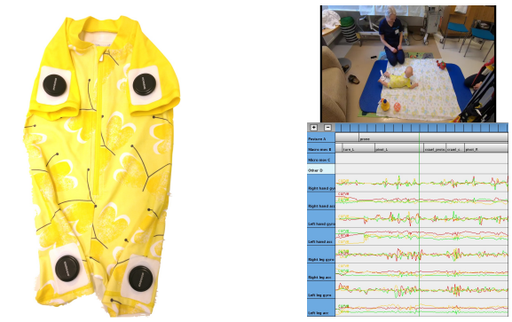
Figure 1 : Experimental design. (a) Photograph of the smart jumpsuit with four proximally placed movement sensors. (b) The annotation setup displaying annotations with synchronized video and movement data.
원문 · CC BY 4.0 · Manu Airaksinen, Okko Räsänen, Elina Ilén, Taru Häyrinen, Anna Kivi, Viviana Marchi, Anastasia Gallen, Sonja Blom, Anni Varhe, Nico Kaartinen, Leena Haataja, Sampsa Vanhatalo · Automatic Posture and Movement Tracking of Infants with Wearable Movement Sensors · 원문 그림 인용 · 원본 PDF 3쪽에서 그림 영역을 추출했습니다.자세와 움직임 주석 체계와 일치도
주석 체계는 자세 트랙과 움직임 트랙의 두 개 층으로 나뉩니다. 자세 트랙은 엎드림, 바로 누움, 왼쪽 옆으로 누움, 오른쪽 옆으로 누움, 크롤링 자세의 다섯 범주를 사용하고, 움직임 트랙은 여덟 범주를 정의하되 crawl 4 limbs 범주가 하나의 기록에만 있어 분석에서 제외되어 일곱 범주가 사용되었습니다. 각 기록은 세 명의 주석자가 독립적으로 영상과 센서 파형을 보며 주석했습니다. 일치도는 Fleiss' κ로 측정되었으며, 자세 트랙은 0.923, 움직임 트랙은 0.580이었습니다. 혼동행렬에서는 움직임 트랙의 macro still과 crawl proto 주변 혼동이 많았고, t-SNE 시각화에서도 움직임 범주 경계가 연속적으로 나타났습니다.
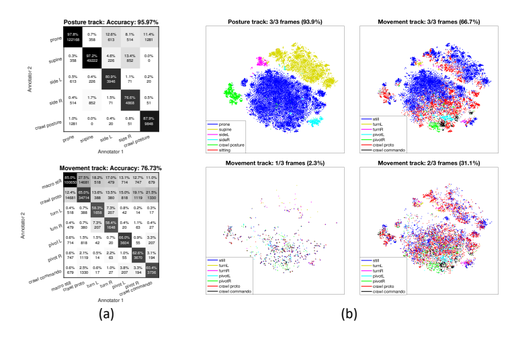
Figure 2 : (a) Total cumulative confusion matrices across all possible annotator pairs for the Posture (top) and Movement (bottom) track. The percentages of each column sum up to one and the absolute values denote the number of frames corresponding each cell. (b) t-SNE visualization of the entire dataset based on SVM input features. Color coding is based on the annotations of Posture (top left) and Movement categories (the rest). The visualization of the Movement track has been broken down into 3/3 (top right), 2/3 (bottom right), and 1/3 (bottom left) annotator agreement levels. The ambiguity differences in the annotation accuracies between the tracks can be clearly seen.
원문 · CC BY 4.0 · Manu Airaksinen, Okko Räsänen, Elina Ilén, Taru Häyrinen, Anna Kivi, Viviana Marchi, Anastasia Gallen, Sonja Blom, Anni Varhe, Nico Kaartinen, Leena Haataja, Sampsa Vanhatalo · Automatic Posture and Movement Tracking of Infants with Wearable Movement Sensors · 원문 그림 인용 · 원본 PDF 6쪽에서 그림 영역을 추출했습니다.반복 주석 정제와 소프트 라벨
주석자 간 불일치를 학습에 반영하기 위해 저자들은 반복 주석 정제(IAR)를 제안합니다. 각 프레임의 사람 라벨은 0/3, 1/3, 2/3, 3/3 판단 수에 따라 0, 0.33, 0.67, 1의 사전 확률로 바뀝니다. 학습 피험자를 제외한 나머지 피험자로 분류기를 학습해 우도를 얻고, 이를 사람 사전 확률과 곱한 뒤 프레임별 합이 1이 되도록 정규화합니다. 이렇게 얻은 소프트 라벨로 다음 반복의 분류기를 학습하며, 매 반복에서 사람 원래 라벨을 기준으로 결합해 사람 판단에서 벗어나지 않도록 합니다. 3/3과 0/3 프레임은 바뀌지 않고, 두 개 이상 클래스 사이의 모호한 프레임만 분류기 판단에 따라 변할 수 있습니다.
원문은 이 과정을 다섯 번 반복했다고 설명하며, 평가 테스트 데이터에는 IAR을 적용하지 않았습니다.
SVM 기준선과 CNN 분류기
SVM 기준선은 120샘플 창, 50% 중첩 프레임마다 채널별 통계와 주파수 특징 14개를 계산하여 24채널에서 336차원 특징 벡터를 만듭니다. 다중 클래스 분류는 선형 커널을 쓰는 오류 정정 출력 부호(ECOC) 앙상블로 수행됩니다. 종단간 CNN은 센서 모듈, 센서 융합 모듈, 시계열 모델링 모듈로 구성됩니다. 센서 모듈은 가속도계와 자이로스코프에 독립 2D 합성곱 경로와 공유 경로를 두고, 센서 융합 모듈은 센서 수준 특징을 공통 고수준 특징으로 결합합니다. 시계열 모듈은 확장 합성곱을 쌓은 잔차 구조로 프레임 수준 특징의 시간 문맥을 모델링합니다. 움직임 트랙 CNN에는 자세 분류 결과의 arg max를 나타내는 원-핫 조건 벡터가 시계열 모듈 입력에 추가되는데, 저자들은 움직임 범주가 자세 문맥에 강하게 의존한다고 설명합니다.
LOSO 평가와 SVM·CNN 비교
평가는 22명의 기록을 대상으로 한 명씩 보류하는 LOSO 교차검증으로 수행되었습니다. 주 평가 집합은 세 명의 주석자가 모두 일치한 full agreement 프레임이고, 보완 집합은 다수결 정답을 쓰는 전체 프레임 집합입니다. 지표는 정확도, UAR, UAP, UAF를 사용하며 기록 단위 클래스별 F-score를 Mann-Whitney U-test로 비교했습니다. 자세 트랙에서는 두 분류기의 차이가 비교적 작았지만, CNN은 여러 움직임 범주에서 더 좋은 성능을 보였습니다. 중앙값 F-score는 CNN 움직임 트랙에서 약 80%였고 SVM은 그보다 약 5~10 percentage point 낮았습니다.
특히 엎드린 자세의 crawl commando, crawl proto, pivoting 범주에서 SVM의 낮은 성능이 두드러졌습니다.
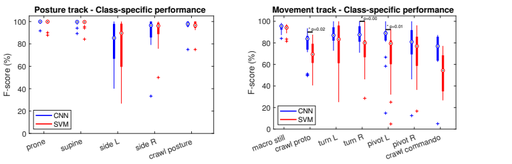
Figure 4 : Performance of classifiers. Class-specific F-score box plots for individual recordings for the Posture and Movement tracks using the CNN (blue) and SVM (red) classifiers. Statistically significant recording-level differences (p < 0.05; Mann-Whitney U-test, N=22) between SVM and CNN performance are indicated. Note the significantly better performance of CNN in movement patterns that take place in prone position (crawl proto, turn, pivot).
원문 · CC BY 4.0 · Manu Airaksinen, Okko Räsänen, Elina Ilén, Taru Häyrinen, Anna Kivi, Viviana Marchi, Anastasia Gallen, Sonja Blom, Anni Varhe, Nico Kaartinen, Leena Haataja, Sampsa Vanhatalo · Automatic Posture and Movement Tracking of Infants with Wearable Movement Sensors · 원문 그림 인용 · 원본 PDF 9쪽에서 그림 영역을 추출했습니다.CNN 성능과 사람 일치도 비교
CNN의 완전 합의 프레임에서 자세 트랙은 정확도 99.1%, UAR 96.2%, UAP 95.7%, UAF 96.0%를 보였습니다. 움직임 트랙은 같은 집합에서 정확도 90.7%, UAR 82.4%, UAP 85.9%, UAF 83.5%였습니다. 전체 프레임 집합에서는 자세 트랙 정확도 98.2%, 움직임 트랙 정확도 81.7%였습니다. 혼동행렬은 사람 주석자 간 혼동 양상과 비슷하며, 좌우 축의 혼동은 자동 분류에서 거의 나타나지 않았습니다. IAR 반복에 따른 Fleiss' κ 변화에서 분류기-사람 일치도는 초기 반복 이후 포화되었고, 저자들은 이 결과를 분류기가 사람 주석자와 비슷한 수준의 일관성을 보였다는 해석으로 제시합니다.
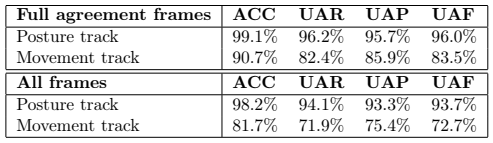
Table 1 : Overall performance of the CNN classifier in terms of accuracy (ACC), unweighted average recall (UAR), unweighted average precision (UAP), and unweighted average F-score (UAF).
원문 · CC BY 4.0 · Manu Airaksinen, Okko Räsänen, Elina Ilén, Taru Häyrinen, Anna Kivi, Viviana Marchi, Anastasia Gallen, Sonja Blom, Anni Varhe, Nico Kaartinen, Leena Haataja, Sampsa Vanhatalo · Automatic Posture and Movement Tracking of Infants with Wearable Movement Sensors · 원문 그림 인용 · 원본 PDF 11쪽에서 그림 영역을 추출했습니다.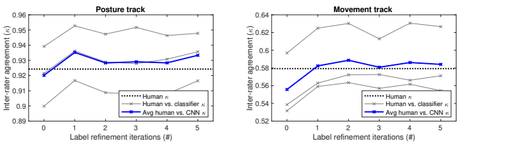
Figure 6 : The effect of IAR-based label refinement on the agreement (κ) between CNN classifier outputs and the three original human annotation tracks (gray lines) as a function of IAR iterations on held-out test data. The mean pair-wise agreement between classifier and the three human annotations is shown with the blue line and Fleiss’κ agreement across all human annotators is shown with the dotted black line. A clear improvement in classifier performance is observed due to label refinement on the training data, reaching the human-to-human agreement rate.
원문 · CC BY 4.0 · Manu Airaksinen, Okko Räsänen, Elina Ilén, Taru Häyrinen, Anna Kivi, Viviana Marchi, Anastasia Gallen, Sonja Blom, Anni Varhe, Nico Kaartinen, Leena Haataja, Sampsa Vanhatalo · Automatic Posture and Movement Tracking of Infants with Wearable Movement Sensors · 원문 그림 인용 · 원본 PDF 11쪽에서 그림 영역을 추출했습니다.센서 구성에 따른 SVM 성능
센서 구성 비교는 SVM 분류기로 수행되었습니다. 원문에 따르면 개별 센서 구성은 네 센서 구성보다 낮은 성능을 보였고, 한쪽 팔과 한쪽 다리를 조합한 구성은 네 센서 구성과 거의 비슷한 결과를 보였습니다. 이 결과는 SVM 기반의 UAR 비교이며, 센서 배치가 CNN 결과에도 같은 방식으로 적용된다는 근거로 쓰이지는 않습니다. 저자들은 팔과 다리 한쪽만 기록하면 좌우 차이를 측정하기 어렵다는 점을 실용적 한계로 설명합니다.
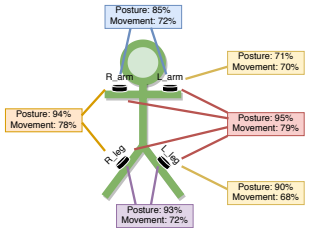
Figure 7 : The effect of sensor setup on classification performance (UAR) using the SVM classifier. Any individual sensor configuration is inferior to the four-sensor setup. However, classification of data from a combination of one arm and one leg leads to almost comparable results.
원문 · CC BY 4.0 · Manu Airaksinen, Okko Räsänen, Elina Ilén, Taru Häyrinen, Anna Kivi, Viviana Marchi, Anastasia Gallen, Sonja Blom, Anni Varhe, Nico Kaartinen, Leena Haataja, Sampsa Vanhatalo · Automatic Posture and Movement Tracking of Infants with Wearable Movement Sensors · 원문 그림 인용 · 원본 PDF 11쪽에서 그림 영역을 추출했습니다.적용 범위와 남은 한계
이 연구의 주된 한계는 22명의 영아와 한 번의 실험실 세션에 기반한다는 점입니다. 움직임 트랙은 자세 트랙보다 일치도가 낮아 주석 불확실성이 여전히 큽니다. SVM은 엎드린 자세의 움직임에서 낮은 성능을 보였으므로, 이 결과는 모든 분류기에 대한 일반 결론이 아니라 이 연구의 SVM 기준선에 대한 관찰입니다. 센서 구성 비교는 SVM 결과이며, 본문에 제시된 원문 범위 밖의 가정 환경이나 장기 추적 효과는 이 연구에서 검증되지 않았습니다. 저자들은 기능 바이오마커로서의 효능은 향후 연구가 필요하다고 언급합니다.
논문 정보
- 저자
- Manu Airaksinen, Okko Räsänen, Elina Ilén, Taru Häyrinen, Anna Kivi, Viviana Marchi, Anastasia Gallen, Sonja Blom, Anni Varhe, Nico Kaartinen, Leena Haataja, Sampsa Vanhatalo
- 학회·저널
- arXiv · 프리프린트
- 최초 공개일
- 2019년 9월 21일
- 등록일
- 2026년 11월 6일
- 수정일
- 2019년 12월 18일
- 버전
- v2
- arXiv
- 1909.09823
- 분류
- cs.CV · cs.LG · stat.ML
- 원문 이용 조건
- CC BY 4.0
- 제공 범위
- 논문 정보, 해설, 허용된 원문 그림
AI 해설은 논문 원문과 별개의 설명이며 오류가 있을 수 있습니다. 원문과 그림은 각 출처의 이용 조건과 따로 표시된 권리를 따릅니다.
초록
Infants' spontaneous and voluntary movements mirror developmental integrity of brain networks since they require coordinated activation of multiple sites in the central nervous system. Accordingly, early detection of infants with atypical motor development holds promise for recognizing those infants who are at risk for a wide range of neurodevelopmental disorders (e.g., cerebral palsy, autism spectrum disorders). Previously, novel wearable technology has shown promise for offering efficient, scalable and automated methods for movement assessment in adults. Here, we describe the development of an infant wearable, a multi-sensor smart jumpsuit that allows mobile accelerometer and gyroscope data collection during movements. Using this suit, we first recorded play sessions of 22 typically developing infants of approximately 7 months of age. These data were manually annotated for infant posture and movement based on video recordings of the sessions, and using a novel annotation scheme specifically designed to assess the overall movement pattern of infants in the given age group. A machine learning algorithm, based on deep convolutional neural networks (CNNs) was then trained for automatic detection of posture and movement classes using the data and annotations. Our experiments show that the setup can be used for quantitative tracking of infant movement activities with a human equivalent accuracy, i.e., it meets the human inter-rater agreement levels in infant posture and movement classification. We also quantify the ambiguity of human observers in analyzing infant movements, and propose a method for utilizing this uncertainty for performance improvements in training of the automated classifier. Comparison of different sensor configurations also shows that four-limb recording leads to the best performance in posture and movement classification.
원문 인용
Manu Airaksinen, Okko Räsänen, Elina Ilén, Taru Häyrinen, Anna Kivi, Viviana Marchi, Anastasia Gallen, Sonja Blom, Anni Varhe, Nico Kaartinen, Leena Haataja, Sampsa Vanhatalo (2019). Automatic Posture and Movement Tracking of Infants with Wearable Movement Sensors. arXiv:1909.09823v2. https://arxiv.org/abs/1909.09823v2
BibTeX
@misc{airaksinen2019automatic,
  title = {{Automatic Posture and Movement Tracking of Infants with Wearable Movement Sensors}},
  author = {Manu Airaksinen and Okko Räsänen and Elina Ilén and Taru Häyrinen and Anna Kivi and Viviana Marchi and Anastasia Gallen and Sonja Blom and Anni Varhe and Nico Kaartinen and Leena Haataja and Sampsa Vanhatalo},
  year = {2019},
  eprint = {1909.09823},
  archivePrefix = {arXiv},
  url = {https://arxiv.org/abs/1909.09823v2}
}