논문 해설
HybridSpec: Throughput-Aware Speculative Decoding for Hybrid GDN-MoE Models
HybridSpec: 하이브리드 GDN-MoE 모델을 위한 처리량 인식 speculative decoding
- 연구 문제 하이브리드 GDN-MoE 타깃에서는 검증 길이에 따라 검증 비용이 밀집 모델보다 크게 증가하여, 기존 길이 선택이 비용을 충분히 반영하지 못합니다.
- 연구 방법 HybridSpec은 드래프터 신호와 측정된 지연 시간으로 검증 길이를 GPU에서 고르고, 첫 MoE 라우터 경계에서 검증을 두 단계로 나눕니다. GDN 검증은 병렬 커널과 한 번의 상태 재구성 커널로 수행합니다.
- 주요 결과 세 GDN-MoE 타깃에서 그리디 디코딩 기준 HybridSpec은 자기회귀 디코딩보다 1.75×–1.88× 빠르고 vanilla DFlash보다 1.30×–1.33× 빠릅니다.
검증 길이 선택의 문제
speculative decoding에서 병렬 드래프터는 드래프트 비용을 낮추어 전체 시간을 타깃의 검증 비용이 지배하게 만듭니다. 이때 한 라운드에서 타깃이 처리하는 토큰 수인 검증 길이가 핵심 설계 선택이 됩니다. 더 많은 드래프트 토큰을 검증하면 더 많이 수락될 수 있지만, 첫 거부 이후에 처리한 토큰은 낭비됩니다. 본 논문은 Gated DeltaNet(GDN) 레이어와 혼합 전문가(MoE) 레이어를 함께 쓰는 하이브리드 타깃에서 이 선택이 특히 어려워진다고 설명합니다. Qwen3.6-35B-A3B에서 DFlash로 프로파일한 결과, 검증 길이를 4에서 16으로 늘릴 때 검증 시간이 71% 증가했고 그 증가는 거의 GDN과 MoE 레이어에서 나타났습니다.
같은 조건에서 밀집 Qwen3-4B 타깃은 4%–6% 증가했습니다.
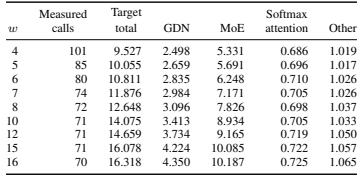
Table 4 : Qwen3.6-35B-A3B target-side GPU time across verification lengths, in milliseconds per measured verification call. The total is the union of slightly overlapping component intervals, so the components do not sum exactly to it.
원문 · CC BY 4.0 · Haiyu Wang, Sai Qian Zhang, Zechun Liu, Steven Li · HybridSpec: Throughput-Aware Speculative Decoding for Hybrid GDN-MoE Models · 원문 그림 인용 · 원본 PDF 19쪽에서 그림 영역을 추출했습니다.HybridSpec의 두 단계 검증과 길이 선택
HybridSpec은 드래프터 신호와 측정된 타깃 지연 시간으로 명목 검증 길이를 GPU에서 선택합니다. 이후 검증은 첫 MoE 라우터 경계에서 두 단계로 나뉩니다. 0단계는 첫 라우터까지 Layer 0을 실행해 전문가 할당을 얻고, 라우팅 보정은 관찰된 새 전문가 수를 바탕으로 한 토큰을 추가로 유지할지 결정합니다. 1단계는 선택된 토큰에 대해서만 나머지 레이어를 실행합니다. 길이 선택은 라운드별 점수 Ctgt와 수락 확률 추정을 사용하는 Dinkelbach 형식의 목표를 최대화하며, 목표는 풀링된 처리량입니다. 이 점수는 최대화 대상인 G와 비용 L의 비율이 아니라 G−ρL의 가법적 판정으로 바뀝니다.
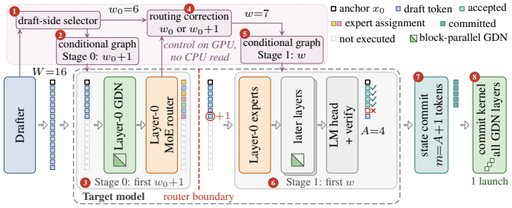
Figure 2 : One round of HybridSpec in single-request greedy decoding, with illustrative values: nominal verification lengthw 0 = 6, executed verification lengthw= 7, andA= 4accepted draft tokens. Circled numbers mark the steps described in Section 3.2.
원문 · CC BY 4.0 · Haiyu Wang, Sai Qian Zhang, Zechun Liu, Steven Li · HybridSpec: Throughput-Aware Speculative Decoding for Hybrid GDN-MoE Models · 원문 그림 인용 · 원본 PDF 5쪽에서 그림 영역을 추출했습니다.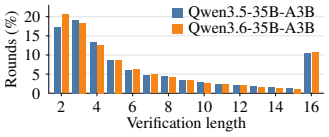
Figure 4 : Executed verification lengths of HybridSpec on the 280 test prompts. Vanilla DFlash verifies 16 tokens per round.
원문 · CC BY 4.0 · Haiyu Wang, Sai Qian Zhang, Zechun Liu, Steven Li · HybridSpec: Throughput-Aware Speculative Decoding for Hybrid GDN-MoE Models · 원문 그림 인용 · 원본 PDF 8쪽에서 그림 영역을 추출했습니다.출력 보존의 조건
논문은 정확한 산술에서 선택된 어떤 검증 길이도 목표 모델의 탐욕적 출력을 보존한다고 제시합니다. 이 결론은 정확한 산술, 인과적 접두사 불변성, 상태의 정확한 복구, 용량 제한이 없는 MoE 라우팅 같은 가정에 의존합니다. 온도 샘플링에서는 각 드래프트 토큰을 확률 1의 제안으로 보는 point-mass 규칙을 사용하며, 이 경우 검증 길이가 토큰 분포를 바꾸지 않는다는 결론이 같은 가정 아래에서 제시됩니다. 부동소수점에서는 근접한 로짓 때문에 argmax가 뒤집힐 수 있어 정확한 토큰 일치가 보장되지 않는다고 원문은 기술합니다.
GDN 병렬 검증과 상태 재구성
기본 GDN 검증기는 토큰마다 상태를 갱신하고 각 토큰 뒤의 전체 상태를 저장합니다. HybridSpec은 대상 입력을 하나의 청크로 보고 모든 토큰을 병렬로 처리하며, 삼각 시스템을 한 번 풀어 압축 인자 (zi, ki, gi)만 보존합니다. 수락된 상태 Sm은 S0과 앞의 m개 인자로부터 재구성되고, 한 번의 커널 실행으로 모든 GDN 레이어의 상태를 재구성합니다. 격리된 벤치마크에서 모든 드래프트 토큰이 수락된 경우 길이 4–16에서 1.54×–4.04× 빠르다고 보고되며, 이 수치는 전체 종단 간 속도와 구분해야 합니다.
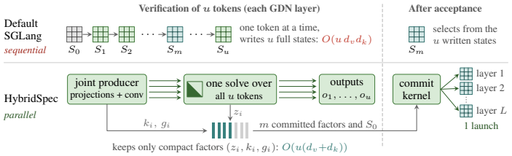
Figure 3 : GDN verification and accepted-state reconstruction in the default SGLang verifier and in HybridSpec. The default verifier steps through theutokens one at a time, whereas HybridSpec processes allutokens in parallel and rebuilds the accepted states of all GDN layers in parallel, in one launch. Teal marks the accepted state and the factors of themcommitted tokens.
원문 · CC BY 4.0 · Haiyu Wang, Sai Qian Zhang, Zechun Liu, Steven Li · HybridSpec: Throughput-Aware Speculative Decoding for Hybrid GDN-MoE Models · 원문 그림 인용 · 원본 PDF 7쪽에서 그림 영역을 추출했습니다.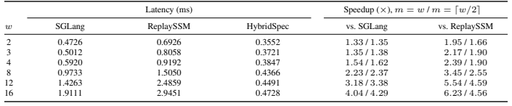
Table 5 : Latency (ms) of GDN verification plus accepted-state reconstruction for the 30 GDN layers of Qwen3.6-35B-A3B on one A100 when allm=winput tokens are committed, that is, when every draft token is accepted. Speedups of HybridSpec are given form=wand form=⌈w/2⌉, when about half of the input tokens are committed. ReplaySSM uses its default launch parameters, as in Table 1.
원문 · CC BY 4.0 · Haiyu Wang, Sai Qian Zhang, Zechun Liu, Steven Li · HybridSpec: Throughput-Aware Speculative Decoding for Hybrid GDN-MoE Models · 원문 그림 인용 · 원본 PDF 20쪽에서 그림 영역을 추출했습니다.종단 간 평가와 절제 결과
SPEED-Bench Qualitative의 테스트 프롬프트에서 그리디 디코딩으로 평가했을 때, HybridSpec의 평균 속도 향상 비율은 Qwen3.5-35B-A3B에서 1.88×, Qwen3.6-35B-A3B에서 1.83×, Qwen3.5-122B-A10B-GPTQ-INT4에서 1.75×입니다. 같은 설정의 vanilla DFlash는 각각 1.45×, 1.37×, 1.32×입니다. Qwen3.6-35B-A3B의 DFlash 기준 검증 길이는 16이며, HybridSpec은 평균 검증 길이 6.2를 사용하고 평균 수락 길이는 4.57입니다. 절제 실험에서는 길이 선택이 1.19×–1.25×, 라우팅 보정이 1.06×, GDN 커널이 1.05× 기여한다고 보고됩니다.
이 결과들은 주로 배치 크기 1의 그리디 디코딩에서 얻은 것입니다.
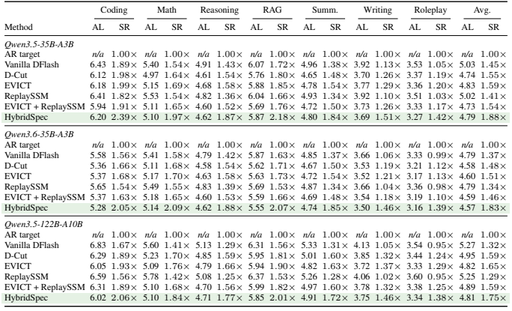
Table 1 : End-to-end comparison under greedy decoding. AL is the number of tokens emitted per verification round, and SR is the decode-throughput speedup over paired autoregressive (AR) de- coding. Summ. denotes summarization, and Avg. is the mean over the seven categories.
원문 · CC BY 4.0 · Haiyu Wang, Sai Qian Zhang, Zechun Liu, Steven Li · HybridSpec: Throughput-Aware Speculative Decoding for Hybrid GDN-MoE Models · 원문 그림 인용 · 원본 PDF 8쪽에서 그림 영역을 추출했습니다.정확성 점검과 적용 범위
GSM8K 1,319개 테스트 문제에서 HybridSpec은 96.06%, vanilla DFlash는 96.21%를 기록했습니다. 논문은 이 차이의 단측 95% 하한이 사전에 정한 비열등성 마진 −1포인트보다 크다고 보고합니다. 두 시스템은 부동소수점 커널의 순서 차이로 동일한 토큰을 내지 않을 수 있으므로, 이 점검은 정확한 토큰 일치가 아니라 과제 품질을 비교한 것입니다. 적용 범위는 배치 크기 1의 그리디 디코딩 중심이며, 배치 실험은 별도 부록에서 다뤄지고 온도 1 샘플링도 별도 표로 보고됩니다.
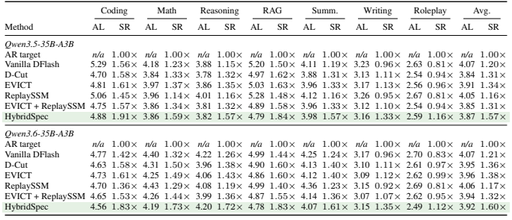
Table 6 : End-to-end comparison under temperature-one sampling, laid out as in Table 1.
원문 · CC BY 4.0 · Haiyu Wang, Sai Qian Zhang, Zechun Liu, Steven Li · HybridSpec: Throughput-Aware Speculative Decoding for Hybrid GDN-MoE Models · 원문 그림 인용 · 원본 PDF 22쪽에서 그림 영역을 추출했습니다.논문 정보
- 저자
- Haiyu Wang, Sai Qian Zhang, Zechun Liu, Steven Li
- 학회·저널
- arXiv · 프리프린트
- 최초 공개일
- 2026년 11월 2일
- 등록일
- 2026년 11월 5일
- 수정일
- 2026년 11월 2일
- 버전
- v1
- arXiv
- 2611.04055
- 분류
- cs.AI · cs.LG
- 원문 이용 조건
- CC BY 4.0
- 제공 범위
- 논문 정보, 해설, 허용된 원문 그림
AI 해설은 논문 원문과 별개의 설명이며 오류가 있을 수 있습니다. 원문과 그림은 각 출처의 이용 조건과 따로 표시된 권리를 따릅니다.
초록
In speculative decoding, parallel drafters such as DFlash make drafting cheap, so target verification dominates each round. A central choice is the verification length, the number of tokens that the target processes in each round. Verifying more draft tokens can accept more of them, but work after the first rejection is wasted. For hybrid target models that combine Gated DeltaNet (GDN) and mixture-of-experts (MoE) layers, verification time grows much faster with this length than for dense models. In a single-request profile of Qwen3.6-35B-A3B with DFlash, it grew by 71% from length 4 to 16, almost entirely in GDN and MoE layers, compared with 4%-6% for a dense Qwen3-4B target. Each GDN layer must update a recurrent state at every token and recover it at the end of the accepted prefix. The MoE cost depends on the experts that the tokens activate, which are known only once verification runs. We present HybridSpec, which selects the verification length on the GPU from draft-side acceptance estimates and measured target latency. Verification then runs this length plus one extra token up to the first MoE router, before any expert runs. There, a lightweight routing correction uses the observed expert assignments to decide whether to keep that token. The rest of verification runs only on the selected tokens. Block-parallel GDN kernels avoid storing a state after every token and reconstruct the accepted state of every GDN layer in one launch. In isolated benchmarks at verification lengths 4 to 16 with every draft token accepted, these kernels, including accepted-state reconstruction, are $1.54\times$-$4.04\times$ faster than the default kernels. With three GDN-MoE target models in single-request greedy decoding, HybridSpec is $1.75\times$-$1.88\times$ faster than autoregressive decoding and $1.30\times$-$1.33\times$ faster than DFlash.
원문 인용
Haiyu Wang, Sai Qian Zhang, Zechun Liu, Steven Li (2026). HybridSpec: Throughput-Aware Speculative Decoding for Hybrid GDN-MoE Models. arXiv:2611.04055v1. https://arxiv.org/abs/2611.04055v1
BibTeX
@misc{wang2026hybridspec,
  title = {{HybridSpec: Throughput-Aware Speculative Decoding for Hybrid GDN-MoE Models}},
  author = {Haiyu Wang and Sai Qian Zhang and Zechun Liu and Steven Li},
  year = {2026},
  eprint = {2611.04055},
  archivePrefix = {arXiv},
  url = {https://arxiv.org/abs/2611.04055v1}
}