논문 해설
UniHam: A Large-Scale SOC-Complete Dataset and Benchmark for Hamiltonian Learning in Materials
UniHam: 재료에서 해밀토니안 학습을 위한 대규모 SOC-완전 데이터셋 및 벤치마크
- 연구 문제 기존 해밀토니안 데이터셋은 규모·구조 다양성·SOC 포함 측면에서 제한적이어서, SOC를 포함한 대규모 공개 벤치마크가 필요합니다.
- 주요 결과 HamGNN은 Recon-id에서 total MAE 1.50 meV로 DeepH-pack의 2.44 meV보다 낮았고, 원소 그룹 제거 OOD-Comp에서도 더 작은 성능 저하를 보였습니다. HamGNN(FT)는 밴드갭 MAE를 1.697 eV에서 0.622 eV로 낮춰 스펙트럼 수준 평가의 중요성을 보여 줍니다.
문제: 해밀토니안 학습 데이터의 부족
전자 해밀토니안을 구조로부터 예측하면 DFT의 높은 계산 비용을 피하면서 여러 물성을 얻을 수 있습니다. 그러나 기존 해밀토니안 데이터셋은 규모가 작고 구조 다양성이 낮으며, 중요한 상대론적 효과인 스핀–궤도 결합(SOC)을 빠뜨리는 경우가 많습니다. SOC가 없으면 해밀토니안은 실수값으로 제한되며, 무거운 원소나 위상 물질에서 필요한 복소수 스핀 혼합 항을 표현하지 못합니다. 이 논문은 이런 데이터 병목을 해결하기 위해 SOC를 포함한 대규모 공개 데이터셋 UniHam을 구축하고, 구조만을 입력으로 받는 등변 모델을 표준화된 평가로 비교하는 범위를 설정합니다.
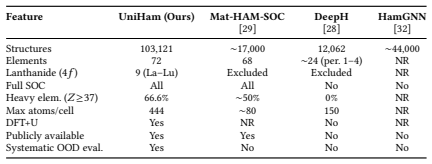
Table 1 : Feature-level comparison between UniHam and prior Hamiltonian datasets. NR = not reported.
원문 · CC BY 4.0 · Yuewen Huang, Pin Chen, Yutong Lu · UniHam: A Large-Scale SOC-Complete Dataset and Benchmark for Hamiltonian Learning in Materials · 원문 그림 인용 · 원본 PDF 3쪽에서 그림 영역을 추출했습니다.UniHam 데이터 구축과 분할
UniHam은 103,121개의 구조를 포함하며 72개 원소와 225개의 공간군을 다룹니다. 모든 라벨은 OpenMX로 비공선 스핀과 전체 SOC를 켜서 계산했고, 이 조건에서 복소수 Hermitian 해밀토니안이 생성됩니다. Recon-id 학습 풀은 원자 60개 이하 구조(약 90,000개)로 제한되었고, 이를 약 86,000개 학습, 2,000개 검증, 2,000개 테스트로 나눴습니다. 분할은 가장 희귀한 원소를 기준으로 한 bin 안에서 seed=42로 섞어 배분하며, 60원자를 넘는 나머지 구조는 OOD-Size 평가에 남겨졌습니다. 이 제한은 SOC 해밀토니안의 차원이 원자 수에 따라 커지면서 GPU 메모리를 넘기 때문이라고 설명됩니다.
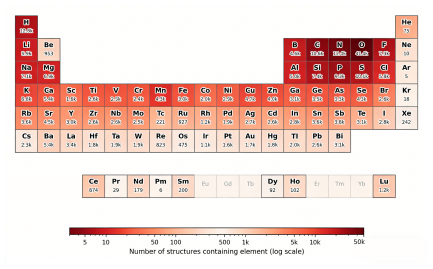
Figure 2 : Periodic-table heatmap of per-element structure counts in UniHam. The 72 covered elements are color-coded by occurrence frequency.
원문 · CC BY 4.0 · Yuewen Huang, Pin Chen, Yutong Lu · UniHam: A Large-Scale SOC-Complete Dataset and Benchmark for Hamiltonian Learning in Materials · 원문 그림 인용 · 원본 PDF 4쪽에서 그림 영역을 추출했습니다.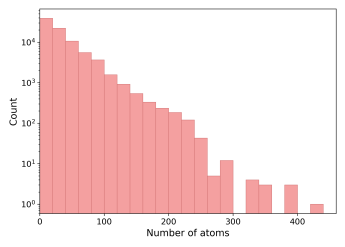
Figure 3 : Distribution of the number of atoms per unit cell. Most structures contain 10–60 atoms; a long tail extends to 444.
원문 · CC BY 4.0 · Yuewen Huang, Pin Chen, Yutong Lu · UniHam: A Large-Scale SOC-Complete Dataset and Benchmark for Hamiltonian Learning in Materials · 원문 그림 인용 · 원본 PDF 4쪽에서 그림 영역을 추출했습니다.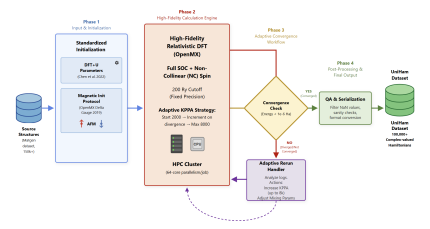
Figure 5 : UniHam Dataset Construction Pipeline.
원문 · CC BY 4.0 · Yuewen Huang, Pin Chen, Yutong Lu · UniHam: A Large-Scale SOC-Complete Dataset and Benchmark for Hamiltonian Learning in Materials · 원문 그림 인용 · 원본 PDF 10쪽에서 그림 영역을 추출했습니다.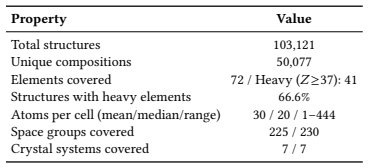
Table 9 : Summary statistics of the UniHam dataset.
원문 · CC BY 4.0 · Yuewen Huang, Pin Chen, Yutong Lu · UniHam: A Large-Scale SOC-Complete Dataset and Benchmark for Hamiltonian Learning in Materials · 원문 그림 인용 · 원본 PDF 11쪽에서 그림 영역을 추출했습니다.기준 모델과 과제 설계
비교 대상은 구조만을 입력으로 받는 두 등변 모델인 DeepH-pack(DeepH-E3)과 HamGNN입니다. HamGNN은 기본 학습(Base)과 밴드 에너지 손실을 추가한 fine-tuning 변형(FT)으로 나뉘어 평가됩니다. 평가 과제는 네 가지입니다. OOD-Comp는 In, 희토류(RE), 비활성 기체(NG) 원소 그룹을 학습에서 완전히 제거하고 재학습하는 세 시나리오입니다. Prop-id는 예측 해밀토니안을 대각화하여 밴드갭, 밴드 구조, DOS를 DFT 기준과 비교합니다. 주 재구성 지표는 게이지 보정된 MAE이며, 전역 이동 Δμ는 하위 물리량을 바꾸지 않는다는 가정으로 제거됩니다.
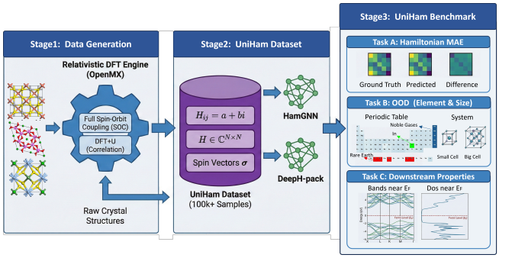
Figure 1 : Overview of the UniHam Benchmark Framework. The pipeline consists of three stages: (1) Data Generation: Con- structing high-quality Hamiltonian labels using relativistic DFT (OpenMX) with full Spin-Orbit Coupling (SOC) and DFT+U corrections. (2) Benchmarking: Training representative models (HamGNN, DeepH) on the UniHam dataset containing 100k+ complex-valued Hamiltonians. (3) Comprehensive Evaluation: Assessing model performance across three dimensions: Hamil- tonian Reconstruction (MAE), Out-of-Distribution (OOD) Generalization (testing both unseen elements and varying atom counts), and Downstream Physical Properties (Bandgaps, Band structures, and DOS near the Fermi level).
원문 · CC BY 4.0 · Yuewen Huang, Pin Chen, Yutong Lu · UniHam: A Large-Scale SOC-Complete Dataset and Benchmark for Hamiltonian Learning in Materials · 원문 그림 인용 · 원본 PDF 2쪽에서 그림 영역을 추출했습니다.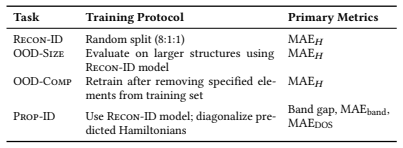
Table 2 : Task configurations and evaluation protocols.
원문 · CC BY 4.0 · Yuewen Huang, Pin Chen, Yutong Lu · UniHam: A Large-Scale SOC-Complete Dataset and Benchmark for Hamiltonian Learning in Materials · 원문 그림 인용 · 원본 PDF 5쪽에서 그림 영역을 추출했습니다.재구성 정확도와 조성 외삽 결과
Recon-id 테스트에서 HamGNN의 total MAE는 1.50 meV이고 DeepH-pack은 2.44 meV입니다. 허수부 MAE는 두 모델에서 실수부보다 작지만, 저자들은 SOC에 의한 스핀 전이 항을 더 어려운 부분으로 해석합니다. OOD-Size에서는 HamGNN의 OOD/ID 비율이 0.89로 보고되어 시스템 크기 전이가 잘 이뤄졌습니다. 이 OOD 결과는 세 시나리오 조건에서 얻은 값입니다.
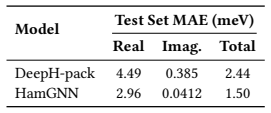
Table 3 : Hamiltonian reconstruction performance (MAE in meV) on the test set, decomposed by real part, imaginary part, and total.
원문 · CC BY 4.0 · Yuewen Huang, Pin Chen, Yutong Lu · UniHam: A Large-Scale SOC-Complete Dataset and Benchmark for Hamiltonian Learning in Materials · 원문 그림 인용 · 원본 PDF 6쪽에서 그림 영역을 추출했습니다.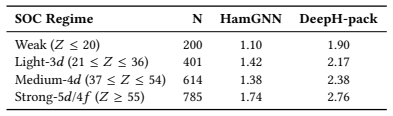
Table 4 : Hamiltonian MAE (meV) stratified by SOC strength regime, defined by the maximum atomic number 𝑍max in each structure.
원문 · CC BY 4.0 · Yuewen Huang, Pin Chen, Yutong Lu · UniHam: A Large-Scale SOC-Complete Dataset and Benchmark for Hamiltonian Learning in Materials · 원문 그림 인용 · 원본 PDF 6쪽에서 그림 영역을 추출했습니다.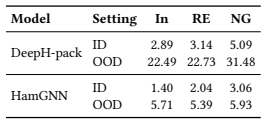
Table 5 : Compositional out-of-distribution generalization: Hamiltonian MAE (meV). “ID” rows report the MAE on the same element subgroups under the standard random-split model (elements present in training). “OOD” rows report the MAE when these elements areentirely removedfrom training. Degradation factors (×) are computed per element group.
원문 · CC BY 4.0 · Yuewen Huang, Pin Chen, Yutong Lu · UniHam: A Large-Scale SOC-Complete Dataset and Benchmark for Hamiltonian Learning in Materials · 원문 그림 인용 · 원본 PDF 7쪽에서 그림 영역을 추출했습니다.하위 전자구조 속성 평가
Prop-id 평가에서 HamGNN(FT)는 밴드갭 MAE를 1.697 eV에서 0.622 eV로, 밴드 구조 MAE를 1.612 eV에서 0.360 eV로, DOS MAE를 7.48에서 4.73 states/eV로 낮춥니다. 같은 실험에서 HamGNN(Base)는 DeepH-pack보다 해밀토니안 MAE가 낮았지만, 밴드 구조 오차 개선은 약 10% 수준에 그쳤습니다. 이 점은 Hamiltonian MAE만으로는 하위 물리 정확도를 충분히 대표하지 못한다는 저자들의 해석과 연결됩니다. DOS는 HamGNN(FT)에서도 상관계수 0.555로 밴드 구조 상관계수 0.988보다 낮아 여전히 어려운 과제로 남습니다.
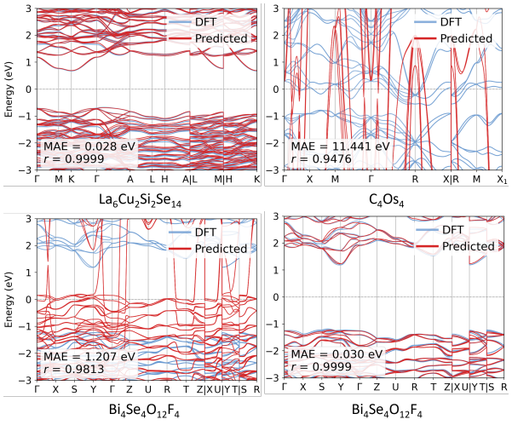
Figure 4 : Qualitative comparison of predicted band structures. (Top left) La 6Cu2Si2Se14 predicted by HamGNN (Base), achieving near-perfect agreement (band MAE = 0.028 eV). (Top right) C 4Os4 predicted by HamGNN (Base), showing severe deviations (band MAE = 11.4 eV) due to strong SOC from Os. (Bottom) Bi 4Se4O12F4 predicted by HamGNN Base (left) vs. HamGNN FT (right), demonstrating how eigenvalue-level fine-tuning corrects conduction-band artifacts.
원문 · CC BY 4.0 · Yuewen Huang, Pin Chen, Yutong Lu · UniHam: A Large-Scale SOC-Complete Dataset and Benchmark for Hamiltonian Learning in Materials · 원문 그림 인용 · 원본 PDF 8쪽에서 그림 영역을 추출했습니다.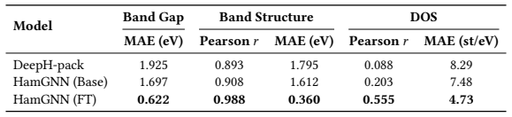
Table 7 : Downstream property prediction accuracy on the test set. Band gap error is evaluated on 1,252 non-metallic structures; band structure and DOS metrics are computed on all 2,000 test structures within a±3 eV window around the Fermi level.
원문 · CC BY 4.0 · Yuewen Huang, Pin Chen, Yutong Lu · UniHam: A Large-Scale SOC-Complete Dataset and Benchmark for Hamiltonian Learning in Materials · 원문 그림 인용 · 원본 PDF 8쪽에서 그림 영역을 추출했습니다.적용 범위와 한계
원문은 SOC를 포함한 해밀토니안이 구조 크기와 원소 수에 따라 계산 및 메모리 비용이 크게 늘어난다고 밝히며, 이로 인해 배치 크기와 모델 용량이 제한된다고 설명합니다. 또한 DeepH-pack은 원문에서 eigenvalue 수준의 fine-tuning 기능을 기본 제공하지 않아 MAE 학습 변형만 보고되었습니다. 따라서 HamGNN(FT)의 스펙트럼 손실 효과를 DeepH-pack의 동일 조건 결과로 확장하지 않습니다. 실제 GNoME 교차 데이터 평가는 DFT 재계산 없이 720개 직접 밴드갭 후보에 대해 92%가 Materials Project에서 확인되었다고 보고되며, 이는 저자가 제시한 스크리닝 사례입니다.
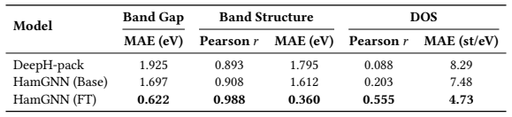
Table 8 : Band-gap distribution of 720 direct-gap candidates identified by HamGNN (FT) on 3,000 GNoME structures.
원문 · CC BY 4.0 · Yuewen Huang, Pin Chen, Yutong Lu · UniHam: A Large-Scale SOC-Complete Dataset and Benchmark for Hamiltonian Learning in Materials · 원문 그림 인용 · 원본 PDF 8쪽에서 그림 영역을 추출했습니다.논문 정보
- 저자
- Yuewen Huang, Pin Chen, Yutong Lu
- 학회·저널
- arXiv · 프리프린트
- 최초 공개일
- 2026년 11월 9일
- 등록일
- 2026년 11월 10일
- 수정일
- 2026년 11월 9일
- 버전
- v1
- arXiv
- 2611.12509
- DOI
- 10.1145/3770855.3817531
- 분류
- cs.LG · cond-mat.mtrl-sci
- 원문 이용 조건
- CC BY 4.0
- 제공 범위
- 논문 정보, 해설, 허용된 원문 그림
AI 해설은 논문 원문과 별개의 설명이며 오류가 있을 수 있습니다. 원문과 그림은 각 출처의 이용 조건과 따로 표시된 권리를 따릅니다.
초록
Accurate prediction of electronic Hamiltonians would enable broad property inference while avoiding the high computational cost of Density Functional Theory (DFT). However, progress toward general-purpose materials foundation models is limited by a data bottleneck: existing Hamiltonian datasets are typically small, lack structural diversity, and often omit essential relativistic physics such as spin--orbit coupling (SOC). We therefore construct UniHam, a large-scale Hamiltonian dataset and benchmark suite comprising 100,000+ DFT-computed complex-valued Hermitian Hamiltonians with full SOC, covering 72 elements and a wide range of crystal geometries and symmetries (spanning diverse lattice types and space-group families). Building on UniHam, we benchmark two representative state-of-the-art models under a standardized protocol and introduce complementary evaluation metrics that jointly assess three dimensions: (i) Hamiltonian reconstruction accuracy, (ii) out-of-distribution (OOD) generalization across composition/symmetry shifts, and (iii) the ability to support downstream property prediction from the predicted Hamiltonians. Experiments on UniHam demonstrate that the proposed benchmark and metrics effectively differentiate model capabilities, revealing intrinsic SOC- and element-dependent failure modes, large variations in compositional OOD robustness, and the necessity of spectral-level evaluation to assess whether Hamiltonian predictions reliably support downstream electronic-structure properties. Overall, UniHam provides a reproducible, SOC-complete benchmark that can sharpen model comparisons and accelerate the development of next-generation foundation models for quantum materials.
원문 인용
Yuewen Huang, Pin Chen, Yutong Lu (2026). UniHam: A Large-Scale SOC-Complete Dataset and Benchmark for Hamiltonian Learning in Materials. arXiv:2611.12509v1. https://doi.org/10.1145/3770855.3817531
BibTeX
@article{huang2026uniham,
  title = {{UniHam: A Large-Scale SOC-Complete Dataset and Benchmark for Hamiltonian Learning in Materials}},
  author = {Yuewen Huang and Pin Chen and Yutong Lu},
  year = {2026},
  eprint = {2611.12509},
  archivePrefix = {arXiv},
  doi = {10.1145/3770855.3817531},
  url = {https://arxiv.org/abs/2611.12509v1}
}