논문 해설
TriGen: A Generative Paradigm for Trigger-Induced Recommendation
TriGen: 트리거 유도 추천을 위한 생성 패러다임
- 연구 문제 생성형 추천은 히스토리의 연속성에 기대어 다음 항목을 만들기 때문에, 클릭 직후의 즉각적 의도 전환을 반영하기 어렵습니다.
- 연구 방법 트리거를 히스토리 꼬리에 반복 배치하고, 트리거 경로와 히스토리 경로를 라우터로 결합한 뒤 디코더의 각 단계에 위치별 조건을 더합니다.
- 주요 결과 산업 데이터셋 평균에서 TriGen은 Recall@5 5.58, NDCG@10 7.33을 기록해 트리거 없는 TIGER와 단순 트리거 결합 베이스라인을 넘었습니다.
트리거 유도 추천에서 생성형 추천이 겪는 긴장
사용자가 피드의 항목을 클릭하면 바로 후속 피드가 열리고, 클릭된 항목은 단순한 과거 행동이 아니라 즉각적인 쇼핑 의도를 드러내는 트리거가 됩니다. 기존 생성형 추천은 사용자의 장기 히스토리를 이어 가는 방식으로 다음 항목의 Semantic ID를 자기회귀적으로 생성하므로, 갑작스러운 의도 전환을 반영할 전용 장치가 부족합니다. 반대로 트리거 유도 추천의 기존 방법은 CTR을 점수로 예측하는 판별형 방식이어서 토큰 단위 생성을 직접 조절하지 못합니다.
이 논문은 여기서 선호 연속성과 트리거 기반 의도 전환 사이의 구조적 긴장을 핵심 문제로 봅니다. 히스토리에 지나치게 기대면 즉각적 충동을 놓치고, 트리거에만 기대면 후보가 좁은 의미 공간에 갇혀 과도한 특화가 생깁니다. 이 긴장은 인코딩, 표현, 디코딩의 세 단계에서 각각 다른 형태로 나타납니다.
꼬리 트리거 주입과 이중 경로 융합
TriGen은 인코더-디코더 생성 프레임워크입니다. 먼저 히스토리 표현 H 뒤에 트리거 표현 e_trg를 N번 반복해 붙인 시퀀스를 만들고, RoPE의 상대 위치 모델링으로 트리거와 최근 행동의 상호작용을 유도합니다. 반복 횟수 N은 트리거가 자기 주의에서 차지하는 쿼리-키 용량을 조절하여, N이 크면 의도 쪽으로, N이 작으면 히스토리 쪽으로 문맥을 기울이게 합니다.
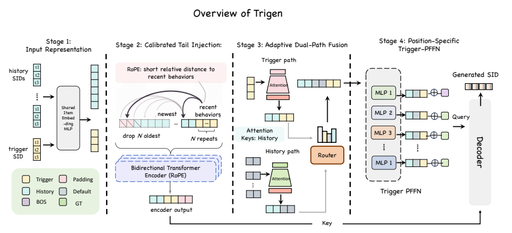
Figure 2 : Overall architecture of TriGen. (a) Calibrated Tail Injection: The trigger is appended to the sequence tail with 𝑁 repetitions, placing it adjacent to recent behaviors. RoPE models relative positions, while 𝑁 controls the repetition count to regulate trigger influence. (b) Adaptive Dual-Path Fusion: Parallel pathways decouple trigger-conditioned steering from history-preserved preference, dynamically balanced by an input-dependent gating router. (c) Position-Specific Trigger-PFFN: Step-specific feed-forward networks project the fused representation into level-aware condition signals, maintaining persistent, coarse-to-fine guidance throughout autoregressive decoding.
원문 · CC BY 4.0 · Muyu Zou, Haibo Xing, Shunye Tang, Liyan Tie, Lingyu Mu, Yandong Wang, Jinxin Hu · TriGen: A Generative Paradigm for Trigger-Induced Recommendation · 원문 그림 인용 · 원본 PDF 4쪽에서 그림 영역을 추출했습니다.표현 단계에서는 인코더 출력을 그대로 쓰지 않고 트리거 경로와 기본 쿼리 기반 히스토리 경로를 원본 히스토리 표현에서 따로 뽑습니다. 각 단계 l에서 트리거 경로는 단계별 투영 행렬로 트리거를 질의로 삼고, 히스토리 경로는 학습 가능한 기본 쿼리를 씁니다. 두 조건 벡터는 평균 풀링한 전역 프로파일을 입력받는 라우터가 계산한 시그모이드 가중치 w_l로 c_l = w_l t_l + (1 − w_l) h_l처럼 볼록 결합됩니다. 따라서 가중치는 요청마다 달라지며, 고정된 균등 결합이 아닙니다.
위치별 Trigger-PFFN 디코딩
디코더 쪽에서는 조건 시퀀스 C의 각 위치 l마다 독립적인 MLP_l을 두어 조건 벡터를 변환합니다. Semantic ID는 잔차 양자화로 얻은 계층 토큰이므로 앞쪽 토큰은 넓은 범주를, 뒤쪽 토큰은 세부 속성을 맡는다는 것이 저자들의 설명입니다. 이 변환된 조건 c̃_l은 teacher-forcing 학습에서 디코더 입력에 더해집니다. 첫 단계는 BOS 임베딩에, 이후 단계는 이전 정답 토큰의 임베딩에 해당 위치 조건을 더합니다.
이렇게 하면 트리거 지도는 디코딩 시작점에만 한 번 주어지지 않고 매 단계의 입력에 남습니다. 저자들은 이 설계가 대상 항목의 앞쪽 범주와 뒤쪽 속성에 서로 다른 강도의 조건을 주는 장치라고 봅니다.
산업 데이터셋과 Amazon 벤치마크 비교
산업 데이터셋에서 TriGen은 5개 시드의 평균으로 Recall@5 5.58, Recall@10 15.50, NDCG@5 4.16, NDCG@10 7.33을 기록했습니다. 같은 표에서 트리거 없는 생성 베이스라인 TIGER는 Recall@5 2.39, Recall@10 7.53을 보였고, 단순 트리거 결합 방식인 GR + trigger append는 Recall@5 4.35, Recall@10 12.15를 기록했습니다. 따라서 TriGen은 두 계열 모두보다 높은 값을 보였습니다. 이 산업 데이터셋은 다중 양성 recall 설정으로 평가되며, 표준편차는 부록 E에 따로 보고됩니다.
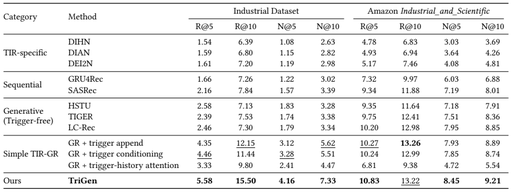
Table 1 : Overall performance comparison on the industrial dataset and the AmazonIndustrial_and_Scientificbenchmark. Results report the mean performance over 5 seeds (corresponding standard deviations are detailed in Appendix E, Table 7). R@𝐾 and N@𝐾 denote Recall@𝐾 and NDCG@𝐾, respectively. The best performance in each column is highlighted in bold, and the second-best is underlined .
원문 · CC BY 4.0 · Muyu Zou, Haibo Xing, Shunye Tang, Liyan Tie, Lingyu Mu, Yandong Wang, Jinxin Hu · TriGen: A Generative Paradigm for Trigger-Induced Recommendation · 원문 그림 인용 · 원본 PDF 6쪽에서 그림 영역을 추출했습니다.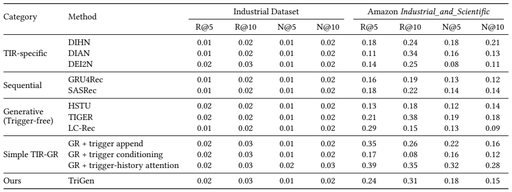
Table 7 : Standard deviations across 5 independent runs on the industrial dataset and the AmazonIndustrial_and_Scientific benchmark. The corresponding means are reported in Table 1. R@ 𝐾 and N@𝐾 denote Recall@𝐾 and NDCG@𝐾, respectively.
원문 · CC BY 4.0 · Muyu Zou, Haibo Xing, Shunye Tang, Liyan Tie, Lingyu Mu, Yandong Wang, Jinxin Hu · TriGen: A Generative Paradigm for Trigger-Induced Recommendation · 원문 그림 인용 · 원본 PDF 13쪽에서 그림 영역을 추출했습니다.Amazon Industrial_and_Scientific 벤치마크에서는 실제 트리거 필드가 없어 가장 최근 히스토리 항목을 시뮬레이션 트리거로 썼습니다. 따라서 Recall@10은 GR + trigger append가 근소하게 높았으며, 이 공개 벤치마크의 결과는 산업 데이터셋과 같은 강도로 읽지 않는 것이 맞습니다. 저자들은 공개 데이터의 트리거가 실제 클릭 신호가 아니므로 이 결과를 트리거 모델링 기여의 하한으로 해석합니다.
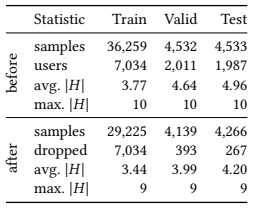
Table 5 : Statistics of the public dataset before and after the trigger rewriting. “After” is the sample set used by every model; avg.|𝐻| there excludes the trigger, which trigger-free baselines still read as the last history item.
원문 · CC BY 4.0 · Muyu Zou, Haibo Xing, Shunye Tang, Liyan Tie, Lingyu Mu, Yandong Wang, Jinxin Hu · TriGen: A Generative Paradigm for Trigger-Induced Recommendation · 원문 그림 인용 · 원본 PDF 10쪽에서 그림 영역을 추출했습니다.구성요소 제거 실험
산업 데이터셋의 ablation에서 트리거를 제거한 no trigger 변형은 Recall@5 2.88, Recall@10 8.27로 전체 모델보다 크게 낮았습니다. 꼬리 주입을 뺀 w/o Calibrated Tail Injection은 Recall@5 4.16, 이중 경로 융합을 뺀 w/o Adaptive Dual-Path Fusion은 Recall@5 5.11, 위치별 Trigger-PFFN을 뺀 변형은 Recall@5 4.28을 기록했습니다. 각 행은 해당 구성요소를 제거한 변형이며, 그 결과는 제거한 요소를 유지하는 효용을 보여 줍니다.
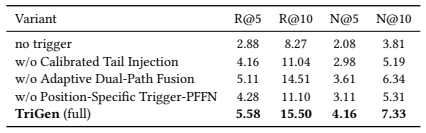
Table 2 : Ablation study of TriGen on the industrial dataset. R@𝐾 and N@𝐾 denote Recall@𝐾 and NDCG@𝐾 (%), respec- tively. The best performance in each column is highlighted in bold.
원문 · CC BY 4.0 · Muyu Zou, Haibo Xing, Shunye Tang, Liyan Tie, Lingyu Mu, Yandong Wang, Jinxin Hu · TriGen: A Generative Paradigm for Trigger-Induced Recommendation · 원문 그림 인용 · 원본 PDF 7쪽에서 그림 영역을 추출했습니다.세부 설계 분석에서는 꼬리 위치 배치가 머리 위치보다 높았고, 반복 횟수는 증가에 따라 성능이 먼저 오르고 나중에 내려가는 형태를 보였습니다. 균등 결합은 라우팅 가중치보다 낮았으며 start-only 주입과 공유 투영도 전체 모델보다 낮았습니다.
공개 벤치마크 트리거와 단일 트리거 가정
공개 Amazon 벤치마크의 트리거는 실제 클릭이 아니라 가장 최근 상호작용으로 시뮬레이션되었습니다. 저자들은 이 가정이 트리거가 가진 즉각적 의도 신호를 약하고 잡음이 많게 만든다고 보며, 공개 결과를 하한으로 해석합니다. 또한 TriGen은 요청마다 하나의 트리거만 가정하므로 여러 최근 신호가 동시에 들어오는 표면에는 직접 적용되지 않습니다.
이 연구의 실측 결과는 산업 데이터셋의 실제 트리거 필드에서 나온 것이며, 공개 데이터의 결과는 같은 강도의 증거로 볼 수 없습니다.
논문 정보
- 저자
- Muyu Zou, Haibo Xing, Shunye Tang, Liyan Tie, Lingyu Mu, Yandong Wang, Jinxin Hu
- 학회·저널
- arXiv · 프리프린트
- 최초 공개일
- 2026년 11월 12일
- 등록일
- 2026년 11월 13일
- 수정일
- 2026년 11월 12일
- 버전
- v1
- arXiv
- 2611.16395
- 분류
- cs.IR
- 원문 이용 조건
- CC BY 4.0
- 제공 범위
- 논문 정보, 해설, 허용된 원문 그림
AI 해설은 논문 원문과 별개의 설명이며 오류가 있을 수 있습니다. 원문과 그림은 각 출처의 이용 조건과 따로 표시된 권리를 따릅니다.
초록
Generative recommendation typically operates under the User-Induced Recommendation (UIR) setting, predicting target items by autoregressively generating semantic IDs as a passive continuation of long-term user history. However, this paradigm overlooks Trigger-Induced Recommendation (TIR), an essential industrial scenario where a user click triggers an immediate follow-up feed. In TIR, recommendations must dynamically align with the instant trigger intent without compromising historical preference continuity. Traditional TIR methods rely on discriminative scoring and cannot guide token-level generation, while existing generative models lack mechanisms to reconcile this structural tension. To address this challenge, we propose TriGen, establishing a tailored generative paradigm for trigger-induced recommendation. TriGen introduces calibrated tail injection to re-encode local history, adaptively arbitrates between persistent tastes and immediate impulses via dynamic gating, and applies position-specific transformations to sustain level-aware trigger guidance across decoding steps. Extensive offline evaluations confirm consistent gains over competitive baselines. Furthermore, online A/B tests across six country markets demonstrate significant revenue and GMV improvements, leading to the full production deployment of TriGen.
원문 인용
Muyu Zou, Haibo Xing, Shunye Tang, Liyan Tie, Lingyu Mu, Yandong Wang, Jinxin Hu (2026). TriGen: A Generative Paradigm for Trigger-Induced Recommendation. arXiv:2611.16395v1. https://arxiv.org/abs/2611.16395v1
BibTeX
@misc{zou2026trigen,
  title = {{TriGen: A Generative Paradigm for Trigger-Induced Recommendation}},
  author = {Muyu Zou and Haibo Xing and Shunye Tang and Liyan Tie and Lingyu Mu and Yandong Wang and Jinxin Hu},
  year = {2026},
  eprint = {2611.16395},
  archivePrefix = {arXiv},
  url = {https://arxiv.org/abs/2611.16395v1}
}