논문 해설
Continual Learning for Multimodal Data Fusion of a Soft Gripper
소프트 그리퍼의 다중모달 데이터 융합을 위한 지속 학습
- 연구 문제 서로 다른 모달리티를 재학습 없이 순차적으로 통합하는 지속 학습 문제를 다룹니다.
- 연구 방법 FeCAM을 확장하여 온라인 배치 학습, 중간 계층 특징 표현, 준지도 의사 레이블 부여를 결합한 exFeCAM을 제안합니다.
- 주요 결과 맞춤형 다중 모달 데이터셋과 VGGSound에서 exFeCAM은 naive-concat, naive-add, Vanilla FeCAM보다 높은 정확도를 보고합니다.
연구 문제와 배경
이 논문은 소프트 그리퍼의 촉각 신호와 물체 이미지처럼 서로 다른 모달리티를 재학습 없이 순차적으로 통합하는 지속 학습 문제를 다룹니다. 기존 방식은 모달리티를 특징 단위로 연결한 뒤 전체 모델을 처음부터 다시 학습해야 하는 경우가 많고, 새 도메인이 들어올 때마다 과거 데이터를 저장하거나 재생해야 하는 부담이 있습니다. 저자들은 이러한 제약을 줄이기 위해 클래스 증분 학습과 도메인 증분 학습을 결합한 설정을 제안합니다. 여기서 각 모달리티는 하나의 새로운 도메인으로 취급됩니다. 또한 레이블 데이터가 적고 비레이블 데이터가 많은 상황을 함께 고려합니다.
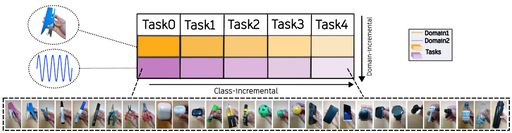
Figure 1 : Multimodal data comprising of two different domains, domain 1 contains the images of various objects in differ- ent orientations, lightning conditions, and different levels of occlusion by the operator and domain 2 contains the tactile sensor information for the corresponding objects. Moving from left to right the model trains in a class-incremental manner, while going from top-bottom it trains in a domain-incremental manner.
원문 · CC BY 4.0 · Nilay Kushawaha, Egidio Falotico · Continual Learning for Multimodal Data Fusion of a Soft Gripper · 원문 그림 인용 · 원본 PDF 4쪽에서 그림 영역을 추출했습니다.exFeCAM의 학습과 예측 구조
exFeCAM은 FeCAM을 확장한 방법입니다. FeCAM은 각 클래스의 특징 분포를 평균과 공분산을 가진 다변량 정규분포로 모델링하고, 마할라노비스 거리가 가장 작은 클래스를 선택합니다. 원래 FeCAM은 한 태스크의 데이터를 임시 메모리에 모은 뒤에야 학습할 수 있어 온라인 학습에 적합하지 않다고 설명됩니다. exFeCAM은 배치 단위로 특징을 받아 클래스별 평균과 공분산을 계산하고, 이미 본 클래스는 이전 프로토타입과 평균하여 딕셔너리를 갱신합니다. 테스트 단계에서는 저장된 프로토타입으로 마할라노비스 거리를 계산합니다. 이 구조에서 학습 시 저장되는 대상은 원본 데이터가 아니라 클래스별 프로토타입입니다.
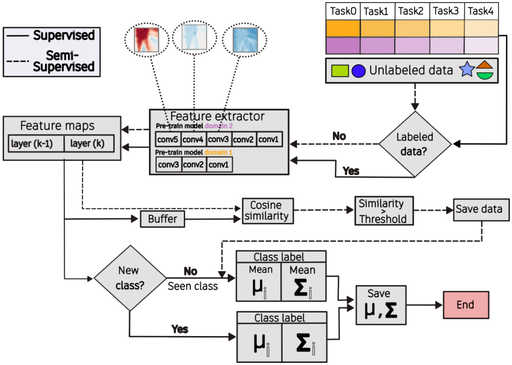
Figure 3 : exFeCAM algorithm with intra-layer feature representation, online batchwise learning, and SSL capabilities for multimodal training. During training on multiple domains, the algorithm stores the mean and covariance matrices of the classes in a dictionary. In the testing phase, the algorithm uses these stored prototypes and employs the Mahalanobis dis- tance to determine the prediction class. Supervised training is depicted with solid black lines, while unsupervised training is illustrated with dashed black lines.
원문 · CC BY 4.0 · Nilay Kushawaha, Egidio Falotico · Continual Learning for Multimodal Data Fusion of a Soft Gripper · 원문 그림 인용 · 원본 PDF 7쪽에서 그림 영역을 추출했습니다.중간 계층 특징 표현과 준지도 학습
중간 계층 특징 표현은 특징 추출기의 마지막 k개 계층의 표현을 합치는 기법입니다. 저자들은 서로 다른 계층의 출력 차원이 다를 수 있으므로 합산 대신 연결을 선택했다고 밝힙니다. 준지도 학습 단계에서는 태스크마다 일부 기준 특징 맵을 임시 버퍼에 저장하고, 비레이블 특징과의 코사인 유사도가 임계값을 넘으면 가장 유사한 기준 특징의 클래스 레이블을 의사 레이블로 부여합니다. 이 과정에서 해당 클래스의 평균과 공분산이 갱신됩니다. 임계값은 Optuna로 탐색하지만 원문은 이 탐색 범위를 본문에서 자세히 제시하지 않습니다.
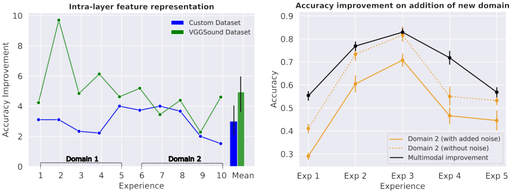
Figure 4 : On the left: intra layer feature representation for the custom dataset and the VGGSound dataset, we compare the improvement in the accuracy of the FeCAM algorithm on addition of knowledge from the last as well the penultimate layers of the pre-trained feature extractors. On the right: the plot shows sensor data accuracy (in orange) with and with- out the addition of random gaussian noise, the solid line in black shows the improvement in the prediction accuracy for the different experiences after addition of the image domain.
원문 · CC BY 4.0 · Nilay Kushawaha, Egidio Falotico · Continual Learning for Multimodal Data Fusion of a Soft Gripper · 원문 그림 인용 · 원본 PDF 10쪽에서 그림 영역을 추출했습니다.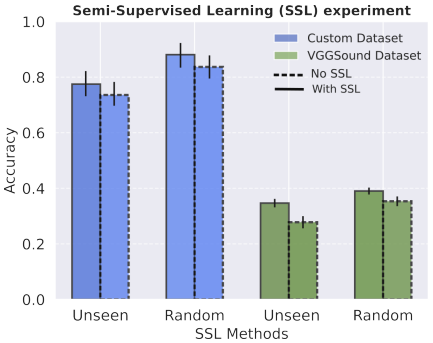
Figure 6 : Accuracy of the exFeCAM algorithm across two different SSL scenarios. The blue plots correspond to the cus- tom dataset, while the green plots represent the VGGSound dataset. Bar plots with solid lines indicate the condition where SSL is integrated into the algorithm, whereas dotted lines represent the condition without SSL.
원문 · CC BY 4.0 · Nilay Kushawaha, Egidio Falotico · Continual Learning for Multimodal Data Fusion of a Soft Gripper · 원문 그림 인용 · 원본 PDF 13쪽에서 그림 영역을 추출했습니다.데이터셋과 실험 설정
맞춤형 다중 모달 데이터셋은 소프트 그리퍼의 촉각 센서 신호와 물체 이미지로 구성됩니다. 센서 신호는 10개 객체 클래스에서 수집되고 각 데이터 포인트는 600차원 벡터입니다. 이미지는 13,500장이며 128x128에서 32x32로 크기를 줄입니다. 또한 VGGSound 부분집합에서 다섯 개의 상위 클래스와 각 두 개의 하위 클래스를 사용합니다. 특징 추출기는 도메인 1에서 그리퍼 데이터로, 도메인 2에서 Core50으로 사전 학습되며 VGGSound 실험에서는 ImageNet1k로 사전 학습된 ResNet18을 사용합니다.
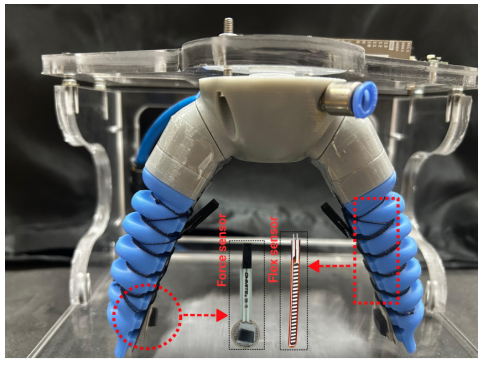
Figure 2 : Commercial two-finger pneumatic gripper equipped with two force sensors and two flex sensors affixed together using stretchable nylon thread. The flex sensor measures the bending of the finger and the force sensor measures the mag- nitude of the force applied to the fingertip.
원문 · CC BY 4.0 · Nilay Kushawaha, Egidio Falotico · Continual Learning for Multimodal Data Fusion of a Soft Gripper · 원문 그림 인용 · 원본 PDF 5쪽에서 그림 영역을 추출했습니다.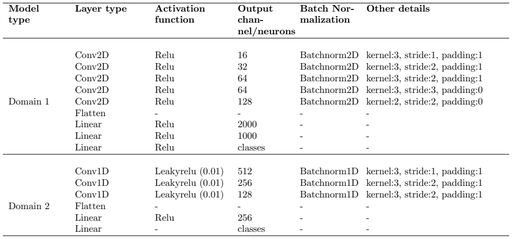
Table 1 : Pre-train model architecture for both the domains of the custom multimodal dataset, domain 1 represents the image data and domain 2 signifies the sensor data. The linear layers for both the models are removed once the pre-training is completed . Here, ”classes” refers to the total number of output classes during the pre-training phase.
원문 · CC BY 4.0 · Nilay Kushawaha, Egidio Falotico · Continual Learning for Multimodal Data Fusion of a Soft Gripper · 원문 그림 인용 · 원본 PDF 8쪽에서 그림 영역을 추출했습니다.정확도 비교와 절제 결과
맞춤형 다중 모달 데이터셋에서 exFeCAM은 70.50±1.79의 정확도를 보고하며, naive-concat의 45.16±1.68 및 naive-add의 43.43±1.59보다 높습니다. VGGSound에서는 exFeCAM이 45.96±1.98로, Vanilla FeCAM의 39.96±1.16보다 높습니다. 중간 계층 특징 표현을 추가하면 맞춤형 데이터셋에서 평균 약 3.12±1.09, VGGSound에서 평균 약 4.90±1.20의 향상이 보고됩니다. 이 수치들은 원문이 보고한 실험 조건에서의 결과이며, 다른 데이터나 과제로 일반화된 결과가 아닙니다.

Table 2 : Comparison of the accuracy of the exFeCAM algorithm and the benchmark methods across two different multi- modal datasets. The joint method represents a scenario where the algorithm has access to the entire dataset at once.
원문 · CC BY 4.0 · Nilay Kushawaha, Egidio Falotico · Continual Learning for Multimodal Data Fusion of a Soft Gripper · 원문 그림 인용 · 원본 PDF 11쪽에서 그림 영역을 추출했습니다.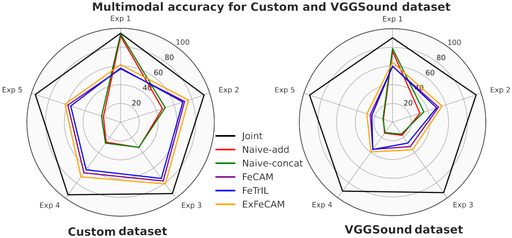
Figure 5 : On the left, the radar plot illustrates the accuracy of various algorithms after incremental training on each ex- perience for the custom multimodal dataset. The accuracy per experience represents the average performance across two domains: visual and sensor signals. On the right, the radar plot presents the per-experience accuracy for the VGGSound dataset, where the two domains consist of visual and audio data.
원문 · CC BY 4.0 · Nilay Kushawaha, Egidio Falotico · Continual Learning for Multimodal Data Fusion of a Soft Gripper · 원문 그림 인용 · 원본 PDF 12쪽에서 그림 영역을 추출했습니다.한계와 적용 범위
VGGSound의 전체 정확도는 맞춤형 데이터셋보다 낮게 보고됩니다. 저자들은 이를 프레임 배경의 복잡성과 다양성 때문일 수 있다고 해석합니다. 또한 실시간 실험에서 평균과 공분산 행렬은 22.5 MB의 메모리를 차지한다고 보고되지만, 이는 이 실험 설정에서의 측정입니다. 실시간 실험에서는 물체 위치와 카메라 시점이 학습 때와 달라 잘못된 예측이 나올 수 있었고, 일부 객체에서는 약 82초의 짧은 추가 학습이 사용되었습니다. 준지도 학습 시나리오 결과는 시각 모달리티에 한정되어 있습니다.
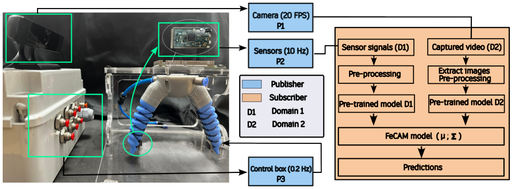
Figure 7 : The real-time multimodal experiment using ROS involves three publishers and one subscriber node. The pub- lishers (P1, P2, P3) are depicted in blue, while the subscriber is shown in yellow. P1 operates at a frequency of 20 Hz, P2 operates at 10 Hz, and P3 operates at 0.2 Hz. The output from P3 is used to actuate a soft finger equipped with sen- sors. The outputs from P1 and P2 are fed to the subscriber, where they undergo pre-processing, feature extraction using a pre-trained network, and finally to the FeCAM algorithm to make the predictions using the saved mean and co-variance matrices.
원문 · CC BY 4.0 · Nilay Kushawaha, Egidio Falotico · Continual Learning for Multimodal Data Fusion of a Soft Gripper · 원문 그림 인용 · 원본 PDF 14쪽에서 그림 영역을 추출했습니다.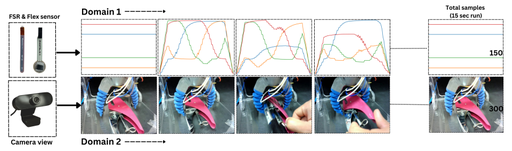
Figure 8 : Real-time images of the object from the camera’s perspective, along with the sensor data from four sensors at- tached to the soft finger, upon it’s actuation. These images and sensor readings are directly fed into the FeCAM model after resizing them to the desired dimension. For a single 15-second run, there are a total of 150 sensor signals and 300 images, representing the number of raw data points and corresponding images of the object.
원문 · CC BY 4.0 · Nilay Kushawaha, Egidio Falotico · Continual Learning for Multimodal Data Fusion of a Soft Gripper · 원문 그림 인용 · 원본 PDF 14쪽에서 그림 영역을 추출했습니다.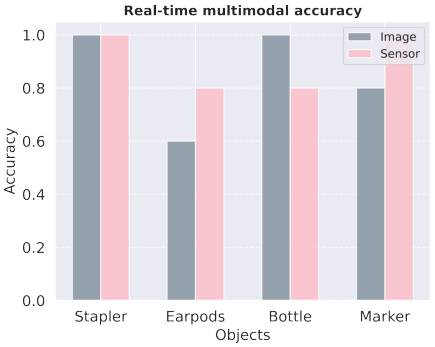
Figure 9 : Real-time object classification accuracy of the two modalities for four different objects. The grey plot represents the prediction accuracy in the image domain, while the pink plot highlights the accuracy for the sensor domain.
원문 · CC BY 4.0 · Nilay Kushawaha, Egidio Falotico · Continual Learning for Multimodal Data Fusion of a Soft Gripper · 원문 그림 인용 · 원본 PDF 15쪽에서 그림 영역을 추출했습니다.논문 정보
- 저자
- Nilay Kushawaha, Egidio Falotico
- 학회·저널
- arXiv · 프리프린트
- 최초 공개일
- 2024년 9월 20일
- 등록일
- 2026년 11월 6일
- 수정일
- 2025년 8월 21일
- 버전
- v2
- arXiv
- 2409.13792
- 분류
- cs.LG · cs.AI · cs.RO
- 원문 이용 조건
- CC BY 4.0
- 제공 범위
- 논문 정보, 해설, 허용된 원문 그림
AI 해설은 논문 원문과 별개의 설명이며 오류가 있을 수 있습니다. 원문과 그림은 각 출처의 이용 조건과 따로 표시된 권리를 따릅니다.
초록
Continual learning (CL) refers to the ability of an algorithm to continuously and incrementally acquire new knowledge from its environment while retaining previously learned information. A model trained on one data modality often fails when tested with a different modality. A straightforward approach might be to fuse the two modalities by concatenating their features and training the model on the fused data. However, this requires retraining the model from scratch each time it encounters a new domain. In this paper, we introduce a continual learning algorithm capable of incrementally learning different data modalities by leveraging both class-incremental and domain-incremental learning scenarios in an artificial environment where labeled data is scarce, yet non-iid (independent and identical distribution) unlabeled data from the environment is plentiful. The proposed algorithm is efficient and only requires storing prototypes for each class. We evaluate the algorithm's effectiveness on a challenging custom multimodal dataset comprising of tactile data from a soft pneumatic gripper, and visual data from non-stationary images of objects extracted from video sequences. Additionally, we conduct an ablation study on the custom dataset and the Core50 dataset to highlight the contributions of different components of the algorithm. To further demonstrate the robustness of the algorithm, we perform a real-time experiment for object classification using the soft gripper and an external independent camera setup, all synchronized with the Robot Operating System (ROS) framework.
원문 인용
Nilay Kushawaha, Egidio Falotico (2024). Continual Learning for Multimodal Data Fusion of a Soft Gripper. arXiv:2409.13792v2. https://arxiv.org/abs/2409.13792v2
BibTeX
@misc{kushawaha2024continual,
  title = {{Continual Learning for Multimodal Data Fusion of a Soft Gripper}},
  author = {Nilay Kushawaha and Egidio Falotico},
  year = {2024},
  eprint = {2409.13792},
  archivePrefix = {arXiv},
  url = {https://arxiv.org/abs/2409.13792v2}
}