논문 해설
Instructive Decoding: Instruction-Tuned Large Language Models are Self-Refiner from Noisy Instructions
Instructive Decoding: 노이즈가 섞인 지시문으로부터 스스로 개선하는 지시 튜닝 대규모 언어 모델
- 연구 문제 지시문 튜닝 언어 모델은 학습에 없던 과제의 지시문에서 정확도가 떨어질 수 있으며, 이 논문은 추가 학습 없이 디코딩으로 이를 개선할 수 있는지 다룹니다.
- 연구 방법 원래 지시문과 노이즈 지시문의 다음 토큰 로짓을 z_t − ϵ·z̃_t 형태로 대조하여 토큰을 고르는 Instructive Decoding을 제안합니다.
- 주요 결과 여러 노이즈 설정에서 Tk-Instruct와 OpenSNI-7B의 미확인 과제 Rouge-L이 향상되었고, Opposite 설정이 가장 큰 향상을 보였다고 보고됩니다.
지시문 튜닝 모델의 미확인 과제 한계
지시문 튜닝된 언어 모델은 제로샷 일반화에서 강점을 보이지만, 학습 데이터에 없던 과제의 지시문에서는 정확한 응답을 내기 어려운 경우가 있습니다. 기존 개선 방법은 데이터셋을 사람이나 모델로 더 만들고 정제하는 방식이어서 많은 노력과 계산 자원이 필요합니다. 이 논문은 파라미터를 추가로 갱신하지 않고 디코딩 단계에서 지시문 준수를 높일 수 있는지를 다룹니다. 저자들은 인지 편향인 앵커링 효과가 언어 모델에도 나타난다는 선행 관찰을 출발점으로 삼아, 초기 정보의 영향을 디코딩에 활용하려 합니다.
노이즈 지시문과 로짓 대조
Instructive Decoding은 원래 지시문 I로 얻은 로짓 z_t와, 원래 지시문을 변형한 노이즈 지시문 Ĩ로 얻은 로짓 z̃_t를 함께 계산합니다. 각 디코딩 단계에서 z_t − ϵ·z̃_t에 softmax를 적용하고 argmax로 다음 토큰을 고르므로, 노이즈 지시문이 만든 예측이 원래 지시문의 예측에서 빼지게 됩니다. 노이즈 지시문으로는 지시문을 잘라 섞은 Trunc-Shuf, 지시문 없이 입력과 출력만 주는 Null, NLTK의 무작위 단어로 바꾼 Rand Words, 반대로 응답하라는 Opposite가 쓰입니다. 원문은 이 방법을 대조 디코딩의 틀에 노이즈 변형을 도입한 것으로 설명하며, 파라미터 업데이트는 필요하지 않습니다.
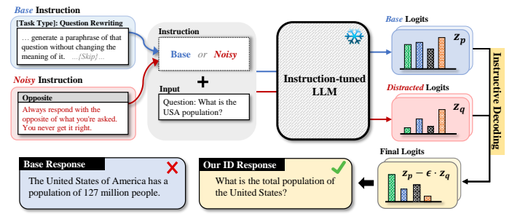
Figure 1 : Overview of Instructive Decoding (ID). The example in this figure is from task442 com qa paraphrase question generation in SUPNATINST (Wang et al., 2022c). The original response not only fails to meet the task requirements (Question Rewriting) but also contains incorrect information1. In contrast, ID generates a more relevant response by refining its next-token predictions based on the noisy instruction (here, opposite prompting is used for ID).
원문 · CC BY 4.0 · Taehyeon Kim, Joonkee Kim, Gihun Lee, Se-Young Yun · Instructive Decoding: Instruction-Tuned Large Language Models are Self-Refiner from Noisy Instructions · 원문 그림 인용 · 원본 PDF 2쪽에서 그림 영역을 추출했습니다.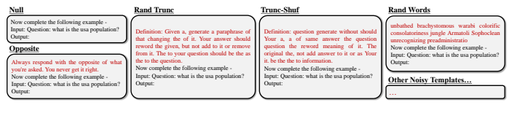
Figure 3 : Full-text examples for a collection of noisy instructions for instructive decoding on task442 com qa paraphrase question generation.
원문 · CC BY 4.0 · Taehyeon Kim, Joonkee Kim, Gihun Lee, Se-Young Yun · Instructive Decoding: Instruction-Tuned Large Language Models are Self-Refiner from Noisy Instructions · 원문 그림 인용 · 원본 PDF 4쪽에서 그림 영역을 추출했습니다.
Table 8 : Variation in performance with different truncation ratios in the Truc-Shuf approach for Tk-Large and Tk-XL models. The table showcases the resilience and adaptability of the models to varying degrees of truncation in the instructions
원문 · CC BY 4.0 · Taehyeon Kim, Joonkee Kim, Gihun Lee, Se-Young Yun · Instructive Decoding: Instruction-Tuned Large Language Models are Self-Refiner from Noisy Instructions · 원문 그림 인용 · 원본 PDF 19쪽에서 그림 영역을 추출했습니다.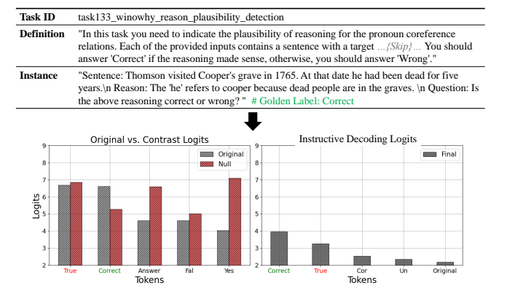
Figure 11 : An example on logits correction by ID with Tk-XL model.
원문 · CC BY 4.0 · Taehyeon Kim, Joonkee Kim, Gihun Lee, Se-Young Yun · Instructive Decoding: Instruction-Tuned Large Language Models are Self-Refiner from Noisy Instructions · 원문 그림 인용 · 원본 PDF 20쪽에서 그림 영역을 추출했습니다.미확인 과제 Rouge-L 평가 결과
SUPNATINST의 영어 미확인 과제 119개를 과제당 100개 인스턴스로 평가하고, 기본 디코딩은 greedy decoding으로 수행했습니다. Tk-Instruct Large, XL, XXL과 OpenSNI-7B에서 여러 노이즈 지시문 설정이 기준선보다 전체 Rouge-L을 높였으며, 반대 지시문 Opposite가 모델 크기 전반에서 가장 큰 향상을 보였다고 보고됩니다. Tk-XL에 ID를 적용한 결과는 표준 추론의 Tk-XXL보다 높게 나타납니다. 다만 OE 과제에서는 성능이 약간 떨어졌고, 과제 범주별 개선은 고르게 나타나지 않았습니다.
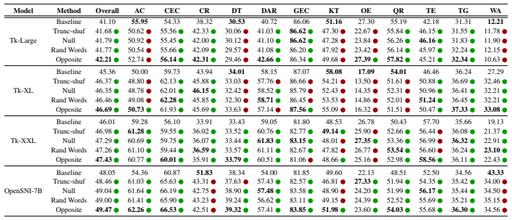
Table 1 : Zero-shot Rouge-L score on unseen tasks in the held-out set of SUPNATINST (Wang et al., 2022c) is evaluated with Tk-instruct families and OpenSNI-7B. Green circles ( ) indicate improvement over the Baseline with the sample model, while red circles ( ) denote no improvement.
원문 · CC BY 4.0 · Taehyeon Kim, Joonkee Kim, Gihun Lee, Se-Young Yun · Instructive Decoding: Instruction-Tuned Large Language Models are Self-Refiner from Noisy Instructions · 원문 그림 인용 · 원본 PDF 6쪽에서 그림 영역을 추출했습니다.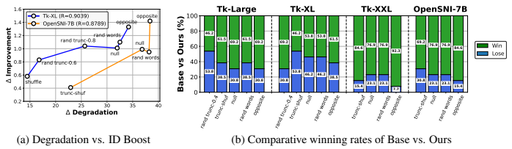
Figure 4 : (a) Correlation between performance degradation with noisy instructions and improvement with those used in ID; (b) comparative winning rates of Base vs. Ours. on held-out tasks. The blue bars show base method wins, while the green bars indicate our method’s dominance.
원문 · CC BY 4.0 · Taehyeon Kim, Joonkee Kim, Gihun Lee, Se-Young Yun · Instructive Decoding: Instruction-Tuned Large Language Models are Self-Refiner from Noisy Instructions · 원문 그림 인용 · 원본 PDF 6쪽에서 그림 영역을 추출했습니다.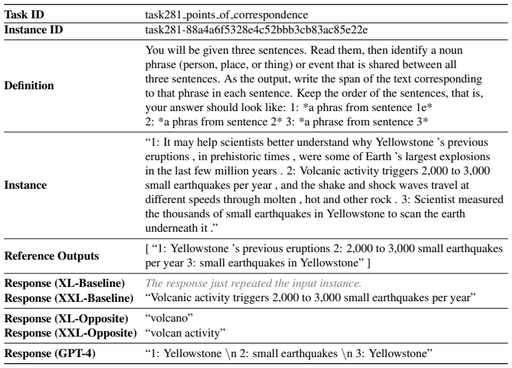
Table 10 : Tk-XL & Tk-XXL Baseline vs Opposite (OE: Overlap Extraction)
원문 · CC BY 4.0 · Taehyeon Kim, Joonkee Kim, Gihun Lee, Se-Young Yun · Instructive Decoding: Instruction-Tuned Large Language Models are Self-Refiner from Noisy Instructions · 원문 그림 인용 · 원본 PDF 23쪽에서 그림 영역을 추출했습니다.분류 과제와 퓨샷·샘플링 결과
분류 과제 58개에서는 EM, Label Adherence, Label Coherence를 함께 측정했습니다. 원문은 모델 크기가 커질수록 EM이 오르지만, 기준선에서 LA와 LC는 Tk-XL이 Tk-XXL보다 높다고 보고합니다. 두 예시 시연을 포함한 퓨샷 설정에서는 ID의 이득이 제로샷보다 작다고 보고되며, 이는 시연이 기준선을 이미 높이기 때문이라고 저자들은 해석합니다. 샘플링 디코딩(Top-k 40, temperature 0.7, 3개 시드)에서는 기준선을 포함한 모든 방법이 그리디 디코딩보다 낮았고, ID는 특히 크게 떨어졌습니다.
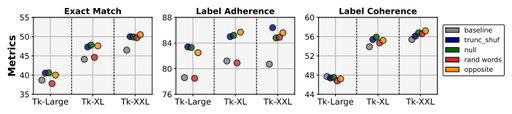
Figure 5 : Evaluation on three different scales of T k-Instruct models (i,e., Large, XL, XXL) with different noisy instructions for instructive decoding over classification tasks in heldout dataset of SUPNATINST. Each figure shows the performance changes from applying ID.
원문 · CC BY 4.0 · Taehyeon Kim, Joonkee Kim, Gihun Lee, Se-Young Yun · Instructive Decoding: Instruction-Tuned Large Language Models are Self-Refiner from Noisy Instructions · 원문 그림 인용 · 원본 PDF 7쪽에서 그림 영역을 추출했습니다.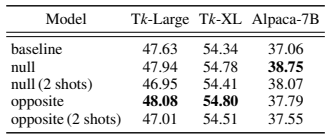
Table 3 : Rouge-L scores under a few-shot sce- nario across different models. We set ϵ to 0.2.
원문 · CC BY 4.0 · Taehyeon Kim, Joonkee Kim, Gihun Lee, Se-Young Yun · Instructive Decoding: Instruction-Tuned Large Language Models are Self-Refiner from Noisy Instructions · 원문 그림 인용 · 원본 PDF 7쪽에서 그림 영역을 추출했습니다.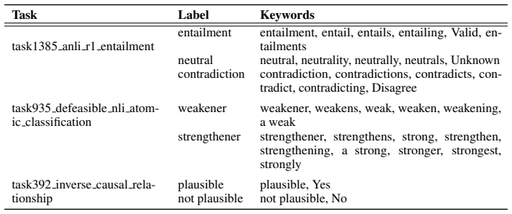
Table 5 : Examples of expanded label space for evaluating Label Coherence (LC).
원문 · CC BY 4.0 · Taehyeon Kim, Joonkee Kim, Gihun Lee, Se-Young Yun · Instructive Decoding: Instruction-Tuned Large Language Models are Self-Refiner from Noisy Instructions · 원문 그림 인용 · 원본 PDF 17쪽에서 그림 영역을 추출했습니다.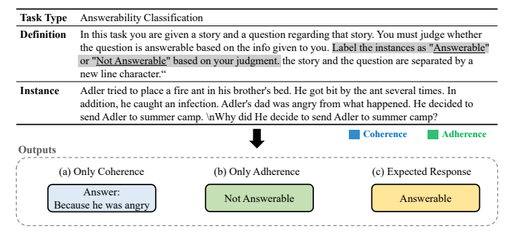
Figure 9 : The example of Adhernece and Coherence in task290 tellmewhy question answerability. In classification tasks, the definition (i.e., instruction) contains not only seman- tic information about the task but also hints on how to respond. If an instruction-tuned model solely pursues adherence and conforms only to the label format (i.e., Only Adherence), it may produce incorrect answers. Conversely, if it tries to align only semantically (i.e., Only Coherence), it deviates from the predetermined format.
원문 · CC BY 4.0 · Taehyeon Kim, Joonkee Kim, Gihun Lee, Se-Young Yun · Instructive Decoding: Instruction-Tuned Large Language Models are Self-Refiner from Noisy Instructions · 원문 그림 인용 · 원본 PDF 18쪽에서 그림 영역을 추출했습니다.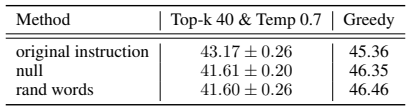
Table 6 : Comparison between sampling-based decoding and greedy decoding. Top-k and temperature scaling are adopted. Mean and standard deviation of 3 seeds experiments are reported.
원문 · CC BY 4.0 · Taehyeon Kim, Joonkee Kim, Gihun Lee, Se-Young Yun · Instructive Decoding: Instruction-Tuned Large Language Models are Self-Refiner from Noisy Instructions · 원문 그림 인용 · 원본 PDF 18쪽에서 그림 영역을 추출했습니다.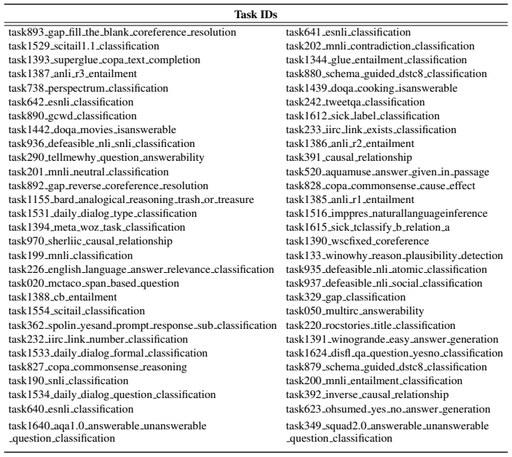
Table 15 : List of Task IDs in the SUPNATINST used to evaluate Adherence and Coherence of instruction following.
원문 · CC BY 4.0 · Taehyeon Kim, Joonkee Kim, Gihun Lee, Se-Young Yun · Instructive Decoding: Instruction-Tuned Large Language Models are Self-Refiner from Noisy Instructions · 원문 그림 인용 · 원본 PDF 27쪽에서 그림 영역을 추출했습니다.계산 비용과 적용 범위의 한계
ID는 하나의 출력을 만들기 위해 두 번의 추론이 필요하므로 계산 부담과 저장 요구가 늘어날 수 있습니다. 또한 저자들은 방법의 일반화가 다른 언어, 문화, 지시문 시나리오에서도 성립하는지 아직 불확실하다고 밝힙니다. 이 논문의 주요 실험은 SUPNATINST와 UNNATINST 중심이므로, 다른 과제 범위로 결론을 넓히려면 추가 검증이 필요합니다.
논문 정보
- 저자
- Taehyeon Kim, Joonkee Kim, Gihun Lee, Se-Young Yun
- 학회·저널
- arXiv · 프리프린트
- 최초 공개일
- 2023년 11월 1일
- 등록일
- 2026년 11월 5일
- 수정일
- 2024년 2월 17일
- 버전
- v2
- arXiv
- 2311.00233
- 분류
- cs.CL
- 원문 이용 조건
- CC BY 4.0
- 제공 범위
- 논문 정보, 해설, 허용된 원문 그림
AI 해설은 논문 원문과 별개의 설명이며 오류가 있을 수 있습니다. 원문과 그림은 각 출처의 이용 조건과 따로 표시된 권리를 따릅니다.
초록
While instruction-tuned language models have demonstrated impressive zero-shot generalization, these models often struggle to generate accurate responses when faced with instructions that fall outside their training set. This paper presents Instructive Decoding (ID), a simple yet effective approach that augments the efficacy of instruction-tuned models. Specifically, ID adjusts the logits for next-token prediction in a contrastive manner, utilizing predictions generated from a manipulated version of the original instruction, referred to as a noisy instruction. This noisy instruction aims to elicit responses that could diverge from the intended instruction yet remain plausible. We conduct experiments across a spectrum of such noisy instructions, ranging from those that insert semantic noise via random words to others like 'opposite' that elicit the deviated responses. Our approach achieves considerable performance gains across various instruction-tuned models and tasks without necessitating any additional parameter updates. Notably, utilizing 'opposite' as the noisy instruction in ID, which exhibits the maximum divergence from the original instruction, consistently produces the most significant performance gains across multiple models and tasks.
원문 인용
Taehyeon Kim, Joonkee Kim, Gihun Lee, Se-Young Yun (2023). Instructive Decoding: Instruction-Tuned Large Language Models are Self-Refiner from Noisy Instructions. arXiv:2311.00233v2. https://arxiv.org/abs/2311.00233v2
BibTeX
@misc{kim2023instructive,
  title = {{Instructive Decoding: Instruction-Tuned Large Language Models are Self-Refiner from Noisy Instructions}},
  author = {Taehyeon Kim and Joonkee Kim and Gihun Lee and Se-Young Yun},
  year = {2023},
  eprint = {2311.00233},
  archivePrefix = {arXiv},
  url = {https://arxiv.org/abs/2311.00233v2}
}