논문 해설
SafeAPT: Safe Simulation-to-Real Robot Learning using Diverse Policies Learned in Simulation
SafeAPT: 시뮬레이션에서 학습한 다양한 정책을 활용한 안전한 시뮬레이션-실제 로봇 학습
- 연구 문제 시뮬레이션에서 학습한 정책을 실제 로봇에 옮길 때 안전 제약을 지키면서 데이터 효율적으로 높은 보상을 얻는 것이 어렵습니다.
- 연구 방법 시뮬레이션에서 MAP-Elites로 안전한 정책 레퍼토리를 만들고, 실제 로봇 관측으로 보상·안전 모델을 갱신하며 ESI를 최대화하는 정책을 선택합니다.
- 주요 결과 시뮬레이션과 실제 Kuka 하키 실험에서 SafeAPT는 제시된 조건에서 안전 위반을 가장 적게 보였고, 실제 하키 실험에서는 높은 보상을 얻었습니다.
실제 로봇 학습의 데이터 효율과 안전 문제
강화학습을 실제 로봇에 직접 적용하면 많은 시행이 필요하고, 그 과정에서 로봇이 스스로를 손상시키거나 주변에 해를 끼칠 수 있습니다. 시뮬레이션에서 학습한 정책을 실제 세계로 옮기는 시뮬레이션-실제 전이는 데이터 효율을 높이는 유망한 방법이지만, 시뮬레이션과 실제 세계 사이의 현실 격차(reality-gap)가 존재합니다. 이 격차 때문에 시뮬레이션에서 안전해 보인 정책도 실제 로봇에서는 안전하지 않을 수 있습니다. 이 논문은 이 상황에서 목표가 시뮬레이션에 미리 정해지지 않은 다중 목표 과제와 안전 제약을 함께 다룹니다.
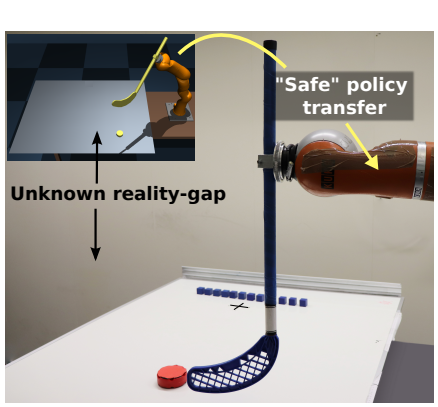
Fig. 1 : Safe sim-to-real policy transfer when there is unknown reality-gap ( e.g., unknown friction) between the simulation and the real world, and when the goal of the task is not specified apriori in the simulation (e.g., desired location of the puck is not specified in simulation).
원문 · CC BY 4.0 · Rituraj Kaushik, Karol Arndt, Ville Kyrki · SafeAPT: Safe Simulation-to-Real Robot Learning using Diverse Policies Learned in Simulation · 원문 그림 인용 · 원본 PDF 1쪽에서 그림 영역을 추출했습니다.정책 레퍼토리 생성과 안전 변환 모델
SafeAPT는 먼저 시뮬레이션에서 목표 공간의 각 셀에 정책을 저장하는 정책 레퍼토리를 만듭니다. 이 과정에서 MAP-Elites를 사용하며, 여러 동역학 조건에서 정책을 평가하고 각 정책의 적합도로 최소 안전 점수를 사용합니다. 목표 공간의 한 셀에 여러 정책이 들어오면 안전 점수가 더 높은 튜플을 남깁니다. 실제 로봇에서는 주어진 목표에 따라 레퍼토리 튜플에 보상을 계산하고, 시뮬레이션 결과를 사전 평균으로 둔 가우시안 과정 회귀 모델로 보상과 안전 점수의 변환을 에피소드마다 갱신합니다. 이 모델은 실제 세계의 관측으로 학습되는 부분이며, 시뮬레이션 결과는 학습의 출발점인 사전 정보로 쓰입니다.
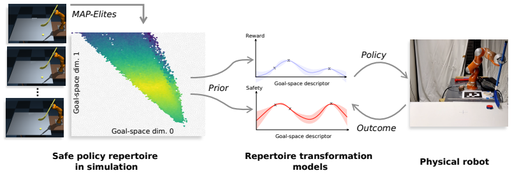
Fig. 2 : Overview: SafeAPT first generates a large set of policies (also called a repertoire) that are maximally safe to achieve diverse goals in various simulated dynamics conditions ( e.g., friction, joint damage, mass etc.). Then, given an arbitrary goal in the real world, the robot figures out the most suitable policy to maximize the reward by iteratively trying policies from the repertoire. SafeAPT ensures data-efficiency and minimizes the safety violations during real-world interactions thanks to the probabilistic reward model and safety model learned online using the simulated data as “priors”.
원문 · CC BY 4.0 · Rituraj Kaushik, Karol Arndt, Ville Kyrki · SafeAPT: Safe Simulation-to-Real Robot Learning using Diverse Policies Learned in Simulation · 원문 그림 인용 · 원본 PDF 2쪽에서 그림 영역을 추출했습니다.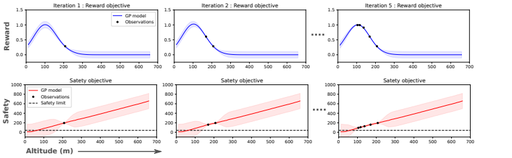
Fig. 3 : GP updates in Asteroid landing experiment: Plots show how reward and safety GP models are updated using the observations after each episode and how SafeAPT cautiously improves the reward while maintaining safety at each trial.
원문 · CC BY 4.0 · Rituraj Kaushik, Karol Arndt, Ville Kyrki · SafeAPT: Safe Simulation-to-Real Robot Learning using Diverse Policies Learned in Simulation · 원문 그림 인용 · 원본 PDF 6쪽에서 그림 영역을 추출했습니다.ESI 획득 함수와 안전 필터
실제 로봇에서 정책 선택은 기대 개선량(EI)을 수정한 기대 안전 개선량(ESI)으로 이루어집니다. ESI는 EI에 지시 함수 1λ(x)를 곱하며, 하한 신뢰 구간 LCB(x)가 안전 한계 λ보다 작으면 그 값은 0이 되고, 그렇지 않으면 1이 됩니다. 따라서 LCB가 λ 이상인 정책만 실제 로봇 시험 후보로 남습니다. 각 에피소드에서는 ESI를 최대화하는 레퍼토리 정책을 선택하고, 실행 결과로 GP 모델을 다시 갱신합니다. 원문은 κ가 커지면 안전 확률 상한이 낮아지지만 위험하지만 보상이 높을 수 있는 정책을 덜 시험하게 되므로 κ가 안전과 보상의 균형을 정한다고 설명합니다.
시뮬레이션 과제와 기준선 설정
실험은 소행성 착륙, 4자유도 평면 팔 목표 도달, Kuka 팔 하키의 세 시뮬레이션 과제와 실제 Kuka 하키 과제에서 수행됩니다. 소행성 착륙에서는 중력이 3에서 10 m/s² 사이로 변하며, 안전 한계는 40미터입니다. 평면 팔은 4개의 위험 영역에서 1 단위 이상 떨어져야 하고, 하키 시뮬레이션에서는 마찰 계수가 0.4에서 0.7 사이로 변하며 퍼크는 테이블 가장자리에서 0.1미터 이상 떨어져야 합니다. 비교 기준선은 정책 파라미터 공간에서 직접 최적화하는 CBO, 실제 세계의 안전 변환을 학습하지 않는 SafeAPT (no GP-safety), 단일 동역학 조건으로 레퍼토리를 만든 SafeAPT (single dynamics)입니다.
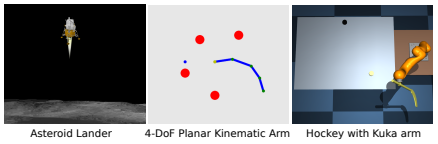
Fig. 4 : Simulated experiments
원문 · CC BY 4.0 · Rituraj Kaushik, Karol Arndt, Ville Kyrki · SafeAPT: Safe Simulation-to-Real Robot Learning using Diverse Policies Learned in Simulation · 원문 그림 인용 · 원본 PDF 6쪽에서 그림 영역을 추출했습니다.안전 위반 횟수와 실제 하키 결과
시뮬레이션의 Table I에서 SafeAPT의 안전 위반 횟수는 소행성 착륙에서 0.0 ± 0.0이며, CBO는 1.13 ± 2.36입니다. 이 값은 실험당 20에피소드 동안의 위반 횟수이며 15회 반복의 평균과 표준편차입니다. 안전 변환 모델을 제외한 SafeAPT (no GP-safety)의 하키 시뮬레이션 위반 횟수는 15.73 ± 3.84로 가장 높습니다. 실제 Kuka 하키 실험에서 SafeAPT는 8회 반복 동안 안전 위반이 0.0 ± 0.0이었고, 최대 보상은 0.97 ± 0.04입니다. CBO의 위반 횟수는 0.72 ± 0.86입니다. 이 결과는 해당 과제와 조건에서 얻은 것이며 다른 과제에 그대로 일반화하지 않습니다.
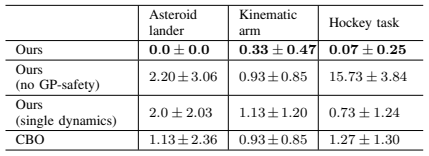
원문 그림 TABLE I: Safety violations per experiment: the number of times the safety limit is violated in each experiment of 20 episodes (mean and standard deviation over 15 replicates).
원문 · CC BY 4.0 · Rituraj Kaushik, Karol Arndt, Ville Kyrki · SafeAPT: Safe Simulation-to-Real Robot Learning using Diverse Policies Learned in Simulation · 원문 그림 인용 · 원본 PDF 6쪽에서 그림 영역을 추출했습니다.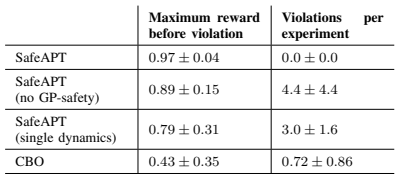
원문 그림 TABLE II: Results of physical Kuka-arm hockey task: Tables shows that on average, SafeAPT achieves higher reward before any safety violation compared to the baselines (8 replicates, each with budget of 15 episodes)
원문 · CC BY 4.0 · Rituraj Kaushik, Karol Arndt, Ville Kyrki · SafeAPT: Safe Simulation-to-Real Robot Learning using Diverse Policies Learned in Simulation · 원문 그림 인용 · 원본 PDF 8쪽에서 그림 영역을 추출했습니다.적용 범위와 한계
원문은 SafeAPT가 목표 공간의 이산화가 충분히 조밀하지 않으면 사전 계산된 정책이 최적이 아닐 수 있다고 밝힙니다. 또한 정책을 더 정제하려면 Safe-Opt 같은 방법으로 파라미터 공간에서 추가 조정을 할 수 있다고 제안합니다. 이 연구의 실제 로봇 실험은 Kuka 하키 과제 하나이며, 다른 로봇 과제에서의 성능은 이 논문의 결과로 확인되지 않았습니다.
논문 정보
- 저자
- Rituraj Kaushik, Karol Arndt, Ville Kyrki
- 학회·저널
- arXiv · 프리프린트
- 최초 공개일
- 2022년 1월 27일
- 등록일
- 2026년 11월 6일
- 수정일
- 2022년 1월 27일
- 버전
- v1
- arXiv
- 2201.13248
- 분류
- cs.RO · cs.AI · cs.LG · cs.NE
- 원문 이용 조건
- CC BY 4.0
- 제공 범위
- 논문 정보, 해설, 허용된 원문 그림
AI 해설은 논문 원문과 별개의 설명이며 오류가 있을 수 있습니다. 원문과 그림은 각 출처의 이용 조건과 따로 표시된 권리를 따릅니다.
초록
The framework of Simulation-to-real learning, i.e, learning policies in simulation and transferring those policies to the real world is one of the most promising approaches towards data-efficient learning in robotics. However, due to the inevitable reality gap between the simulation and the real world, a policy learned in the simulation may not always generate a safe behaviour on the real robot. As a result, during adaptation of the policy in the real world, the robot may damage itself or cause harm to its surroundings. In this work, we introduce a novel learning algorithm called SafeAPT that leverages a diverse repertoire of policies evolved in the simulation and transfers the most promising safe policy to the real robot through episodic interaction. To achieve this, SafeAPT iteratively learns a probabilistic reward model as well as a safety model using real-world observations combined with simulated experiences as priors. Then, it performs Bayesian optimization on the repertoire with the reward model while maintaining the specified safety constraint using the safety model. SafeAPT allows a robot to adapt to a wide range of goals safely with the same repertoire of policies evolved in the simulation. We compare SafeAPT with several baselines, both in simulated and real robotic experiments and show that SafeAPT finds high-performance policies within a few minutes in the real world while minimizing safety violations during the interactions.
원문 인용
Rituraj Kaushik, Karol Arndt, Ville Kyrki (2022). SafeAPT: Safe Simulation-to-Real Robot Learning using Diverse Policies Learned in Simulation. arXiv:2201.13248v1. https://arxiv.org/abs/2201.13248v1
BibTeX
@misc{kaushik2022safeapt,
  title = {{SafeAPT: Safe Simulation-to-Real Robot Learning using Diverse Policies Learned in Simulation}},
  author = {Rituraj Kaushik and Karol Arndt and Ville Kyrki},
  year = {2022},
  eprint = {2201.13248},
  archivePrefix = {arXiv},
  url = {https://arxiv.org/abs/2201.13248v1}
}