논문 해설
Deep reinforcement learning for flow control exploits different physics for increasing Reynolds-number regimes
심층 강화학습 기반 유동 제어는 레이놀즈 수 영역이 높아질수록 서로 다른 물리 현상을 활용한다
- 연구 문제 심층 강화학습으로 two-jet 실린더 흐름을 제어할 때 Reynolds 수가 커지면 제어 전략과 항력 감소 효과가 어떻게 달라지는지가 핵심 질문입니다.
- 연구 방법 Alya 유동 solver와 PPO 기반 DRL 에이전트를 결합하여 실린더 상하 제트의 질량 유량을 학습합니다. 관측은 압력 witness point이고 보상은 항력과 양력 페널티를 결합합니다.
- 주요 결과 Re = 100에서는 CD가 8.9 % 감소하고, Re = 2000에서는 평균 CD가 3.39에서 2.79로 17 % 이상 감소합니다. Re = 1000에서 학습한 에이전트를 Re = 2000에 교차 적용하면 19 % 감소가 관측됩니다.
연구 문제와 배경
이 논문은 항공 분야에서 항력을 줄이기 위한 능동 흐름 제어를 다룹니다. 항력 감소는 연료 소비와 온실가스 배출 감소로 이어지므로 중요합니다. 능동 제어 방법은 제어 전략이 흐름 상태에 따라 복잡하게 변하기 때문에 설계가 어렵습니다. 저자들은 이 문제를 실린더 주변의 두 제트를 사용하는 2차원 실린더 흐름으로 단순화하여 살펴봅니다.
기존 연구는 주로 Re = 100 부근에서 심층 강화학습(DRL) 제어를 검증했습니다. 이 논문은 Re = 100, 1000, 2000 세 조건을 비교하여, 더 높은 Reynolds 수에서 학습된 제어 전략이 기존 전략과 같은 물리 메커니즘을 쓰는지 확인하는 것을 목표로 합니다.
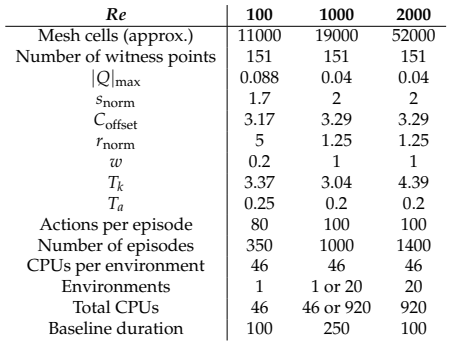
Table 1 : Parameters of the simulations for each Reynolds number considered in this work.
원문 · CC BY 4.0 · Pau Varela, Pol Suárez, Francisco Alcántara-Ávila, Arnau Miró, Jean Rabault, Bernat Font, Luis Miguel García-Cuevas, Oriol Lehmkuhl, Ricardo Vinuesa · Deep reinforcement learning for flow control exploits different physics for increasing Reynolds-number regimes · 원문 그림 인용 · 원본 PDF 5쪽에서 그림 영역을 추출했습니다.Alya 솔버와 DRL 제어 구성
제어 대상은 실린더를 감싸는 사각형 채널이며, 실린더 상단과 하단 벽에 두 개의 합성 제트가 있습니다. 에이전트의 행동 a는 상단 제트의 질량 유량 Q1에 대응하고, 하단 제트는 Q2 = −Q1로 설정되어 전체 질량 유량의 합이 0이 되도록 합니다.
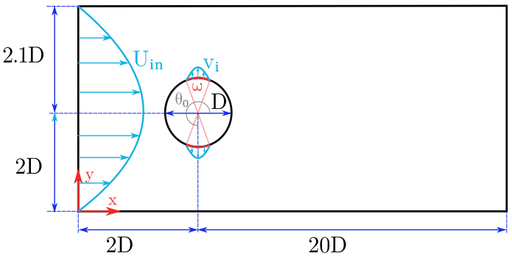
Figure 1 . Main domain dimensions in terms of the cylinder diameter D, where ω represents the jet width and θ0 is the angle of the center of the jet. In light blue the parabolic velocity profile of the inlet and the jet are represented. The domain representation is not to scale.
원문 · CC BY 4.0 · Pau Varela, Pol Suárez, Francisco Alcántara-Ávila, Arnau Miró, Jean Rabault, Bernat Font, Luis Miguel García-Cuevas, Oriol Lehmkuhl, Ricardo Vinuesa · Deep reinforcement learning for flow control exploits different physics for increasing Reynolds-number regimes · 원문 그림 인용 · 원본 PDF 4쪽에서 그림 영역을 추출했습니다.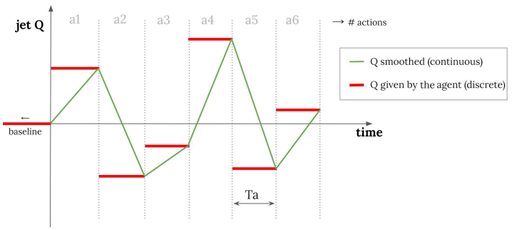
Figure 4 . Flow rate of the jet Q smoothed and applied in the numerical simulation (green) versus the discrete Q decided by the DRL agent (red).
원문 · CC BY 4.0 · Pau Varela, Pol Suárez, Francisco Alcántara-Ávila, Arnau Miró, Jean Rabault, Bernat Font, Luis Miguel García-Cuevas, Oriol Lehmkuhl, Ricardo Vinuesa · Deep reinforcement learning for flow control exploits different physics for increasing Reynolds-number regimes · 원문 그림 인용 · 원본 PDF 8쪽에서 그림 영역을 추출했습니다.관측 상태 s는 실린더 주변과 후류에 배치된 151개의 witness point에서 얻은 압력값을 snorm으로 정규화한 값입니다. 보상은 평균 항력 ⟨CD⟩와 양력 페널티 w⟨CL⟩을 결합한 r = rnorm(−⟨CD⟩ − w⟨CL⟩ + Coffset)으로 정의됩니다. 여기서 rnorm은 보상을 대략 0과 1 사이로 맞추는 계수이며, Coffset은 초기 보상을 0 근처에 두기 위한 상수입니다. 이 설정은 양력 편향을 줄이기 위해 양력 항을 포함합니다.
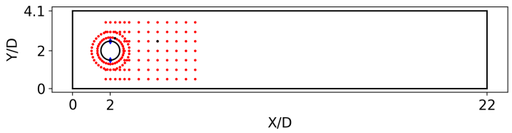
Figure 3 . Schematic representation of the computational domain, where the red dots correspond to the location of the probes. The position of two probes is remarked as black dots for further analysis in subsection 3.3.
원문 · CC BY 4.0 · Pau Varela, Pol Suárez, Francisco Alcántara-Ávila, Arnau Miró, Jean Rabault, Bernat Font, Luis Miguel García-Cuevas, Oriol Lehmkuhl, Ricardo Vinuesa · Deep reinforcement learning for flow control exploits different physics for increasing Reynolds-number regimes · 원문 그림 인용 · 원본 PDF 7쪽에서 그림 영역을 추출했습니다.PPO 에이전트는 두 개의 512 뉴런 밀집층으로 구성된 ANN 정책을 학습하며, 구현에는 Tensorforce 라이브러리가 사용됩니다. 유동은 Alya 솔버가 비압축성 점성 Navier–Stokes 방정식을 풀어 계산합니다. 이산화에는 EMAC 형태의 비선형 대류항과 확산항에 대한 Crank–Nicolson 방식이 사용됩니다.
Re = 100 검증과 제어 메커니즘
Re = 100 조건에서 학습된 제어 정책은 기준 흐름 100 time units 이후 결정론적 모드로 적용되었고, 제어 후 CD는 2.95로 기준 흐름 대비 8.9 % 감소했습니다. 이 결과는 기존 Rabault 등의 Re = 100 결과와 같은 방향으로 확인되었습니다.
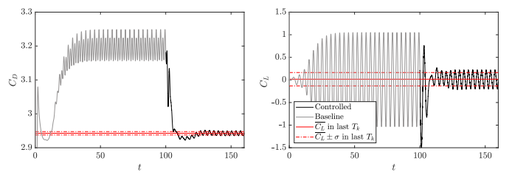
Figure 8 . Temporal evolution of CD (left) and CL (right) obtained through the application of the DRL control (at t = 100), run in a deterministic mode, for Re = 100.
원문 · CC BY 4.0 · Pau Varela, Pol Suárez, Francisco Alcántara-Ávila, Arnau Miró, Jean Rabault, Bernat Font, Luis Miguel García-Cuevas, Oriol Lehmkuhl, Ricardo Vinuesa · Deep reinforcement learning for flow control exploits different physics for increasing Reynolds-number regimes · 원문 그림 인용 · 원본 PDF 12쪽에서 그림 영역을 추출했습니다.제어 전후 흐름장을 보면, 에이전트는 후류 와류를 조작하여 재순환 영역의 크기를 키우고 von Kármán street의 주파수와 진폭을 낮춥니다. 이 전략은 두 제트가 후류와 반대 방향의 흐름을 만들어 와류를 억제하는 반대 방향 제어(opposition control)에 해당합니다.
Re = 1000의 병렬 학습과 전략
Re = 1000에서는 학습 비용을 줄이기 위해 20개의 다중 환경을 사용하는 방식이 적용되었습니다. 원문은 이 조건에서 단일 환경 학습이 같은 수준에 도달하려면 에피소드 수가 세 배 정도 필요하다고 보고합니다. 이는 Re가 한 자릿수 증가할 때 학습 난이도가 커진다는 점을 보여 줍니다.
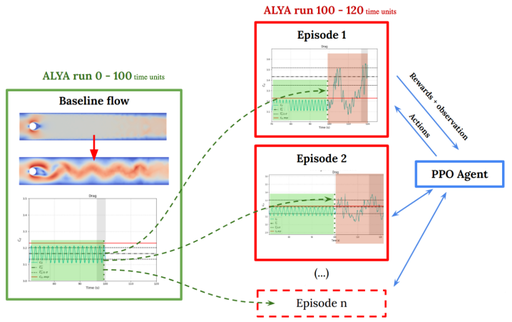
Figure 6 . General overview of the DRL-CFD (computational fluid dynamics) framework employed in this work. A multi-environment approach is used to parallelise the learning and to speed up training.
원문 · CC BY 4.0 · Pau Varela, Pol Suárez, Francisco Alcántara-Ávila, Arnau Miró, Jean Rabault, Bernat Font, Luis Miguel García-Cuevas, Oriol Lehmkuhl, Ricardo Vinuesa · Deep reinforcement learning for flow control exploits different physics for increasing Reynolds-number regimes · 원문 그림 인용 · 원본 PDF 10쪽에서 그림 영역을 추출했습니다.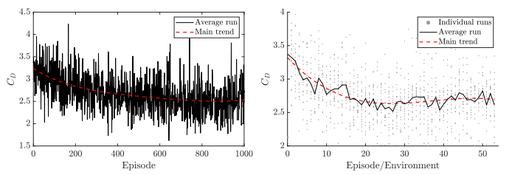
Figure 11 . Evolution of CD in the last vortex-shedding for each episode employing a single environment (left) or a 20-multi-environment approach (right) showing the learning curve indexed by the episode number for one of the 20 environments.
원문 · CC BY 4.0 · Pau Varela, Pol Suárez, Francisco Alcántara-Ávila, Arnau Miró, Jean Rabault, Bernat Font, Luis Miguel García-Cuevas, Oriol Lehmkuhl, Ricardo Vinuesa · Deep reinforcement learning for flow control exploits different physics for increasing Reynolds-number regimes · 원문 그림 인용 · 원본 PDF 14쪽에서 그림 영역을 추출했습니다.Re = 1000의 제어 전략은 동기적 blowing으로 나타나며, Ren 등의 연구와 흐름 구조가 일치한다고 보고됩니다. 제어는 재순환 기포를 늘리고 항력을 줄입니다.
Re = 2000의 새로운 제어 전략
Re = 2000에서 기준 흐름의 평균 CD는 3.39이고, 제어 후 평균 CD는 2.79로 17 % 이상 개선되었습니다. 이 값은 제어가 t = 50에서 시작된 결정론적 평가 구간의 평균입니다. 양력 CL 평균은 0 근처로 유지되었지만 진동 피크는 Re = 100 경우만큼 줄지 않았습니다.
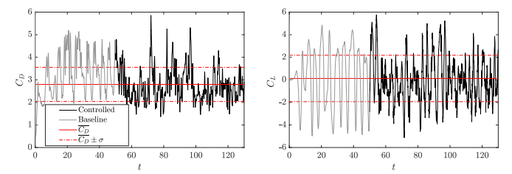
Figure 13 . Temporal evolution of CD (left) and CL (right) obtained through the application of the DRL control (at t = 50), run in a deterministic mode, for Re = 2000.
원문 · CC BY 4.0 · Pau Varela, Pol Suárez, Francisco Alcántara-Ávila, Arnau Miró, Jean Rabault, Bernat Font, Luis Miguel García-Cuevas, Oriol Lehmkuhl, Ricardo Vinuesa · Deep reinforcement learning for flow control exploits different physics for increasing Reynolds-number regimes · 원문 그림 인용 · 원본 PDF 16쪽에서 그림 영역을 추출했습니다.이 조건에서 에이전트는 재순환 기포를 늘리지 않고, 제트의 고주파 흡입과 분사로 박리점을 실린더 뒤쪽으로 이동시킵니다. 저자들은 이 전략을 항력 위기(drag crisis)와 유사한 현상으로 해석합니다. 이 해석은 저자의 해석이며, 이 논문은 항력 위기 자체를 직접 검증하지 않습니다.
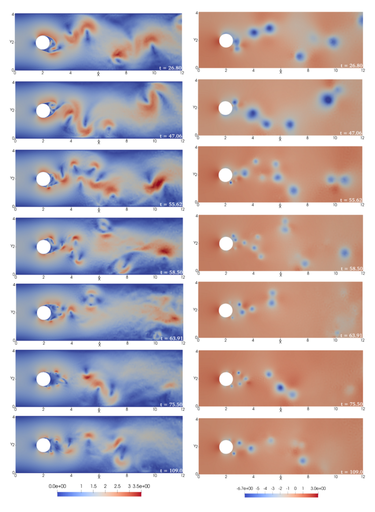
Figure 16 . Velocity-magnitude (left) and pressure (right) fields progression atRe = 2000. The control starts at t = 50, therefore the first two panels of each column correspond to the uncontrolled case and the rest (involving smaller vortices) correspond to the controlled flow.
원문 · CC BY 4.0 · Pau Varela, Pol Suárez, Francisco Alcántara-Ávila, Arnau Miró, Jean Rabault, Bernat Font, Luis Miguel García-Cuevas, Oriol Lehmkuhl, Ricardo Vinuesa · Deep reinforcement learning for flow control exploits different physics for increasing Reynolds-number regimes · 원문 그림 인용 · 원본 PDF 19쪽에서 그림 영역을 추출했습니다.교차 적용과 전이 영역 해석
Re = 100과 Re = 1000에서 학습한 에이전트를 Re = 2000 흐름에 결정론적 모드로 적용했습니다. Re = 100 에이전트는 항력을 줄이지 못했지만, Re = 1000 에이전트는 평균 CD 2.74를 얻어 기준 흐름 대비 19 % 항력 감소를 보였습니다. 이 값은 Re = 2000에서 직접 학습한 에이전트보다 약간 큽니다.
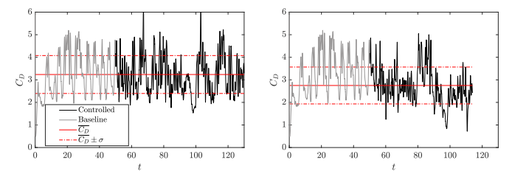
Figure 17 . Temporal evolution of CD obtained through cross-application of agents trained at Re = 100 (left) and Re = 1000 (right) in a deterministic mode to a case with a Reynolds number of 2000.
원문 · CC BY 4.0 · Pau Varela, Pol Suárez, Francisco Alcántara-Ávila, Arnau Miró, Jean Rabault, Bernat Font, Luis Miguel García-Cuevas, Oriol Lehmkuhl, Ricardo Vinuesa · Deep reinforcement learning for flow control exploits different physics for increasing Reynolds-number regimes · 원문 그림 인용 · 원본 PDF 20쪽에서 그림 영역을 추출했습니다.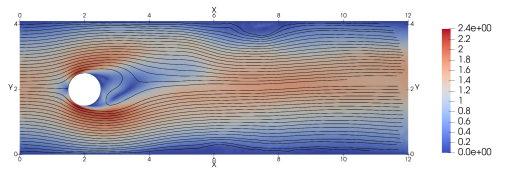
Figure 19 . Average flow fields at Re = 2000, using the training obtained for Re = 1000.
원문 · CC BY 4.0 · Pau Varela, Pol Suárez, Francisco Alcántara-Ávila, Arnau Miró, Jean Rabault, Bernat Font, Luis Miguel García-Cuevas, Oriol Lehmkuhl, Ricardo Vinuesa · Deep reinforcement learning for flow control exploits different physics for increasing Reynolds-number regimes · 원문 그림 인용 · 원본 PDF 21쪽에서 그림 영역을 추출했습니다.저자들은 두 상반된 제어 전략이 비슷한 성능을 보이는 점을 Re = 2000 흐름이 더 높은 Reynolds 수 흐름으로 가는 전이 영역에 속할 가능성으로 해석합니다. 이를 검증하려면 더 높은 Reynolds 수를 시뮬레이션해야 하며, 이 논문의 범위를 넘어섭니다. 따라서 이 가능성은 검증된 결론이 아닙니다.
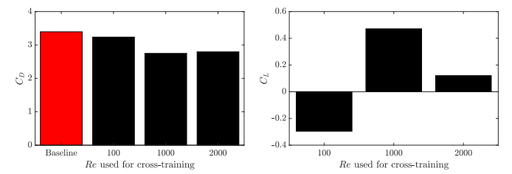
Figure 18 . Average CD (left) and average CL (right) comparison between three different cross-application of agents.
원문 · CC BY 4.0 · Pau Varela, Pol Suárez, Francisco Alcántara-Ávila, Arnau Miró, Jean Rabault, Bernat Font, Luis Miguel García-Cuevas, Oriol Lehmkuhl, Ricardo Vinuesa · Deep reinforcement learning for flow control exploits different physics for increasing Reynolds-number regimes · 원문 그림 인용 · 원본 PDF 21쪽에서 그림 영역을 추출했습니다.적용 범위와 남은 질문
이 결과는 2차원 실린더와 두 개의 합성 제트, 그리고 원문이 정한 Reynolds 수와 학습 설정에서 얻은 것입니다. 제어 결과는 결정론적 평가 구간의 평균과 특정 기준 흐름에 의존하며, 흐름이 혼돈적인 Re = 2000에서는 시드나 시작 조건에 따라 차이가 날 수 있습니다. 원문은 이 차이를 흐름의 혼돈성과 평가 실행 차이로 설명합니다.
또한 Re = 2000 전략이 더 높은 Reynolds 수에서도 유지되는지는 아직 확인되지 않았습니다. 이 논문은 더 높은 Reynolds 수 시뮬레이션을 향후 과제로 남깁니다.
논문 정보
- 저자
- Pau Varela, Pol Suárez, Francisco Alcántara-Ávila, Arnau Miró, Jean Rabault, Bernat Font, Luis Miguel García-Cuevas, Oriol Lehmkuhl, Ricardo Vinuesa
- 학회·저널
- arXiv · 프리프린트
- 최초 공개일
- 2022년 11월 4일
- 등록일
- 2026년 11월 6일
- 수정일
- 2022년 11월 4일
- 버전
- v1
- arXiv
- 2211.02572
- 분류
- physics.flu-dyn
- 원문 이용 조건
- CC BY 4.0
- 제공 범위
- 논문 정보, 해설, 허용된 원문 그림
AI 해설은 논문 원문과 별개의 설명이며 오류가 있을 수 있습니다. 원문과 그림은 각 출처의 이용 조건과 따로 표시된 권리를 따릅니다.
초록
Deep artificial neural networks (ANNs) used together with deep reinforcement learning (DRL) are receiving growing attention due to their capabilities to control complex problems. This technique has been recently used to solve problems related to flow control. In this work, an ANN trained through a DRL agent is used to perform active flow control. Two-dimensional simulations of the flow around a cylinder are conducted and an active control based on two jets located on the walls of the cylinder is considered. By gathering information from the flow surrounding the cylinder, the ANN agent is able to learn effective control strategies for the jets, leading to a significant drag reduction. In the present work, a Reynolds-number range beyond those previously considered is studied and compared with results obtained using classical flow-control methods. Significantly different nature in the control strategies is identified by the DRL as the Reynolds number Re increases. For Re <= 1000 the classical control strategy based on an opposition control relative to the wake oscillation is obtained. For Re = 2000 the new strategy consists of an energisation of the boundary layers and the separation area, which modulate the flow separation and reduce drag in a fashion similar to that of the drag crisis, through a high frequency actuation. A cross-application of agents is performed for a flow at Re = 2000, obtaining similar results in terms of drag reduction with the agents trained at Re = 1000 and 2000. The fact that two different strategies yield the same performance make us question whether this Reynolds number regime (Re = 2000) belongs to a transition towards a nature-different flow which would only admit a high-frequency actuation strategy to obtain drag reduction. This finding allows the application of ANNs trained at lower Reynolds numbers but comparable in nature, saving computational resources.
원문 인용
Pau Varela, Pol Suárez, Francisco Alcántara-Ávila, Arnau Miró, Jean Rabault, Bernat Font, Luis Miguel García-Cuevas, Oriol Lehmkuhl, Ricardo Vinuesa (2022). Deep reinforcement learning for flow control exploits different physics for increasing Reynolds-number regimes. arXiv:2211.02572v1. https://arxiv.org/abs/2211.02572v1
BibTeX
@misc{varela2022deep,
  title = {{Deep reinforcement learning for flow control exploits different physics for increasing Reynolds-number regimes}},
  author = {Pau Varela and Pol Suárez and Francisco Alcántara-Ávila and Arnau Miró and Jean Rabault and Bernat Font and Luis Miguel García-Cuevas and Oriol Lehmkuhl and Ricardo Vinuesa},
  year = {2022},
  eprint = {2211.02572},
  archivePrefix = {arXiv},
  url = {https://arxiv.org/abs/2211.02572v1}
}