논문 해설
Roboclock: A Unified Benchmark for Time-Aware Robotic Intelligence
RoboClock: 시간 제약을 반영한 로봇 조작 벤치마크
- 연구 문제 기존 로봇 벤치마크는 공간 정확도와 과제 완료만 보고 시간 제약은 거의 보지 않습니다. 추론 중 세계가 멈춰 성공률이 부풀려집니다.
- 연구 방법 RoboClock은 시간 제약이 있는 60개 조작 과제를 모은 벤치마크입니다. 추론하는 동안에도 환경 시계를 흘려 보내, 늦은 행동이 제때 적용되지 않게 합니다.
- 주요 결과 30개가 넘는 방법 중 가장 좋은 학습된 VLA도 쉬운 난이도 과제에서 시간 성공률이 8.3%에 그쳤습니다.
기존 벤치마크가 놓치는 시간
기존 턴 기반 평가에서는 정책이 행동을 계산하는 동안 시뮬레이션 세계가 멈춰 있습니다. 그래서 에이전트는 시행착오와 재시도를 무제한으로 할 수 있고, 추론에 걸린 시간도 제약 없이 허용됩니다. 저자들은 이 구조가 과제 성공률을 인위적으로 부풀린다고 봅니다. 실제로 추론이 차지하는 시간의 비중은 정책 계열마다 크게 달랐습니다.
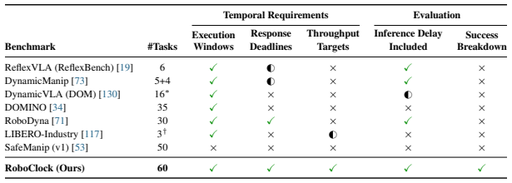
Table 1 .Comparison of temporal robotic benchmarks.✓: supported;×: not supported;G #: partial or indirect.
원문 · CC BY 4.0 · Yujie Zhao, Anthony L. Hu, Zimeng Huang, Zhijing Wu, Luobin Wang, Richard Li, Shrivas Sudharsan, Henrik I. Christensen, Jishen Zhao · Roboclock: A Unified Benchmark for Time-Aware Robotic Intelligence · 원문 그림 인용 · 원본 PDF 3쪽에서 그림 영역을 추출했습니다.반응형 VLA인 π0.5는 에피소드 약 70초 가운데 9%만 추론에 썼습니다. 반면 WAM인 OpenWAM-α는 약 145초 가운데 56%를, VLM 에이전트인 Qwen3.8-Flash-Next는 약 285초 가운데 78%를 추론에 썼습니다. Qwen3.8-Flash-Next의 경우 반복된 실패 호출과 로봇이 가만히 서 있는 시간이 이 비중을 더 키웠습니다. 실제 세계에서 시간은 효율 지표 이상입니다. 에이전트 속도가 물체 동역학과 맞물려 과제 성공을 결정하기 때문입니다.
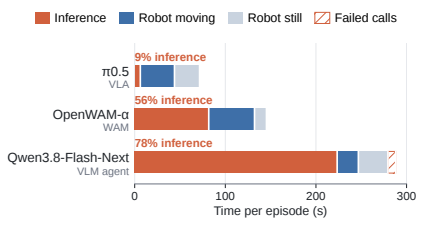
Figure 2 .Time breakdown per episode across RoboClock tasks.
원문 · CC BY 4.0 · Yujie Zhao, Anthony L. Hu, Zimeng Huang, Zhijing Wu, Luobin Wang, Richard Li, Shrivas Sudharsan, Henrik I. Christensen, Jishen Zhao · Roboclock: A Unified Benchmark for Time-Aware Robotic Intelligence · 원문 그림 인용 · 원본 PDF 2쪽에서 그림 영역을 추출했습니다.RoboClock은 다섯 응용 영역과 세 난이도 수준에 걸쳐 60개의 시간 제약 조작 과제를 모았습니다. 시간 파라미터는 제조사 문서, 실증 연구, 스포츠 규정, 공개 표준에서 가져왔으며 이런 자료가 존재하는 곳에서만 그렇게 했습니다. 과제는 세 가지 주요 유형으로 나뉩니다. 첫째 Temporal Window는 정해진 구간 안에서 행동해야 하는 과제로, 현상액 욕조에서 필름을 제때 꺼내는 일이 여기에 속합니다[117]. 둘째 Event-Reactive는 무작위로 정해지는 시점에 발생한 사건에 빠르게 반응해야 하는 과제로, 갑작스러운 고장 경고 뒤의 비상 정지가 예입니다[19, 71, 131]. 셋째 Throughput은 최소 완료율을 맞춰야 하는 과제로, 반복되는 수요에 맞춰 공 공급기를 채우는 일이 예입니다[70, 117].
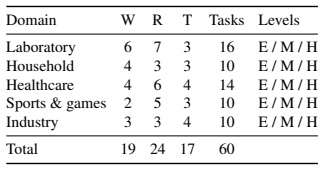
Table 9 . Task suite by domain and primary temporal category. W: Temporal Window, R: Event-Reactive, T: Throughput.
원문 · CC BY 4.0 · Yujie Zhao, Anthony L. Hu, Zimeng Huang, Zhijing Wu, Luobin Wang, Richard Li, Shrivas Sudharsan, Henrik I. Christensen, Jishen Zhao · Roboclock: A Unified Benchmark for Time-Aware Robotic Intelligence · 원문 그림 인용 · 원본 PDF 16쪽에서 그림 영역을 추출했습니다.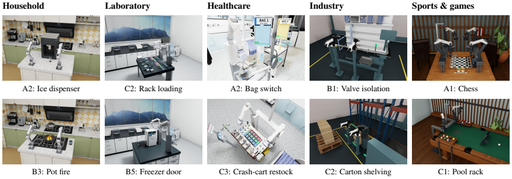
Figure 11 .Scenes and assets across the five domains,two task scenes per column. Excluding robots, room shells, variants, and procedural props, the domains use 27 (Household), 14 (Laboratory), 26 (Healthcare), 23 (Industry), and 21 (Sports & games) object and fixture models, from Lightwheel Kitchen, RoboCasa, YCB-Video, HANDAL, IndustReal, Sketchfab, Poly Haven, HOT3D, CAD libraries, and NVIDIA Isaac.
원문 · CC BY 4.0 · Yujie Zhao, Anthony L. Hu, Zimeng Huang, Zhijing Wu, Luobin Wang, Richard Li, Shrivas Sudharsan, Henrik I. Christensen, Jishen Zhao · Roboclock: A Unified Benchmark for Time-Aware Robotic Intelligence · 원문 그림 인용 · 원본 PDF 22쪽에서 그림 영역을 추출했습니다.각 과제는 하나의 주요 유형을 가지며 2차 시간 제약을 함께 가질 수 있습니다. 과제를 이 세 유형으로 구성한 것은 앞서 말한 실패 양상을 그대로 반영하기 위해서입니다.
세 가지 시간 제약과 지연을 반영한 평가
RoboClock은 과제를 주된 시간 제약 유형 세 가지로 나누며, 이 분류의 기준은 물리적으로 옳은 행동이 쓸모 있는지 여부입니다. Temporal Window는 목표 사건이 [ts, te] 안에서 일어나야 하므로 이르거나 늦은 행동이 모두 실패합니다. 예를 들어 물의 흐름이 6초, 4초, 2초에 걸쳐 지나가는 목표 띠 안에서 수도꼭지를 잠그는 과제가 여기에 속합니다. 창은 시작 시점이나 규칙이 정한 신호에서 열리므로, 실제로 판정에 걸리는 것은 te뿐입니다. Event-Reactive는 무작위 시점 tevent에 예고 없이 나타나는 트리거에 0 이상 Δt 미만 안에 반응해야 하며, 모터 고장 경고 뒤 3초 안에 비상정지 버튼을 누르는 과제가 그 예입니다.
Throughput은 올바른 완료 횟수 N을 시간 T로 나눈 값이 Rmin 이상이어야 하며, 공이 12초 간격으로 여섯 번 요청될 때 품절 없이 공급하는 과제가 여기에 해당합니다.
Latency-Aligned 프로토콜은 관측에 환경 시계로 타임스탬프를 찍고, 정책이 추론하는 동안 환경 시간이 흘러서 행동이 적용되는 시점이 뒤로 밀리도록 설계되었습니다. 이를 구현하는 block-and-replay 절차는 관측 시점의 상태를 저장하고 추론 중에는 물리 연산을 멈춥니다. 그다음 상태를 복원한 뒤, 추론 지연과 고정된 제어 인터페이스 지연 δ를 더한 시간 동안 이전에 정해진 제어를 재생합니다. 새 행동 청크는 관측 시점에 추론 지연과 δ를 더한 시점에서 다음 제어 시간 단계로 올림해 적용되므로, 추론이 끝날 때 장면은 이미 변해 있고 정책은 낡은 관측을 근거로 행동하게 됩니다. 실행은 동기식이어서 다음 관측은 행동 청크가 끝난 뒤에 받으며, 저자들은 결정적 재생을 쓰면 시뮬레이터 속도와 무관하게 행동 타이밍이 제어 단계 이산화 범위 안에서 보존된다고 봅니다.
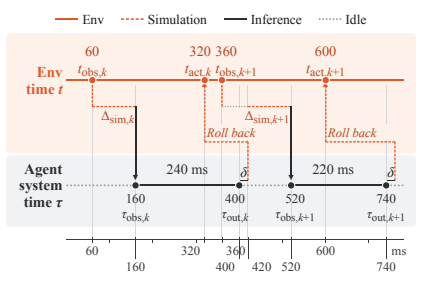
Figure 3 .Temporal alignment between environment and agent. Environment time t advances with inference, control delay, and actions; simulation overhead∆ sim,k affects only agent timeτ.
원문 · CC BY 4.0 · Yujie Zhao, Anthony L. Hu, Zimeng Huang, Zhijing Wu, Luobin Wang, Richard Li, Shrivas Sudharsan, Henrik I. Christensen, Jishen Zhao · Roboclock: A Unified Benchmark for Time-Aware Robotic Intelligence · 원문 그림 인용 · 원본 PDF 4쪽에서 그림 영역을 추출했습니다.평가 지표는 Progress Score(PS), Physical Success Rate(PSR), Temporal Success Rate(TSR), Latency-Aligned TSR(LTSR) 네 가지입니다. 30개가 넘는 방법을 평가한 결과, 가장 좋은 접근은 학습된 π0.5였지만 LTSR은 8.3%에 그쳤습니다. VLA는 fine-tuning으로 크게 나아졌으나 보지 못한 과제로의 일반화는 제한적이었습니다. WAM은 PSR이 14.8%로 더 높았으나 지연에 대한 민감도가 더 컸습니다.
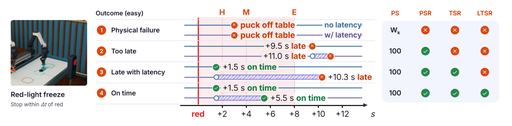
Figure 4 .Illustrative outcomes under the four metrics in Red-light freeze.Times are relative to red-light onset; H/M/E mark the hard/medium/easy response limits (2/4/8 s), with outcomes evaluated at the easy limit (∆t= 8 s). Blue and purple timelines show execution with inference paused and with latency advancing environment time, respectively. (1) Physical failure retains partial PS but fails all success criteria. (2) A late stop achieves full PS and physical success (PSR), but fails TSR and LTSR. (3) A stop that is timely only with inference paused satisfies TSR but fails LTSR. (4) A timely stop even with latency satisfies all criteria.
원문 · CC BY 4.0 · Yujie Zhao, Anthony L. Hu, Zimeng Huang, Zhijing Wu, Luobin Wang, Richard Li, Shrivas Sudharsan, Henrik I. Christensen, Jishen Zhao · Roboclock: A Unified Benchmark for Time-Aware Robotic Intelligence · 원문 그림 인용 · 원본 PDF 5쪽에서 그림 영역을 추출했습니다.과제 구성과 오라클 시연
시간 제한이 있는 42개 과제 가운데 8개는 쉬운 난이도의 한계를 제조사 문서나 경기 규칙 같은 문서화된 시간에서 가져왔습니다. 나머지는 17개 Throughput 과제를 포함해 기준 제어기에 맞춰 보정했으며, 이 기준 제어기는 hard 난이도에서도 최소 20% 또는 0.3 s의 여유를 남깁니다. 모든 과제는 도메인 저자들의 사람 검토를 통과해, 워크플로와 단서가 현실적이고 시간 제한이 달성 가능한지 확인받았습니다. 난이도 세 단계는 주된 시간 제약인 구간 폭, 반응 한계, 요구 속도 중 하나를 조여 만들며, 난이도와 무관하게 각 시드가 물체 배치, 사건 시작 시점, 물리 및 공정 파라미터를 미리 정한 범위에서 균일하게 뽑습니다.
사건 시점과 잠재 파라미터는 시각 단서로만 드러납니다. 이 때문에 정책은 고정된 일정에 기대지 않고 장면을 계속 관찰해야 합니다.

Table 16 . Time-parameter provenance: Laboratory. (a) Tasks whose window is set by a physical parameter of the scene (Tab. 14); their values are not sourced. (b) Tasks with a time limit (Tab. 15) and Throughput tasks; each value is compared with a documented real-world time.
원문 · CC BY 4.0 · Yujie Zhao, Anthony L. Hu, Zimeng Huang, Zhijing Wu, Luobin Wang, Richard Li, Shrivas Sudharsan, Henrik I. Christensen, Jishen Zhao · Roboclock: A Unified Benchmark for Time-Aware Robotic Intelligence · 원문 그림 인용 · 원본 PDF 24쪽에서 그림 영역을 추출했습니다.
Table 17 . Time-parameter provenance: Healthcare. (a) Tasks whose window is set by a physical parameter of the scene (Tab. 14); their values are not sourced. (b) Tasks with a time limit (Tab. 15) and Throughput tasks; each value is compared with a documented real-world time.
원문 · CC BY 4.0 · Yujie Zhao, Anthony L. Hu, Zimeng Huang, Zhijing Wu, Luobin Wang, Richard Li, Shrivas Sudharsan, Henrik I. Christensen, Jishen Zhao · Roboclock: A Unified Benchmark for Time-Aware Robotic Intelligence · 원문 그림 인용 · 원본 PDF 25쪽에서 그림 영역을 추출했습니다.
Table 17 . Time-parameter provenance: Healthcare (continued).
원문 · CC BY 4.0 · Yujie Zhao, Anthony L. Hu, Zimeng Huang, Zhijing Wu, Luobin Wang, Richard Li, Shrivas Sudharsan, Henrik I. Christensen, Jishen Zhao · Roboclock: A Unified Benchmark for Time-Aware Robotic Intelligence · 원문 그림 인용 · 원본 PDF 26쪽에서 그림 영역을 추출했습니다.
Table 18 . Time-parameter provenance: Household. (a) Tasks whose window is set by a physical parameter of the scene (Tab. 14); their values are not sourced. (b) Tasks with a time limit (Tab. 15) and Throughput tasks; each value is compared with a documented real-world time.
원문 · CC BY 4.0 · Yujie Zhao, Anthony L. Hu, Zimeng Huang, Zhijing Wu, Luobin Wang, Richard Li, Shrivas Sudharsan, Henrik I. Christensen, Jishen Zhao · Roboclock: A Unified Benchmark for Time-Aware Robotic Intelligence · 원문 그림 인용 · 원본 PDF 27쪽에서 그림 영역을 추출했습니다.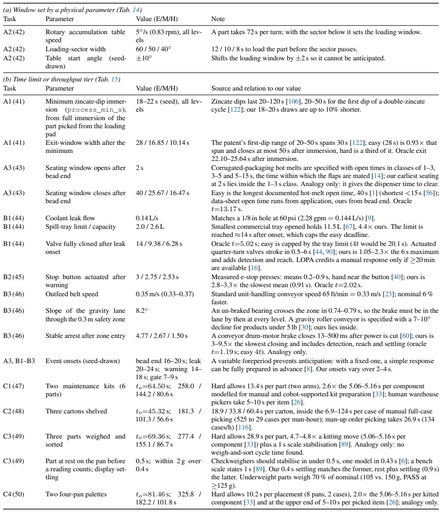
Table 19 . Time-parameter provenance: Industry. (a) Tasks whose window is set by a physical parameter of the scene (Tab. 14); their values are not sourced. (b) Tasks with a time limit (Tab. 15) and Throughput tasks; each value is compared with a documented real-world time.
원문 · CC BY 4.0 · Yujie Zhao, Anthony L. Hu, Zimeng Huang, Zhijing Wu, Luobin Wang, Richard Li, Shrivas Sudharsan, Henrik I. Christensen, Jishen Zhao · Roboclock: A Unified Benchmark for Time-Aware Robotic Intelligence · 원문 그림 인용 · 원본 PDF 28쪽에서 그림 영역을 추출했습니다.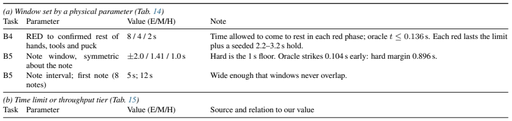
Table 20 . Time-parameter provenance: Sports & games. (a) Tasks whose window is set by a physical parameter of the scene (Tab. 14); their values are not sourced. (b) Tasks with a time limit (Tab. 15) and Throughput tasks; each value is compared with a documented real-world time.
원문 · CC BY 4.0 · Yujie Zhao, Anthony L. Hu, Zimeng Huang, Zhijing Wu, Luobin Wang, Richard Li, Shrivas Sudharsan, Henrik I. Christensen, Jishen Zhao · Roboclock: A Unified Benchmark for Time-Aware Robotic Intelligence · 원문 그림 인용 · 원본 PDF 29쪽에서 그림 영역을 추출했습니다.시연 데이터는 scripted oracle이 만듭니다. 이 oracle은 현재 시뮬레이터의 ground-truth 상태, 즉 자세, 접촉, 공정 변수와 기록된 사건 시작 시점을 읽되 미래 사건은 보지 않습니다. 그다음 inverse kinematics가 이 상태를 16차원 관절 목표로 바꾸고, 동작 일정을 시간 조항에 맞게 잡습니다. 마지막으로 과제 평가기가 물리 성공과 시간 성공을 모두 확인한 에피소드만 남깁니다. 대신 실패한 에피소드는 버려지므로, 기록된 시연은 각 과제가 시간 안에 풀릴 수 있다는 것을 검증하는 역할을 합니다.
oracle은 달성 가능성의 기준으로 쓰였습니다. 특권 상태를 읽기 때문에 지각 지연이 없지만, 리그의 관절 속도로 움직이고 단서가 보일 때까지 시작 자세를 유지합니다. 추론을 멈춘 조건에서 시드 0부터 9까지 공개된 모든 난이도에 걸쳐 실행한 결과 99.2%의 물리·시간 성공률을 보였습니다. 사람 조작자는 같은 시간 제약 아래 teleoperation으로 과제를 풀었고, PSR 100%와 TSR 96%에 이르렀습니다. 이는 단서를 인지하고 제때 반응하는 에이전트가 과제를 달성할 수 있다는 것을 보여줍니다.
fine-tuning VLA·WAM의 성능과 전이
공개된 체크포인트 여덟 개는 RoboClock에서 거의 전이되지 않았습니다. 물리 성공률(PSR)은 최대 2.3%, 시간 성공률(TSR)은 0.5%에 그쳤습니다. 그래서 저자들은 45개 학습 과제의 오라클 시연으로 네 모델을 같은 시연 세트에서 3 epoch씩 미세조정했습니다. Table 2는 공개 체크포인트와 fine-tuning 모델을 60개 과제 전체에서 비교하고, Table 3은 학습 과제와 보류한 15개 과제를 나눠 보여 줍니다.
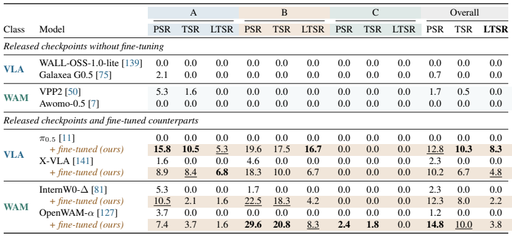
Table 2 . End-to-end policies on all 60 tasks: released RoboDojo checkpoints and our fine-tuned models (Sec. 5). A/B/C: Temporal Window, Event-Reactive, Throughput; metrics (Sec. 4.3) in %, macro-averaged over tasks; latency on eight A100s. Shaded: fine-tuned; bold/underline: best/second best.
원문 · CC BY 4.0 · Yujie Zhao, Anthony L. Hu, Zimeng Huang, Zhijing Wu, Luobin Wang, Richard Li, Shrivas Sudharsan, Henrik I. Christensen, Jishen Zhao · Roboclock: A Unified Benchmark for Time-Aware Robotic Intelligence · 원문 그림 인용 · 원본 PDF 6쪽에서 그림 영역을 추출했습니다.fine-tuning 후 OpenWAM-α는 PSR 14.8%와 TSR 10.0%로 PSR이 가장 높았습니다. 반면 π0.5는 TSR 10.3%와 PSR 12.8%로 TSR이 가장 높았고, InternW0-∆(PSR 12.3%, TSR 8.0%)와 X-VLA(PSR 10.2%, TSR 6.7%)가 뒤를 이었습니다. 개선의 대부분은 Event-Reactive 과제에서 나왔습니다. 네 모델 가운데 세 모델이 이 과제에서 TSR 17%를 넘었지만, Throughput 과제의 TSR은 1.8% 이하에 머물렀습니다. 학습한 과제에서는 TSR이 8.2%에서 13.8%로 올랐습니다. 그러나 보류한 15개 과제에서는 X-VLA만 TSR 2.0%를 보여 0이 아니었습니다.
시연이 실행은 개선하지만 새 과제로는 거의 옮겨 가지 않는다는 뜻입니다.
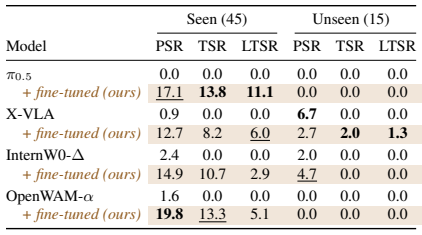
Table 3 . Seen (45 fine-tuning) vs. unseen (15 held-out) tasks, in %. Shaded: fine-tuned;bold/underline : best/second best.
원문 · CC BY 4.0 · Yujie Zhao, Anthony L. Hu, Zimeng Huang, Zhijing Wu, Luobin Wang, Richard Li, Shrivas Sudharsan, Henrik I. Christensen, Jishen Zhao · Roboclock: A Unified Benchmark for Time-Aware Robotic Intelligence · 원문 그림 인용 · 원본 PDF 6쪽에서 그림 영역을 추출했습니다.이 이득이 얼마나 남는지는 추론 속도가 정했습니다. 저자들은 지연을 반영해 다시 잰 LTSR로 평가했습니다. VLA는 대부분의 TSR을 유지했습니다. π0.5는 TSR 10.3%에서 LTSR 8.3%로, X-VLA는 TSR 6.7%에서 LTSR 4.8%로 내려갔습니다. 반면 추론이 느린 WAM은 많은 것을 잃었습니다. OpenWAM-α는 TSR 10.0%에서 LTSR 3.8%로, InternW0-∆는 TSR 8.0%에서 LTSR 2.2%로 떨어졌습니다. 그 결과 π0.5가 LTSR도 가장 높았습니다. 저자들은 이 차이를 추론이 느린 WAM이 실행 시간 측면에서 불리하다는 증거로 봅니다.
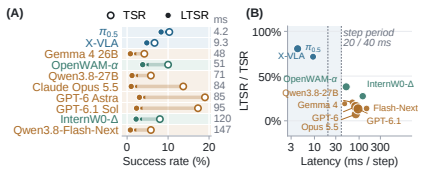
Figure 6 .Latency cost across policy families.(A) TSR and LTSR by inference time per action step. (B) LTSR/TSR ratio; area ∝ TSR. Blue: VLA, green: W AM (both fine-tuned), orange: VLM.
원문 · CC BY 4.0 · Yujie Zhao, Anthony L. Hu, Zimeng Huang, Zhijing Wu, Luobin Wang, Richard Li, Shrivas Sudharsan, Henrik I. Christensen, Jishen Zhao · Roboclock: A Unified Benchmark for Time-Aware Robotic Intelligence · 원문 그림 인용 · 원본 PDF 8쪽에서 그림 영역을 추출했습니다.VLM 에이전트와 추론 지연
VLM 에이전트는 로봇 데이터로 따로 학습하지 않고도 과제 일부를 해냈습니다. Tool-augmented EEF 인터페이스에서 Gemini 4 Argon은 PSR 24.5%와 TSR 18.2%를, GPT-6 Astra는 PSR 22.8%와 TSR 19.0%를 얻었습니다(Tab. 5). GPT-6 Astra의 실제 과제 완료율은 RoboDojo [102]의 시뮬레이션 SR 22.48%와 비슷한 수준이었습니다. 다만 두 모델이 서로 다른 인터페이스를 써서 과제 난이도를 통제한 비교는 할 수 없었습니다.
추론 지연을 넣자 이 결과는 크게 달라졌습니다. 각 질의의 왕복 시간을 반영한 LTSR에서 GPT-6 Astra는 3.0%, Gemini 4 Argon은 8.2%로 떨어졌고, GPT-6.1 Sol과 Claude Opus 5.5는 각각 2.3%와 1.0%였습니다. 저자들은 Gemini가 상대적으로 덜 떨어진 까닭을 성공 에피소드당 모델 턴 수에서 찾습니다. Gemini는 중앙값 3회였고 GPT-6 Astra는 6회였기 때문에, 턴이 적은 쪽은 왕복 지연이 덜 쌓인다고 봅니다.
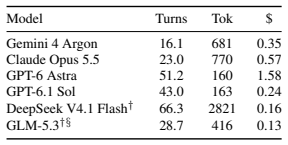
Table 22 .Interaction cost of VLM agents(six-model diagnostic subset under zero latency, 10 seeds per task). Turns: model calls per episode. Tok: output tokens per turn, reasoning included. $: API cost per episode (USD). †open-weight; §text-only.
원문 · CC BY 4.0 · Yujie Zhao, Anthony L. Hu, Zimeng Huang, Zhijing Wu, Luobin Wang, Richard Li, Shrivas Sudharsan, Henrik I. Christensen, Jishen Zhao · Roboclock: A Unified Benchmark for Time-Aware Robotic Intelligence · 원문 그림 인용 · 원본 PDF 31쪽에서 그림 영역을 추출했습니다.API 서빙 속도는 LTSR을 직접 바꾸므로, 저자들은 제공자와 서빙 속도를 함께 보고해야 한다고 봅니다. 표 23에서 GPT-6 Astra(Microsoft Azure)는 18 tokens/s와 26 tokens/s로, Gemini 4 Argon(Google Cloud)은 22 tokens/s와 36 tokens/s로 측정되었습니다. 서빙이 빨라지자 GPT-6 Astra의 LTSR은 0.8%에서 3.0%로, Gemini 4 Argon의 LTSR은 1.0%에서 8.2%로 올랐습니다. Tab. 5는 더 빠른 서빙 결과를 실었습니다.

Table 24 . Results of four API-served VLM agents through Tool-augmented EEF, with faster API serving and latency charged in closed loop (easy level). A/B/C: Temporal Window, Event-Reactive, Throughput; metrics in %, macro-averaged over tasks; all values are those of Tab. 5, and Overall is weighted by the 19/24/17 tasks of A/B/C.Bold: best.
원문 · CC BY 4.0 · Yujie Zhao, Anthony L. Hu, Zimeng Huang, Zhijing Wu, Luobin Wang, Richard Li, Shrivas Sudharsan, Henrik I. Christensen, Jishen Zhao · Roboclock: A Unified Benchmark for Time-Aware Robotic Intelligence · 원문 그림 인용 · 원본 PDF 32쪽에서 그림 영역을 추출했습니다.한계와 적용 범위
시뮬레이션 평가는 이 결과를 읽을 때 가장 먼저 짚어야 할 경계입니다. 평가는 과정을 단순화하고 시간 척도를 압축한 시뮬레이션에서 수행되었으므로, 실제 로봇으로 옮겼을 때의 성능은 아직 검증되지 않았습니다. 부록의 실제 로봇 파일럿은 여섯 과제에 대한 작은 규모의 확인이었고, 여러 조건을 통제한 대규모 검증은 하지 않았습니다. LTSR 역시 추론 하드웨어와 서빙 조건에 따라 달라지므로, 저자들은 서로 다른 시스템을 비교할 때 이 조건을 함께 고려해야 한다고 봅니다.
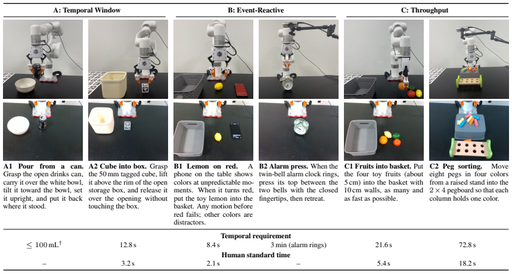
Table 25 . The six real-robot tasks, grouped as in simulation. A: Temporal Window; B: Event-Reactive; C: Throughput. Top row: the scene, photographed from the side; in the B2 and C2 photographs the head camera is the one on the boom above the arm, and the board of fiducial markers at the left edge is used only for camera calibration. Second row: the first head-camera image of an episode, as the model sees it, with the arm’s base at the top. Third row: what the agent must do. Last two rows: the time requirement, which is 4× the human standard time for A2, B1, C1, and C2 and the ringing duration of the alarm for B2; “–”: none applies. †A1 encodes its temporal stopping condition through the physical volume limit: pouring must stop before the amount exceeds 100 mL; no fixed duration is prescribed.
원문 · CC BY 4.0 · Yujie Zhao, Anthony L. Hu, Zimeng Huang, Zhijing Wu, Luobin Wang, Richard Li, Shrivas Sudharsan, Henrik I. Christensen, Jishen Zhao · Roboclock: A Unified Benchmark for Time-Aware Robotic Intelligence · 원문 그림 인용 · 원본 PDF 33쪽에서 그림 영역을 추출했습니다.
Table 28 . Real-robot results of six VLMs, scored by the operator with the rubric of Tab. 27. PS: mean step score; PSR: episodes that complete the task (%); LTSR: episodes that complete it while satisfying the temporal requirement, including the volume-defined stopping condition of A1 (%). Each entry is the mean over 10 episodes. Mean: unweighted mean over the six tasks.Bold: best per column.
원문 · CC BY 4.0 · Yujie Zhao, Anthony L. Hu, Zimeng Huang, Zhijing Wu, Luobin Wang, Richard Li, Shrivas Sudharsan, Henrik I. Christensen, Jishen Zhao · Roboclock: A Unified Benchmark for Time-Aware Robotic Intelligence · 원문 그림 인용 · 원본 PDF 34쪽에서 그림 영역을 추출했습니다.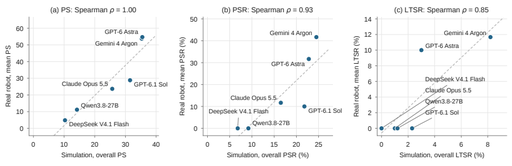
Figure 12 . Real-robot scores against simulated scores for the six VLMs run in both settings. Horizontal axis: simulated Overall, from Tab. 24 for Gemini 4 Argon, GPT-6 Astra, GPT-6.1 Sol, and Claude Opus 5.5, and from Tab. 5 for Qwen3.8-27B and DeepSeek V4.1 Flash. Vertical axis: mean over the real-robot tasks (Tab. 28). Dashed line: least-squares fit through the six points. ρ: Spearman rank correlation, with tied models sharing their mean rank.
원문 · CC BY 4.0 · Yujie Zhao, Anthony L. Hu, Zimeng Huang, Zhijing Wu, Luobin Wang, Richard Li, Shrivas Sudharsan, Henrik I. Christensen, Jishen Zhao · Roboclock: A Unified Benchmark for Time-Aware Robotic Intelligence · 원문 그림 인용 · 원본 PDF 35쪽에서 그림 영역을 추출했습니다.서빙 속도가 실제로 LTSR을 바꾼다는 점은 Tab. 23에서 확인할 수 있습니다. GPT-6 Astra(Microsoft Azure)는 18 tokens/s와 26 tokens/s로, Gemini 4 Argon(Google Cloud)은 22 tokens/s와 36 tokens/s로 측정되었습니다. 서빙이 빨라지자 GPT-6 Astra의 LTSR은 0.8%에서 3.0%로, Gemini 4 Argon의 LTSR은 1.0%에서 8.2%로 올랐습니다. 상승은 대기 시간 창이 모델 턴을 한 번 이상 허용하는 과제에서 나타났고, 몇 초 안에 응답해야 하는 과제는 0에 머물렀습니다. Gemini의 상승폭이 더 컸던 것은 성공 에피소드당 턴이 중앙값 3회로 GPT-6 Astra의 6회보다 적었기 때문입니다.
난이도별 비교에도 같은 조건이 걸려 있습니다. Easy 난이도의 LTSR 8.2%는 hard 난이도에서 3.3%와 1.5%로 떨어졌고, 이 하락은 특히 Temporal Window 과제(20.5%에서 16.8%)와 Event-Reactive 과제(24.6%에서 14.2%)에서 두드러졌습니다. 다만 easy 실행과 이후 medium, hard 실행 사이에 API 서빙 속도가 달랐을 수 있어, 난이도 간 LTSR 비교는 참고용으로만 읽을 수 있다고 저자들은 봅니다. 추론 지연을 가정값으로 바꾼 Fig. 5의 실험도 같은 한계를 가집니다. 이 실험은 초당 35에서 3K tokens의 디코딩 속도를 가정하고, prefill, 네트워크, 대기열 시간은 빼고 토큰 수는 고정했습니다.
그래서 Fig. 5는 디코딩 속도가 주는 효과를 보여 줄 뿐, 특정 배포 환경의 LTSR을 보여 주지는 않습니다.
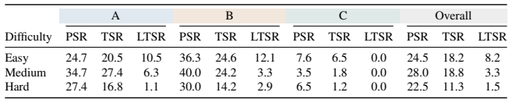
Table 21 . Gemini 4 Argon through Tool-augmented EEF on all 60 tasks at the three difficulty levels (10 seeds per task, 0–9). PSR and TSR with inference paused; LTSR with measured API latency. Easy: Tab. 24. A/B/C: Temporal Window, Event-Reactive, Throughput; metrics in %, macro-averaged over tasks; Overall is weighted by the 19/24/17 tasks of A/B/C.
원문 · CC BY 4.0 · Yujie Zhao, Anthony L. Hu, Zimeng Huang, Zhijing Wu, Luobin Wang, Richard Li, Shrivas Sudharsan, Henrik I. Christensen, Jishen Zhao · Roboclock: A Unified Benchmark for Time-Aware Robotic Intelligence · 원문 그림 인용 · 원본 PDF 31쪽에서 그림 영역을 추출했습니다.논문 정보
- 저자
- Yujie Zhao, Anthony L. Hu, Zimeng Huang, Zhijing Wu, Luobin Wang, Richard Li, Shrivas Sudharsan, Henrik I. Christensen, Jishen Zhao
- 학회·저널
- arXiv · 프리프린트
- 최초 공개일
- 2026년 11월 24일
- 등록일
- 2026년 11월 25일
- 수정일
- 2026년 11월 24일
- 버전
- v1
- arXiv
- 2611.32233
- 분류
- cs.RO · cs.AI
- 원문 이용 조건
- CC BY 4.0
- 제공 범위
- 논문 정보, 해설, 허용된 원문 그림
AI 해설은 논문 원문과 별개의 설명이며 오류가 있을 수 있습니다. 원문과 그림은 각 출처의 이용 조건과 따로 표시된 권리를 따릅니다.
초록
Time is a fundamental dimension of robotic intelligence: a robot may fail despite physically correct actions if it acts outside a valid time window, responds too slowly to an event, or fails to meet required throughput. Yet existing robotic benchmarks primarily emphasize spatial correctness and logical task completion, largely overlooking the temporal constraints of real-world applications. We present RoboClock, a unified benchmark for time-aware robotic manipulation featuring 60 tasks across five application domains. Mirroring these failure modes, RoboClock structures tasks around three types of temporal constraints: Temporal Window, Event-Reactive, and Throughput. Furthermore, RoboClock incorporates a Latency-Aligned evaluation protocol that continuously advances environment time during model inference and control-interface delays, paired with time-sensitive metrics. Evaluating over 30 methods, we find that the best-performing approach is the trained VLA, yet it achieves only 8.3% temporal success even on Easy-level tasks, with persistent challenges in generalization and transfer. These findings reveal fundamental limitations in current robotic systems and highlight the need to jointly optimize physical competence, temporal reasoning, and execution latency.
원문 인용
Yujie Zhao, Anthony L. Hu, Zimeng Huang, Zhijing Wu, Luobin Wang, Richard Li, Shrivas Sudharsan, Henrik I. Christensen, Jishen Zhao (2026). Roboclock: A Unified Benchmark for Time-Aware Robotic Intelligence. arXiv:2611.32233v1. https://arxiv.org/abs/2611.32233v1
BibTeX
@misc{zhao2026roboclock,
  title = {{Roboclock: A Unified Benchmark for Time-Aware Robotic Intelligence}},
  author = {Yujie Zhao and Anthony L. Hu and Zimeng Huang and Zhijing Wu and Luobin Wang and Richard Li and Shrivas Sudharsan and Henrik I. Christensen and Jishen Zhao},
  year = {2026},
  eprint = {2611.32233},
  archivePrefix = {arXiv},
  url = {https://arxiv.org/abs/2611.32233v1}
}