논문 해설
Reinforcement Learning Control of a Biomechanical Model of the Upper Extremity
상지의 생체역학 모델에 대한 강화학습 제어
- 연구 문제 신호 의존 및 상수 운동 잡음과 운동 시간 최소화 가정이 완전한 골격 상지 모델에서도 Fitts’ Law와 2/3 Power Law를 재현하는지 검증합니다.
- 연구 방법 Upper Extremity Dynamic Model을 MuJoCo로 구현하고, 자유도별 2차 근육 동역학 액추에이터와 soft actor-critic 정책을 사용해 무작위 목표에 최소 시간으로 도달하는 제어를 학습합니다.
- 주요 결과 이산 Fitts’ Law 과제에서 ID와 중앙값 운동 시간의 선형 근사는 R2 = 0.9986이며, 타원 via-point 과제의 로그-로그 회귀는 β = 0.65, R = 0.84로 2/3 지수에 가까운 결과를 보고합니다.
문제 설정: 완전한 골격 상지 모델에서 운동 법칙 재현
사람의 팔 운동은 무수히 많은 가능한 움직임 중에서 운동 시간을 최소화하는 방향으로 선택된다고 가정되어 왔습니다. 이때 제어 잡음은 신호 의존 잡음과 상수 잡음으로 가정됩니다. 기존 검증은 주로 점질량 모델이나 평면 연결 링크 모델에서 이루어졌으므로, 이 논문은 같은 가정이 완전한 골격 상지 모델에서도 Fitts’ Law와 2/3 Power Law를 재현하는지 묻습니다.
Fitts’ Law는 목표의 거리 D와 폭 W로 정의되는 난이도 지수와 운동 시간 사이의 선형 관계를 설명합니다. 2/3 Power Law는 곡률 반경과 접선 속도 사이의 비선형 관계를 설명하며, 지수 β가 약 2/3인 것으로 알려져 있습니다. 이 논문은 이 두 법칙을 재현하는 제어 정책을 강화학습으로 얻고, 그 궤적을 분석합니다.
모델, 정책 학습, 근육 단순화
사용된 모델은 Upper Extremity Dynamic Model입니다. 이 모델은 7개의 작동 자유도를 가지며, 원문에서는 이를 MuJoCo로 구현했다고 설명합니다. 근육을 개별적으로 구현하면 계산이 지나치게 느려지므로, 각 자유도에 작용하는 2차 동역학 액추에이터로 근육 작용을 단순화합니다. 이 액추에이터는 정책이 출력한 행동 벡터를 활성도로 바꾸고, 활성도에 상수 모멘트 암 계수를 곱해 토크를 만듭니다.

Figure 1 . Synthesized reaching movement. A policy implemented as a neural network computes motor control signals of simplified muscles at the joints of a biomechanical upper extremity model from observations of the current state of the upper body. We use Deep Reinforcement Learning to learn a policy that reaches random targets in minimal time, given signal-dependent and constant motor noise.
원문 · CC BY 4.0 · Florian Fischer, Miroslav Bachinski, Markus Klar, Arthur Fleig, Jörg Müller · Reinforcement Learning Control of a Biomechanical Model of the Upper Extremity · 원문 그림 인용 · 원본 PDF 14쪽에서 그림 영역을 추출했습니다.정책은 soft actor-critic 알고리즘으로 학습됩니다. 액터 네트워크는 행동 분포의 평균과 표준편차를 출력하고, 크리틱 네트워크는 상태-행동 가치를 추정합니다. 보상은 매 시간 단계마다 동일한 음의 시간 보상으로 주어지며, 목표 도달이 빨라질수록 반환이 커집니다. 이 보상만으로는 목표에 도달하기 전 행동을 구분하기 어려우므로, 목표 직경을 60 cm에서 2 cm 미만으로 줄이는 적응형 커리큘럼을 함께 사용합니다. 커리큘럼은 최근 성공률이 70% 아래이면 목표 직경을 1 cm 키우고, 90%를 넘으면 1 cm 줄입니다.
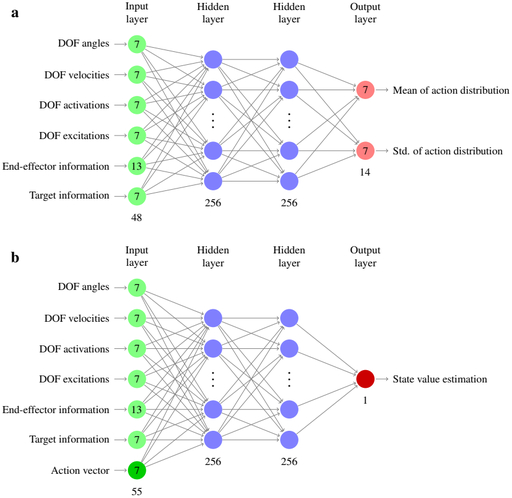
Figure 6 . Neuronal network architectures. a. The actor network takes a state s as input and returns the policy πθ in terms of mean and standard deviation of the seven normal distributions, from which the components of the action vector are drawn. b. The critic network takes both state s and action vector a as input and returns the estimated state-action value. Two critic networks are trained simultaneously to improve the speed and stability of learning (Double Q-Learning). Detailed information about the input state components are given in the Methods section.
원문 · CC BY 4.0 · Florian Fischer, Miroslav Bachinski, Markus Klar, Arthur Fleig, Jörg Müller · Reinforcement Learning Control of a Biomechanical Model of the Upper Extremity · 원문 그림 인용 · 원본 PDF 18쪽에서 그림 영역을 추출했습니다.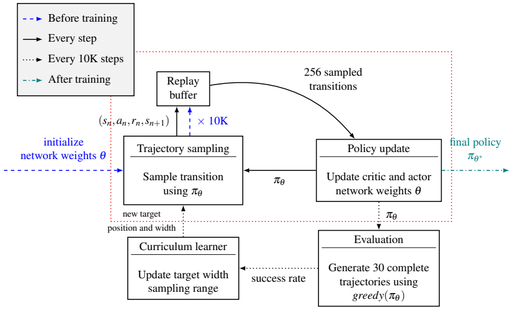
Figure 7 . Reinforcement learning procedure. Before training, the networks are initialized with random weights θ, and 10K transitions are generated using the resulting initial policy. These are stored in the replay buffer (blue dashed arrows). During training (red dotted box), trajectory sampling and policy update steps are executed alternately in each step. The targets used in the trajectory sampling part are generated by the curriculum learner, which is updated every 10K steps, based on an evaluation of the most recent (greedy) policy. As soon as the target width suggested by the curriculum learner falls below 1 cm, the training phase is completed and the final policy πθ∗ is returned (teal dash-dotted arrow).
원문 · CC BY 4.0 · Florian Fischer, Miroslav Bachinski, Markus Klar, Arthur Fleig, Jörg Müller · Reinforcement Learning Control of a Biomechanical Model of the Upper Extremity · 원문 그림 인용 · 원본 PDF 19쪽에서 그림 영역을 추출했습니다.이산 Fitts’ Law 과제에서의 운동 시간 선형성
이산 Fitts’ Law 과제는 ISO 9241-9 기준에 따라 원형으로 배치된 13개 목표를 사용합니다. 각 과제 조건과 방향마다 50회 운동을 수행하여 총 6500회 운동을 얻었으며, 원문에서는 모두 성공했다고 보고합니다.
난이도 지수 ID는 log2(D/W + 1)로 계산되며 1에서 4까지 범위입니다. 각 ID별 중앙값 운동 시간을 선형 함수로 근사한 결과, 결정계수는 R2 = 0.9986입니다. 이는 운동 시간이 ID에 선형적으로 증가한다는 Fitts’ Law와 일치하는 관찰입니다. 다만 이 결과는 이 과제 설정과 이 모델에서 얻은 것입니다.
타원 via-point 과제에서의 2/3 Power Law
2/3 Power Law 검증에는 타원 via-point 과제를 사용합니다. 타원은 수평 15 cm, 수직 6 cm 직경이며 학습 중 목표 샘플링 영역 안에 놓입니다. 학습 때는 목표에 빠르고 정확하게 도달하도록만 학습되었기 때문에, 타원을 따라가게 하려고 목표를 타원 위에 순차적으로 배치하는 moving target 기법을 사용합니다. 이 기법은 약 20개의 via-point를 만들고, 각 목표가 전체 곡선의 10%를 덮도록 배치합니다.
100 Hz로 샘플링한 말단장치 궤적에서 곡률 반경과 속도를 계산한 뒤 로그-로그 회귀를 수행합니다. 그 결과 β = 0.65, k = 0.54이며 상관계수는 R = 0.84, 결정계수는 R2 = 0.71입니다. 저자들은 β가 2/3에 가까우므로 이 결과가 2/3 Power Law와 일치한다고 해석합니다. 다만 타원 크기와 과제 설정에 따라 편차가 생길 수 있다는 선행 관찰도 함께 고려합니다.
관측 가정과 근육 단순화의 한계
이 접근의 한계는 두 가지입니다. 첫째, 모든 상태 정보가 잡음 없이 즉시 제어기에 제공된다는 완벽한 관측 가정입니다. 둘째, 계산 부담 때문에 근육 동역학을 자유도 단위의 단순화된 액추에이터로 대체한 점입니다. 저자들은 순환 신경망이나 믿음 상태 같은 접근으로 관측 문제를 다룰 수 있다고 제안하지만, 이 논문에서 그 접근을 검증하지는 않았습니다. 또한 근육 모델을 쓴 학습의 결과가 같은 법칙을 재현하는지는 아직 확인되지 않은 질문으로 남아 있습니다.
논문 정보
- 저자
- Florian Fischer, Miroslav Bachinski, Markus Klar, Arthur Fleig, Jörg Müller
- 학회·저널
- arXiv · 프리프린트
- 최초 공개일
- 2020년 11월 13일
- 등록일
- 2026년 11월 6일
- 수정일
- 2022년 4월 20일
- 버전
- v2
- arXiv
- 2011.07105
- DOI
- 10.1038/s41598-021-93760-1
- 분류
- q-bio.QM · cs.HC · cs.LG · cs.RO
- 원문 이용 조건
- CC BY 4.0
- 제공 범위
- 논문 정보, 해설, 허용된 원문 그림
AI 해설은 논문 원문과 별개의 설명이며 오류가 있을 수 있습니다. 원문과 그림은 각 출처의 이용 조건과 따로 표시된 권리를 따릅니다.
초록
Among the infinite number of possible movements that can be produced, humans are commonly assumed to choose those that optimize criteria such as minimizing movement time, subject to certain movement constraints like signal-dependent and constant motor noise. While so far these assumptions have only been evaluated for simplified point-mass or planar models, we address the question of whether they can predict reaching movements in a full skeletal model of the human upper extremity. We learn a control policy using a motor babbling approach as implemented in reinforcement learning, using aimed movements of the tip of the right index finger towards randomly placed 3D targets of varying size. We use a state-of-the-art biomechanical model, which includes seven actuated degrees of freedom. To deal with the curse of dimensionality, we use a simplified second-order muscle model, acting at each degree of freedom instead of individual muscles. The results confirm that the assumptions of signal-dependent and constant motor noise, together with the objective of movement time minimization, are sufficient for a state-of-the-art skeletal model of the human upper extremity to reproduce complex phenomena of human movement, in particular Fitts' Law and the 2/3 Power Law. This result supports the notion that control of the complex human biomechanical system can plausibly be determined by a set of simple assumptions and can easily be learned.
원문 인용
Florian Fischer, Miroslav Bachinski, Markus Klar, Arthur Fleig, Jörg Müller (2020). Reinforcement Learning Control of a Biomechanical Model of the Upper Extremity. arXiv:2011.07105v2. https://doi.org/10.1038/s41598-021-93760-1
BibTeX
@article{fischer2020reinforcement,
  title = {{Reinforcement Learning Control of a Biomechanical Model of the Upper Extremity}},
  author = {Florian Fischer and Miroslav Bachinski and Markus Klar and Arthur Fleig and Jörg Müller},
  year = {2020},
  eprint = {2011.07105},
  archivePrefix = {arXiv},
  doi = {10.1038/s41598-021-93760-1},
  url = {https://arxiv.org/abs/2011.07105v2}
}