논문 해설
Reuse your FLOPs: Scaling RL on Hard Problems by Conditioning on Very Off-Policy Prefixes
FLOP 재사용: 매우 오프폴리시한 접두사에 조건화하여 어려운 문제에서 강화학습 확장하기
- 연구 문제 대부분의 RL은 정답이 드문 어려운 문제에서 학습 신호가 부족해 정체되며, 이 논문은 과거에 쓰인 샘플링 계산량을 off-policy 정답 트레이스로 재사용하는 방법을 제시합니다.
- 연구 방법 정답 off-policy 트레이스의 접두부를 문제에 붙여 조건으로 사용하고, 접두부 토큰은 마스킹한 채 온폴리시 RL을 수행합니다.
- 주요 결과 Llama-3.1-8B-instruct 실험에서 PrefixRL은 거부 샘플링 비용을 포함해도 SFT+RL보다 약 2배 계산 효율이 높았고, 접두부 없는 학습 문제의 정확도가 45% 높았습니다.
어려운 문제에서 RL이 멈추는 이유
대부분의 RL 방법은 현재 정책이 생성한 롤아웃 중 정답을 골라 학습하는 온폴리시 방식입니다. 그런데 기반 모델의 pass@k가 거의 0인 어려운 문제에서는 정답 트레이스가 거의 나오지 않아 정책 그래디언트가 0에 가깝게 되고, 학습 보상이 정체됩니다. 이 논문은 이전 추론이나 RL 실행에서 이미 지불된 샘플링 계산량을 정답 off-policy 트레이스의 형태로 다시 쓸 수 있다는 점에서 출발합니다. 질문은 이 off-policy 트레이스를 어떻게 활용해야 하며, 그 활용이 원래 RL 목적함수를 바꾸지 않으면서 샘플 효율을 높일 수 있는지입니다.
접두부 조건화를 통한 PrefixRL
PrefixRL은 정답 off-policy 트레이스를 지도 학습의 목표로 쓰지 않고, 그 트레이스의 접두부를 원래 문제에 덧붙여 접두부 문제를 만듭니다. 학습은 접두부 없는 원래 문제와 접두부 문제를 함께 사용하는 온폴리시 RL이며, 접두부 토큰에는 그래디언트를 마스킹합니다. 따라서 off-policy 토큰에 대한 정책 그래디언트의 불안정성을 피하면서, 접두부가 정책을 정답 가능성이 높은 상태로 옮겨 학습 신호를 키웁니다. 원문 목적함수는 접두부 문제 집합의 기대 보상과 원래 문제 집합의 기대 보상을 더하는 형태입니다. 기반 모델의 거부 샘플링으로 각 문제마다 정답 트레이스 하나를 모으고, 그 트레이스의 토큰 길이 40%에서 80% 사이 무작위 지점에서 접두부를 잘라 문제마다 세 개의 접두부 문제를 만듭니다.
이 구성은 실험 설정에서 확인되는 조건입니다.
목적함수 일관성과 샘플 효율 분석
이론 분석은 접두부가 정답 트레이스이고 어떤 정책 µ가 Doff를 실현한다는 가정(Assumption 3.1) 아래에서 이루어집니다. 이 가정 하에서 PrefixRL 목적함수의 최대화자는 원래 RL 목적 J(π)도 최대화합니다(Theorem 3.2). 또한 자연 정책 그래디언트로 PrefixRL을 업데이트하는 경우 Theorem 3.3은 최적 값과의 차이가 KL(µ||π0)/T의 제곱근과 critic 근사 항으로 상한되는 것을 보입니다. 원문은 Doff가 거부 샘플링으로 만들어졌을 때 KL(µ||π0)이 O(log R)이라고 설명합니다. 이 결과는 조건부 일관성과 NPG 분석에 대한 것이며, 실제 REINFORCE 구현 전체의 보증으로 확대되지 않습니다.
접두부 문제 학습이 접두부 없는 문제로 일반화되는 현상
저자들은 접두부 문제에서만 온폴리시 RL을 수행해도 접두부 없는 원래 문제의 정확도가 향상되는 back-generalization을 보고합니다. 접두부 길이를 특정 구간에서 무작위로 선택해 학습하면, 평가 시 더 짧은 접두부와 접두부 없는 문제로 성능이 전이됩니다. 긴 접두부만으로 학습하면 학습-평가 불일치가 커서 전이가 느리지만 800 스텝 학습에서는 측정 가능한 향상이 나타납니다. 저자들은 이 현상이 접두부 문제와 접두부 없는 문제의 정책 표현이 공유되는 함수 근사에서 나온다고 해석하며, 단순한 상태 이어붙이기(stitching)만으로는 설명되지 않는다고 주장합니다.
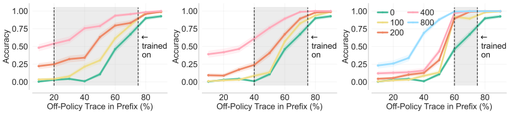
Figure 4 Back-generalization (train/test mismatch):We run RLonlyon prefixed problems where the prefix length of the off-policy trace lies in the shaded interval. We evaluate different RL training checkpoints across the full range of prefix lengths, including no-prefix problems (0% prefixing). Training on longer prefixes improves performance on shorter prefixes and can eventually improve no-prefix, indicating back-generalization (a,b). When training uses very long prefixes only there is a severe train/test mismatch, and back-generalization to no-prefix problems takes more training steps (c).
원문 · CC BY 4.0 · Amrith Setlur, Zijian Wang, Andrew Cohen, Paria Rashidinejad, Sang Michael Xie · Reuse your FLOPs: Scaling RL on Hard Problems by Conditioning on Very Off-Policy Prefixes · 원문 그림 인용 · 원본 PDF 6쪽에서 그림 영역을 추출했습니다.기준선과 off-policy 사용 방식의 불안정성
비교 대상은 온폴리시 RL, Doff에 대한 SFT 후 RL(SFT+RL), 중요도 가중 off-policy RL, LUFFY입니다. SFT 후 RL은 학습 초기에 pass@1을 올리지만 엔트로피가 급격히 낮아져 약 100 RL 반복 후 pass@64가 떨어진다고 보고됩니다. 중요도 가중 off-policy RL은 토큰 단위 가중치와 클리핑 때문에 그래디언트 분산과 편향이 커져 그래디언트 노름 급증과 보상 붕괴가 나타납니다. 이 결과는 원문 설정에서 관찰된 현상이며, 두 방식이 항상 실패한다는 일반 결론은 아닙니다.

Figure 13 Supervising the policy on Doff can cause diversity collapse or training instabilities during RL: (a, b)Warm-starting the RL run by running SFT onDoff before (mid-training) reduces token entropy (a) and hurts exploration during RL (worse Pass@64 performance in (b)).(c, d)Directly using Doff during online RL by updating the current RL policy importance-weighted off-policy traces (in addition to on-policy traces) leads to training instabilities. We see the gradient norm (clipped at 1.0) blow up during training (d) and this leads to optimization collapse (c).
원문 · CC BY 4.0 · Amrith Setlur, Zijian Wang, Andrew Cohen, Paria Rashidinejad, Sang Michael Xie · Reuse your FLOPs: Scaling RL on Hard Problems by Conditioning on Very Off-Policy Prefixes · 원문 그림 인용 · 원본 PDF 17쪽에서 그림 영역을 추출했습니다.계산량을 맞춘 실험과 held-out 평가
Llama-3.1-8B-instruct에서 PrefixRL은 거부 샘플링 비용을 포함해도 가장 강한 기준선인 SFT+RL보다 약 2배 높은 계산 효율을 보였고, 접두부 없는 학습 문제에서의 정확도는 45% 높았습니다. Qwen3-4B-instruct에서는 30% 높았습니다. AIME 2025에서는 계산량을 맞춘 비교에서 pass@1이 12% 개선되었다고 보고됩니다. 또한 Llama 모델에서 AIME 2025 pass@1은 38.2에서 61.3으로, HMMT 2025 pass@1은 29.2에서 49.4로 올랐습니다. 이 수치는 해당 모델과 평가 설정에서의 결과입니다.
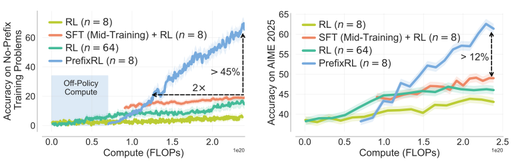
Figure 2 PrefixRL affords a self-improvement pipeline that recycles RL flops on hard problems.We instantiate PrefixRL for self- improvement by collecting a dataset of off-policy traces through large-scale rejection sampling on the base LLM (distilled Llama3.1-8B). In FLOPs-matched training, PrefixRL outperforms the strongest baseline (SFT on rejection-sampled data + RL): 2×higher compute efficiency (including rejection-sampling cost) and>45%(over 3×relative) higher final training accuracy on no-prefix training problems(left), with gains transferring to standardized evals such as AIME ’25(right).
원문 · CC BY 4.0 · Amrith Setlur, Zijian Wang, Andrew Cohen, Paria Rashidinejad, Sang Michael Xie · Reuse your FLOPs: Scaling RL on Hard Problems by Conditioning on Very Off-Policy Prefixes · 원문 그림 인용 · 원본 PDF 3쪽에서 그림 영역을 추출했습니다.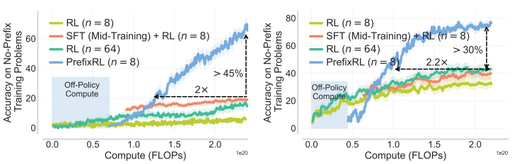
Figure 7 Training compute matched evaluation of PrefixRL.Using prefixed-problems sourced by rejection sampling the base model, we run PrefixRL on the dataset of hard training problems (low pass rate under the base model) and measure accuracy on the no-prefix training problems for (Left) Llama-3.1-8b-instruct and (Right) Qwen-3-4b-instruct. Even accountingfortheinitialcomputespentonrejectionsampling(shadedblueregion),PrefixRLimprovescompute-efficiency by 2×over the strongest baseline with and an absolute gain of 45% with Llama and 30% with Qwen.
원문 · CC BY 4.0 · Amrith Setlur, Zijian Wang, Andrew Cohen, Paria Rashidinejad, Sang Michael Xie · Reuse your FLOPs: Scaling RL on Hard Problems by Conditioning on Very Off-Policy Prefixes · 원문 그림 인용 · 원본 PDF 8쪽에서 그림 영역을 추출했습니다.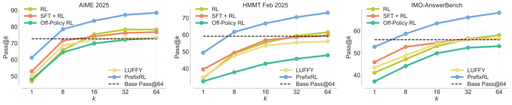
Figure 8 Held-out pass@ k of PrefixRL trained Llama models: We measurepass@k (%) on AIME’25, HMMT’25 and 200 problems from IMO-AnswerBench for our distilled Llama-3.1-8B (base model) finetuned with standard on-policy RL, and PrefixRL (with and without off-policy suffix injection). Note that IMO-AnswerBench is sampled from a similar distribution to our training problems, but is still held-out. The horizontal dashed line marks the base model’s pass@64.
원문 · CC BY 4.0 · Amrith Setlur, Zijian Wang, Andrew Cohen, Paria Rashidinejad, Sang Michael Xie · Reuse your FLOPs: Scaling RL on Hard Problems by Conditioning on Very Off-Policy Prefixes · 원문 그림 인용 · 원본 PDF 9쪽에서 그림 영역을 추출했습니다.다른 모델 계열의 접두부와 전이의 비대칭성
Qwen3-4B-instruct에서 만든 접두부로 Llama를 학습해도 PrefixRL은 효과를 보였습니다. 원문은 Qwen 접두부가 더 off-policy여서도 학습 정확도와 AIME 결과가 Llama 접두부의 경우와 비슷하다고 보고합니다. 반대로 Llama 접두부로 Qwen을 학습하면 효과가 약해서 학습 정확도와 AIME 2025 모두 제한적입니다. 저자들은 이를 외부 접두부 상태가 대상 모델과 얼마나 호환되는지에 따른 차이로 해석합니다.
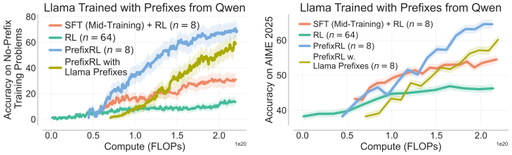
Figure 10 PrefixRL is still effective with off-policy prefixes from a different model family.We train Llama3.1-8b-instruct on prefixed-problems constructed using prefixes of rejection sampled traces from the Qwen-3-4b-instruct(left). Interestingly, even though prefixes are more out-of-distribution than those rejection sampled from Llama3.1-8b itself, they are still equally effective in improving on hard problems compared to when the prefixes are sampled from Llama3.1-8b (olive green line). We also plot the performance on AIME when we train Llama with prefixes from Qwen(right).
원문 · CC BY 4.0 · Amrith Setlur, Zijian Wang, Andrew Cohen, Paria Rashidinejad, Sang Michael Xie · Reuse your FLOPs: Scaling RL on Hard Problems by Conditioning on Very Off-Policy Prefixes · 원문 그림 인용 · 원본 PDF 10쪽에서 그림 영역을 추출했습니다.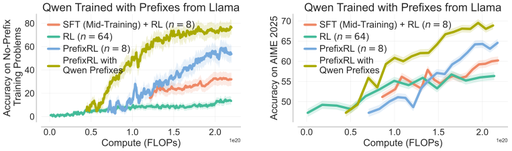
Figure 16 Training Qwen model with prefixes from Llama.Opposite of our experiment in Figure 10, here we train Qwen3-4b- instruct base LLM using off-policy traces sourced by rejection sampling Llama-3.1-8b-instruct model. We find that while off-policy prefixes from Llama are not as effective at improving Qwen as the other way around. Moreover, we also end up spending more compute upfront on rejection sampling the traces with the less capable Llama base model. We show accuracy on no-prefix training problems(left)and AIME 2025(right).
원문 · CC BY 4.0 · Amrith Setlur, Zijian Wang, Andrew Cohen, Paria Rashidinejad, Sang Michael Xie · Reuse your FLOPs: Scaling RL on Hard Problems by Conditioning on Very Off-Policy Prefixes · 원문 그림 인용 · 원본 PDF 32쪽에서 그림 영역을 추출했습니다.학습 동역학과 엔트로피 보존
SFT를 off-policy 데이터에 적용하면 토큰 엔트로피가 크게 떨어지는 반면, PrefixRL은 엔트로피의 대부분을 유지합니다. PrefixRL은 모든 음수 배치의 비율도 낮추며, 접두부 없는 문제에서 평균 응답 길이가 짧아집니다. 저자들은 정답 트레이스가 보통 더 짧고 짧은 응답이 그래디언트 분산을 줄인다고 설명합니다. 그래디언트 노름과 표준편차 측정에서 PrefixRL은 더 높은 노름과 더 낮은 분산을 보입니다. 이 해석은 원문의 측정 설정에 한정됩니다.
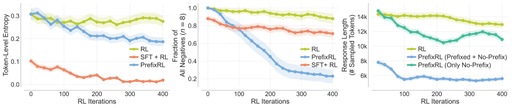
Figure 11 RL Training Dynamics.(Left) Compared to RL and PrefixRL, supervised learning on off-policy data (SFT+RL) leads to much lower token-level entropy during RL, which may hurt exploration. (Middle) PrefixRL has much lower “all negative ratio”, or the number of prompts with all zero rewards (zero advantage) during training. Note that the ratio is measured only on problems without any prefixes. (Right) When we look at the average response length on only no-prefix problems (green), we see PrefixRL generates shorter responses, mostly because correct solutions are usually shorter and standard RL has worse accuracy. Blue shows the average length across all problems, which is lower due to prefixing. This shortening is one way that PrefixRL reduces gradient variance and gains on compute efficiency compared to standard RL.
원문 · CC BY 4.0 · Amrith Setlur, Zijian Wang, Andrew Cohen, Paria Rashidinejad, Sang Michael Xie · Reuse your FLOPs: Scaling RL on Hard Problems by Conditioning on Very Off-Policy Prefixes · 원문 그림 인용 · 원본 PDF 10쪽에서 그림 영역을 추출했습니다.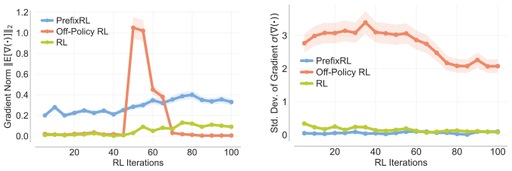
Figure 12 PrefixRL signal-to-noise ratio and safely training on off-policy suffixes.PrefixRL simultaneously has higher gradient norm (left) and lower gradient variance (right) than both standard RL and importance-weighted off-policy RL. For off-policyRLinparticular, theimportanceweightingcausesthegradientvariancetobemuchhigherandcausesagradient norm spike, which is a sign of training instability. PrefixRL avoids these issues while still leveraging off-policy data.
원문 · CC BY 4.0 · Amrith Setlur, Zijian Wang, Andrew Cohen, Paria Rashidinejad, Sang Michael Xie · Reuse your FLOPs: Scaling RL on Hard Problems by Conditioning on Very Off-Policy Prefixes · 원문 그림 인용 · 원본 PDF 11쪽에서 그림 영역을 추출했습니다.적용 범위와 한계
접두부 훈련 분포가 긴 접두부에 치우치면 back-generalization이 약해지고 짧은 접두부와 접두부 없는 문제로의 전이가 제한됩니다. 또한 실험은 수학 추론 벤치마크와 두 모델 계열에 국한됩니다. 원문은 주요 전이 결과가 지정된 접두부 길이 구간과 학습 스텝 수에 의존함을 보여 주므로, 이 결과를 임의의 분포나 과제로 일반화하기 전에 해당 조건을 확인해야 합니다.
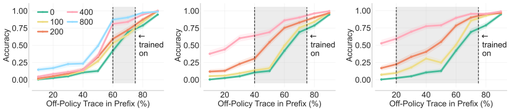
Figure 14 Back-generalization (train-test mismatch):On Llama3.1-8b-instruct we run RL only on prefixed problems sourced from Qwen3-4b-instruct whose prefix length (percent of the off-policy trace) lies in the shaded interval. At evaluation, we test across the full range of prefix lengths, including no-prefix problems (0% prefix). The performance at different RL training iterations (0, 100, 200, 400 and 800) is represented with different colors. Similar to Figure 4, where the prefixes are also sourced from Llama-3.1-8b When the mismatch is moderate, training on longer prefixes improves performance on shorter prefixes and can eventually improve no-prefix, indicating back-generalization (b, c). But different from Figure 4, we find that when the prefix distribution is skewed towards long prefixes back-generalization is weaker despite running RL for 800 iterations.
원문 · CC BY 4.0 · Amrith Setlur, Zijian Wang, Andrew Cohen, Paria Rashidinejad, Sang Michael Xie · Reuse your FLOPs: Scaling RL on Hard Problems by Conditioning on Very Off-Policy Prefixes · 원문 그림 인용 · 원본 PDF 29쪽에서 그림 영역을 추출했습니다.논문 정보
- 저자
- Amrith Setlur, Zijian Wang, Andrew Cohen, Paria Rashidinejad, Sang Michael Xie
- 학회·저널
- arXiv · 프리프린트
- 최초 공개일
- 2026년 1월 26일
- 등록일
- 2026년 10월 30일
- 수정일
- 2026년 2월 3일
- 버전
- v2
- arXiv
- 2601.18795
- 분류
- cs.LG · cs.AI · cs.CL
- 원문 이용 조건
- CC BY 4.0
- 제공 범위
- 논문 정보, 해설, 허용된 원문 그림
AI 해설은 논문 원문과 별개의 설명이며 오류가 있을 수 있습니다. 원문과 그림은 각 출처의 이용 조건과 따로 표시된 권리를 따릅니다.
초록
Typical reinforcement learning (RL) methods for LLM reasoning waste compute on hard problems, where correct on-policy traces are rare, policy gradients vanish, and learning stalls. To bootstrap more efficient RL, we consider reusing old sampling FLOPs (from prior inference or RL training) in the form of off-policy traces. Standard off-policy methods supervise against off-policy data, causing instabilities during RL optimization. We introduce PrefixRL, where we condition on the prefix of successful off-policy traces and run on-policy RL to complete them, side-stepping off-policy instabilities. PrefixRL boosts the learning signal on hard problems by modulating the difficulty of the problem through the off-policy prefix length. We prove that the PrefixRL objective is not only consistent with the standard RL objective but also more sample efficient. Empirically, we discover back-generalization: training only on prefixed problems generalizes to out-of-distribution unprefixed performance, with learned strategies often differing from those in the prefix. In our experiments, we source the off-policy traces by rejection sampling with the base model, creating a self-improvement loop. On hard reasoning problems, PrefixRL reaches the same training reward 2x faster than the strongest baseline (SFT on off-policy data then RL), even after accounting for the compute spent on the initial rejection sampling, and increases the final reward by 3x. The gains transfer to held-out benchmarks, and PrefixRL is still effective when off-policy traces are derived from a different model family, validating its flexibility in practical settings.
원문 인용
Amrith Setlur, Zijian Wang, Andrew Cohen, Paria Rashidinejad, Sang Michael Xie (2026). Reuse your FLOPs: Scaling RL on Hard Problems by Conditioning on Very Off-Policy Prefixes. arXiv:2601.18795v2. https://arxiv.org/abs/2601.18795v2
BibTeX
@misc{setlur2026reuse,
  title = {{Reuse your FLOPs: Scaling RL on Hard Problems by Conditioning on Very Off-Policy Prefixes}},
  author = {Amrith Setlur and Zijian Wang and Andrew Cohen and Paria Rashidinejad and Sang Michael Xie},
  year = {2026},
  eprint = {2601.18795},
  archivePrefix = {arXiv},
  url = {https://arxiv.org/abs/2601.18795v2}
}