논문 해설
PEAKS: Selecting Key Training Examples Incrementally via Prediction Error Anchored by Kernel Similarity
PEAKS: 커널 유사도에 고정된 예측 오차를 통해 핵심 학습 예제를 점진적으로 선택하기
- 연구 문제 스트림으로 도착하는 데이터에서 고정 예산의 학습 집합을 점진적으로 고르는 문제를 다룹니다.
- 연구 방법 예측 오차와 클래스 평균 임베딩과의 유사도를 곱한 PEAKS 점수로 샘플을 선택합니다.
- 주요 결과 pre-training ViT 미세조정과 검증 집합이 없는 설정에서 PEAKS는 무작위 선택과 여러 기준선보다 높은 정확도를 보고하며, 데이터 규모가 커질수록 무작위 선택 대비 이득이 커집니다.
스트림 데이터에서 학습 예제를 고르는 문제
이 논문은 데이터가 연속된 스트림으로 도착하고 전체 데이터 소스에 접근할 수 없는 상황에서, 고정된 예산 k만큼의 학습 집합을 점진적으로 구성하는 문제를 다룹니다. 이 설정을 Incremental Data Selection(IDS)이라고 부릅니다. 기존의 정적 코어셋 선택과 적응형 코어셋 선택은 전체 데이터를 미리 확보하고 여러 번 처리해야 하므로, 데이터가 계속 늘어나는 상황에서는 선택 과정 자체가 부담이 됩니다. 온라인 배치 선택은 배치 단위로 예제를 고르지만, 데이터를 미리 섞어 둘 수 없는 경우 한 배치가 저품질 샘플이나 일시적인 분포 변화로만 채워질 수 있습니다. 또한 많은 기존 방법은 선택한 샘플을 한 번 사용한 뒤 버리거나 다음 에포크에서 다시 거부할 수 있어, 선택된 예제를 여러 번 반복해 학습에 쓰는 설정과 다릅니다.
IDS에서는 선택 결정이 즉시 이루어져야 하며, 선택된 예제는 학습 집합에 남아 이후 갱신에서도 새 데이터와 함께 사용됩니다. 따라서 어떤 예제의 가치는 모델의 현재 상태에 따라 달라집니다.

Figure 2 . Incremental data selection consists of three phases. First, the model is trained on m randomly selected examples. During the main data selection phase, new examples are iteratively selected from the data source using the acquisition function A. The model is updated each time δ new examples are collected. Once the data budget k is reached, the model is fine-tuned on all the selected examples.
원문 · CC BY 4.0 · Gurbuz, Mustafa Burak, Zheng, Xingyu, Dovrolis, Constantine · PEAKS: Selecting Key Training Examples Incrementally via Prediction Error Anchored by Kernel Similarity · 원문 그림 인용 · 원본 PDF 3쪽에서 그림 영역을 추출했습니다.예측 오차와 클래스 대표성의 곱으로 쓰는 PEAKS 점수
PEAKS는 예제 (xp, yp)가 학습 집합에 들어갈 가치를, 그 예제가 같은 클래스 검증 샘플의 로짓을 얼마나 개선하는지로 추정합니다. 마지막 분류층만 갱신한다는 가정과 신경 탄젠트 커널의 1차 테일러 근사 아래에서, 이 개선량은 예측 오차 E(xp)와 특징 벡터 ϕ(xp)·(클래스 평균 임베딩)의 곱으로 쓰입니다. 여기서 E(xp)는 (1 − σ(f(xp))[yp]) + Σ_{i≠yp} σ(f(xp))[i]로 정의되며, 예측 확률이 정답에서 벗어난 정도를 나타냅니다.
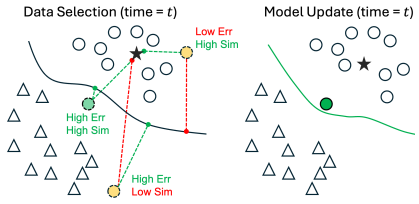
Figure 1 . Illustration of PEAKS: The solid line denotes the deci- sion boundary. Empty markers represent current training samples, and the star indicates the mean embedding of the circular class. During the selection step, among the three potential candidates for inclusion in the training dataset, the green circle is selected due to its high prediction error (Err) and strong similarity (Sim) to the mean embedding. The model is subsequently updated using the newly selected sample along with prior examples. This iterative process is repeated until a total of k new examples are collected.
원문 · CC BY 4.0 · Gurbuz, Mustafa Burak, Zheng, Xingyu, Dovrolis, Constantine · PEAKS: Selecting Key Training Examples Incrementally via Prediction Error Anchored by Kernel Similarity · 원문 그림 인용 · 원본 PDF 1쪽에서 그림 영역을 추출했습니다.검증 집합 없이 쓰는 PEAKS는 클래스 평균 대신 출력층 가중치 W[:,yp]를 클래스 대표로 사용하여 점수를 E(xp)·f(xp, θt)[yp]로 근사합니다. 여기서 f(xp, θt)[yp]는 특징과 대표 벡터의 정렬 정도를 나타냅니다. 실제 선택에서는 클래스별 선택 횟수 c_yp(t)로 점수를 나누어 특정 클래스가 과도하게 선택되는 것을 줄입니다. 선택 결정은 최근 점수를 담은 캐시 C 안에서의 백분위가 100 − p 이상인지로 이루어지며, 캐시는 τ 갱신마다 비워집니다.
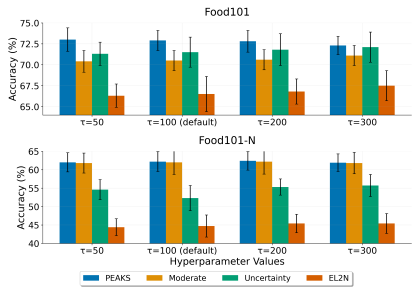
Figure 5 . Impact of refresh period τ on performance. Results are averaged over three seeds, using a fixed selection budget of 10k examples from the Food101 and Food101-N datasets.
원문 · CC BY 4.0 · Gurbuz, Mustafa Burak, Zheng, Xingyu, Dovrolis, Constantine · PEAKS: Selecting Key Training Examples Incrementally via Prediction Error Anchored by Kernel Similarity · 원문 그림 인용 · 원본 PDF 8쪽에서 그림 영역을 추출했습니다.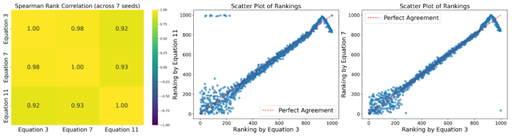
Figure 9 . Left: Spearman rank correlation of 1000 examples scored by exact and approximate methods. Middle: Score ranking agreement between Eq. (3) and Eq. (9). Right: Agreement between Eq. (3) and Eq. (11). Scatter plots are based on a single seed.
원문 · CC BY 4.0 · Gurbuz, Mustafa Burak, Zheng, Xingyu, Dovrolis, Constantine · PEAKS: Selecting Key Training Examples Incrementally via Prediction Error Anchored by Kernel Similarity · 원문 그림 인용 · 원본 PDF 19쪽에서 그림 영역을 추출했습니다.처음부터 학습한 ResNet-18 실험의 결과
처음부터 학습하는 ResNet-18 실험에서는 초기 학습 집합이 충분히 커야 모델 출력이 선택에 쓸 만큼 정보를 가집니다. 이 설정에서 PEAKS는 CIFAR100, Food101, Food101-N 세 데이터셋 모두에서 무작위 선택보다 일반적으로 높은 성능을 보였지만, 이득은 작은 데이터 예산 쪽과 깨끗하게 정리된 CIFAR100에서 두드러지지 않았습니다. CIFAR100의 30k 예산에서는 예외가 하나 있습니다. 원문은 이 현상을 단순 무작위 선택이 간단한 데이터셋에서 강한 기준선이 될 수 있다는 관찰과 연결합니다.
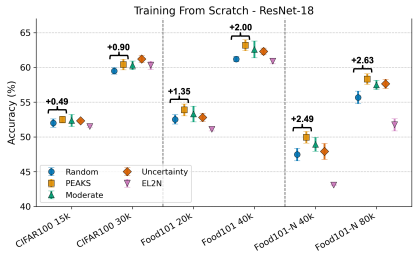
Figure 3 . ResNet-18 without pretraining. Accuracy across three seeds. |m|: 7.5k (CIFAR100), 10k (Food101), 20k (Food101-N). WebVision experiments are omitted due to the computational cost of training from scratch.
원문 · CC BY 4.0 · Gurbuz, Mustafa Burak, Zheng, Xingyu, Dovrolis, Constantine · PEAKS: Selecting Key Training Examples Incrementally via Prediction Error Anchored by Kernel Similarity · 원문 그림 인용 · 원본 PDF 6쪽에서 그림 영역을 추출했습니다.이 결과는 ResNet-18을 처음부터 학습한 설정에 한정됩니다. WebVision은 계산 비용 때문에 이 실험에서 제외되었습니다.
pre-training ViT 미세조정에서의 비교
처음부터 학습하는 설정의 한계를 피하기 위해, 저자들은 ImageNet-1k에서 DINO로 사전학습한 ViT-B/16을 미세조정하는 실험으로 옮겨 갔습니다. 검증 집합을 사용하는 표에서 PEAKS-V는 Random과 여러 임베딩 기반 기준선보다 높은 정확도를 보고합니다. 예를 들어 CIFAR100 ×4 조건에서 PEAKS-V 정확도는 84.3 (±0.6)이고 Random은 81.1 (±0.5)입니다. 이 값은 5개 시드 평균이며, 같은 표의 ×1 조건에서는 PEAKS-V 61.0 (±9.9)과 Random 57.0 (±8.9)으로 차이가 작습니다.
검증 집합이 없는 PEAKS는 출력층 가중치로 클래스 대표를 근사합니다. 이 경우 샘플 수가 매우 적은 ×1 조건에서는 PEAKS-V보다 성능이 낮아집니다. CIFAR100에서는 wrong and low confidence 기준선이 PEAKS보다 높았으며, 저자들은 깨끗하게 정리된 데이터에서는 낮은 신뢰도가 난이도의 신뢰할 만한 신호가 될 수 있다고 해석합니다.
데이터 규모가 커질수록 나타나는 무작위 선택 대비 이득
검증 집합 없이 PEAKS를 WebVision과 Food101-N에서 평가하면, 예산이 커질수록 무작위 선택에 대한 이득이 커지는 경향이 보고됩니다. WebVision ×4 조건에서 PEAKS 정확도는 59.0 (±0.3)이고 Random은 50.1 (±0.1)입니다. 이 값은 3개 시드 평균입니다. 저자들은 PEAKS가 50k와 100k 샘플로 Random이 200k와 400k 샘플을 사용한 것과 비슷한 정확도를 낸다고 보고합니다. Food101-N에서는 Random이 대략 두 배의 데이터를 필요로 한다고 보고합니다.
이 결과는 WebVision과 Food101-N의 해당 예산 범위와 pre-training ViT-B/16 설정에서 얻은 관찰입니다.
클래스 정규화 항과 선택 중복 분석
클래스 정규화 항을 제거한 변형과 PEAKS를 비교하면, CIFAR100 ×1 조건에서 정규화를 제거한 PEAKS는 57.8이고 PEAKS는 59.0입니다. 원문은 이 항이 균형 데이터와 불균형 데이터 모두에서 성능을 일관되게 높인다고 보고합니다. 이 결과는 3개 시드 평균이며 WebVision은 계산 제약 때문에 제외되었습니다.
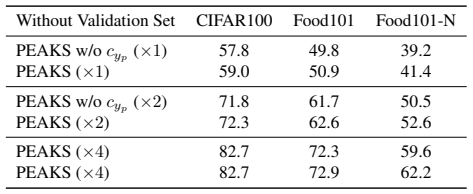
Table 5 . Impact of class normalization for PEAKS. Test accuracies averaged across 3 seeds without validation set. Data budgets ×1, ×2, and ×4 refer to dataset sizes of 2.5k, 5k, and 10k examples
원문 · CC BY 4.0 · Gurbuz, Mustafa Burak, Zheng, Xingyu, Dovrolis, Constantine · PEAKS: Selecting Key Training Examples Incrementally via Prediction Error Anchored by Kernel Similarity · 원문 그림 인용 · 원본 PDF 23쪽에서 그림 영역을 추출했습니다.선택 집합의 중복을 보면, CIFAR-100과 Food-101에서 전체 데이터의 30%를 고르는 설정에서 PEAKS와 EL2N 최종 학습 집합의 Jaccard 유사도는 0.36에서 0.40 사이입니다. 이는 두 방법이 완전히 같은 샘플을 고르지 않지만, 커널 유사도 항이 선택에 역할을 한다는 해석을 뒷받침합니다. 두 방법의 정확도가 비슷하게 나타나는 경우도 있어 서로 다른 집합이 비슷한 효과를 낼 수 있다는 점도 함께 보고됩니다.
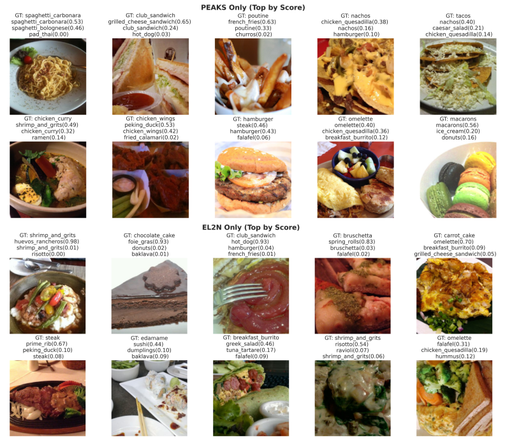
Figure 11 . Shown above are two separate 2×5 grids of images from the Food101 dataset encountered in the middle of the data selection phase. The first figure highlights the top 10 images (by score) that were exclusively selected by PEAKS but not by EL2N, while the second figure shows the top 10 images (by score) exclusively selected by EL2N but not by PEAKS. Each image is annotated with its ground-truth label and the top three predicted classes (with their respective softmax probabilities). This comparison illustrates the differences in selection criteria between the two methods.
원문 · CC BY 4.0 · Gurbuz, Mustafa Burak, Zheng, Xingyu, Dovrolis, Constantine · PEAKS: Selecting Key Training Examples Incrementally via Prediction Error Anchored by Kernel Similarity · 원문 그림 인용 · 원본 PDF 21쪽에서 그림 영역을 추출했습니다.적용 범위와 남은 질문
이 연구의 결과는 특정 조건에 묶여 있습니다. 점수 유도는 마지막 분류층만 갱신한다는 가정과 커널 영역의 1차 근사에 기대며, 실험에서는 전체 구조를 학습합니다. 따라서 이 가정이 모든 신경망과 학습 방식으로 옮겨진다고 보기는 어렵습니다. 처음부터 학습하는 설정에서는 이득이 작았고, 검증 집합이 없는 PEAKS는 샘플이 매우 적은 조건에서 PEAKS-V보다 낮았습니다. 원문은 IDS를 위한 더 정교한 정규화나 학습 가소성 개선이 필요할 수 있다고 제안합니다.
또한 CL 설정, 분포가 변하는 스트림, 다른 배치 구성 방식은 이 논문에서 평가되지 않았습니다. 샘플 사용 균등화 대안은 부록의 한 설정에서만 비교되었습니다.
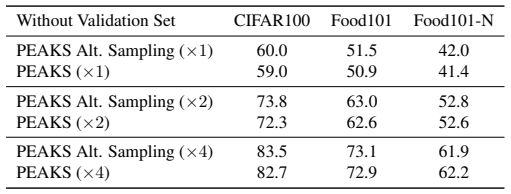
Table 4 . Alternative sampling using counts. Test accuracies averaged across 3 seeds without validation set. Data budgets ×1, ×2, and ×4 refer to dataset sizes of 2.5k, 5k, and 10k examples
원문 · CC BY 4.0 · Gurbuz, Mustafa Burak, Zheng, Xingyu, Dovrolis, Constantine · PEAKS: Selecting Key Training Examples Incrementally via Prediction Error Anchored by Kernel Similarity · 원문 그림 인용 · 원본 PDF 22쪽에서 그림 영역을 추출했습니다.논문 정보
- 저자
- Gurbuz, Mustafa Burak, Zheng, Xingyu, Dovrolis, Constantine
- 학회·저널
- arXiv · 프리프린트
- 최초 공개일
- 2025년 4월 7일
- 등록일
- 2026년 10월 29일
- 수정일
- 2025년 7월 1일
- 버전
- v4
- arXiv
- 2504.05250
- 원문 이용 조건
- CC BY 4.0
- 제공 범위
- 논문 정보, 해설, 허용된 원문 그림
AI 해설은 논문 원문과 별개의 설명이며 오류가 있을 수 있습니다. 원문과 그림은 각 출처의 이용 조건과 따로 표시된 권리를 따릅니다.
초록
As deep learning continues to be driven by ever-larger datasets, understanding which examples are most important for generalization has become a critical question. While progress in data selection continues, emerging applications require studying this problem in dynamic contexts. To bridge this gap, we pose the Incremental Data Selection (IDS) problem, where examples arrive as a continuous stream, and need to be selected without access to the full data source. In this setting, the learner must incrementally build a training dataset of predefined size while simultaneously learning the underlying task. We find that in IDS, the impact of a new sample on the model state depends fundamentally on both its geometric relationship in the feature space and its prediction error. Leveraging this insight, we propose PEAKS (Prediction Error Anchored by Kernel Similarity), an efficient data selection method tailored for IDS. Our comprehensive evaluations demonstrate that PEAKS consistently outperforms existing selection strategies. Furthermore, PEAKS yields increasingly better performance returns than random selection as training data size grows on real-world datasets. The code is available at https://github.com/BurakGurbuz97/PEAKS.
원문 인용
Gurbuz, Mustafa Burak, Zheng, Xingyu, Dovrolis, Constantine (2025). PEAKS: Selecting Key Training Examples Incrementally via Prediction Error Anchored by Kernel Similarity. arXiv:2504.05250v4. https://arxiv.org/abs/2504.05250v4
BibTeX
@misc{burak2025peaks,
  title = {{PEAKS: Selecting Key Training Examples Incrementally via Prediction Error Anchored by Kernel Similarity}},
  author = {Gurbuz, Mustafa Burak and Zheng, Xingyu and Dovrolis, Constantine},
  year = {2025},
  eprint = {2504.05250},
  archivePrefix = {arXiv},
  url = {https://arxiv.org/abs/2504.05250v4}
}