논문 해설
Data-Efficient LLM Safety Alignment Guided by Interpretable Features
해석 가능한 특징으로 안내되는 데이터 효율적인 LLM 안전 정렬
- 연구 문제 안전 정렬 데이터는 크기가 커서 비용이 높고 과잉 거부를 함께 일으키는 문제가 있습니다.
- 연구 방법 SAE의 안전 특징 커버리지로 프롬프트를 고르고 다중 에이전트 합성으로 과잉 거부 하위 집합을 만듭니다.
- 주요 결과 2.4K 규모의 LIS는 비교한 동일 크기 및 전체 데이터셋보다 높은 F1을 기록했습니다. LLaMA3.1-Alpaca에서 F1 82.32를 기록했습니다.
과잉 거부와 큰 안전 데이터의 비용
안전 정렬에 쓰이는 SFT 데이터셋은 보통 20K에서 300K 이상으로 크고, 안전성을 높이는 과정에서 무해한 프롬프트까지 거부하는 과잉 거부 문제가 함께 생깁니다. 이 논문은 이 두 문제를 동시에 줄이기 위해 작지만 대표성 있는 데이터를 고르는 방법을 다룹니다. 원문은 소량의 안전 데이터가 안전성을 크게 올릴 수 있지만 약 2,000개를 넘으면 과잉 거부가 늘어난다는 선행 연구의 관찰을 인용합니다. 그래서 목표는 데이터를 많이 모으는 것이 아니라 안전 위험의 범위와 안전과 유용성의 경계를 잘 덮는 것입니다.
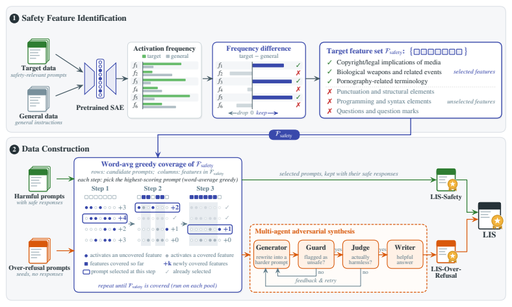
Figure 1 : Overview of the LIS construction pipeline.Stage 1: Identifying safety features by comparing SAE activations of the safety data against other data.Stage 2: Seeds from over-refusal data are processed through a multi-agent adversarial synthesis framework to produce the final over-refusal subset. The safety subset is obtained directly by filtering safety data.
원문 · CC BY 4.0 · Hongyu Li, Zhan Yu, Zhe Zhao, Kimmo Yan, Xiong Kuang, Renfen Hu · Data-Efficient LLM Safety Alignment Guided by Interpretable Features · 원문 그림 인용 · 원본 PDF 4쪽에서 그림 영역을 추출했습니다.SAE 특징으로 안전 특징을 고르는 방식
이후 안전 데이터와 일반 데이터에서 각 특징이 0보다 큰 값으로 활성화되는 빈도를 세고, 두 빈도의 log-odds 차이를 Score로 정의합니다. Score가 양수인 특징을 안전 특징 집합으로 삼습니다. log-odds를 쓴 이유는 빈도 차이 Δp보다 상대적 차이를 반영해 드문 안전 특징도 높은 점수를 받을 수 있게 하기 위해서입니다.
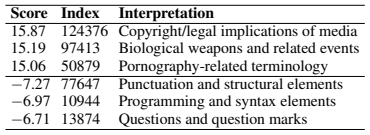
Table 2 : Feature score, index and interpretations; inter- pretations sourced from Neuronpedia (Lin, 2023). For more examples, see Appendix G.
원문 · CC BY 4.0 · Hongyu Li, Zhan Yu, Zhe Zhao, Kimmo Yan, Xiong Kuang, Renfen Hu · Data-Efficient LLM Safety Alignment Guided by Interpretable Features · 원문 그림 인용 · 원본 PDF 3쪽에서 그림 영역을 추출했습니다.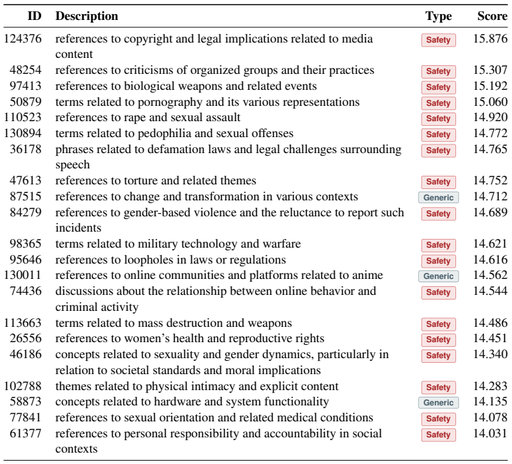
Table 18 : Top 50 features with the highest Scores
원문 · CC BY 4.0 · Hongyu Li, Zhan Yu, Zhe Zhao, Kimmo Yan, Xiong Kuang, Renfen Hu · Data-Efficient LLM Safety Alignment Guided by Interpretable Features · 원문 그림 인용 · 원본 PDF 31쪽에서 그림 영역을 추출했습니다.단어 평균 탐욕적 선택과 길이 정규화
프롬프트 선택 단계에서는 각 후보 프롬프트가 이번 단계에서 새로 덮는 안전 특징 수 NewCov를 그 프롬프트의 단어 수 |x|로 나눈 값을 최대화합니다. 식으로는 x* = arg max NewCov(x_i)/|x_i| 입니다. 여기서 분자는 새로 덮는 안전 특징의 개수이고 분모는 단어 수이므로, 길지만 주제가 하나인 프롬프트가 높은 점수를 받지 못하도록 길이 편향을 줄입니다. 동점이면 새로 덮는 특징들의 Score 합으로 정합니다. 저자들은 길이 정규화가 없을 때 긴 jailbreak 샘플이 선택되면서 분포가 한쪽으로 몰릴 수 있다고 해석합니다.
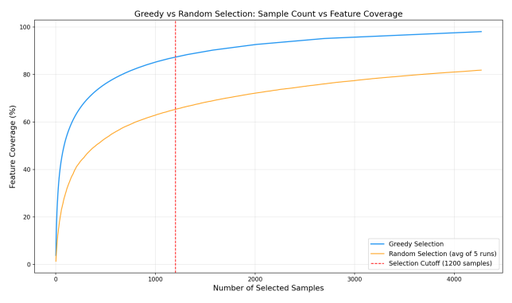
Figure 16 : Coverage of safety features by greedy and random algorithms. In the early stages of filtering, greedy algorithms can significantly improve the coverage of safety features in the dataset.
원문 · CC BY 4.0 · Hongyu Li, Zhan Yu, Zhe Zhao, Kimmo Yan, Xiong Kuang, Renfen Hu · Data-Efficient LLM Safety Alignment Guided by Interpretable Features · 원문 그림 인용 · 원본 PDF 31쪽에서 그림 영역을 추출했습니다.다중 에이전트 적대적 합성
과잉 거부 하위 집합은 OR-Bench 시드 프롬프트를 Generator가 더 위험해 보이게 다시 쓰는 것으로 시작합니다. Guard가 거부하면 Judge가 실제 유해인지 판단하고, 거부하지 않으면 Generator가 더 위험해 보이도록 다시 씁니다. Judge가 유해하다고 판단하면 피드백에 따라 무해하게 고쳐 씁니다. 최종적으로 Response-Writer가 무해한 부분을 짚고 위험 요소를 피하거나 안전한 대안을 주는 응답을 생성합니다. 이 과정은 FalseReject의 아이디어를 참고했습니다.
동일 크기와 전체 데이터셋 비교
실험은 LLaMA3.1-Alpaca와 Qwen3.5-9B-Base에서 같은 체크포인트와 같은 fine-tuning 설정으로 LIS, TRIDENT-Core와 Edge, WildJailbreak를 비교했습니다. 동일 크기 비교에서는 각 데이터셋에서 2.4K개를 무작위로 뽑은 기준선을, 전체 비교에서는 원래 크기의 데이터셋을 사용했습니다. LLaMA3.1-Alpaca에서 LIS는 F1 82.32를 기록했고, Qwen3.5-9B-Base에서는 F1 87.09를 기록했습니다. Recall은 1에서 평균 unsafe rate를 뺀 값이고 Precision은 1에서 평균 over-refusal rate를 뺀 값입니다.
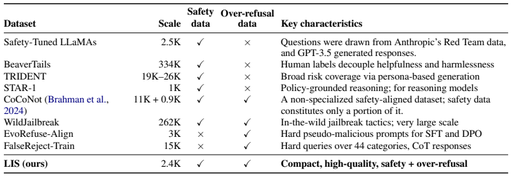
Table 1 : The scale, composition, and characteristics of each training dataset.
원문 · CC BY 4.0 · Hongyu Li, Zhan Yu, Zhe Zhao, Kimmo Yan, Xiong Kuang, Renfen Hu · Data-Efficient LLM Safety Alignment Guided by Interpretable Features · 원문 그림 인용 · 원본 PDF 3쪽에서 그림 영역을 추출했습니다.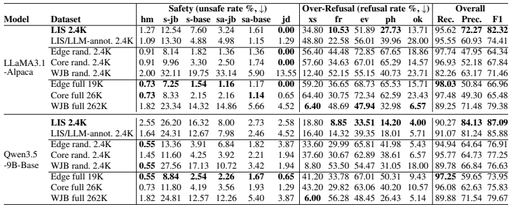
Table 3 : Size-matched (2.4K) and full-dataset comparison on two model families understrictly unified settings. rand. = random equal-size subset. Recall = 1−avg(unsafe rate) , Precision = 1−avg(over-refusal rate) (Jiang et al., 2024). Best result in each column within each model family is inbold.
원문 · CC BY 4.0 · Hongyu Li, Zhan Yu, Zhe Zhao, Kimmo Yan, Xiong Kuang, Renfen Hu · Data-Efficient LLM Safety Alignment Guided by Interpretable Features · 원문 그림 인용 · 원본 PDF 6쪽에서 그림 영역을 추출했습니다.선택 전략과 두 하위 집합의 역할
TRIDENT-Core에서 1,200개를 고르는 다섯 전략을 비교했을 때, Word-average Greedy는 여섯 개 안전 벤치마크 가운데 다섯 개에서 가장 낮은 unsafe rate를 보였습니다. Anti-Greedy는 전반적으로 나빴습니다. 두 하위 집합을 따로 학습한 실험에서는 LIS-Safety 단독이 Recall 97.91로 가장 높았지만 Precision은 43.52로 낮았습니다. LIS-Over-Refusal 단독은 Precision 81.89를 보였으나 Recall은 72.60이었습니다. 두 하위 집합을 함께 쓴 전체 LIS만 두 지표의 균형을 보였습니다.
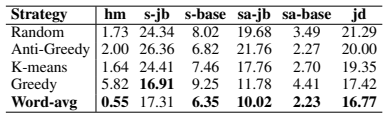
Table 4 : Comparison of the Word-average Greedy (Word-avg) with other filtering methods: Unsafe rate (%,↓) across selection strategies. Best inbold.
원문 · CC BY 4.0 · Hongyu Li, Zhan Yu, Zhe Zhao, Kimmo Yan, Xiong Kuang, Renfen Hu · Data-Efficient LLM Safety Alignment Guided by Interpretable Features · 원문 그림 인용 · 원본 PDF 6쪽에서 그림 영역을 추출했습니다.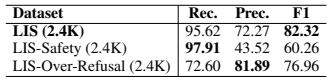
Table 5 : Results of training LLaMA3.1-Alpaca on each subset alone
원문 · CC BY 4.0 · Hongyu Li, Zhan Yu, Zhe Zhao, Kimmo Yan, Xiong Kuang, Renfen Hu · Data-Efficient LLM Safety Alignment Guided by Interpretable Features · 원문 그림 인용 · 원본 PDF 7쪽에서 그림 영역을 추출했습니다.학습 비용과 합성 품질 점검
LIS fine-tuning은 8개의 NVIDIA H20 GPU에서 배치 크기 32로 2 epoch을 돌려 0.99 GPU-hours가 걸렸다고 보고합니다. 같은 실험 조건의 TRIDENT와 WildJailbreak 원래 레시피는 각각 11.5와 289.2 GPU-hours가 필요하다고 보고합니다. 과잉 거부 하위 집합의 품질은 전문 주석자가 200개 샘플을 검토해 91%를 적격으로 표시한 결과로 점검했습니다.
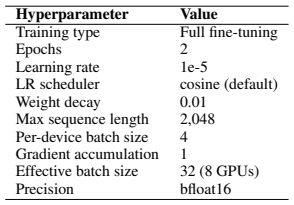
Table 8 : Hyperparameters for instruction tuning on LIS.
원문 · CC BY 4.0 · Hongyu Li, Zhan Yu, Zhe Zhao, Kimmo Yan, Xiong Kuang, Renfen Hu · Data-Efficient LLM Safety Alignment Guided by Interpretable Features · 원문 그림 인용 · 원본 PDF 11쪽에서 그림 영역을 추출했습니다.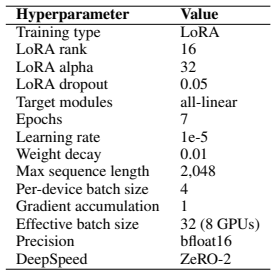
Table 10 : Original TRIDENT recipe (Core / Edge), used only for the cost estimate in Appendix A.4.
원문 · CC BY 4.0 · Hongyu Li, Zhan Yu, Zhe Zhao, Kimmo Yan, Xiong Kuang, Renfen Hu · Data-Efficient LLM Safety Alignment Guided by Interpretable Features · 원문 그림 인용 · 원본 PDF 12쪽에서 그림 영역을 추출했습니다.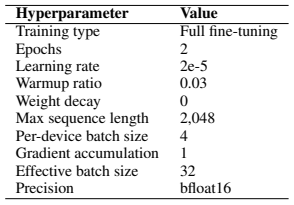
Table 11 : Original WildJailbreak recipe (mixed with Tulu-2-Mix), used only for the cost estimate in Ap- pendix A.4.
원문 · CC BY 4.0 · Hongyu Li, Zhan Yu, Zhe Zhao, Kimmo Yan, Xiong Kuang, Renfen Hu · Data-Efficient LLM Safety Alignment Guided by Interpretable Features · 원문 그림 인용 · 원본 PDF 12쪽에서 그림 영역을 추출했습니다.한계
안전 특징은 Score가 양수이면 고르므로 안전과 직접 관련 없는 특징도 섞일 수 있습니다. 저자들은 Alpaca가 TRIDENT의 일반 특징을 완전히 상쇄하지 못한다고 설명합니다. 합성 데이터의 품질과 다양성은 합성 프레임워크에 쓴 모델의 능력에 제한되며, LIS의 작은 규모 때문에 극단적인 시나리오가 덜 다뤄질 수 있습니다.
논문 정보
- 저자
- Hongyu Li, Zhan Yu, Zhe Zhao, Kimmo Yan, Xiong Kuang, Renfen Hu
- 학회·저널
- arXiv · 프리프린트
- 최초 공개일
- 2026년 11월 12일
- 등록일
- 2026년 11월 13일
- 수정일
- 2026년 11월 12일
- 버전
- v1
- arXiv
- 2611.16183
- 분류
- cs.CL · cs.AI
- 원문 이용 조건
- CC BY 4.0
- 제공 범위
- 논문 정보, 해설, 허용된 원문 그림
AI 해설은 논문 원문과 별개의 설명이며 오류가 있을 수 있습니다. 원문과 그림은 각 출처의 이용 조건과 따로 표시된 권리를 따릅니다.
초록
Existing large language models typically rely on massive fine-tuning datasets for safety alignment, which results in higher costs for safety alignment and often leads to the problem of over-refusal. We propose Less is Safer (LIS), a compact yet highly effective dataset for safety alignment, constructed through interpretable feature-guided selection and adversarial synthesis. Specifically, we leverage Sparse Autoencoder (SAE) activations to efficiently select prompts that cover diverse and interpretable safety features. Then, we employ a multi-agent adversarial synthesis framework to generate harmless prompts that nevertheless elicit unnecessary refusals. LIS contains only 2.4K samples, yet outperforms much larger datasets, e.g., TRIDENT-Core (26K), TRIDENT-Edge (19K) and WildJailbreak (262K), in overall performance on four safety and five over-refusal benchmarks. Through ablation experiments, we demonstrate that neither safety data nor over-refusal data alone can achieve optimal results. We also used safety features from SAE, annotated by an LLM, for data filtering, but the results were inferior to those obtained using the pipeline proposed in this paper.
원문 인용
Hongyu Li, Zhan Yu, Zhe Zhao, Kimmo Yan, Xiong Kuang, Renfen Hu (2026). Data-Efficient LLM Safety Alignment Guided by Interpretable Features. arXiv:2611.16183v1. https://arxiv.org/abs/2611.16183v1
BibTeX
@misc{li2026data,
  title = {{Data-Efficient LLM Safety Alignment Guided by Interpretable Features}},
  author = {Hongyu Li and Zhan Yu and Zhe Zhao and Kimmo Yan and Xiong Kuang and Renfen Hu},
  year = {2026},
  eprint = {2611.16183},
  archivePrefix = {arXiv},
  url = {https://arxiv.org/abs/2611.16183v1}
}