논문 해설
Detecting Shadow AI: Unsanctioned LLM Agents on Enterprise Endpoints: A Taxonomy, an Open Detector and a Controlled Evaluation
섀도 AI 탐지: 엔터프라이즈 엔드포인트의 승인되지 않은 LLM 에이전트, 분류 체계, 공개 탐지기 및 통제된 평가
- 연구 문제 승인되지 않은 AI 에이전트는 제품 시그니처 없이 배포되어 기존 네트워크·인벤토리·행동 탐지로 구분하기 어렵습니다.
- 연구 방법 Agent Detector는 DNS 캐시와 전용 주소 범위로 원격 서비스 신원을 얻고, 프로세스 행동과 설정·설치·이력을 상관시켜 에이전트를 탐지합니다.
- 주요 결과 합성 벤치에서 Agent Detector는 행동 쌍둥이와 양성 워크로드를 플래그하지 않으면서 에이전트를 다수 실행에서 탐지했습니다. 행동 규칙 D1과 D2는 쌍둥이를 플래그했습니다.
에이전트 확산과 탐지의 어려움
기업 IT 조직이 승인하지 않은 기술을 쓰는 shadow IT는 오래된 거버넌스 문제입니다. 이 논문은 자율형 AI 에이전트가 이 문제를 훨씬 빠르게 키운다고 주장합니다. 따라서 먼저 해결해야 할 질문은 엔드포인트에서 승인되지 않은 에이전트를 찾을 수 있는가입니다. 네트워크는 암호화된 API 연결만 보고, 인벤토리는 설치된 제품만 보며, 행동 기반 탐지는 npm install이나 IDE 터미널처럼 에이전트와 같은 행동을 보이는 정상 프로그램과 구분하기 어렵습니다. 논문은 이 행동 쌍둥이 문제를 중심 난제로 삼습니다.
원격 서비스의 신원을 중심으로 한 상관 탐지
Agent Detector는 행동만 보는 규칙 대신 원격 서비스의 신원을 행동과 연결합니다. 수집기는 프로세스, TCP 연결, DNS 클라이언트 캐시, 실행 이력, 설치 정보, 환경 변수를 읽으며 네트워크 트래픽은 보내지 않습니다. DNS 캐시는 원격 주소를 최근 resolve된 카탈로그 호스트 이름에 역으로 귀속시키는 데 쓰이고, 전용 주소 범위는 DNS 정보 없이도 연결을 귀속시킵니다. 상관기는 도구와 사용자별로 증거를 묶고, 모델 서비스에 연결된 프로세스 아래에 셸이나 인터프리터가 있으면 probable-agent 규칙으로 판단합니다. 행동 신호는 식별된 모델 연결이 있을 때만 평가되므로 행동 쌍둥이가 단독으로 플래그되지 않습니다.
탐지 결과는 차단이 아니라 알림으로 이어지며, 사용자는 알림을 수락해야 하고 수락 기록이 남습니다.
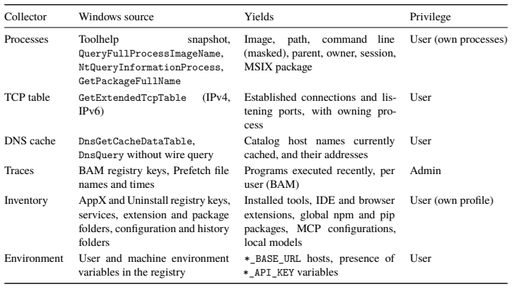
Table 5 : Collectors of Agent Detector. “Admin” means that the source is readable only with administrator or SYSTEMrightsontheWindowsbuildwetested(Section 11).
원문 · CC BY 4.0 · Jeremy Canale, Fabien Soulis · Detecting Shadow AI: Unsanctioned LLM Agents on Enterprise Endpoints: A Taxonomy, an Open Detector and a Controlled Evaluation · 원문 그림 인용 · 원본 PDF 21쪽에서 그림 영역을 추출했습니다.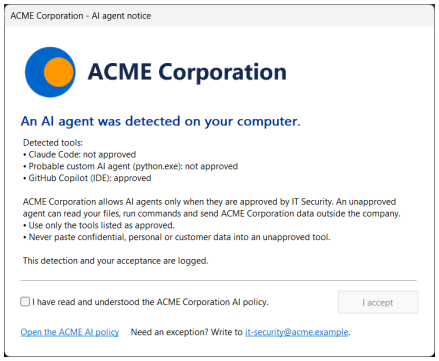
Figure 8 : Thenoticeshowntoauserwhenanagentisdetected,herewiththebrandingofafictitiouscompany. Theusermustticktheboxbeforetheonlybuttonisenabled;thewindowhasnoclosebutton.
원문 · CC BY 4.0 · Jeremy Canale, Fabien Soulis · Detecting Shadow AI: Unsanctioned LLM Agents on Enterprise Endpoints: A Taxonomy, an Open Detector and a Controlled Evaluation · 원문 그림 인용 · 원본 PDF 25쪽에서 그림 영역을 추출했습니다.합성 벤치와 행동 기준선 비교
평가는 한 대의 워크스테이션에서 표준 사용자 권한으로 실행한 합성 벤치입니다. 벤치에는 12개 합성 에이전트, 3개 AI 구성요소, 9개 양성 에피소드가 있으며 각 설정을 5회 반복했습니다. 양성 에피소드에는 행동 쌍둥이 3개, 개발자 워크로드 5개, 상속된 기본 URL을 쓰는 사례 1개가 포함됩니다. 비교 기준으로는 시그니처 탐지기 D0, 인터프리터·포트 443·셸을 보는 규칙 D1, 모든 프로세스에 같은 조건을 적용하는 D2를 사용했습니다. 원문은 D1과 D2가 행동 쌍둥이와 npm install을 플래그했다고 보고하며, D1의 precision은 0.69, D2의 precision은 0.71입니다.
Agent Detector는 모든 에이전트를 다수 실행에서 탐지했고 양성 워크로드는 플래그하지 않았습니다. 이 결과는 작은 합성 벤치에 대한 것이며 탐지기 순위를 매기기 위한 것이 아닙니다.
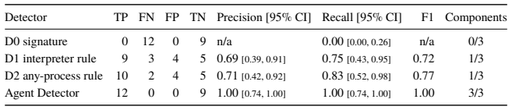
Table 11 : Detectorsonthe12agentepisodesandthe9benignepisodesofthemainset(standarduser,majority outcomeover5runs),withexact95%confidenceintervals. ThelastcolumncountstheAIcomponents(inference runtime, MCP server, LLM client without tools) that each detector flagged; they are not agents and are not countedinprecisionandrecall.
원문 · CC BY 4.0 · Jeremy Canale, Fabien Soulis · Detecting Shadow AI: Unsanctioned LLM Agents on Enterprise Endpoints: A Taxonomy, an Open Detector and a Controlled Evaluation · 원문 그림 인용 · 원본 PDF 36쪽에서 그림 영역을 추출했습니다.DNS 캐시 만료와 적용 범위
DNS 캐시 귀속에는 시간 제약이 있습니다. CDN 뒤의 제공자 네 곳에 장기 연결 에이전트를 두고 15초마다 스캔한 실험에서 어떤 연결도 295초 이후에는 귀속되지 않았습니다. 귀속은 캐시 항목이 만료되면서 끝났고, 연결 자체는 계속 살아 있었습니다. 원문은 Mistral, OpenRouter, Groq의 답변이 최대 300초 살아 있다고 보고하며, OpenAI는 최대 60초라서 한 번만 귀속되었다고 설명합니다. 또한 간헐적 에이전트는 주기적 스캔에서 약 세 번 중 한 번꼴로만 보였습니다. 원문은 Windows 빌드에서 BAM과 Prefetch, 다른 사용자 프로세스가 관리자 권한 없이는 읽히지 않는다고 밝힙니다.
가상 머신, 컨테이너, WSL 2 내부 에이전트와 클라우드 에이전트는 엔드포인트 표에서 보이지 않습니다.
논문 정보
- 저자
- Jeremy Canale, Fabien Soulis
- 학회·저널
- arXiv · 프리프린트
- 최초 공개일
- 2026년 11월 9일
- 등록일
- 2026년 11월 10일
- 수정일
- 2026년 11월 9일
- 버전
- v1
- arXiv
- 2611.12377
- 분류
- cs.AI · cs.CR
- 원문 이용 조건
- CC BY 4.0
- 제공 범위
- 논문 정보, 해설, 허용된 원문 그림
AI 해설은 논문 원문과 별개의 설명이며 오류가 있을 수 있습니다. 원문과 그림은 각 출처의 이용 조건과 따로 표시된 권리를 따릅니다.
초록
Shadow IT, the use of technology that the IT organisation has not approved, is a long-standing governance problem. We argue that autonomous AI agents can make it grow much faster: agents make building tools nearly free, act with their user's privileges, and leave behind scripts, automations and MCP servers that are themselves unsanctioned. A simple compounding model shows that, under its assumptions, shadow IT grows exponentially once agentic artifacts reproduce faster than the organisation retires them; retiring them starts with detecting them. We then ask whether unsanctioned agents can be detected on Windows endpoints. We propose a taxonomy of nine classes of agents and six layers of endpoint footprint, and argue that rules based only on the structure of processes and connections cannot separate an agent from its behavioural twin, the same program talking to a non-AI service. We present Agent Detector, an open-source Windows detector that anchors behaviour to the identity of the remote service and correlates it with configuration, installation and execution history, using a catalog of 39 tools and 184 LLM endpoint entries; it informs users through a notice they must acknowledge instead of blocking. On a controlled bench of 12 synthetic agents, 3 AI components and 9 benign workloads, repeated 5 times on one workstation, two behavioural rules flagged every behavioural twin, while Agent Detector flagged none and detected every agent in the majority of runs. Its limits are temporal: a connection to a provider behind a shared content-delivery network is attributable only while the DNS cache holds the provider's name, one to five minutes, and an intermittent agent was seen by about one scan in three. A scan costs about 154 ms. The bench is too small to rank detectors; it maps what each kind of evidence can see: unsanctioned agents can be partly detected, and not by behaviour alone.
원문 인용
Jeremy Canale, Fabien Soulis (2026). Detecting Shadow AI: Unsanctioned LLM Agents on Enterprise Endpoints: A Taxonomy, an Open Detector and a Controlled Evaluation. arXiv:2611.12377v1. https://arxiv.org/abs/2611.12377v1
BibTeX
@misc{canale2026detecting,
  title = {{Detecting Shadow AI: Unsanctioned LLM Agents on Enterprise Endpoints: A Taxonomy, an Open Detector and a Controlled Evaluation}},
  author = {Jeremy Canale and Fabien Soulis},
  year = {2026},
  eprint = {2611.12377},
  archivePrefix = {arXiv},
  url = {https://arxiv.org/abs/2611.12377v1}
}