논문 해설
Test-Time Self-Play: Scaling without a Verifier
테스트 타임 셀프 플레이: 검증기 없이 확장하기
- 연구 문제 검증기가 없거나 약한 상황에서 단일 어려운 대상 문제를 테스트 시점에 개선하는 방법을 다룹니다.
- 연구 방법 TTSP는 동결된 Qwen3-8B 위의 제안자와 solver 두 LoRA 어댑터가 합성 문제를 통해 함께 학습하는 자기 대결 방식입니다.
- 주요 결과 TTSP는 평가한 검증기 강도에서 기준선보다 우수했고, 검증기 제거 한계에서 mean@8이 35% 절대 향상되었다고 보고됩니다.
검증기가 없는 테스트 시점 스케일링의 문제
대형 언어 모델은 배포 시점에 추가 계산을 써서 어려운 대상 문제의 성능을 높일 수 있습니다. 기존 테스트 시점 스케일링 방법 대부분은 대상 문제에 대한 검증기가 후보 해법의 정답 여부를 판정해 주는 것을 전제로 합니다. 그러나 실제 배포 환경에서는 이런 강한 검증기를 얻기 어려운 경우가 많습니다. 이 논문은 대상 문제에 대한 검증기가 없거나 약할 때에도 단일 어려운 문제에 대해 모델을 적응시킬 수 있는지를 묻습니다. 이때 외부 학습 데이터나 정답 쌍도 사용하지 않는다는 조건이 함께 붙습니다.
저자들은 이 질문에 답하기 위해 대상 문제 자체의 검증 신호 대신 합성 문제에서 얻은 학습 신호를 사용하는 방향을 택합니다. 합성 문제는 대상 문제에 조건화되어 생성되며, 실행 가능한 참조 프로그램과 보류된 테스트로 자체 검증됩니다.
TTSP의 제안자와 solver의 상호작용
TTSP는 공유 동결 백본 위에 두 개의 LoRA 어댑터를 둡니다. 제안자 정책은 대상 문제와 최근 합성 문제 이력을 문맥으로 받아 새 합성 문제, 테스트, 참조 해법을 생성합니다. 생성된 후보는 필터를 거쳐 유효한 문제만 학습 배치에 들어갑니다. solver 정책은 이 합성 문제들과 재생 버퍼에서 뽑은 과거 문제를 풀고, 보류된 생성 테스트를 통과했는지에 따라 이진 보상을 받습니다.
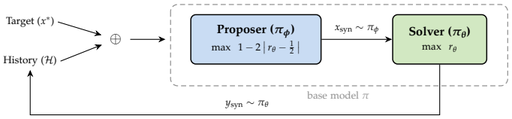
Figure 2 :Overview of Test-Time Self-Play.Given a target problem x⋆ and previously generated synthetic problems, the proposer policyπϕ generates target-conditioned synthetic problems D consisting of a problem statement, tests, and a reference solution. The solver policy is rewarded for correctly solving the synthetic problems, while the proposer is rewarded for generating synthetic problems near the solver’s current learning frontier (both via GRPO; see the red arrows). The synthetic problem history provides context for the proposer and fills a replay buffer B. After a sufficient number of iterations, the test-time trained solver can then attempt the target problem.
원문 · CC BY 4.0 · Akira Yoshiyama, Akmal Ashirmatov, Jonas Hübotter, Ido Hakimi, Andreas Krause · Test-Time Self-Play: Scaling without a Verifier · 원문 그림 인용 · 원본 PDF 2쪽에서 그림 영역을 추출했습니다.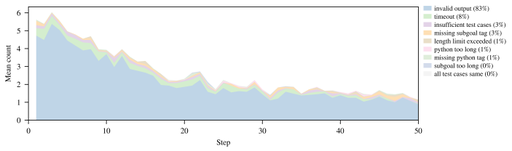
Figure 9 :Synthetic problem rejection diagnostics.Pre-training proposer generations rejected before entering solver training, averaged over target problems and grouped by failure type. Rejection counts decrease over training; invalid generated output is the largest rejection category.
원문 · CC BY 4.0 · Akira Yoshiyama, Akmal Ashirmatov, Jonas Hübotter, Ido Hakimi, Andreas Krause · Test-Time Self-Play: Scaling without a Verifier · 원문 그림 인용 · 원본 PDF 23쪽에서 그림 영역을 추출했습니다.제안자의 보상은 solver의 평균 보상 r̄θ에 대해 r_ϕ(x̂)=1−2|r̄θ(x̂)−1/2|로 정의됩니다. 이 삼각형 형태는 solver의 평균 보상이 1/2 근처일 때 최대가 되며, 원문은 희소한 이진 보상에서 GRPO의 집단 상대 신호가 가장 크게 나타나는 구간과 맞춘다고 설명합니다. 재생 버퍼는 solve rate가 학습 신호가 있는 구간에 있는 문제만 다시 뽑으며, 재생할 때에는 과거 보상을 재사용하지 않고 현재 solver로 롤아웃을 새로 얻습니다.
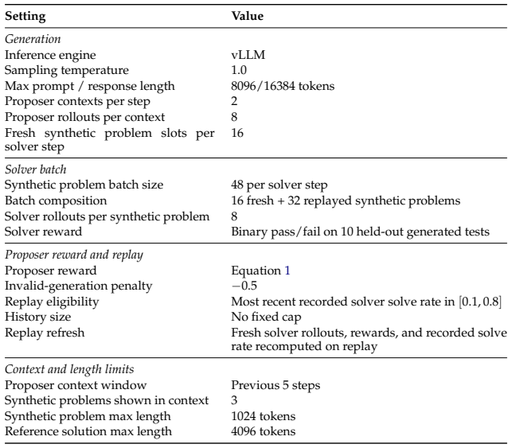
Table 7 :Curriculum, rollout, and replay hyperparameters.Fresh synthetic problems are generated by the proposer; replayed synthetic problems are sampled from history and re-evaluated under the current solver policy when replayed.
원문 · CC BY 4.0 · Akira Yoshiyama, Akmal Ashirmatov, Jonas Hübotter, Ido Hakimi, Andreas Krause · Test-Time Self-Play: Scaling without a Verifier · 원문 그림 인용 · 원본 PDF 20쪽에서 그림 영역을 추출했습니다.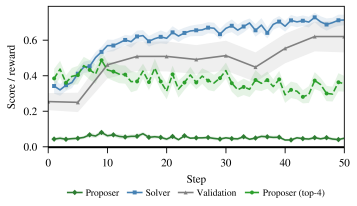
Figure 10 :Average and top-4proposer reward during TTSP training.TheProposercurve is the mean proposer reward over generated synthetic problems, whileProposer (top-4) averages the four highest proposer rewards at each step. The gap measures within-batch reward concentration. Solver reward and unfiltered target validation are shown for reference. Shaded bands denote±1 SEM across target problems.
원문 · CC BY 4.0 · Akira Yoshiyama, Akmal Ashirmatov, Jonas Hübotter, Ido Hakimi, Andreas Krause · Test-Time Self-Play: Scaling without a Verifier · 원문 그림 인용 · 원본 PDF 24쪽에서 그림 영역을 추출했습니다.두 어댑터는 모두 GRPO로 갱신되며 KL 정규화 계수는 0으로 둡니다. 원문은 이 설정을 Hübotter 등(2025)의 테스트 시점 적응 설정을 따른 것으로 밝힙니다.
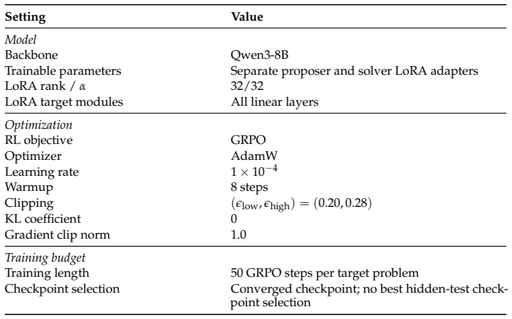
Table 6 :Core TTSP training hyperparameters.All values are fixed across target problems. The model is adapted per target through separate proposer and solver LoRA adapters, while the Qwen 3 8B backbone remains frozen.
원문 · CC BY 4.0 · Akira Yoshiyama, Akmal Ashirmatov, Jonas Hübotter, Ido Hakimi, Andreas Krause · Test-Time Self-Play: Scaling without a Verifier · 원문 그림 인용 · 원본 PDF 20쪽에서 그림 영역을 추출했습니다.검증기 강도별 평가 프로토콜
평가는 LiveCodeBench v6의 HardLCBv6 집합에서 이루어집니다. 이 집합은 Qwen3-8B의 mean@512가 0과 0.7 사이에 있는 대상 문제들로 정의되며, 이를 다시 0.1 초과 0.7 미만인 MidHardLCBv6와 0 초과 0.1 이하인 VeryHardLCBv6로 나눕니다. 각 방법은 대상 문제마다 여덟 개의 제출 후보를 내고, 평가 시점 검증기 v로 걸러낸 후보 집합의 v⋆ 통과 비율을 mean@8로 측정합니다. 검증기 조건은 v0, v25, v50, v75 같은 보정된 인공 검증기와 공개 테스트 vpub, 비공개 테스트 vpriv, 둘을 합친 v⋆로 구성됩니다.
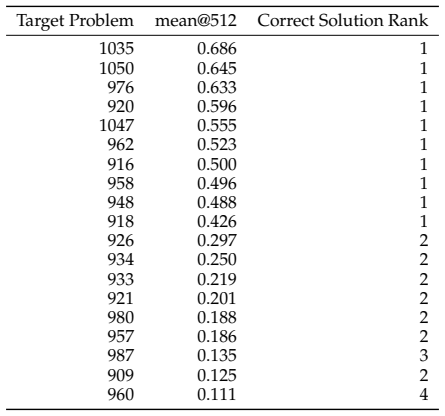
Table 3 :MidHardLCBv6 target problems.LiveCodeBench v6 target problem identifiers and base model mean@512 of Qwen 3 8B for each selected target problem in the MidHardLCBv6 subset (0.1<mean@512<0.7).
원문 · CC BY 4.0 · Akira Yoshiyama, Akmal Ashirmatov, Jonas Hübotter, Ido Hakimi, Andreas Krause · Test-Time Self-Play: Scaling without a Verifier · 원문 그림 인용 · 원본 PDF 16쪽에서 그림 영역을 추출했습니다.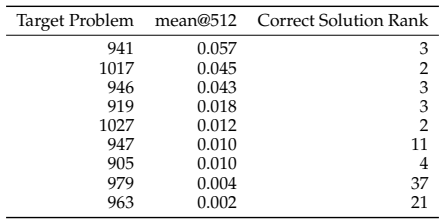
Table 4 :VeryHardLCBv6 target problems.LiveCodeBench v6 target problem identifiers and base model mean@512 of Qwen 3 8B for each selected target problem in the VeryHardLCBv6 subset (0<mean@512≤0.1).
원문 · CC BY 4.0 · Akira Yoshiyama, Akmal Ashirmatov, Jonas Hübotter, Ido Hakimi, Andreas Krause · Test-Time Self-Play: Scaling without a Verifier · 원문 그림 인용 · 원본 PDF 16쪽에서 그림 영역을 추출했습니다.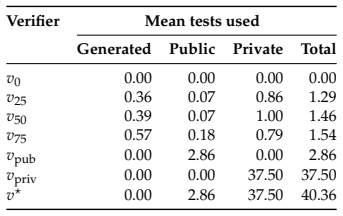
Table 5 :Tests used by each evaluation-time verifier on HardLCBv6.Values are averages over the 28 target problems and are grouped by test source.
원문 · CC BY 4.0 · Akira Yoshiyama, Akmal Ashirmatov, Jonas Hübotter, Ido Hakimi, Andreas Krause · Test-Time Self-Play: Scaling without a Verifier · 원문 그림 인용 · 원본 PDF 18쪽에서 그림 영역을 추출했습니다.검증기 v0은 모든 후보를 통과시키므로 필터링이 없는 조건입니다. 후보가 전혀 통과하지 못하는 경우에는 직전 체크포인트의 점수를 이어 쓰는 규칙을 적용하며, 이 규칙은 모든 방법에 같게 적용됩니다. 기준선은 거부 샘플링, 기능 다수결(FMV), ACE 문맥 최적화입니다.
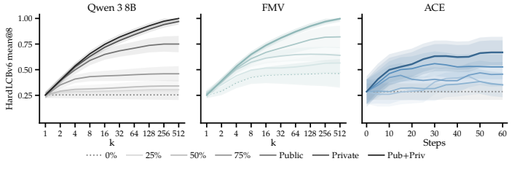
Figure 3 :Baselines performance on HardLCBv6 as compute scales.Each line reports the mean@8 with the indicated evaluation-time verifier applied to the validation problem submissions. Left and middle: Qwen 3 8B and FMV scale on the number of sampled rollouts k. Right: ACE scales on the number of generation–reflection–curation steps.
원문 · CC BY 4.0 · Akira Yoshiyama, Akmal Ashirmatov, Jonas Hübotter, Ido Hakimi, Andreas Krause · Test-Time Self-Play: Scaling without a Verifier · 원문 그림 인용 · 원본 PDF 7쪽에서 그림 영역을 추출했습니다.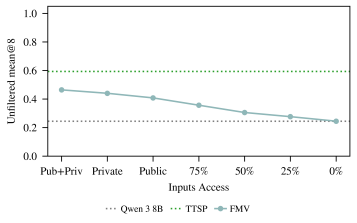
Figure 8 :FMV under partial test-input access on HardLCBv6.The final evaluation-time filter is removed, and all submitted candidates are scored directly against the public+private evaluator v⋆. The x-axis denotes the test inputs available to FMV for functional clustering, not a post-hoc verifier. TTSP and Qwen 3 8B are shown as unfiltered baselines independent of FMV’s input-access condition.
원문 · CC BY 4.0 · Akira Yoshiyama, Akmal Ashirmatov, Jonas Hübotter, Ido Hakimi, Andreas Krause · Test-Time Self-Play: Scaling without a Verifier · 원문 그림 인용 · 원본 PDF 22쪽에서 그림 영역을 추출했습니다.검증기 강도에 따른 결과
원문은 TTSP가 평가한 모든 검증기 강도에서 최고 성능을 보였다고 보고합니다. 검증기 제거 한계에서 mean@8은 35% 절대 향상됩니다. TTSP 곡선은 검증기 강도 전반에서 대체로 평탄하게 유지되는 반면, 기준선은 검증기가 약해질수록 하락하며 TTSP와의 차이가 벌어집니다. 저자들은 기준선이 선택, 군집화, 또는 보상 신호로 검증기에 의존하기 때문에 이런 차이가 생긴다고 해석합니다.
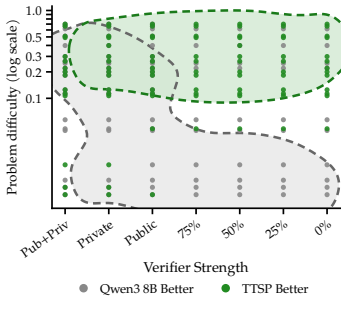
Figure 5 :Best performing method per prob- lem and verifier strength.Each point is a (target problem, verifier strength) pair, col- ored by the method with higher mean@8. The x-axis orders verifier strength and the y-axis reports problem difficulty, measured as the base policy’s mean@512.
원문 · CC BY 4.0 · Akira Yoshiyama, Akmal Ashirmatov, Jonas Hübotter, Ido Hakimi, Andreas Krause · Test-Time Self-Play: Scaling without a Verifier · 원문 그림 인용 · 원본 PDF 8쪽에서 그림 영역을 추출했습니다.학습 과정에서는 개선의 대부분이 처음 10 학습 단계 안에서 나타나고 이후 곡선은 체크포인트 간 잡음 범위에서 안정적이라고 보고됩니다. 이 결과는 HardLCBv6라는 특정 대상 집합과 Qwen3-8B 기반 설정에서 얻은 것입니다.
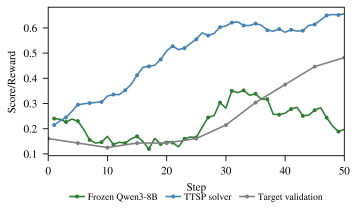
Figure 11 :Frozen-base and adapted-solver performance on generated synthetic problems. Example trajectory for one target problem.Frozen Qwen 3 8Bis the initial model evaluated on the synthetic problems generated at each step;TTSP solveris the adapted solver evaluated on the same synthetic problems;Target validationis the adapted solver’s unfiltered mean@8 on the original target problem underv 0.
원문 · CC BY 4.0 · Akira Yoshiyama, Akmal Ashirmatov, Jonas Hübotter, Ido Hakimi, Andreas Krause · Test-Time Self-Play: Scaling without a Verifier · 원문 그림 인용 · 원본 PDF 24쪽에서 그림 영역을 추출했습니다.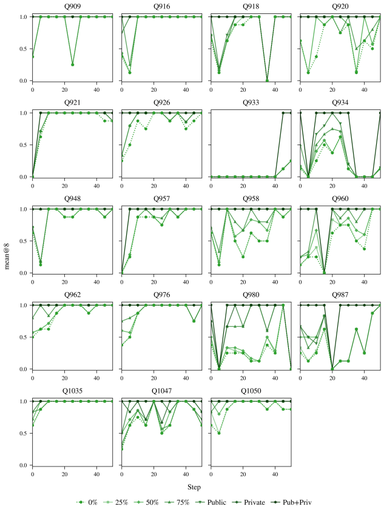
Figure 14 :Per-target TTSP training curves on MidHardLCBv6.Mean@8 over GRPO steps for each individual target problem, with one panel per target and one line per evaluation- time verifier strength. Many targets show the rapid rise within 10–20 steps and stable plateau seen in the aggregate curve of Figure 4.
원문 · CC BY 4.0 · Akira Yoshiyama, Akmal Ashirmatov, Jonas Hübotter, Ido Hakimi, Andreas Krause · Test-Time Self-Play: Scaling without a Verifier · 원문 그림 인용 · 원본 PDF 28쪽에서 그림 영역을 추출했습니다.적용 범위와 한계
TTSP는 기반 정책이 대상 문제의 정답을 일정 수준 생성할 수 있을 때에만 효과가 있습니다. MidHardLCBv6에서는 검증기가 약할수록 개선이 크게 나타나지만, VeryHardLCBv6에서는 개선이 거의 0으로 보고됩니다. 저자들은 기반 정답 생성률이 매우 낮으면 제안자가 대상 문제로 되돌아오는 학습 과정을 만들 수 없다고 해석합니다.
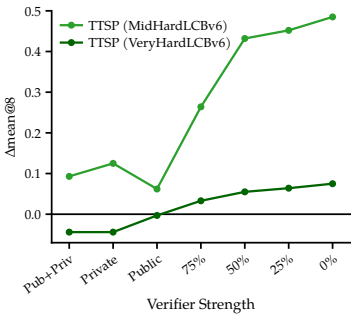
Figure 7 :Difference in mean@8 between TTSP and Qwen3-8B.The gap is large and positive on MidHardLCBv6 as the verifier weakens. On VeryHardLCBv6, the gap is near zero: only marginally positive under the weakest verifiers.
원문 · CC BY 4.0 · Akira Yoshiyama, Akmal Ashirmatov, Jonas Hübotter, Ido Hakimi, Andreas Krause · Test-Time Self-Play: Scaling without a Verifier · 원문 그림 인용 · 원본 PDF 10쪽에서 그림 영역을 추출했습니다.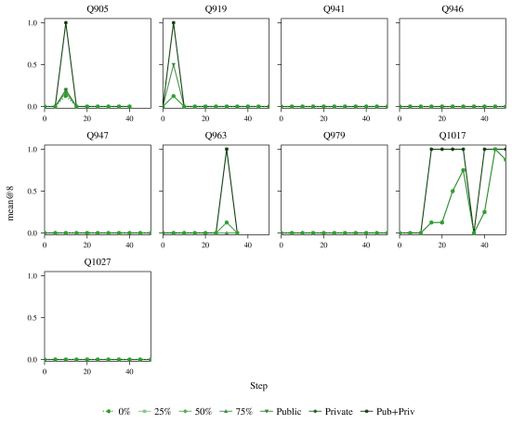
Figure 16 :Per-target TTSP training curves on VeryHardLCBv6.Mean@8 over GRPO steps for each individual target problem, with one panel per target and one line per evaluation- time verifier strength. The flat or noisy curves illustrate the discovery-side failure mode discussed in Section 5.4 when base coverage is below mean@512≈0.1.
원문 · CC BY 4.0 · Akira Yoshiyama, Akmal Ashirmatov, Jonas Hübotter, Ido Hakimi, Andreas Krause · Test-Time Self-Play: Scaling without a Verifier · 원문 그림 인용 · 원본 PDF 30쪽에서 그림 영역을 추출했습니다.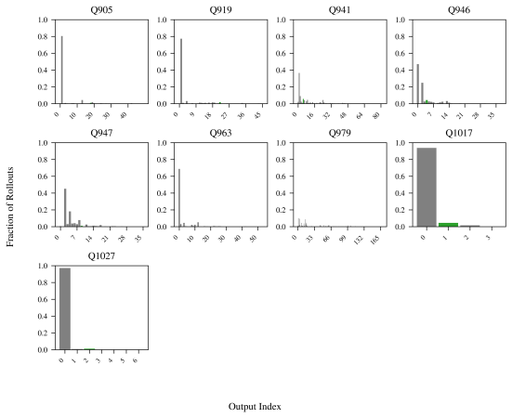
Figure 17 :Functional output clusters for VeryHardLCBv6.Qwen 3 8B functional output cluster distribution for each target problem in VeryHardLCBv6. Each panel shows, for one target, the fraction of 512 base rollouts whose execution traces fall into each functional cluster, with the correct cluster highlighted in green. The correct cluster typically carries negligible mass, matching the discovery-regime characterization in Figure 7.
원문 · CC BY 4.0 · Akira Yoshiyama, Akmal Ashirmatov, Jonas Hübotter, Ido Hakimi, Andreas Krause · Test-Time Self-Play: Scaling without a Verifier · 원문 그림 인용 · 원본 PDF 30쪽에서 그림 영역을 추출했습니다.또한 TTSP는 자기 생성 내용만으로 학습 신호를 얻기 때문에 제안자가 보상 함수를 악용하거나 solver의 엔트로피가 줄어드는 문제를 감시해야 합니다. 이 논문은 대상마다 별도로 적응하므로 여러 대상 사이에서 계산을 나누어 쓰지는 않습니다. 원문의 한계는 이 실험 범위에 한정되며 다른 도메인에서의 성능은 별도로 확인해야 합니다.
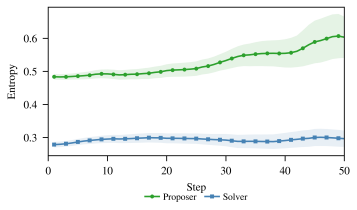
Figure 12 :Policy entropy during TTSP training.Mean proposer-policy and solver-policy entropy across GRPO steps on HardLCBv6, averaged over target problems. The proposer entropy increases over training, while solver entropy remains stable. Shaded regions show variation across target problems. Shaded bands denote±1 SEM across target problems.
원문 · CC BY 4.0 · Akira Yoshiyama, Akmal Ashirmatov, Jonas Hübotter, Ido Hakimi, Andreas Krause · Test-Time Self-Play: Scaling without a Verifier · 원문 그림 인용 · 원본 PDF 25쪽에서 그림 영역을 추출했습니다.논문 정보
- 저자
- Akira Yoshiyama, Akmal Ashirmatov, Jonas Hübotter, Ido Hakimi, Andreas Krause
- 학회·저널
- arXiv · 프리프린트
- 최초 공개일
- 2026년 11월 5일
- 등록일
- 2026년 11월 6일
- 수정일
- 2026년 11월 5일
- 버전
- v1
- arXiv
- 2611.07367
- 분류
- cs.LG · cs.AI
- 원문 이용 조건
- CC BY 4.0
- 제공 범위
- 논문 정보, 해설, 허용된 원문 그림
AI 해설은 논문 원문과 별개의 설명이며 오류가 있을 수 있습니다. 원문과 그림은 각 출처의 이용 조건과 따로 표시된 권리를 따릅니다.
초록
Test-time scaling methods spend additional compute at deployment to improve a large language model's performance on a hard target problem. Most methods rely on a verifier that scores candidate solutions for correctness, using it to select among or refine the model's outputs. In many deployment regimes, however, a strong verifier on the target problem is unavailable. We introduce Test-Time Self-Play (TTSP), an approach to test-time scaling using asymmetric self-play without reliance on a verifier. On a difficulty-calibrated subset of LiveCodeBench v6, TTSP is the best-performing method at every verifier strength we evaluate, and the gap to the strongest baseline widens as the verifier weakens; in the no-verifier limit, TTSP yields a 35\% absolute improvement in mean@8. The gains hold across a range of verifier strengths, except when the base policy has near-zero coverage of the correct answer.
원문 인용
Akira Yoshiyama, Akmal Ashirmatov, Jonas Hübotter, Ido Hakimi, Andreas Krause (2026). Test-Time Self-Play: Scaling without a Verifier. arXiv:2611.07367v1. https://arxiv.org/abs/2611.07367v1
BibTeX
@misc{yoshiyama2026test,
  title = {{Test-Time Self-Play: Scaling without a Verifier}},
  author = {Akira Yoshiyama and Akmal Ashirmatov and Jonas Hübotter and Ido Hakimi and Andreas Krause},
  year = {2026},
  eprint = {2611.07367},
  archivePrefix = {arXiv},
  url = {https://arxiv.org/abs/2611.07367v1}
}