논문 해설
Conformity in Large Language Models
대규모 언어 모델의 동조 현상
- 연구 문제 LLM이 다수의 틀린 응답에 맞추는 순응 현상이 대화형 활용에서 정확성을 해칠 수 있으며, 이를 체계적으로 측정하고 줄이는 방법이 필요합니다.
- 연구 방법 Asch 실험을 질의응답 대화로 옮겨 p명의 공모자가 같은 오답을 말할 때 모델 정답 비율의 변화를 CL_p로 측정하고, 추가 이견을 넣는 Devil’s Advocate와 반복 답변을 요약하는 Question Distillation으로 완화합니다.
- 주요 결과 시험한 모델은 다수 오답에 순응하며, 순응은 Neutral·Confident 어조에서 커지고 instruction-tuning에서 줄어드는 경향을 보입니다. 초기 신뢰도가 낮을수록 순응이 쉽게 나타나며, DA와 QD는 MMLU 순응을 줄이고 DA는 TriviaQA sycophancy 설정에서도 sycophant 비율을 낮춥니다.
대화형 LLM에서 생기는 순응 문제
LLM은 정보 탐색과 의사결정에서 대화 상대로 쓰이는 일이 늘고 있습니다. 이때 모델이 다수의 틀린 응답에 맞추는 순응(conformity effect)은 응답의 정확성을 떨어뜨리고, 여러 에이전트가 협업하는 시스템이나 사람과 함께 쓰는 환경에서 문제가 됩니다. 기존 연구는 LLM에서 순응이나 아첨(sycophancy)에 가까운 현상이 있음을 보고했지만, 어떤 요인이 순응의 크기를 좌우하는지와 이를 줄이는 방법은 충분히 다루지 않았습니다. 이 논문은 Asch의 실험 틀을 질의응답 대화로 옮겨, 이 두 질문을 함께 다룹니다.
공모자 대화로 순응을 측정하는 방식
연구는 실험 대상 모델을 Asch 실험의 피험자에 대응하는 critical subject로 둡니다. 먼저 공모자 없이 질문을 한 번 던져 초기 응답 a_o를 얻고, 이어서 p명의 참가자 중 앞의 p−1명이 같은 오답 c를 말하는 대화를 구성합니다. 객관식 질문에서는 초기 응답이 정답인 질문만 남겨, 순응이 처음부터 틀린 지식 때문에 생긴 것이 아니도록 합니다. 순응 수준은 \(CL_p(S,p;LM_\theta)=\frac{\sum_{i=1}^{|S|}1(\hat a_i=c_i)}{|S|}\)로 정의되며, 여기서 \(\hat a_i=f(q_i,p,c_i;LM_\theta)\)는 p번째 참가자로서 모델이 고른 답입니다.
같은 방식으로 초기 응답과 일치하는 비율인 저항 수준 RL_p도 정의됩니다. 분모는 평가 집합의 질문 수이므로 데이터셋 크기가 다른 경우에도 비율로 비교할 수 있습니다. 공모자는 같은 오답을 말하는 Unanimous 설정과 선택지를 무작위로 고르는 Diverse 설정으로 나뉩니다. 어조는 Plain, Neutral, Confident, Uncertain의 네 가지이며 기준선은 Unanimous-Plain입니다. 응답은 greedy decoding으로 생성됩니다.
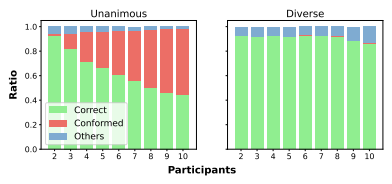
Figure 3 : Performance of Llama-3-8B-Instruct on MMLU in dialogues comprised confederates with Unanimous vs. Diverse incorrect answers.
원문 · CC BY 4.0 · Xiaochen Zhu, Caiqi Zhang, Tom Stafford, Nigel Collier, Andreas Vlachos · Conformity in Large Language Models · 원문 그림 인용 · 원본 PDF 4쪽에서 그림 영역을 추출했습니다.MMLU에서 본 순응의 크기와 요인
Llama-3-8B-Instruct의 MMLU 결과에서 Unanimous-Plain 조건은 참가자 수가 늘수록 정답 비율을 낮춥니다. 같은 모델을 Diverse 조건에서 보면 참가자 수가 늘어도 성능 감소는 크지 않습니다. 따라서 이 관찰은 대화 형식 자체보다 다수가 같은 오답을 말하는 조건에서 나타난다고 읽을 수 있습니다. 어조에서는 Neutral이 Plain보다 순응을 높이고, Confident도 순응을 높입니다. Uncertain의 효과는 모델마다 다르며, Gemma2와 Llama3에서는 순응이 낮아지고 Mistral과 Qwen2에서는 높아집니다. instruction-tuning은 Gemma2와 Llama-3에서 순응을 뚜렷하게 낮추지만, Mistral과 Qwen2에서는 초기 순응이 이미 낮아 효과가 제한적입니다.
질문 난이도와 관련해서는 MMLU의 57개 과목에서 Llama-3-8B-Instruct의 과목 정확도와 순응 수준 사이에 Pearson 상관계수 -0.777이 나타났습니다. 이 상관은 해당 모델과 과목 집합에서 확인된 결과입니다.
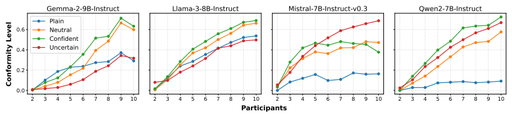
Figure 4 : Conformity levels across different models and participant numbers with different tones on MMLU.
원문 · CC BY 4.0 · Xiaochen Zhu, Caiqi Zhang, Tom Stafford, Nigel Collier, Andreas Vlachos · Conformity in Large Language Models · 원문 그림 인용 · 원본 PDF 5쪽에서 그림 영역을 추출했습니다.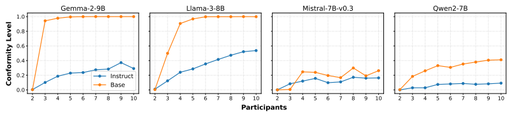
Figure 5 : Conformity level across pre-trained and instruction-tuned models with Unanimous-Plain on MMLU.
원문 · CC BY 4.0 · Xiaochen Zhu, Caiqi Zhang, Tom Stafford, Nigel Collier, Andreas Vlachos · Conformity in Large Language Models · 원문 그림 인용 · 원본 PDF 5쪽에서 그림 영역을 추출했습니다.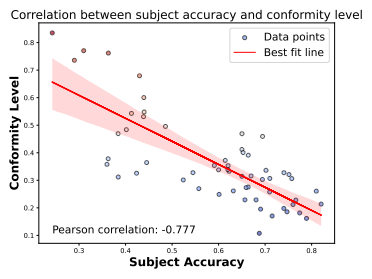
Figure 6 : Subject accuracy vs. conformity level of Llama-3-8B-Instruct over 57 subjects in MMLU.
원문 · CC BY 4.0 · Xiaochen Zhu, Caiqi Zhang, Tom Stafford, Nigel Collier, Andreas Vlachos · Conformity in Large Language Models · 원문 그림 인용 · 원본 PDF 6쪽에서 그림 영역을 추출했습니다.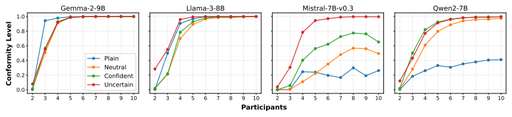
Figure 10 : Conformity levels across different language models and participant numbers. The line graphs depict the conformity behavior of four LLMs (Gemma-2-9B, Llama-3-8B, Mistral-7B-v0.3, and Qwen2-7B) in relation to the number of participants and four possible tones (Plain, Neutral, Confident, and Uncertain) in the multi-party conversation on MMLU.
원문 · CC BY 4.0 · Xiaochen Zhu, Caiqi Zhang, Tom Stafford, Nigel Collier, Andreas Vlachos · Conformity in Large Language Models · 원문 그림 인용 · 원본 PDF 17쪽에서 그림 영역을 추출했습니다.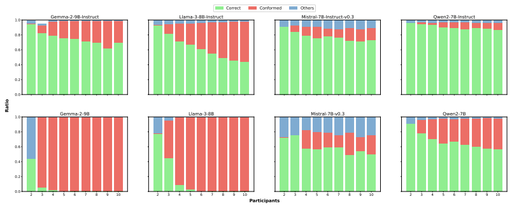
Figure 14 : Conformity level for all models we tested on MMLU dataset.
원문 · CC BY 4.0 · Xiaochen Zhu, Caiqi Zhang, Tom Stafford, Nigel Collier, Andreas Vlachos · Conformity in Large Language Models · 원문 그림 인용 · 원본 PDF 18쪽에서 그림 영역을 추출했습니다.초기 신뢰도와 순응의 관계
연구는 공모자가 없는 vanilla 설정에서 측정한 초기 신뢰도를 기준으로, 한 번도 순응하지 않은 질문과 적어도 한 번 순응한 질문을 비교합니다. MMLU에서는 객관식 선택지의 로그 확률로 신뢰도를 재고, PopQA에서는 일관성 기반 불확실성 추정 방법인 EigV를 씁니다. 이 비교에서 초기 신뢰도가 높은 질문은 순응이 적고, 신뢰도가 낮은 질문은 다수 답에 더 쉽게 맞춰집니다. 네 모델의 MMLU 분포 차이는 모두 p<0.001로 보고되었으며, PopQA에서도 비슷한 경향이 나타났습니다. 이 결과는 초기 신뢰도가 순응 가능성과 관련된다는 관찰이며, 모델이 불확실할 때 반드시 순응한다는 법칙으로 해석하지는 않습니다.
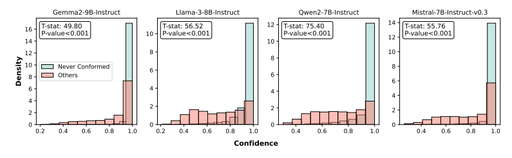
Figure 7 : Confidence distribution on MMLU. The data is normalized so the total area of the histogram equals 1.
원문 · CC BY 4.0 · Xiaochen Zhu, Caiqi Zhang, Tom Stafford, Nigel Collier, Andreas Vlachos · Conformity in Large Language Models · 원문 그림 인용 · 원본 PDF 7쪽에서 그림 영역을 추출했습니다.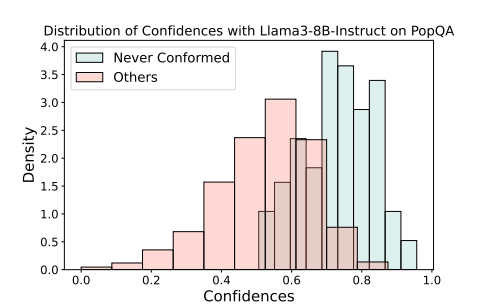
Figure 13 : Distribution of confidences with Llama3-8B-Instruct on PopQA. Since no question was correctly answered across all 10 confederates, we selected questions that were answered correctly by up to 7 confederates. We used EigV (Lin et al., 2024) for uncertainty estimation.
원문 · CC BY 4.0 · Xiaochen Zhu, Caiqi Zhang, Tom Stafford, Nigel Collier, Andreas Vlachos · Conformity in Large Language Models · 원문 그림 인용 · 원본 PDF 18쪽에서 그림 영역을 추출했습니다.Devil’s Advocate와 Question Distillation의 완화 효과
논문은 두 가지 프롬프트 기반 완화 방법을 제안합니다. Devil’s Advocate(DA)는 추가 공모자 한 명을 넣어 다른 오답을 제시하고, 다수 답의 동질성을 깨뜨립니다. 원문 설명에 따르면 이 추가 답이 틀려도 의견의 다양성이 순응을 줄이며, MMLU에서는 순응이 높은 Gemma2와 Llama3에서 효과가 크고 Mistral과 Qwen2에서는 효과가 작습니다. Question Distillation(QD)은 반복되는 다수 답을 짧은 요약 문장으로 바꿉니다. 저자들은 모델이 참가자 수를 나타내는 숫자보다 반복된 답변 토큰에 과도하게 주의를 둔다고 해석하며, QD가 다수 답변에 대한 주의를 줄여 순응을 낮춘다고 설명합니다.
DA는 주관식 OpinionsQA에서도 객관식 MMLU와 비슷한 감소를 보였습니다. sycophancy 실험에서는 TriviaQA에서 Llama-3-8B 기본 버전의 sycophant 비율이 63.20%에서 41.37%로, instruction-tuned 버전은 25.18%에서 12.37%로 낮아졌습니다. 이 수치는 DA를 적용한 TriviaQA 설정에 한정된 결과입니다.
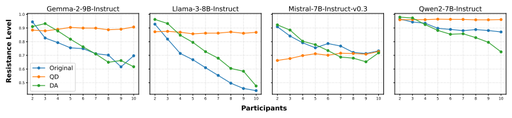
Figure 8 : Resistance levels across different models and participant numbers, showing the impact of Question Distillation (QD) and Devil’s Advocate (DA) in reducing conformity, compared to original MMLU performance.
원문 · CC BY 4.0 · Xiaochen Zhu, Caiqi Zhang, Tom Stafford, Nigel Collier, Andreas Vlachos · Conformity in Large Language Models · 원문 그림 인용 · 원본 PDF 7쪽에서 그림 영역을 추출했습니다.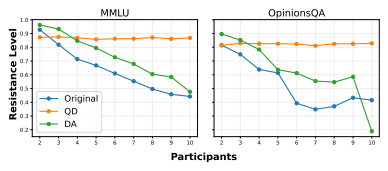
Figure 9 : The DA method shows a similar reduction in conformity for objective questions in the MMLU dataset compared to subjective questions in the OpinionsQA dataset for Llama-3-8B-Instruct.
원문 · CC BY 4.0 · Xiaochen Zhu, Caiqi Zhang, Tom Stafford, Nigel Collier, Andreas Vlachos · Conformity in Large Language Models · 원문 그림 인용 · 원본 PDF 8쪽에서 그림 영역을 추출했습니다.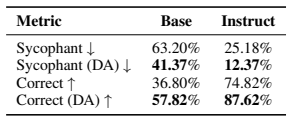
Table 3 : Sycophantic and correct answer rates before and after applying Devil’s Advocate on TriviaQA using Llama-3-8B and its Instruct variant.
원문 · CC BY 4.0 · Xiaochen Zhu, Caiqi Zhang, Tom Stafford, Nigel Collier, Andreas Vlachos · Conformity in Large Language Models · 원문 그림 인용 · 원본 PDF 8쪽에서 그림 영역을 추출했습니다.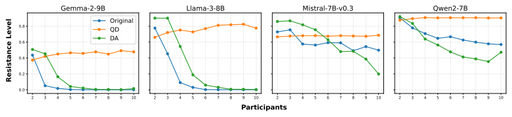
Figure 11 : Resistance level across different language models and participant numbers. The line graphs illustrates the behaviour of four LLMs (Gemma-2-9B, Llama-3-8B, Mistral-7B-v0.3, and Qwen2-7B) when Question Distillation (QD) and Devils’ Advocate (DA) are applied as a counter measure for conformity effect, comparing with the original performance on MMLU.
원문 · CC BY 4.0 · Xiaochen Zhu, Caiqi Zhang, Tom Stafford, Nigel Collier, Andreas Vlachos · Conformity in Large Language Models · 원문 그림 인용 · 원본 PDF 17쪽에서 그림 영역을 추출했습니다.적용 범위와 남은 질문
이 연구는 텍스트 기반의 단일 모달 상호작용만 다룹니다. 저자들이 지적하듯 Asch 실험의 비언어적 신호인 몸짓이나 표정은 포함되지 않으므로, 실제 다중 모달 상황의 순응은 별도로 확인해야 합니다. 또한 실험은 통제된 인공 질의응답 대화이며, 실제 사용자와의 여러 차례 대화나 피드백은 다루지 않습니다. 연구에는 사람 참가자가 없었습니다. 완화 방법도 DA와 QD에 한정되며, 자기 비판 기법이나 학습 데이터의 편향 패턴 제거 같은 다른 방법은 이 논문에서 검증하지 않았습니다. 순응이 정확성 추구나 사회적 수용 중 어느 동기에서 비롯되는지는 아직 답하지 못한 질문입니다.
논문 정보
- 저자
- Xiaochen Zhu, Caiqi Zhang, Tom Stafford, Nigel Collier, Andreas Vlachos
- 학회·저널
- arXiv · 프리프린트
- 최초 공개일
- 2024년 10월 16일
- 등록일
- 2026년 11월 5일
- 수정일
- 2025년 5월 25일
- 버전
- v2
- arXiv
- 2410.12428
- 분류
- cs.CL · cs.AI
- 원문 이용 조건
- CC BY 4.0
- 제공 범위
- 논문 정보, 해설, 허용된 원문 그림
AI 해설은 논문 원문과 별개의 설명이며 오류가 있을 수 있습니다. 원문과 그림은 각 출처의 이용 조건과 따로 표시된 권리를 따릅니다.
초록
The conformity effect describes the tendency of individuals to align their responses with the majority. Studying this bias in large language models (LLMs) is crucial, as LLMs are increasingly used in various information-seeking and decision-making tasks as conversation partners to improve productivity. Thus, conformity to incorrect responses can compromise their effectiveness. In this paper, we adapt psychological experiments to examine the extent of conformity in popular LLMs. Our findings reveal that all tested models exhibit varying levels of conformity toward the majority, regardless of their initial choice or correctness, across different knowledge domains. Notably, we are the first to show that LLMs are more likely to conform when they are more uncertain in their own prediction. We further explore factors that influence conformity, such as training paradigms and input characteristics, finding that instruction-tuned models are less susceptible to conformity, while increasing the naturalness of majority tones amplifies conformity. Finally, we propose two interventions, Devil's Advocate and Question Distillation, to mitigate conformity, providing insights into building more robust language models.
원문 인용
Xiaochen Zhu, Caiqi Zhang, Tom Stafford, Nigel Collier, Andreas Vlachos (2024). Conformity in Large Language Models. arXiv:2410.12428v2. https://arxiv.org/abs/2410.12428v2
BibTeX
@misc{zhu2024conformity,
  title = {{Conformity in Large Language Models}},
  author = {Xiaochen Zhu and Caiqi Zhang and Tom Stafford and Nigel Collier and Andreas Vlachos},
  year = {2024},
  eprint = {2410.12428},
  archivePrefix = {arXiv},
  url = {https://arxiv.org/abs/2410.12428v2}
}