논문 해설
EmbodiedLab: Benchmarking Embodied Agents That Act to Know
EmbodiedLab: 알기 위해 행동하는 구체화된 에이전트 벤치마킹
- 연구 문제 에이전트가 목표를 받지만 해답을 받지 않은 상태에서 물리 시스템을 조작해 측정값을 얻고 결과를 알아내야 하는 능력을 평가하는 문제입니다.
- 연구 방법 정량 과학 실험 30개를 시뮬레이션 실험실에 구현하고, 세 단계 인터페이스에서 에이전트가 코드로 장비를 조작하도록 합니다.
- 주요 결과 T0에서 Claude Opus 5.5가 43.3%, GPT-6 Astra가 40.0%의 성공률을 보였으며, 대부분의 실패는 장비와의 상호작용에서 나타났습니다.
문제 설정: 알기 위해 행동하기
기존 조작 벤치마크는 목표 상태가 주어진 상태에서 로봇이 그 상태에 도달하는지를 평가합니다. 반대로 과학 발견 벤치마크는 실험을 텍스트 명령이나 정확한 질의로 바꾸어 물리적 행동 없이 정보를 얻습니다. EmbodiedLab은 두 방식의 중간에 놓인 문제를 다룹니다. 에이전트는 목표를 받지만 그 목표를 만족하는 상태나 답은 받지 않으며, 물리 시스템의 상태를 바꾸고 계기의 피드백을 읽어 무엇을 알아내야 하는지 스스로 정해야 합니다. 이 연구는 이러한 행위를 acting to know라고 부르고, 정량 과학 실험을 통해 통제 가능한 평가 장으로 만듭니다.
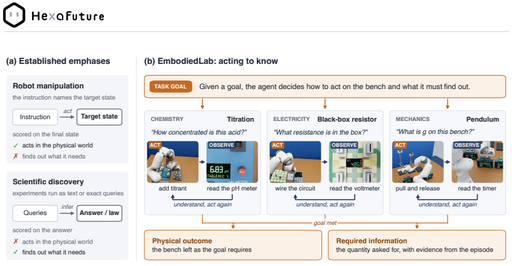
Figure 2 .Acting to know.(a) Manipulation benchmarks stop at acting to change the scene into a named target state; science benchmarks find things out without physical action. (b) Given a goal, a EmbodiedLab agent changes the state of the apparatus through interaction, observes the feedback and acts again on what it learned, in the same loop across disciplines; at submission, what it found out, the evidence it recorded and the bench state are scored.
원문 · CC BY 4.0 · Hongcheng Gao, Zelin Zheng, Alex Zhou, Jay Zhu, Shijia Ge, Yazhe Wang, Xiping Li, Jianshu Zeng, Di Wu, Xuan Shangguan, Yexing Wan, Lingyu He, Yongli Wang, Xiaohan Yu, Zhiqi Jia, Yue Liu, Bryan Hooi, Yinpeng Dong, Wentao Zhang, Sihang Wu, Xiao He · EmbodiedLab: Benchmarking Embodied Agents That Act to Know · 원문 그림 인용 · 원본 PDF 2쪽에서 그림 영역을 추출했습니다.핵심 질문은 이 능력을 벤치마크로 측정할 수 있는지, 그리고 실패가 어디에서 생기는지입니다. 저자들은 실험마다 숨겨진 파라미터를 인스턴스마다 새로 뽑기 때문에 결과를 미리 알 수 없지만 정확하게 채점할 수 있다고 설명합니다.
벤치마크 구성과 인터페이스 수준
EmbodiedLab은 열역학, 전기, 광학, 역학, 화학 다섯 분야의 30개 정량 실험을 14개 장치 플랫폼에서 제공합니다. 로봇 팔과 두 손가락 그리퍼가 세 대의 카메라 영상을 보며 장비를 조작하고, 계기의 눈금과 디스플레이를 읽습니다. 과제 카드에는 목표와 규칙이 있지만 방법은 없습니다.
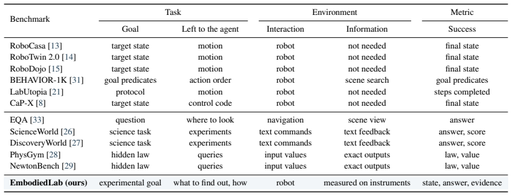
Table 1 .What a task hands to the agent, along task, environment and metric.
원문 · CC BY 4.0 · Hongcheng Gao, Zelin Zheng, Alex Zhou, Jay Zhu, Shijia Ge, Yazhe Wang, Xiping Li, Jianshu Zeng, Di Wu, Xuan Shangguan, Yexing Wan, Lingyu He, Yongli Wang, Xiaohan Yu, Zhiqi Jia, Yue Liu, Bryan Hooi, Yinpeng Dong, Wentao Zhang, Sihang Wu, Xiao He · EmbodiedLab: Benchmarking Embodied Agents That Act to Know · 원문 그림 인용 · 원본 PDF 4쪽에서 그림 영역을 추출했습니다.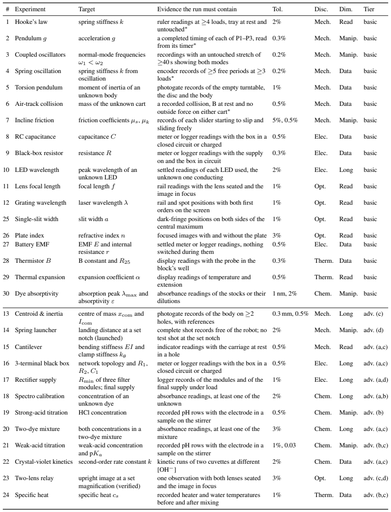
Table 6 .The 30 experiments.Tol.: tolerance, relative unless a unit is given; Dim.: primary capability dimension. Letters mark the decisions an advanced experiment requires (Sec. B): (a) choosing the conditions, (b) sequential design, (c) model identification, (d) acting on the result. Evidence: what a run must contain beyond readings cited from its own episode that match the instrument; ∗: the result must also agree with the evaluator’s refit of the cited readings.
원문 · CC BY 4.0 · Hongcheng Gao, Zelin Zheng, Alex Zhou, Jay Zhu, Shijia Ge, Yazhe Wang, Xiping Li, Jianshu Zeng, Di Wu, Xuan Shangguan, Yexing Wan, Lingyu He, Yongli Wang, Xiaohan Yu, Zhiqi Jia, Yue Liu, Bryan Hooi, Yinpeng Dong, Wentao Zhang, Sihang Wu, Xiao He · EmbodiedLab: Benchmarking Embodied Agents That Act to Know · 원문 그림 인용 · 원본 PDF 15쪽에서 그림 영역을 추출했습니다.인터페이스는 세 단계로 중첩됩니다. T0는 카메라 영상, 로봇 상태, 관절 제어를 제공하며 평가 수준입니다. T1은 실제 깊이 정보로 마스크된 픽셀의 3차원 점을 주고, cuRobo로 충돌을 피하는 손 동작 계획을 추가합니다. T2는 강한 에이전트의 성공 실행에서 증류한 조작 기술을 더하며, 진단용 수준이라 공개 프로토콜에는 포함되지 않습니다. 이 구조 덕분에 수준을 바꾸었을 때의 성공률 변화로 실패가 행동 실행 쪽에 얼마나 있는지 가늠할 수 있습니다.
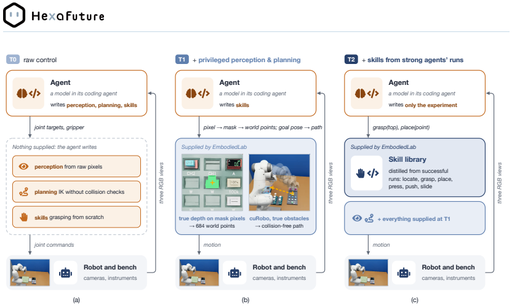
Figure 4 .Interface levels.Robot, bench and camera views are the same at every level; each level supplies more between the agent and the robot. (a) T0 supplies only the camera images, the robot state, joint position targets and gripper commands. (b) T1 supplies ground-truth depth on segmentation masks and cuRobo [41] planning against the true obstacles, shown with real outputs of T1 runs. (c) T2 adds a skill library, distilled from the successful runs of the strongest agents, in the agent’s workspace.
원문 · CC BY 4.0 · Hongcheng Gao, Zelin Zheng, Alex Zhou, Jay Zhu, Shijia Ge, Yazhe Wang, Xiping Li, Jianshu Zeng, Di Wu, Xuan Shangguan, Yexing Wan, Lingyu He, Yongli Wang, Xiaohan Yu, Zhiqi Jia, Yue Liu, Bryan Hooi, Yinpeng Dong, Wentao Zhang, Sihang Wu, Xiao He · EmbodiedLab: Benchmarking Embodied Agents That Act to Know · 원문 그림 인용 · 원본 PDF 6쪽에서 그림 영역을 추출했습니다.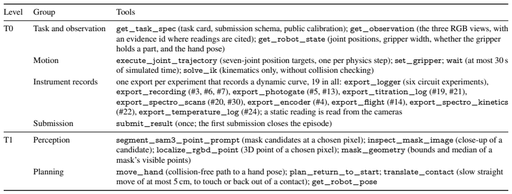
Table 8 .Public toolsby group and level. T2 adds no tools: its skills are code in the agent’s workspace that calls the T1 tools.
원문 · CC BY 4.0 · Hongcheng Gao, Zelin Zheng, Alex Zhou, Jay Zhu, Shijia Ge, Yazhe Wang, Xiping Li, Jianshu Zeng, Di Wu, Xuan Shangguan, Yexing Wan, Lingyu He, Yongli Wang, Xiaohan Yu, Zhiqi Jia, Yue Liu, Bryan Hooi, Yinpeng Dong, Wentao Zhang, Sihang Wu, Xiao He · EmbodiedLab: Benchmarking Embodied Agents That Act to Know · 원문 그림 인용 · 원본 PDF 17쪽에서 그림 영역을 추출했습니다.채점 방식과 성공 기준
실행이 끝나 제출되면 환경은 기록을 봉인하고 오차 e를 계산합니다. e는 각 양의 추정값과 목표값의 차이를 허용 오차 ϵj로 나눈 값 중 최댓값이며, 성공 여부는 게이트 G가 모두 만족되고 e가 1 이하일 때로 정해집니다. 게이트는 인용된 측정값이 같은 에피소드에서 나왔는지, 측정 조건이 지켜졌는지, 장비가 원래 위치로 복구되었는지를 확인합니다.
실패한 실행의 진행 정도는 마일스톤 L1부터 L6까지로 나타냅니다. 과정 점수는 L1부터 L4까지 각 10점, L5와 L6은 각 30점으로 가중합니다. 성공률 SR(X)은 각 실험 안에서 실행을 먼저 평균하고 실험들을 같은 가중치로 평균하므로, 실행 수가 다른 실험이 결과를 왜곡하지 않습니다.
주요 결과와 단계별 실패 위치
T0에서 Claude Opus 5.5는 43.3%, GPT-6 Astra는 40.0%의 성공률을 보였습니다. 나머지 에이전트는 최대 28.3%였습니다. 이 결과는 가장 강한 에이전트도 절반을 넘기지 못했다는 뜻이며, 측정된 실험과 인터페이스 조건 안에서만 해석해야 합니다.
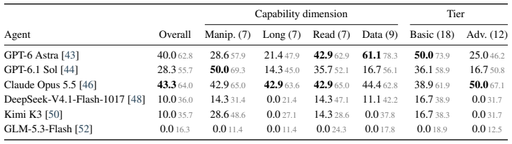
Table 2 .Main results at T0.Success rate (%) with the process score (0–100) in grey, overall and per capability dimension and tier; numbers of experiments in parentheses; best success rate in bold.
원문 · CC BY 4.0 · Hongcheng Gao, Zelin Zheng, Alex Zhou, Jay Zhu, Shijia Ge, Yazhe Wang, Xiping Li, Jianshu Zeng, Di Wu, Xuan Shangguan, Yexing Wan, Lingyu He, Yongli Wang, Xiaohan Yu, Zhiqi Jia, Yue Liu, Bryan Hooi, Yinpeng Dong, Wentao Zhang, Sihang Wu, Xiao He · EmbodiedLab: Benchmarking Embodied Agents That Act to Know · 원문 그림 인용 · 원본 PDF 8쪽에서 그림 영역을 추출했습니다.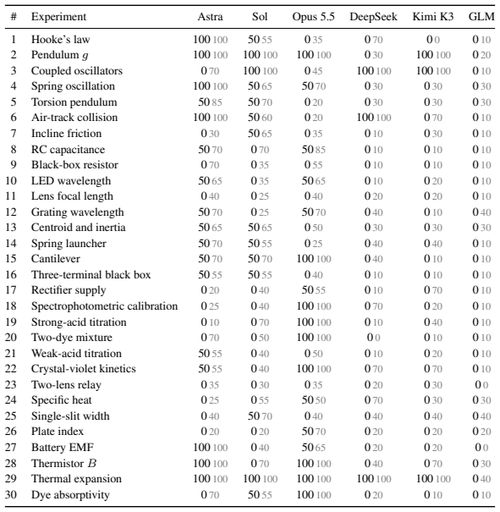
Table 9 .Per-experiment success at T0(%), with the process score in grey, each averaged over the runs of the experiment.
원문 · CC BY 4.0 · Hongcheng Gao, Zelin Zheng, Alex Zhou, Jay Zhu, Shijia Ge, Yazhe Wang, Xiping Li, Jianshu Zeng, Di Wu, Xuan Shangguan, Yexing Wan, Lingyu He, Yongli Wang, Xiaohan Yu, Zhiqi Jia, Yue Liu, Bryan Hooi, Yinpeng Dong, Wentao Zhang, Sihang Wu, Xiao He · EmbodiedLab: Benchmarking Embodied Agents That Act to Know · 원문 그림 인용 · 원본 PDF 18쪽에서 그림 영역을 추출했습니다.단계별 분석에서 가장 강한 세 에이전트는 측정 가능한 상태에 도달하는 단계(L1–L4)를 대체로 통과했지만, 결과를 허용 오차 안에서 알아내는 단계(L5)와 장비를 복구하는 단계(L6)에서 실패가 많이 나타났습니다. 반면 나머지 에이전트는 측정값이 충분해지기 전에 많이 멈추었습니다.
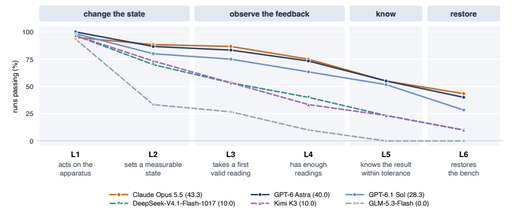
Figure 6 .Where runs stop at T0.Share of runs that pass each milestone, per agent, averaged as in Eq. (4); the last point is the success rate, given in brackets in the legend below, and the steepest segment of a curve is the stage where the agent loses most runs. L1–L2 change the state of the apparatus, L3–L4 observe the feedback until the readings suffice, L5 knows the result within tolerance and L6 restores the bench.
원문 · CC BY 4.0 · Hongcheng Gao, Zelin Zheng, Alex Zhou, Jay Zhu, Shijia Ge, Yazhe Wang, Xiping Li, Jianshu Zeng, Di Wu, Xuan Shangguan, Yexing Wan, Lingyu He, Yongli Wang, Xiaohan Yu, Zhiqi Jia, Yue Liu, Bryan Hooi, Yinpeng Dong, Wentao Zhang, Sihang Wu, Xiao He · EmbodiedLab: Benchmarking Embodied Agents That Act to Know · 원문 그림 인용 · 원본 PDF 8쪽에서 그림 영역을 추출했습니다.수준 비교에서 T1의 인식과 계획 추가는 성공률을 최대 10점 바꾸었습니다. T2의 조작 기술 추가는 약한 에이전트의 성공률을 10.0에서 26.7점 높였지만, 기술을 받은 에이전트들도 강한 에이전트의 T1 수준에 도달하지 못했습니다.
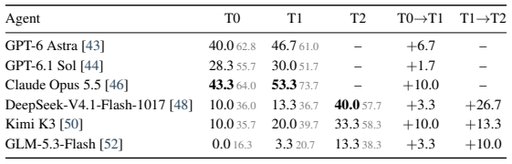
Table 3 .Success across levels: success rate (%) with the process score (0–100) in grey, and the change in success rate in percentage points. T2 skills are distilled from the successful runs of the GPT and Claude agents and are not given back to them.
원문 · CC BY 4.0 · Hongcheng Gao, Zelin Zheng, Alex Zhou, Jay Zhu, Shijia Ge, Yazhe Wang, Xiping Li, Jianshu Zeng, Di Wu, Xuan Shangguan, Yexing Wan, Lingyu He, Yongli Wang, Xiaohan Yu, Zhiqi Jia, Yue Liu, Bryan Hooi, Yinpeng Dong, Wentao Zhang, Sihang Wu, Xiao He · EmbodiedLab: Benchmarking Embodied Agents That Act to Know · 원문 그림 인용 · 원본 PDF 9쪽에서 그림 영역을 추출했습니다.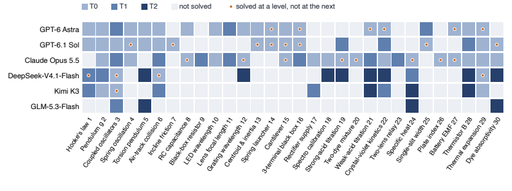
Figure 9 .Lowest level that solves each experiment, per agent; a dot marks an experiment the agent solves at one level but not at the next level it is run at. The GPT and Claude agents are not run at T2.
원문 · CC BY 4.0 · Hongcheng Gao, Zelin Zheng, Alex Zhou, Jay Zhu, Shijia Ge, Yazhe Wang, Xiping Li, Jianshu Zeng, Di Wu, Xuan Shangguan, Yexing Wan, Lingyu He, Yongli Wang, Xiaohan Yu, Zhiqi Jia, Yue Liu, Bryan Hooi, Yinpeng Dong, Wentao Zhang, Sihang Wu, Xiao He · EmbodiedLab: Benchmarking Embodied Agents That Act to Know · 원문 그림 인용 · 원본 PDF 18쪽에서 그림 영역을 추출했습니다.해석의 범위와 한계
이 결과는 본문에 보고된 30개 실험, 6개 모델 또는 에이전트, 세 인터페이스 수준 안에서 얻어진 것입니다. T2는 성공 실행에서 증류한 기술을 쓰므로 부분적으로 알려진 해법을 재사용하며, 공개 프로토콜에 포함되지 않은 진단 수준입니다. 따라서 T2의 결과를 일반적인 능력 향상으로 읽으면 안 됩니다.
실패 원인은 첫 번째 결정적 오류를 기준으로 분류되었습니다. 원문은 로봇의 물리적 실행과 장비 상호작용이 실패의 큰 부분을 차지한다고 보고합니다. 그러나 이 분류는 각 실패의 한 원인을 고른 것이며, 모든 실패를 완전하게 설명하는 인과 모형으로 볼 수는 없습니다.
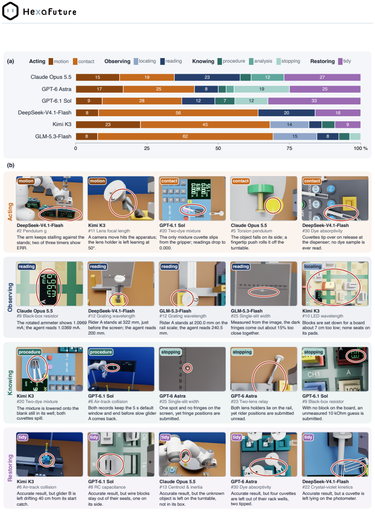
Figure 10 .Why runs fail at T0.(a) Failed runs by the cause of their first decisive error, in percent of each agent’s failed runs with an attributed cause, grouped by the stage of acting to know. (b) Typical failures, five per stage, each shown in a frame from the agent’s own cameras with the decisive spot ringed; the chip on each frame names the cause.
원문 · CC BY 4.0 · Hongcheng Gao, Zelin Zheng, Alex Zhou, Jay Zhu, Shijia Ge, Yazhe Wang, Xiping Li, Jianshu Zeng, Di Wu, Xuan Shangguan, Yexing Wan, Lingyu He, Yongli Wang, Xiaohan Yu, Zhiqi Jia, Yue Liu, Bryan Hooi, Yinpeng Dong, Wentao Zhang, Sihang Wu, Xiao He · EmbodiedLab: Benchmarking Embodied Agents That Act to Know · 원문 그림 인용 · 원본 PDF 19쪽에서 그림 영역을 추출했습니다.논문 정보
- 저자
- Hongcheng Gao, Zelin Zheng, Alex Zhou, Jay Zhu, Shijia Ge, Yazhe Wang, Xiping Li, Jianshu Zeng, Di Wu, Xuan Shangguan, Yexing Wan, Lingyu He, Yongli Wang, Xiaohan Yu, Zhiqi Jia, Yue Liu, Bryan Hooi, Yinpeng Dong, Wentao Zhang, Sihang Wu, Xiao He
- 학회·저널
- arXiv · 프리프린트
- 최초 공개일
- 2026년 10월 26일
- 등록일
- 2026년 10월 29일
- 수정일
- 2026년 10월 26일
- 버전
- v1
- arXiv
- 2610.35385
- 분류
- cs.RO
- 원문 이용 조건
- CC BY 4.0
- 제공 범위
- 논문 정보, 해설, 허용된 원문 그림
AI 해설은 논문 원문과 별개의 설명이며 오류가 있을 수 있습니다. 원문과 그림은 각 출처의 이용 조건과 따로 표시된 권리를 따릅니다.
초록
Embodied agents are expected to accomplish real-world goals by deciding for themselves how and when to interact with their surroundings. For many such goals, changing the physical state of the world is the means rather than the end: the agent changes the state of a system through interaction, observes the feedback, and explores until it either achieves the goal itself (e.g., discovering physical laws) or learns what the goal requires; it acts to know. Manipulation benchmarks stop at acting to change, with the target state given; scientific discovery benchmarks evaluate knowing but replace physical experimentation with symbolic actions or numerical queries. We introduce EmbodiedLab, a benchmark in which a robot must act to know. Quantitative science experiments make this setting controllable: the parameters of the system are resampled for every instance, so the result cannot be known in advance, yet it can be scored exactly. Across 30 experiments in five disciplines on 14 apparatus platforms, the agent receives an objective and the apparatus, chooses its own procedure, and operates a physics-based simulated laboratory, reading the instruments through its cameras. Evaluation checks what the agent came to know, grounded in readings recorded during the episode, as well as the physical state the task requires; every experiment is verified to be solvable. We evaluate six frontier models in their developers' coding agents with native observation and control, with added perception and motion planning, and with manipulation skills distilled from the strongest agents. With native control, even the strongest agent succeeds less than half the time; for every agent, most failures arise in interacting with the apparatus, and manipulation skills help weaker agents more than perception and planning. The benchmark and its evaluation code are available at https://github.com/HexaFuture/EmbodiedLab.
원문 인용
Hongcheng Gao, Zelin Zheng, Alex Zhou, Jay Zhu, Shijia Ge, Yazhe Wang, Xiping Li, Jianshu Zeng, Di Wu, Xuan Shangguan, Yexing Wan, Lingyu He, Yongli Wang, Xiaohan Yu, Zhiqi Jia, Yue Liu, Bryan Hooi, Yinpeng Dong, Wentao Zhang, Sihang Wu et al. (2026). EmbodiedLab: Benchmarking Embodied Agents That Act to Know. arXiv:2610.35385v1. https://arxiv.org/abs/2610.35385v1
BibTeX
@misc{gao2026embodiedlab,
  title = {{EmbodiedLab: Benchmarking Embodied Agents That Act to Know}},
  author = {Hongcheng Gao and Zelin Zheng and Alex Zhou and Jay Zhu and Shijia Ge and Yazhe Wang and Xiping Li and Jianshu Zeng and Di Wu and Xuan Shangguan and Yexing Wan and Lingyu He and Yongli Wang and Xiaohan Yu and Zhiqi Jia and Yue Liu and Bryan Hooi and Yinpeng Dong and Wentao Zhang and Sihang Wu and Xiao He},
  year = {2026},
  eprint = {2610.35385},
  archivePrefix = {arXiv},
  url = {https://arxiv.org/abs/2610.35385v1}
}