논문 해설
BOOD: Boundary-based Out-Of-Distribution Data Generation
BOOD: 경계 기반 분포 외 데이터 생성
- 연구 문제 BOOD는 기존 자동 OOD 데이터 생성이 결정 경계와의 관계를 명시하지 못하는 문제를 다루며, 텍스트 조건 잠재 공간에서 경계 근처 특징을 골라 이미지 수준의 OOD 데이터를 만듭니다.
- 연구 방법 ID 특징을 경계 너머로 섭동하는 횟수로 거리를 재고, 가장 가까운 특징을 OOD 특징으로 바꾼 뒤 확산 모델로 이미지를 생성합니다.
- 주요 결과 저자들이 보고한 CIFAR-100 실험에서 BOOD는 평균 FPR95 10.67, 평균 AUROC 97.42를 기록해 DreamOOD보다 좋은 평균 지표를 보였습니다.
연구 문제와 OOD 데이터 생성의 어려움
OOD 탐지 모델은 학습 중 ID 데이터와 경계 바깥의 보조 데이터를 함께 보아야 결정 경계를 더 정확히 세울 수 있습니다. 그러나 사람이 OOD 이미지를 수집하는 방식은 인력과 시간 비용이 크고, 실세계에서 얻기 어려운 OOD 이미지도 있습니다. 기존 자동 생성 방법인 DreamOOD는 텍스트 조건 잠재 공간의 저우도 영역에서 OOD 시각 임베딩을 샘플링하지만, 저우도 영역과 클래스 사이의 결정 경계 관계가 명시적이지 않아 생성 이미지가 결정 경계 위에 놓인다고 보장하지 못합니다. BOOD는 이 지점을 겨냥하여 결정 경계 근처의 ID 특징을 찾고, 이를 경계 너머로 섭동한 OOD 특징을 확산 모델로 디코딩하여 이미지 수준의 OOD 데이터를 만드는 것을 목표로 합니다.
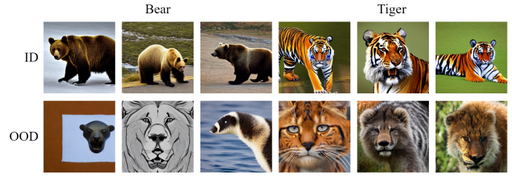
Figure 1 . Top: images generated from ID features. Bottom: images generated from OOD features. Compared to preparing ID image datasets, preparing OOD image datasets incurs substantial costs in terms of resource allocation, particularly with respect to labor and time investment. Moreover, certain OOD images, as illustrated in the above figure, are impossible to acquire through real-world data collection methods. Consequently, there exists a pressing need for the development of automated pipelines capable of generating OOD datasets.
원문 · CC BY 4.0 · Qilin Liao, Shuo Yang, Bo Zhao, Ping Luo, Hengshuang Zhao · BOOD: Boundary-based Out-Of-Distribution Data Generation · 원문 그림 인용 · 원본 PDF 2쪽에서 그림 영역을 추출했습니다.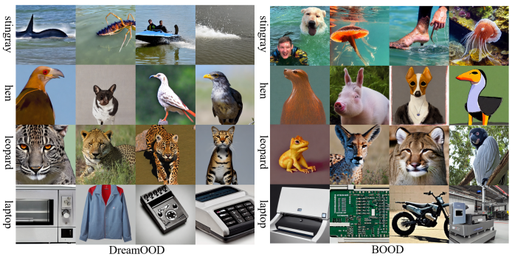
Figure 8 . Left: OOD images generated with DreamOOD (Du et al., 2023). Right: OOD images generated with BOOD.
원문 · CC BY 4.0 · Qilin Liao, Shuo Yang, Bo Zhao, Ping Luo, Hengshuang Zhao · BOOD: Boundary-based Out-Of-Distribution Data Generation · 원문 그림 인용 · 원본 PDF 13쪽에서 그림 영역을 추출했습니다.텍스트 조건 잠재 공간에서 경계 특징을 찾고 OOD 이미지를 생성하는 절차
BOOD는 먼저 이미지 인코더 hθ를 ID 이미지 특징과 CLIP 텍스트 인코더가 만든 클래스 토큰 임베딩 Γ(y)의 정렬 손실로 학습하여 확산 모델 입력 공간과 호환되는 text-conditioned latent space를 만듭니다. 이 정렬은 DreamOOD를 따른 것입니다. 다음으로 각 ID 특징 z에 대해 예측이 y에서 바뀔 때까지 손실의 gradient 방향으로 step size α만큼 섭동하는 횟수 k를 셉니다. 원문은 이 k를 결정 경계까지 거리의 대리 값으로 사용하며, 거리 집합 D에서 가장 작은 r% 값에 해당하는 ID boundary features를 선택합니다. 선택된 특징은 예측이 바뀔 때까지 같은 방향으로 섭동된 뒤, c 단계를 더 섭동하여 OOD 특징 zood가 됩니다.
마지막으로 Stable Diffusion의 텍스트 표현 Zy에서 Γ(y) 자리를 zood로 바꾸어 OOD 이미지를 생성합니다. 이 과정은 학습 단계에 고정된 인코더와 생성 단계의 확산 모델을 함께 쓰며, 생성된 이미지는 OOD 정규화 학습에 사용됩니다.
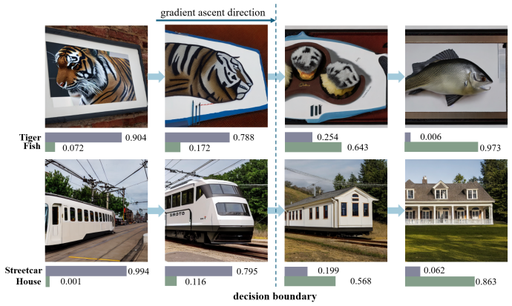
Figure 2 . Illustration of perturbing ID boundary feature process. The bar charts under each image represent the prediction probability of the perturbed features by the image classifier. After each perturbation, the prediction probability of the original class decreases. When the prediction of the image classifier switches, we consider the obtained feature crossed the decision boundary.
원문 · CC BY 4.0 · Qilin Liao, Shuo Yang, Bo Zhao, Ping Luo, Hengshuang Zhao · BOOD: Boundary-based Out-Of-Distribution Data Generation · 원문 그림 인용 · 원본 PDF 3쪽에서 그림 영역을 추출했습니다.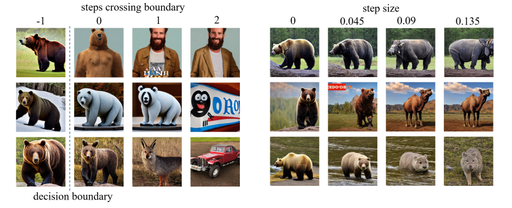
Figure 3 . Left: the effect of perturbing steps c after crossing the boundary, Right: the effect of step size α.
원문 · CC BY 4.0 · Qilin Liao, Shuo Yang, Bo Zhao, Ping Luo, Hengshuang Zhao · BOOD: Boundary-based Out-Of-Distribution Data Generation · 원문 그림 인용 · 원본 PDF 6쪽에서 그림 영역을 추출했습니다.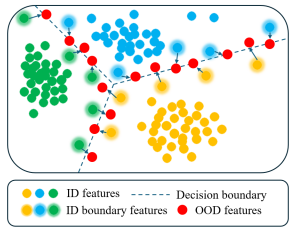
Figure 4 . Illustration of the identified ID boundary features and perturbing them to cross the decision boundary.
원문 · CC BY 4.0 · Qilin Liao, Shuo Yang, Bo Zhao, Ping Luo, Hengshuang Zhao · BOOD: Boundary-based Out-Of-Distribution Data Generation · 원문 그림 인용 · 원본 PDF 6쪽에서 그림 영역을 추출했습니다.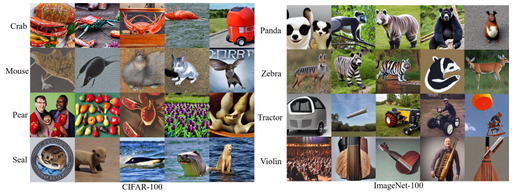
Figure 7 . Left: OOD images generated for C IFAR -100. Right: OOD images generated for I MAGE NET-100.
원문 · CC BY 4.0 · Qilin Liao, Shuo Yang, Bo Zhao, Ping Luo, Hengshuang Zhao · BOOD: Boundary-based Out-Of-Distribution Data Generation · 원문 그림 인용 · 원본 PDF 13쪽에서 그림 영역을 추출했습니다.OOD 정규화 손실과 학습 목표
생성된 OOD 이미지는 OOD 탐지 모델 gθ의 정규화에 쓰입니다. 최종 목적은 교차 엔트로피 손실 LCE와 β 가중 OOD 정규화 손실 LOOD를 더한 형태이며, LOOD는 ID 이미지 항과 OOD 이미지 항으로 이루어집니다. 두 항 모두 energy function E와 VOS와 같은 구조의 3층 MLP ϕ를 사용합니다. β는 CIFAR-100에서 2.5, ImageNet-100에서 1.0으로 설정되었습니다.
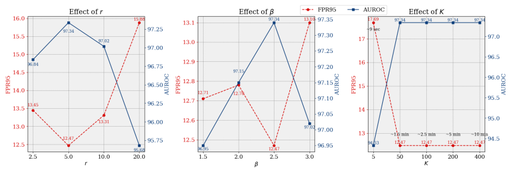
Figure 6 . Left:The effect of pruning rate r. Middle: The effect of β. Right: The effect of maximum perturbation steps K
원문 · CC BY 4.0 · Qilin Liao, Shuo Yang, Bo Zhao, Ping Luo, Hengshuang Zhao · BOOD: Boundary-based Out-Of-Distribution Data Generation · 원문 그림 인용 · 원본 PDF 8쪽에서 그림 영역을 추출했습니다.CIFAR-100과 ImageNet-100에서의 비교 결과
CIFAR-100을 ID 데이터셋으로 한 실험에서 BOOD는 SVHN, PLACES 365, LSUN, ISUN, TEXTURES를 OOD 테스트 데이터셋으로 사용합니다. 이 설정은 ResNet-34를 학습 네트워크로 사용하며, 초기 학습률 0.1과 배치 크기 160을 적용합니다. 평균 FPR95는 DreamOOD의 40.31%에서 BOOD의 10.67%로 낮아지고, 평균 AUROC는 90.15%에서 97.42%로 높아집니다. 표는 3회 실행의 표준편차를 함께 보고합니다. ImageNet-100 실험에서 BOOD의 평균 FPR95는 35.37±0.3, 평균 AUROC는 92.44±0.1로 보고되며 DreamOOD의 평균 FPR95 38.76과 평균 AUROC 92.02와 비교됩니다.
이 수치들은 저자가 보고한 해당 데이터셋과 설정에서의 결과입니다.
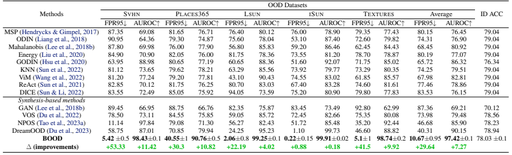
Table 1 . OOD detection results for CIFAR -100 as the in-distribution data. We report standard deviations estimated across 3 runs. Bold numbers are superior results, and the last row is the improvement of our method over previous state-of-the-art DreamOOD (Du et al., 2023).
원문 · CC BY 4.0 · Qilin Liao, Shuo Yang, Bo Zhao, Ping Luo, Hengshuang Zhao · BOOD: Boundary-based Out-Of-Distribution Data Generation · 원문 그림 인용 · 원본 PDF 4쪽에서 그림 영역을 추출했습니다.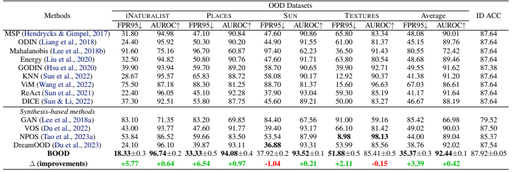
Table 2 . OOD detection results for IMAGENET-100 as the in-distribution data. We report standard deviations estimated across 3 runs. Bold numbers are superior results, and the last row is the improvement of our method over previous state-of-the-art DreamOOD (Du et al., 2023).
원문 · CC BY 4.0 · Qilin Liao, Shuo Yang, Bo Zhao, Ping Luo, Hengshuang Zhao · BOOD: Boundary-based Out-Of-Distribution Data Generation · 원문 그림 인용 · 원본 PDF 5쪽에서 그림 영역을 추출했습니다.경계 식별과 특징 섭동의 절제 결과
절제 실험은 OOD 특징 합성 방식을 세 설정으로 비교합니다. 첫째는 경계 식별로 선택한 ID 특징을 그대로 디코딩하는 설정, 둘째는 무작위로 고른 ID 특징을 경계까지 섭동하는 설정, 셋째는 전체 BOOD입니다. 전체 BOOD의 평균 FPR95는 10.67, 평균 AUROC는 97.42로 보고됩니다. 저자들은 두 모듈이 최고 성능에 필요하다고 해석합니다. 다만 이 표의 결과는 CIFAR-100 평균 지표에 대한 것이며, ID ACC의 차이는 표의 해당 행에서 확인되는 범위로만 읽어야 합니다.
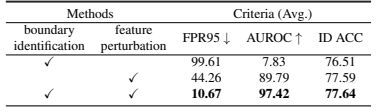
Table 3 . Ablation on OOD feature synthesizing methodologies
원문 · CC BY 4.0 · Qilin Liao, Shuo Yang, Bo Zhao, Ping Luo, Hengshuang Zhao · BOOD: Boundary-based Out-Of-Distribution Data Generation · 원문 그림 인용 · 원본 PDF 7쪽에서 그림 영역을 추출했습니다.계산 비용과 메모리 비교
계산 비용 비교는 잠재 공간 구축, OOD 특징 합성, OOD 이미지 생성, OOD 탐지 모델 정규화의 시간을 BOOD와 DreamOOD에 대해 나누어 보고합니다. 총 비용은 BOOD가 약 16.72h, DreamOOD가 약 16.66h입니다. 저자들은 이 차이가 통계적으로 유의하지 않다고 보고하며, 이 결과는 해당 설정에서의 비용 비교로 읽어야 합니다. 메모리 비교는 CIFAR-100에 대한 별도 표로 제시됩니다.

Table 4 . Computational cost comparison
원문 · CC BY 4.0 · Qilin Liao, Shuo Yang, Bo Zhao, Ping Luo, Hengshuang Zhao · BOOD: Boundary-based Out-Of-Distribution Data Generation · 원문 그림 인용 · 원본 PDF 8쪽에서 그림 영역을 추출했습니다.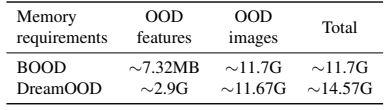
Table 5 . Memory requirements comparison
원문 · CC BY 4.0 · Qilin Liao, Shuo Yang, Bo Zhao, Ping Luo, Hengshuang Zhao · BOOD: Boundary-based Out-Of-Distribution Data Generation · 원문 그림 인용 · 원본 PDF 8쪽에서 그림 영역을 추출했습니다.한계와 적용 범위
저자들은 데이터셋이 확산 모델의 학습 분포와 큰 도메인 차이를 가질 때 BOOD의 성능이 확산 모델의 능력에 영향을 받을 수 있다고 밝힙니다. 또한 섭동 단계 c와 같은 하이퍼파라미터를 조정하기 어렵다고 언급하며, 이를 자동으로 조정하는 방법을 향후 과제로 제시합니다. 본문의 실험 결과는 CIFAR-100과 ImageNet-100의 설정에서 얻은 것이므로, 다른 데이터나 모델로 확대하려면 별도 검증이 필요합니다.
논문 정보
- 저자
- Qilin Liao, Shuo Yang, Bo Zhao, Ping Luo, Hengshuang Zhao
- 학회·저널
- arXiv · 프리프린트
- 최초 공개일
- 2025년 8월 1일
- 등록일
- 2026년 10월 31일
- 수정일
- 2025년 8월 1일
- 버전
- v1
- arXiv
- 2508.00350
- 분류
- cs.LG · cs.CV
- 원문 이용 조건
- CC BY 4.0
- 제공 범위
- 논문 정보, 해설, 허용된 원문 그림
AI 해설은 논문 원문과 별개의 설명이며 오류가 있을 수 있습니다. 원문과 그림은 각 출처의 이용 조건과 따로 표시된 권리를 따릅니다.
초록
Harnessing the power of diffusion models to synthesize auxiliary training data based on latent space features has proven effective in enhancing out-of-distribution (OOD) detection performance. However, extracting effective features outside the in-distribution (ID) boundary in latent space remains challenging due to the difficulty of identifying decision boundaries between classes. This paper proposes a novel framework called Boundary-based Out-Of-Distribution data generation (BOOD), which synthesizes high-quality OOD features and generates human-compatible outlier images using diffusion models. BOOD first learns a text-conditioned latent feature space from the ID dataset, selects ID features closest to the decision boundary, and perturbs them to cross the decision boundary to form OOD features. These synthetic OOD features are then decoded into images in pixel space by a diffusion model. Compared to previous works, BOOD provides a more training efficient strategy for synthesizing informative OOD features, facilitating clearer distinctions between ID and OOD data. Extensive experimental results on common benchmarks demonstrate that BOOD surpasses the state-of-the-art method significantly, achieving a 29.64% decrease in average FPR95 (40.31% vs. 10.67%) and a 7.27% improvement in average AUROC (90.15% vs. 97.42%) on the CIFAR-100 dataset.
원문 인용
Qilin Liao, Shuo Yang, Bo Zhao, Ping Luo, Hengshuang Zhao (2025). BOOD: Boundary-based Out-Of-Distribution Data Generation. arXiv:2508.00350v1. https://arxiv.org/abs/2508.00350v1
BibTeX
@misc{liao2025bood,
  title = {{BOOD: Boundary-based Out-Of-Distribution Data Generation}},
  author = {Qilin Liao and Shuo Yang and Bo Zhao and Ping Luo and Hengshuang Zhao},
  year = {2025},
  eprint = {2508.00350},
  archivePrefix = {arXiv},
  url = {https://arxiv.org/abs/2508.00350v1}
}