논문 해설
ST3D++: Denoised Self-training for Unsupervised Domain Adaptation on 3D Object Detection
ST3D++: 3D 객체 탐지의 비지도 도메인 적응을 위한 잡음 제거 자기 학습
- 연구 문제 3D 객체 검출기는 소스와 타깃 도메인이 다를 때 성능이 크게 떨어지며, 타깃 라벨 없이 자기 학습을 적용하면 의사 레이블 노이즈가 누적됩니다.
- 연구 방법 ST3D++는 ROS로 소스 pre-training의 크기 편향을 줄이고, HQTM으로 의사 레이블을 정제하며, SASD와 CDA로 노이즈 있는 의사 레이블 학습의 영향을 완화합니다.
- 주요 결과 SECOND-IoU 기반 Waymo→KITTI 과제에서 ST3D++는 자동차 65.64, 보행자 53.87, 자전거 53.43의 AP3D를 보고하며 기준선 대비 큰 향상을 보입니다.
라벨 없는 타깃 도메인에서 3D 검출기가 흔들리는 이유
자율주행용 3D 객체 검출기는 한 센서와 지역에서 학습하면 다른 도메인에서 성능이 크게 떨어집니다. 원문은 Waymo LiDAR로 학습한 검출기가 KITTI 데이터에서 45% 이상의 성능 하락을 보인다고 인용합니다. 타깃 도메인에 라벨을 새로 붙이는 것은 비용이 커서, 라벨 없는 타깃 데이터를 활용하는 비지도 도메인 적응(UDA)이 필요합니다.
자기 학습(self-training)은 이미지 과제에서 효과가 확인된 UDA 기법입니다. 소스 데이터로 사전 학습한 뒤 타깃 데이터에 의사 레이블을 만들고 이를 지도 신호로 삼아 반복 학습합니다. 그러나 이 논문은 단순한 자기 학습이 3D 객체 검출에서는 잘 작동하지 않는다고 보고합니다. 원인은 의사 레이블 노이즈이며, 이는 방향이 있는 3D 상자의 부정확한 위치 추정과 잘못된 범주 할당으로 나타납니다.
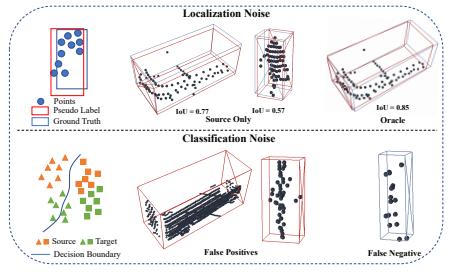
Fig. 2 . Examples of two types self-training noise (red and blue boxes stand for predicted pseudo labels and GTs, respectively). Upper row: ”localization noise” consists of pseudo labels that locate GTs well but suffers from regression errors to their corresponding GTs. Bottom row: “classification noise” mainly includes false-positive and false-negative pseudo labels (i.e. missed GTs).
원문 · CC BY 4.0 · Jihan Yang, Shaoshuai Shi, Zhe Wang, Hongsheng Li, Xiaojuan Qi · ST3D++: Denoised Self-training for Unsupervised Domain Adaptation on 3D Object Detection · 원문 그림 인용 · 원본 PDF 3쪽에서 그림 영역을 추출했습니다.ST3D++의 세 단계 노이즈 제거 파이프라인
ST3D++는 세 단계로 구성됩니다. 첫째, 소스 데이터로 사전 학습할 때 random object scaling(ROS)을 적용합니다. ROS는 상자 내부 점들을 객체 중심 좌표계로 옮긴 뒤 길이·너비·높이 축으로 무작위 배율을 곱하고 다시 원래 좌표계로 되돌리는 객체 단위 증강입니다. 이는 소스 도메인의 객체 크기 편향을 줄여 초기 의사 레이블의 크기 오차를 낮추려는 설계입니다.
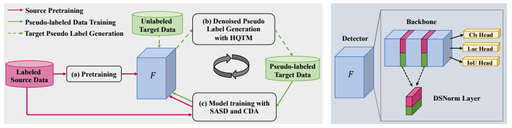
Fig. 3 . Left: An overview of ST3D++ framework, which includes three stages: (a) model pre-training with ROS; (b) Denoised pseudo label generation with HQTM and (c) model training with SASD and CDA. Object detector F iterates between the second and the third stages until convergence. Right: An architecture overview of the object detector. Our ST3D++ is a model-agnostic framework. Any one-stage and two-stage detectors with classification head, localization head and IoU head can be incorporated into our framework.
원문 · CC BY 4.0 · Jihan Yang, Shaoshuai Shi, Zhe Wang, Hongsheng Li, Xiaojuan Qi · ST3D++: Denoised Self-training for Unsupervised Domain Adaptation on 3D Object Detection · 원문 그림 인용 · 원본 PDF 4쪽에서 그림 영역을 추출했습니다.둘째, 의사 레이블 생성 단계에서 hybrid quality-aware triplet memory(HQTM)를 사용합니다. 여기에는 IoU 회귀 헤드로 예측한 IoU u와 분류 신뢰도 p를 o = φp + (1−φ)u로 섞는 하이브리드 기준, [T_neg, T_pos) 구간으로 Positive·Ignored·Negative를 나누는 삼중 상자 분할, 이전 메모리와 새 의사 레이블을 매칭하는 메모리 앙상블과 미매칭 상자의 누적 카운터로 판단하는 메모리 투표가 포함됩니다. 원문은 φ가 과제마다 0에서 0.5 사이로 설정된다고 밝힙니다.
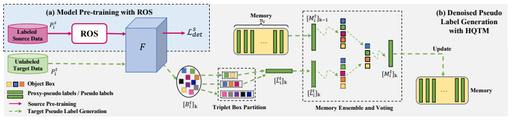
Fig. 4 . Overview of stage (a) and (b). (a) Pre-train the object detector F with random object scaling (ROS) as data augmentation in source domain to mitigate noise owing to source object-size bias. (b) Generate high-quality and consistent pseudo labels on target unlabeled data with our hybrid quality-aware triplet memory (HQTM).
원문 · CC BY 4.0 · Jihan Yang, Shaoshuai Shi, Zhe Wang, Hongsheng Li, Xiaojuan Qi · ST3D++: Denoised Self-training for Unsupervised Domain Adaptation on 3D Object Detection · 원문 그림 인용 · 원본 PDF 5쪽에서 그림 영역을 추출했습니다.셋째, 모델 학습 단계에서 소스 데이터와 의사 레이블 타깃 데이터를 함께 사용하는 source-assisted self-denoised(SASD) 학습을 적용합니다. 이때 소스와 타깃의 배치 정규화 통계가 섞이지 않도록 DSNorm을 적용하여 도메인별 평균과 분산을 따로 추정하고, 스케일·시프트 파라미터는 공유합니다. 또한 curriculum data augmentation(CDA)은 에폭 단계 E마다 증강 강도 δ를 ρ=1.2 비율로 곱해 점차 강하게 적용합니다.
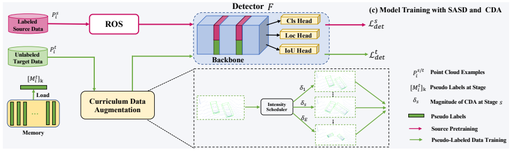
Fig. 7 . Pipeline overview of stage (c). Model is simultaneously optimized on both labeled source data and pseudo-labeled target data. Source- assisted self-denoising (SASD) is incorporated to rectify optimization directions and address normalization statistics shift, while curriculum data augmentation (CDA) prevents model overfitting to easy cases.
원문 · CC BY 4.0 · Jihan Yang, Shaoshuai Shi, Zhe Wang, Hongsheng Li, Xiaojuan Qi · ST3D++: Denoised Self-training for Unsupervised Domain Adaptation on 3D Object Detection · 원문 그림 인용 · 원본 PDF 8쪽에서 그림 영역을 추출했습니다.Waymo에서 KITTI로의 주요 비교 결과
주요 검증은 SECOND-IoU를 기반으로 Waymo→KITTI 과제에서 수행되었습니다. 원문은 ST3D++의 AP3D가 자동차 65.64, 보행자 53.87, 자전거 53.43이라고 보고합니다. 이는 같은 표에 있는 비지도 설정의 결과이며, SN을 함께 쓰는 약지도 설정의 결과는 별도로 구분해야 합니다.
초록에서 말하는 9.6%∼38.16%의 향상은 Waymo→KITTI에서 기준선 대비 AP3D로 보고된 값입니다. 본문에서 저자들은 Source Only 대비 큰 차이가 나타난다고 설명하며, 자동차에서는 대략 38%∼44%, 보행자와 자전거에서는 각각 약 10%∼11%, 9%∼10% 수준의 향상을 제시합니다.
성능 향상의 범위와 남은 한계
원문은 nuScenes→KITTI에서 ST3D++가 자동차 AP3D를 Source Only 대비 크게 높였다고 보고합니다. 다만 Waymo→nuScenes처럼 밀집한 도메인에서 희박한 도메인으로 적응하는 경우의 향상은 상대적으로 작게 나타났습니다. 저자들은 이를 밀집 데이터로 학습된 검출기가 희박 영역에서 낮은 신뢰도의 예측을 내기 때문에 고품질 의사 레이블이 부족하다는 것으로 해석합니다.
또한 SN을 함께 쓰는 약지도 설정은 타깃 객체 크기 통계를 사전에 사용하므로 비지도 결과와 직접 같은 조건으로 볼 수 없습니다. Waymo→Lyft와 Waymo→nuScenes에서는 SN의 개선이 작거나 성능이 떨어진 경우도 있습니다.
논문 정보
- 저자
- Jihan Yang, Shaoshuai Shi, Zhe Wang, Hongsheng Li, Xiaojuan Qi
- 학회·저널
- arXiv · 프리프린트
- 최초 공개일
- 2021년 8월 15일
- 등록일
- 2026년 11월 6일
- 수정일
- 2021년 8월 15일
- 버전
- v1
- arXiv
- 2108.06682
- 분류
- cs.CV · cs.AI
- 원문 이용 조건
- CC BY 4.0
- 제공 범위
- 논문 정보, 해설, 허용된 원문 그림
AI 해설은 논문 원문과 별개의 설명이며 오류가 있을 수 있습니다. 원문과 그림은 각 출처의 이용 조건과 따로 표시된 권리를 따릅니다.
초록
In this paper, we present a self-training method, named ST3D++, with a holistic pseudo label denoising pipeline for unsupervised domain adaptation on 3D object detection. ST3D++ aims at reducing noise in pseudo label generation as well as alleviating the negative impacts of noisy pseudo labels on model training. First, ST3D++ pre-trains the 3D object detector on the labeled source domain with random object scaling (ROS) which is designed to reduce target domain pseudo label noise arising from object scale bias of the source domain. Then, the detector is progressively improved through alternating between generating pseudo labels and training the object detector with pseudo-labeled target domain data. Here, we equip the pseudo label generation process with a hybrid quality-aware triplet memory to improve the quality and stability of generated pseudo labels. Meanwhile, in the model training stage, we propose a source data assisted training strategy and a curriculum data augmentation policy to effectively rectify noisy gradient directions and avoid model over-fitting to noisy pseudo labeled data. These specific designs enable the detector to be trained on meticulously refined pseudo labeled target data with denoised training signals, and thus effectively facilitate adapting an object detector to a target domain without requiring annotations. Finally, our method is assessed on four 3D benchmark datasets (i.e., Waymo, KITTI, Lyft, and nuScenes) for three common categories (i.e., car, pedestrian and bicycle). ST3D++ achieves state-of-the-art performance on all evaluated settings, outperforming the corresponding baseline by a large margin (e.g., 9.6% $\sim$ 38.16% on Waymo $\rightarrow$ KITTI in terms of AP$_{\text{3D}}$), and even surpasses the fully supervised oracle results on the KITTI 3D object detection benchmark with target prior. Code will be available.
원문 인용
Jihan Yang, Shaoshuai Shi, Zhe Wang, Hongsheng Li, Xiaojuan Qi (2021). ST3D++: Denoised Self-training for Unsupervised Domain Adaptation on 3D Object Detection. arXiv:2108.06682v1. https://arxiv.org/abs/2108.06682v1
BibTeX
@misc{yang2021st3d,
  title = {{ST3D++: Denoised Self-training for Unsupervised Domain Adaptation on 3D Object Detection}},
  author = {Jihan Yang and Shaoshuai Shi and Zhe Wang and Hongsheng Li and Xiaojuan Qi},
  year = {2021},
  eprint = {2108.06682},
  archivePrefix = {arXiv},
  url = {https://arxiv.org/abs/2108.06682v1}
}