논문 해설
Focus and Dilution: The Multi-stage Learning Process of Attention
집중과 희석: 어텐션의 다단계 학습 과정
- 연구 문제 Transformer 어텐션이 학습 중 고빈도 토큰에 집중했다가 희석되는 과정을 단일 레이어 설정의 그래디언트 흐름 분석으로 설명합니다.
- 연구 방법 마르코프 데이터에서 단일 레이어 Transformer의 그래디언트 흐름을 임계점 주변에서 단계별로 선형화하여 응축, 집중, 희석, 새 방향의 등장을 기술합니다.
- 주요 결과 합성 마르코프 데이터에서 네 단계 패턴이 관찰되었고, WikiText와 TinyStories에서도 상위 빈도 토큰의 집중 후 희석 패턴이 보고되었습니다.
연구 문제와 기존 분석의 한계
Transformer의 어텐션이 학습 중에 어떻게 변하는지는 아직 기계적으로 충분히 설명되지 않았습니다. 기존 분석은 재매개변수화나 대리 동역학을 도입해 계산을 단순화하는데, 이 과정에서 임베딩, 투영, 어텐션이 서로 얽혀 있는 실제 결합이 가려질 수 있습니다. 이 논문은 어텐션이 처음에는 고빈도 토큰에 집중되었다가 시간이 지나며 그 집중이 희석되는 반복 패턴, 즉 focus–dilution 사이클을 연구 대상으로 삼습니다. 분석 범위는 마르코프 데이터를 학습하는 단일 레이어 Transformer의 그래디언트 흐름으로 제한됩니다.
설정과 학습 동역학의 단계별 선형화
분석 대상은 임베딩 W0, 어텐션 파라미터 WQ와 WK, 출력 투영 W1로 이루어진 한 개의 어텐션 블록입니다. 데이터는 전이행렬 P와 정상분포 π로 생성되는 마르코프 체인이며, 교차엔트로피 손실의 그래디언트 흐름을 인구 기울기 극한에서 다룹니다. 저자들은 작은 초기화 근처에서 원점의 선형화가 임베딩과 투영을 π가 정하는 rank-one 방향으로 응축시킨다고 보고, 이후 두 번째 임계점이 안장점이 되어 어텐션 부분공간이 불안정 방향을 따라 성장하는 과정을 선형화로 기술합니다. 이 단계별 선형화가 논문의 핵심 분석 도구입니다.
집중에서 희석, 새 방향의 등장까지의 메커니즘
첫 단계인 초기 응축에서는 어텐션 파라미터가 O(ε) 수준으로 머물고 임베딩과 투영이 π로 정해지는 rank-one 구조로 모입니다. 다음으로 어텐션이 불안정 방향을 따라 자라며 고빈도 토큰에 편향된 집중이 생깁니다. 이후 rank-one 불변 다양체 위에서 어텐션 진폭이 임베딩의 질량 재분배를 유도하고, 그 결과 고빈도 토큰에 대한 집중이 약해집니다. 마지막으로 저빈도 토큰 사이의 대칭이 깨지면 퇴화된 임계점에서 Θ(δ) 크기의 횡방향 불안정성이 생겨 새로운 임베딩 방향이 열립니다. 이 흐름이 하나의 사이클로 묘사되며, 논문은 이 메커니즘을 이론 설정 안에서 제시합니다.
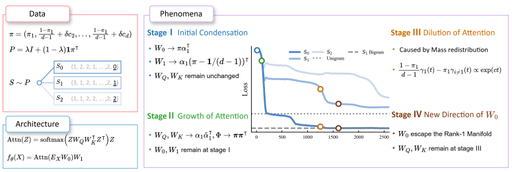
Figure 1 . Overview of the setting and the focus–dilution training pattern. (Left) Sequences are generated by a Markov chain with stationary distribution π. We extract dataset S0, S1, S2 from the training set, which differ only in the identity of the final token in each sequence. (Right) The loss curves exhibit four stages: initial condensation, attention growth, attention dilution, and the emergence of a new direction.
원문 · CC BY 4.0 · Zheng-An Chen, Pengxiao Lin, Zhi-Qin John Xu, Tao Luo · Focus and Dilution: The Multi-stage Learning Process of Attention · 원문 그림 인용 · 원본 PDF 3쪽에서 그림 영역을 추출했습니다.합성 마르코프 데이터에서의 단계 관찰
저자들은 정상분포 π=(0.75,0.19,0.05,0.01)을 공유하는 네 개의 전이행렬로 합성 데이터를 만들고, 길이 20의 시퀀스 10만 개를 사용해 단일 레이어 모델을 학습했습니다. 임베딩 차원은 256이며 Adam을 학습률 1.5×10⁻⁴로 고정해 사용했습니다. 코사인 유사도 행렬로 파라미터 응축을, PCA로 임베딩 궤적을, 어텐션 맵과 엔트로피로 집중과 희석을 관찰했습니다. 그 결과 응축, 어텐션 성장, 희석, 새 방향 등장의 네 단계가 보고됩니다. 이 결과는 해당 합성 설정에서 얻은 관찰이며 다른 전이행렬이나 모델 규모로 자동 일반화되지는 않습니다.
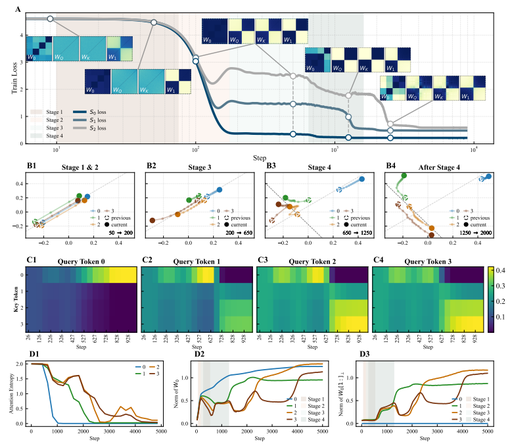
Figure 2 .Empirical focus–dilution cycle. (A)Loss curves for S0, S1, S2, accompanied by cosine-similarity matrices for (W0, WQ, WK , W1).(B)PCA of embeddings reveals one-directional growth (Stage I & II), retraction during dilution (Stage III), and expansion into new directions (Stage IV).(C)Attention maps transition from focus to dilution. Between steps 350 and 550, the attention given to the first token by all query pairs increases synchronously. Afterward, the first token focuses attention on itself, while other tokens reduce their attention towards it.(D1)Attention entropy;(D2), (D3)The embedding norm and the norm of perpendicular component onto the first token.
원문 · CC BY 4.0 · Zheng-An Chen, Pengxiao Lin, Zhi-Qin John Xu, Tao Luo · Focus and Dilution: The Multi-stage Learning Process of Attention · 원문 그림 인용 · 원본 PDF 7쪽에서 그림 영역을 추출했습니다.WikiText와 TinyStories에서의 집중-희석 관찰
실세계 실험에서는 WikiText와 TinyStories에서 상위 세 빈도 토큰과 빈도 10%를 넘는 중간 빈도 토큰 세 개를 추적했습니다. 두 데이터셋 모두에서 어텐션은 처음에 고빈도 토큰을 우선시한 뒤 그 집중을 잃는 희석 패턴을 보였고, 임베딩에서는 retraction 현상이 관찰되었습니다. 다만 1-epoch 학습에서는 배치 구성의 분산 때문에 가장 빈번한 토큰에서도 retraction이 간헐적으로 나타났습니다. 저자들은 TinyStories의 어텐션이 균일 분포에서 자기 어텐션으로 옮겨 가는 모습을 근거로, 초기 학습에서 모델이 pseudo-2-gram처럼 동작한다고 해석합니다.
적용 범위와 남은 한계
이 분석은 단일 레이어 어텐션의 학습 동역학에 주로 초점을 맞추며, 다층 구조나 다중 헤드 구조가 만드는 효과는 아직 포착하지 않습니다. LayerNorm 같은 일반 구성 요소의 영향도 향후 과제로 남아 있습니다. 실세계 실험은 소규모 자연어 데이터에서 얻은 예비적 지지이며, 마르코프 근사는 비마르코프적인 실제 텍스트에 대해 간접적으로만 정당화됩니다.
논문 정보
- 저자
- Zheng-An Chen, Pengxiao Lin, Zhi-Qin John Xu, Tao Luo
- 학회·저널
- arXiv · 프리프린트
- 최초 공개일
- 2026년 5월 2일
- 등록일
- 2026년 10월 29일
- 수정일
- 2026년 5월 2일
- 버전
- v1
- arXiv
- 2605.01199
- 분류
- cs.LG
- 원문 이용 조건
- CC BY 4.0
- 제공 범위
- 논문 정보, 해설, 허용된 원문 그림
AI 해설은 논문 원문과 별개의 설명이며 오류가 있을 수 있습니다. 원문과 그림은 각 출처의 이용 조건과 따로 표시된 권리를 따릅니다.
초록
Transformer-based models have achieved remarkable success across a wide range of domains, yet our understanding of their training dynamics remains limited. In this work, we identify a recurrent focus-dilution cycle in attention learning and provide a rigorous explanation in a one-layer Transformer setting for Markovian data via gradient-flow analysis. Using stage-wise linearization around critical points, we show that a single focus-dilution cycle can be decomposed into a sequence of distinct stages. First, embedding and projection rapidly condense to a rank-one structure, while attention parameters remain effectively frozen. Then, the attention parameters begin to increase, inducing a frequency-driven focus toward high-frequency tokens. As attention continues to evolve, it generates next-order perturbations in embeddings, leading to a mass-redistribution mechanism that progressively dilutes this focus. Finally, small asymmetries among low-frequency tokens lift a degenerate critical point, opening new embedding directions and initiating the next cycle. Experiments on synthetic Markovian data as well as WikiText and TinyStories corroborate the predicted stages and cyclical dynamics.
원문 인용
Zheng-An Chen, Pengxiao Lin, Zhi-Qin John Xu, Tao Luo (2026). Focus and Dilution: The Multi-stage Learning Process of Attention. arXiv:2605.01199v1. https://arxiv.org/abs/2605.01199v1
BibTeX
@misc{chen2026focus,
  title = {{Focus and Dilution: The Multi-stage Learning Process of Attention}},
  author = {Zheng-An Chen and Pengxiao Lin and Zhi-Qin John Xu and Tao Luo},
  year = {2026},
  eprint = {2605.01199},
  archivePrefix = {arXiv},
  url = {https://arxiv.org/abs/2605.01199v1}
}