논문 해설
Reinforcement-learning-based actuator selection method for active flow control
능동 유동 제어를 위한 강화학습 기반 액추에이터 선택 방법
- 연구 문제 많은 작동기로 학습된 강화학습 정책에서 어떤 작동기를 제거해야 적은 작동기로도 성능을 유지할 수 있는지가 문제입니다.
- 연구 방법 PPO-CMA 정책에 Stochastic Gating Layer를 추가하고, 작동기 제거의 가치 함수 영향을 Polyak 평균 지표로 추정하여 작동기를 순차적으로 제거합니다.
- 주요 결과 KS 방정식에서 작동기를 5개에서 1개로 줄일 때 평균 성능은 꾸준히 감소했고, NACA 0012 사례에서는 제거에 따라 항력과 양력 평균이 변하며 표준편차가 크게 늘었습니다.
작동기 선택 문제와 연구 질문
유동 제어에서 작동기(actuator)의 개수와 위치를 정하는 일은 제어 성능과 장치 비용을 함께 좌우합니다. 기존 작동기 배치 연구는 주로 선형 해석, 예를 들어 POD, 응답 민감도, 리졸벤트 분석 등에 기대어 센서나 작동기 위치를 고르는 방식이었습니다. 이 논문은 이러한 흐름에서 벗어나 강화학습으로 학습된 정책을 기반으로 작동기를 희소화하는 방법을 제안합니다. 원문은 작동기 선택을 강화학습으로 다룬 적이 이전에 없었다고 밝히며, 이 연구의 목표를 최초의 강화학습 기반 작동기 배치 알고리즘 제안과 향후 과제 식별의 두 가지로 정리합니다. 질문은 많은 작동기로 미리 학습된 정책에서 출발해 작동기를 하나씩 제거할 때, 각 제거의 영향을 가치 함수로 추정하여 희소한 배치를 찾을 수 있는가입니다.
PPO-CMA 기반 작동기 희소화 방법
기반 학습 알고리즘은 PPO-CMA입니다. PPO-CMA는 on-policy 액터-크리틱 구조로, 액터는 상태를 입력받아 평균 μ와 표준편차 σ를 출력하는 정규분포에서 행동을 샘플링하고 크리틱은 가치 함수를 추정합니다. 제안 방법은 이 액터 출력 앞에 Stochastic Gating Layer(SGL)를 두어 행동 성분마다 베르누이 게이트를 적용합니다. 게이트 값 p_i는 학습 가능한 α_i에 따라 0 또는 1로 샘플링되며, 희소 행동은 a_sparse = p ⊙ a_dense로 정의됩니다. 희소화 단계에서는 α를 조정해 특정 게이트를 닫고, 제거 대상은 각 활성 성분을 클리핑한 정책의 가치 함수 V_i로 추정한 Polyak 평균 지표 m으로 정합니다.
가장 낮게 평가된 성분이 다음 제거 대상으로 선택되고, 선택된 α_i는 천천히 0으로 낮춰지며 이후 정책이 새 배치에 맞게 미세 조정됩니다. 이 과정은 목표 작동기 수에 도달할 때까지 반복됩니다.
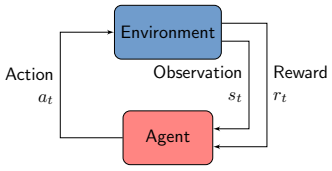
Figure 1 . The reinforcement learning feedback loop
원문 · CC BY 4.0 · Romain Paris, Samir Beneddine, Julien Dandois · Reinforcement-learning-based actuator selection method for active flow control · 원문 그림 인용 · 원본 PDF 5쪽에서 그림 영역을 추출했습니다.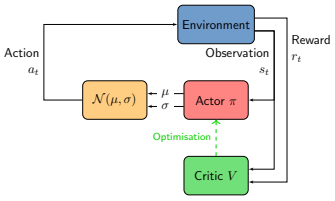
Figure 2 . PPO-CMA agent structure: compared to PPO, the actor has one extra output σ
원문 · CC BY 4.0 · Romain Paris, Samir Beneddine, Julien Dandois · Reinforcement-learning-based actuator selection method for active flow control · 원문 그림 인용 · 원본 PDF 6쪽에서 그림 영역을 추출했습니다.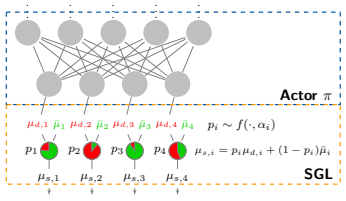
Figure 3 . Structure of the Stochastic Gated Layer (SGL) used to filter the actor output. Here
원문 · CC BY 4.0 · Romain Paris, Samir Beneddine, Julien Dandois · Reinforcement-learning-based actuator selection method for active flow control · 원문 그림 인용 · 원본 PDF 7쪽에서 그림 영역을 추출했습니다.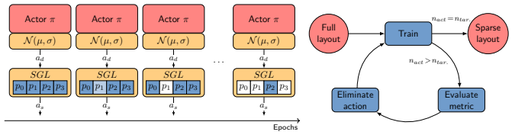
Figure 4 . (left) Schematics of the proposed elimination process. Gates’ opening probability are represented as blue squares in the SGL layer, their colour saturation indicates the opening probability. (right) Illustration of the sequential elimination process proposed. The algorithm iterates over this loop until the breaking condition (i.e. the required number of eliminated actuators) is met.
원문 · CC BY 4.0 · Romain Paris, Samir Beneddine, Julien Dandois · Reinforcement-learning-based actuator selection method for active flow control · 원문 그림 인용 · 원본 PDF 7쪽에서 그림 영역을 추출했습니다.KS 방정식에서의 제거 실험과 결과
첫 번째 검증 사례는 주기적인 1차원 Kuramoto-Sivashinsky 방정식입니다. 이 사례에서는 8개의 균등 배치 작동기에서 시작해 1개까지 순차적으로 줄이는 제거 실험을 수행했습니다. 비교 기준으로는 255개의 가능한 배치를 각각 5개의 테스트 케이스로 학습한 시스템적 연구를 사용했습니다. 결과에서 처음 세 작동기를 제거하는 것은 성능에 미미한 영향을 주었고, 5개에서 1개로 줄이는 동안 평균 성능은 꾸준히 감소했습니다. 2개 작동기의 결과는 시스템적 연구의 평균 보상보다 낮았는데, 저자들은 이것이 알고리즘의 부적절한 배치 선택이나 수렴하지 않은 정책 때문일 수 있다고 해석하며, 추가 미세 조정을 가정한 값은 2개 작동기에서도 평균 이상으로 나타났다고 보고합니다.
1개 작동기의 평균 성능은 시스템적 연구의 최적값보다 약간 높았습니다. 이 결과는 KS 방정식 한 사례에서 얻은 것입니다.
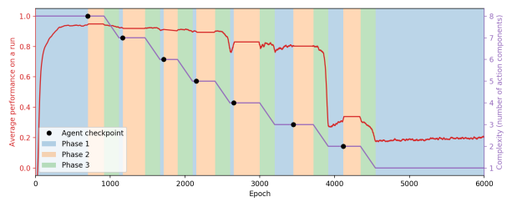
Figure 6 . Example of the one-by-one elimination strategy drawn from a Kuramoto-Savishinsky test case (section 3). The performance curve (red line) has been smoothed using rolling average of length 20 for the sake of readability. Shaded areas in the background illustrate learning phases. Black dots represent the evaluation runs and the checkpoint back-ups of the agent performed during training.
원문 · CC BY 4.0 · Romain Paris, Samir Beneddine, Julien Dandois · Reinforcement-learning-based actuator selection method for active flow control · 원문 그림 인용 · 원본 PDF 9쪽에서 그림 영역을 추출했습니다.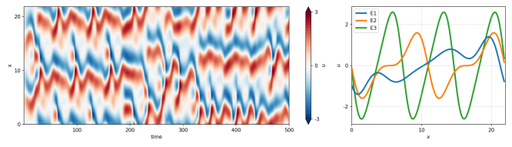
Figure 7 . (left) Spatio-temporal representation of the dynamics of the KS equation on 500 non-dimensional time units, corresponding to 2000 control steps. (right) Shape of the three fixed points of the KS equation.
원문 · CC BY 4.0 · Romain Paris, Samir Beneddine, Julien Dandois · Reinforcement-learning-based actuator selection method for active flow control · 원문 그림 인용 · 원본 PDF 10쪽에서 그림 영역을 추출했습니다.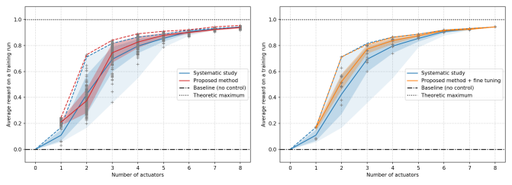
Figure 11 . (left) Average training performance with respect to the number of active action components. The results of the proposed method (red line) are to be compared with the ones of the systematic study (blue line). The red shaded area illustrates the standard deviation across the batch, whereas the blue one represents the performance envelope of all possible layouts. Data points are denoted by grey ”plus” signs. (right) Expected performances of the proposed methods after an extra fine-tuning phase of the agents (orange line) compared to the systematic study (blue line).
원문 · CC BY 4.0 · Romain Paris, Samir Beneddine, Julien Dandois · Reinforcement-learning-based actuator selection method for active flow control · 원문 그림 인용 · 원본 PDF 13쪽에서 그림 영역을 추출했습니다.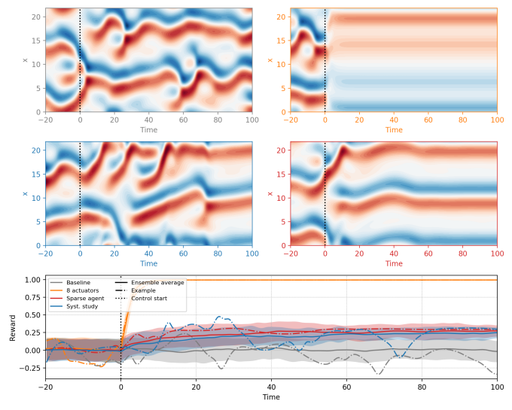
Figure 24 . (bottom) Comparison of the performances of both 1-actuator agents (having only actuator 0 activated) obtained via the systematic study (blue line) and the elimination process (red line) with the non-controlled baseline (grey line) and an 8-actuator agent (orange line). Solid lines represent ensemble averages computed over batches over 100 runs, shaded areas account of the standard deviation across the batch, while dash-dotted lines depict the example run reported on the upper graphs. (upper graphs) Evolution of the state on example runs for each agent.
원문 · CC BY 4.0 · Romain Paris, Samir Beneddine, Julien Dandois · Reinforcement-learning-based actuator selection method for active flow control · 원문 그림 인용 · 원본 PDF 28쪽에서 그림 영역을 추출했습니다.순차 제거 방식의 구조적 한계
KS 사례의 배치 분석은 최적 배치들이 서로 부분집합 관계에 있지 않다는 점을 보여 줍니다. 즉, n개 작동기의 최적 배치가 n+1개 작동기 최적 배치의 부분집합이 아닐 수 있습니다. 저자들은 이 때문에 하나씩 제거하는 방식이 최적 선택을 방해할 수 있다고 보고하며, 이를 방법의 식별된 한계로 제시합니다. 제거 과정에서 가까운 추정값들이 있을 때나 선택이 매우 다른 배치로 이어질 때 어려움이 커집니다. 또한 제외된 작동기의 영향을 추정할 때 정책 적응을 반영하지 않는다는 점도 함께 지적됩니다.
NACA 0012 실속 흐름 실험
두 번째 검증 사례는 레이놀즈 수 Re_c = 1000의 2차원 NACA 0012 실속 흐름입니다. 이 사례의 작동기는 익형 흡입면에 배치된 10개의 독립 제트 입구이며, 제어 행동은 질량 유량 설정으로 변환됩니다. 다양한 받음각에서 정책을 학습한 뒤 희소화 과정을 적용했으며, 받음각 15도에 대한 결과에서 작동기 수를 10개에서 1개까지 줄이는 동안 평균 성능의 변화가 나타납니다. 제거 과정에서 항력 평균은 증가하고 양력 평균은 감소하는 경향이 있었고, 표준편차는 작동기 수가 4개 이하로 줄면서 크게 증가했습니다. 제거 과정이 전체 성능을 완전히 유지하지는 않으며, 이 결과는 특정 받음각과 설정에서의 관찰입니다.
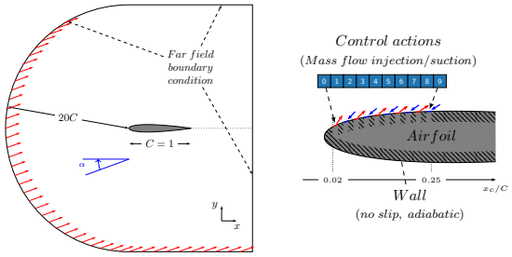
Figure 14 . (left) Flow domain geometry, not at true scale. α denotes the angle of attack and C is the (unitary) chord length. (right) Boundary conditions on the airfoil, with nact = 10. Blue numbered boxes symbolise actuators, number 0 being the upstream-most actuator, number 9 being the downstream-most one.
원문 · CC BY 4.0 · Romain Paris, Samir Beneddine, Julien Dandois · Reinforcement-learning-based actuator selection method for active flow control · 원문 그림 인용 · 원본 PDF 17쪽에서 그림 영역을 추출했습니다.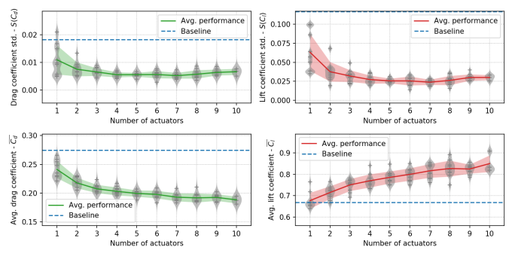
Figure 21 . Averaged training performance indicators with respect to the number of active action component for α = 15°. Data points are denoted by grey “plus” signs. Ensemble averages are computed on these data points (batch-size 5). The blue dashed line represents the uncontrolled (baseline) performance, solid lines denote the evolution of the ensemble average and shaded areas illustrate the standard deviation across the batch. All indicators are computed on the last 40 control steps of a training run. (Upper left) Evolution of the standard deviation of the drag coefficientS(Cd). (Upper right) Evolution of the standard deviation of the lift coefficient S(Cl). (Lower left) Time-averaged drag coefficient Cd. (Lower right) Time-averaged lift coefficient Cl.
원문 · CC BY 4.0 · Romain Paris, Samir Beneddine, Julien Dandois · Reinforcement-learning-based actuator selection method for active flow control · 원문 그림 인용 · 원본 PDF 23쪽에서 그림 영역을 추출했습니다.계산 비용과 적용 범위
제안 알고리즘은 제거 대상을 추정하기 위해 각 작동기를 클리핑한 추가 롤아웃과 별도의 가치 함수 학습을 필요로 합니다. 원문은 이 추가 비용이 환경 계산이 비싼 경우와 활성 작동기 수가 많은 경우에 학습 시간을 크게 늘릴 수 있다고 밝힙니다. 또한 순차 제거는 목표 작동기 수에 도달하는 데 최소한의 학습 에포크를 필요로 합니다. 저자들은 이 비용이 산업용 유동 구성에 바로 적용하기 어렵다고 보고하며, 병렬 제거나 일반 롤아웃을 활용한 가치 추정이 향후 과제라고 제시합니다. 따라서 이 방법의 적용 범위는 계산 비용을 감당할 수 있는 수치 해석 사례에 한정됩니다.
논문 정보
- 저자
- Romain Paris, Samir Beneddine, Julien Dandois
- 학회·저널
- arXiv · 프리프린트
- 최초 공개일
- 2022년 9월 29일
- 등록일
- 2026년 11월 6일
- 수정일
- 2022년 9월 29일
- 버전
- v1
- arXiv
- 2209.14895
- DOI
- 10.1017/jfm.2022.1043
- 분류
- physics.flu-dyn
- 원문 이용 조건
- CC BY 4.0
- 제공 범위
- 논문 정보, 해설, 허용된 원문 그림
AI 해설은 논문 원문과 별개의 설명이며 오류가 있을 수 있습니다. 원문과 그림은 각 출처의 이용 조건과 따로 표시된 권리를 따릅니다.
초록
This paper addresses the issue of actuator selection for active flow control by proposing a novel method built on top of a reinforcement learning agent. Starting from a pre-trained agent using numerous actuators, the algorithm estimates the impact of a potential actuator removal on the value function, indicating the agent's performance. It is applied to two test cases, the one-dimensional Kuramoto-Sivashinsky equation and a laminar bi-dimensional flow around an airfoil at Re=1000 for different angles of attack ranging from 12 to 20 degrees, to demonstrate its capabilities and limits. The proposed actuator-sparsification method relies on a sequential elimination of the least relevant action components, starting from a fully developed layout. The relevancy of each component is evaluated using metrics based on the value function. Results show that, while still being limited by this intrinsic elimination paradigm (i.e. the sequential elimination), actuator patterns and obtained policies demonstrate relevant performances and allow to draw an accurate approximation of the Pareto front of performances versus actuator budget.
원문 인용
Romain Paris, Samir Beneddine, Julien Dandois (2022). Reinforcement-learning-based actuator selection method for active flow control. arXiv:2209.14895v1. https://doi.org/10.1017/jfm.2022.1043
BibTeX
@article{paris2022reinforcement,
  title = {{Reinforcement-learning-based actuator selection method for active flow control}},
  author = {Romain Paris and Samir Beneddine and Julien Dandois},
  year = {2022},
  eprint = {2209.14895},
  archivePrefix = {arXiv},
  doi = {10.1017/jfm.2022.1043},
  url = {https://arxiv.org/abs/2209.14895v1}
}