논문 해설
EfficientPose: Scalable single-person pose estimation
EfficientPose: 확장 가능한 단일 인물 자세 추정
- 연구 문제 단일 인물 2차원 자세 추정에서 OpenPose는 낮은 출력 해상도와 높은 계산량 때문에 정밀도가 중요한 응용과 엣지 기기 적용에 한계가 있습니다.
- 연구 방법 EfficientPose는 EfficientNet 초기 블록을 고해상도와 저해상도 경로로 나누어 교차 해상도 특징을 만들고, Mobile DenseNet 검출 블록과 전치 합성곱 업스케일링을 사용하는 확장 가능한 ConvNet입니다.
- 주요 결과 MPII 검증 세트에서 EfficientPose는 OpenPose보다 적은 FLOPs와 파라미터로 PCKh@10을 높였습니다. 공식 테스트 세트에서는 EfficientPose IV가 10M 미만 모델 중 평균 PCKh@50 91.2를 보고했습니다.
단일 인물 자세 추정의 정밀도와 효율 문제
단일 인물 2차원 자세 추정은 스포츠 동작 분석과 임상 평가처럼 정밀도가 중요한 응용에서 쓰입니다. 그러나 최신 모델은 계산량과 복잡도가 커서 실제 응용에 적용하기 어렵습니다. 이 논문은 OpenPose가 널리 쓰이지만 출력 해상도가 46×46 픽셀로 제한되어 키포인트의 세부 수준이 낮고, 160 GFLOPs의 연산을 필요로 한다고 지적합니다. 연구의 목표는 정밀도와 계산 효율을 함께 가지며 규모를 조절할 수 있는 ConvNet 구조를 만드는 것입니다. 이 목표는 엣지 기기에서 실시간 추론이 가능한 수준까지 확장하는 것을 포함합니다.
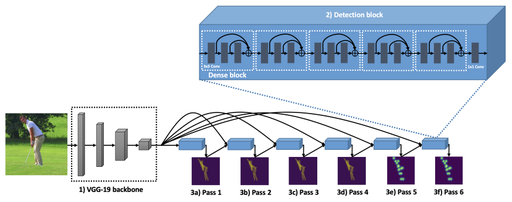
Fig. 1 OpenPose architecture utilizing 1) VGG-19 feature extractor, and 2) 4+2 passes of detection blocks performing 4+2 passes of estimating part affinity fields (3a-d) and confidence maps (3e and 3f)
원문 · CC BY 4.0 · Daniel Groos, Heri Ramampiaro, Espen A. F. Ihlen · EfficientPose: Scalable single-person pose estimation · 원문 그림 인용 · 원본 PDF 4쪽에서 그림 영역을 추출했습니다.EfficientNet 백본과 교차 해상도 특징
EfficientPose는 고해상도 입력과 저해상도 입력을 함께 사용합니다. 저해상도 입력은 고해상도 이미지를 높이와 너비를 절반으로 줄이는 초기 평균 풀링 층을 거쳐 얻습니다. 고해상도 입력은 EfficientNet의 초기 세 블록으로 고수준 의미 정보를 얻고, 저해상도 입력은 초기 두 블록으로 저수준 지역 정보를 얻습니다. 두 경로의 특징을 연결하면 교차 해상도 특징이 만들어지며, 이를 통해 여러 추상화 수준의 특징을 함께 활용합니다. 백본은 ImageNet으로 사전학습된 가중치를 사용하고, 나머지 층은 무작위로 초기화합니다.
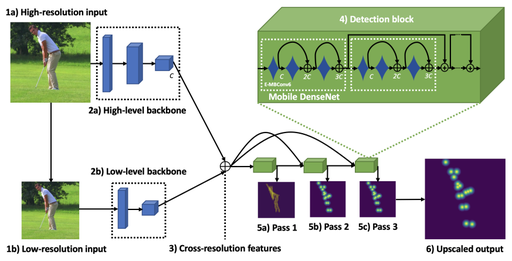
Fig. 2 Proposed architecture comprising 1a) high-resolution and 1b) low-resolution inputs, 2a) high-level and 2b) low-level Ef- ficientNet backbones combined into 3) cross-resolution features, 4) Mobile DenseNet detection blocks, 1+2 passes for estimation of part affinity fields (5a) and confidence maps (5b and 5c), and 6) bilinear upscaling
원문 · CC BY 4.0 · Daniel Groos, Heri Ramampiaro, Espen A. F. Ihlen · EfficientPose: Scalable single-person pose estimation · 원문 그림 인용 · 원본 PDF 4쪽에서 그림 영역을 추출했습니다.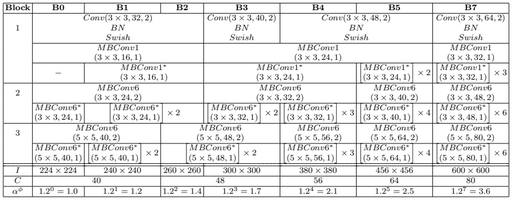
Table 1 The architecture of the initial three blocks of relevant EfficientNet backbones. For Conv(K×K,N,S ), K×K denotes filter size, N is number of output feature maps, and S is stride. BN denotes batch normalization. I defines input size, corresponding with image resolution on ImageNet, whereas αφ refers to the depth factor as determined by Equation 1
원문 · CC BY 4.0 · Daniel Groos, Heri Ramampiaro, Espen A. F. Ihlen · EfficientPose: Scalable single-person pose estimation · 원문 그림 인용 · 원본 PDF 5쪽에서 그림 영역을 추출했습니다.Mobile DenseNet 검출 블록과 업스케일링
검출 블록은 Mobile DenseNet으로 구성되며, 이는 DenseNet에서 영감을 받아 특징 재사용을 지원하는 구조입니다. 각 Mobile DenseNet은 E-MBConv 6 연산 세 개를 연속 사용하고 3C개의 특징 맵을 출력합니다. E-MBConv 6은 MBConv 6을 변형한 것으로, 활성화 함수로 E-swish를 사용합니다. 첫 검출 패스는 part affinity fields로 전체 골격을 추정하고, 이어지는 두 검출 패스가 키포인트 히트맵을 예측합니다. 저해상도 히트맵은 4×4 커널과 stride 2의 전치 합성곱 세 개로 8배 업스케일링되어 출력의 세부 수준을 높입니다.
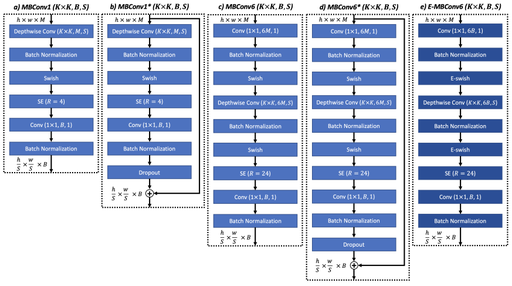
Fig. 3 The composition of MBConvs. From left: a-d)MBConv (K×K,B,S ) in EfficientNets performs depthwise convolution with filter size K×K and strideS, and outputs B feature maps.MBConv∗ (b and d) extends regular MBConvs by including dropout layer and skip connection. e) E-MBConv 6(K× K,B,S ) in Mobile DenseNets adjusts MBConv 6 with E-swish activation and number of feature maps in expansion phase as 6 B. All MBConvs take as input M feature maps with spatial height and width of h and w, respectively.R is the reduction ratio of SE
원문 · CC BY 4.0 · Daniel Groos, Heri Ramampiaro, Espen A. F. Ihlen · EfficientPose: Scalable single-person pose estimation · 원문 그림 인용 · 원본 PDF 5쪽에서 그림 영역을 추출했습니다.복합 스케일링에 따른 모델 변형
EfficientPose는 EfficientNet과 같이 입력 해상도, 너비, 깊이의 세 차원을 함께 조정하는 복합 모델 스케일링을 따릅니다. 이렇게 만든 모델 변형은 EfficientPose I부터 IV까지와 RT입니다. 너비는 고수준 백본의 C와 같게 두고, 깊이는 식 (3)의 D=⌊αφ+0.5⌋로 정한 Mobile DenseNet 개수로 조절합니다. RT 변형은 가장 작은 EfficientNet 규모에 맞춘 단일 해상도 모델입니다.

Table 2 Variants of EfficientPose obtained by scaling resolution, width, and depth. Mobile DenseNets MD(C) computes 3C feature maps. P and Q denotes the number of 2D part affinity fields and confidence maps, respectively. ConvT (K×K,O,S ) defines transposed convolutions with kernel size K×K, output maps O, and stride S
원문 · CC BY 4.0 · Daniel Groos, Heri Ramampiaro, Espen A. F. Ihlen · EfficientPose: Scalable single-person pose estimation · 원문 그림 인용 · 원본 PDF 7쪽에서 그림 영역을 추출했습니다.MPII 검증 세트 비교
검증 실험은 MPII 단일 인물 데이터셋에서 OpenPose와 EfficientPose를 비교합니다. 학습 데이터 29K 장 중 26K는 학습용, 3K는 검증용으로 무작위 분할되었습니다. 정확도는 PCKh@50과 더 엄격한 PCKh@10으로 측정하고, 효율은 FLOPs와 파라미터 수로 측정합니다. 원문 표 3에서 EfficientPose는 OpenPose보다 2.2~184배 적은 FLOPs와 4~56배 적은 파라미터를 가졌으며, PCKh@10은 0.8~12.9% 높았습니다. 고성능 모델인 II~IV는 PCKh@50에서 0.6~2.2% 높았습니다. 이 결과는 MPII 검증 세트와 본문에 명시된 설정에서 얻은 것입니다.
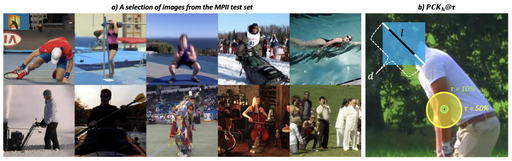
Fig. 4 The MPII single-person pose estimation challenge. From left: a) 10 images from the MPII test set displaying some of the variation and difficulties inherent in this challenge. b) The evaluation metrics PCKh@50 and PCKh@10 define the average of predictions within τl distance (l = 0.6d) from the ground-truth location (e.g., left elbow), with τ being 50% and 10%, respectively
원문 · CC BY 4.0 · Daniel Groos, Heri Ramampiaro, Espen A. F. Ihlen · EfficientPose: Scalable single-person pose estimation · 원문 그림 인용 · 원본 PDF 8쪽에서 그림 영역을 추출했습니다.
Table 3 Performance of EfficientPose compared to OpenPose on the MPII validation dataset, as evaluated by efficiency (number of parameters and FLOPs, and relative reduction in parameters and FLOPs compared to OpenPose) and accuracy (mean PCKh@50 and mean PCKh@10)
원문 · CC BY 4.0 · Daniel Groos, Heri Ramampiaro, Espen A. F. Ihlen · EfficientPose: Scalable single-person pose estimation · 원문 그림 인용 · 원본 PDF 9쪽에서 그림 영역을 추출했습니다.MPII 공식 테스트 세트 결과
공식 MPII 테스트 세트 평가는 제한된 시도 횟수 때문에 OpenPose 기준선, EfficientPose RT, EfficientPose IV에만 수행되었습니다. 이 평가에서 EfficientPose IV는 평균 PCKh@50 91.2를 기록했습니다. 원문은 이 값이 파라미터 수 10M 미만 모델 가운데 최고 수준이라고 보고합니다. 같은 표의 다른 방법들은 저자들이 인용한 선행 결과이므로 이 논문의 동일 조건 재측정 결과로 해석하지 않습니다.
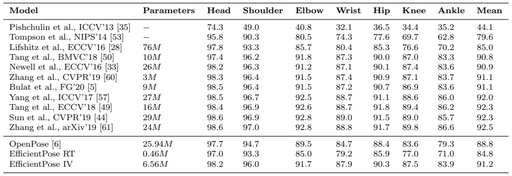
Table 4 State-of-the-art results in PCKh@50 (both for individual body parts and overall mean value) on the official MPII test dataset [1] compared to the number of parameters
원문 · CC BY 4.0 · Daniel Groos, Heri Ramampiaro, Espen A. F. Ihlen · EfficientPose: Scalable single-person pose estimation · 원문 그림 인용 · 원본 PDF 9쪽에서 그림 영역을 추출했습니다.학습 수렴과 학습 예산
EfficientPose II는 200 epoch 안에서 빠르게 수렴하는 것으로 나타났습니다. 반면 OpenPose는 수렴까지 최대 400 epoch이 필요하다고 보고되며, 200 epoch 결과는 85.00, 400 epoch 결과는 87.60의 PCKh@50입니다. 같은 기간의 EfficientPose II는 200 epoch에서 88.18의 PCKh@50을 보입니다. 따라서 이 비교는 학습 예산이 제한된 조건에서 OpenPose가 아직 수렴하지 않았다는 해석을 포함하며, 이를 OpenPose의 확정적 성능 한계로 읽지 않습니다.
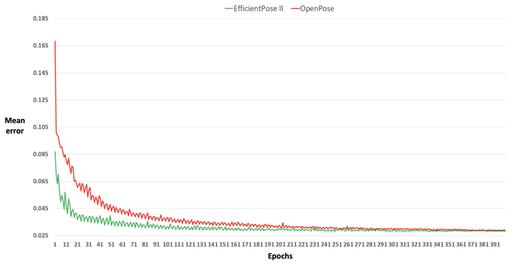
Fig. 5 The progression of the mean error of EfficientPose II and OpenPose on the MPII validation set during the course of training
원문 · CC BY 4.0 · Daniel Groos, Heri Ramampiaro, Espen A. F. Ihlen · EfficientPose: Scalable single-person pose estimation · 원문 그림 인용 · 원본 PDF 9쪽에서 그림 영역을 추출했습니다.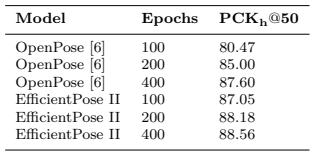
Table 5 Model accuracy on the MPII validation dataset in relation to the number of training epochs
원문 · CC BY 4.0 · Daniel Groos, Heri Ramampiaro, Espen A. F. Ihlen · EfficientPose: Scalable single-person pose estimation · 원문 그림 인용 · 원본 PDF 10쪽에서 그림 영역을 추출했습니다.적용 범위와 향후 과제
이 결과는 MPII 데이터셋과 본문에 명시된 학습 설정에서 얻은 것입니다. 저자들은 특정 임상 환경이나 아동 자세에 대한 일반화는 추가 검증이 필요하다고 봅니다. 또한 저자들은 HPE에서 이미지 분류와 같은 복합 스케일링 계수가 적절하다고 가정했으며, 이는 후속 연구 주제로 제시되었습니다. 백본 pre-training, 최적화 절차, 다인물 확장도 저자들이 향후 연구로 남긴 과제입니다.
부록의 구성 요소 절제 실험
부록 A의 절제 실험은 기본적으로 100 epoch 학습으로 수행되었습니다. 교차 해상도 특징은 PCKh@50에서 큰 차이를 보이지 않았지만 PCKh@10에서 0.6~0.7%의 향상을 보였습니다. 스켈레톤 추정은 PCKh@50에서 1.3~2.4%, PCKh@10에서 0.2~1.4% 향상을 보였고, 검출 패스를 1개에서 2개로 늘린 경우 PCKh@50에서 1.6~1.7%, PCKh@10에서 1.8~1.9% 향상되었습니다. 세 번째 검출 패스는 PCKh@10에서 이득이 없었고, 업샘플링은 PCKh@10에서 9.2~12.3% 향상을 보였습니다. 이 결과들은 각 변형의 제거 실험에서 얻은 것이며 모든 구성 요소가 모든 설정에서 동일하게 유익하다는 뜻은 아닙니다.

Table 6 Model accuracy on the MPII validation dataset in relation to the use of cross-resolution features
원문 · CC BY 4.0 · Daniel Groos, Heri Ramampiaro, Espen A. F. Ihlen · EfficientPose: Scalable single-person pose estimation · 원문 그림 인용 · 원본 PDF 15쪽에서 그림 영역을 추출했습니다.
Table 7 Model accuracy on the MPII validation dataset in relation to the use of skeleton estimation
원문 · CC BY 4.0 · Daniel Groos, Heri Ramampiaro, Espen A. F. Ihlen · EfficientPose: Scalable single-person pose estimation · 원문 그림 인용 · 원본 PDF 15쪽에서 그림 영역을 추출했습니다.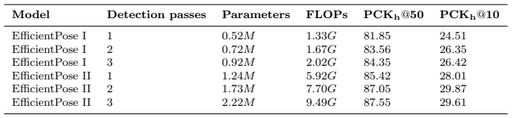
Table 8 Model accuracy on the MPII validation dataset in relation to the number of detection passes
원문 · CC BY 4.0 · Daniel Groos, Heri Ramampiaro, Espen A. F. Ihlen · EfficientPose: Scalable single-person pose estimation · 원문 그림 인용 · 원본 PDF 15쪽에서 그림 영역을 추출했습니다.
Table 9 Model accuracy on the MPII validation dataset in relation to the use of upscaling
원문 · CC BY 4.0 · Daniel Groos, Heri Ramampiaro, Espen A. F. Ihlen · EfficientPose: Scalable single-person pose estimation · 원문 그림 인용 · 원본 PDF 16쪽에서 그림 영역을 추출했습니다.논문 정보
- 저자
- Daniel Groos, Heri Ramampiaro, Espen A. F. Ihlen
- 학회·저널
- arXiv · 프리프린트
- 최초 공개일
- 2020년 4월 25일
- 등록일
- 2026년 11월 6일
- 수정일
- 2020년 12월 4일
- 버전
- v2
- arXiv
- 2004.12186
- DOI
- 10.1007/s10489-020-01918-7
- 분류
- cs.CV · cs.LG · eess.IV
- 원문 이용 조건
- CC BY 4.0
- 제공 범위
- 논문 정보, 해설, 허용된 원문 그림
AI 해설은 논문 원문과 별개의 설명이며 오류가 있을 수 있습니다. 원문과 그림은 각 출처의 이용 조건과 따로 표시된 권리를 따릅니다.
초록
Single-person human pose estimation facilitates markerless movement analysis in sports, as well as in clinical applications. Still, state-of-the-art models for human pose estimation generally do not meet the requirements of real-life applications. The proliferation of deep learning techniques has resulted in the development of many advanced approaches. However, with the progresses in the field, more complex and inefficient models have also been introduced, which have caused tremendous increases in computational demands. To cope with these complexity and inefficiency challenges, we propose a novel convolutional neural network architecture, called EfficientPose, which exploits recently proposed EfficientNets in order to deliver efficient and scalable single-person pose estimation. EfficientPose is a family of models harnessing an effective multi-scale feature extractor and computationally efficient detection blocks using mobile inverted bottleneck convolutions, while at the same time ensuring that the precision of the pose configurations is still improved. Due to its low complexity and efficiency, EfficientPose enables real-world applications on edge devices by limiting the memory footprint and computational cost. The results from our experiments, using the challenging MPII single-person benchmark, show that the proposed EfficientPose models substantially outperform the widely-used OpenPose model both in terms of accuracy and computational efficiency. In particular, our top-performing model achieves state-of-the-art accuracy on single-person MPII, with low-complexity ConvNets.
원문 인용
Daniel Groos, Heri Ramampiaro, Espen A. F. Ihlen (2020). EfficientPose: Scalable single-person pose estimation. arXiv:2004.12186v2. https://doi.org/10.1007/s10489-020-01918-7
BibTeX
@article{groos2020efficientpose,
  title = {{EfficientPose: Scalable single-person pose estimation}},
  author = {Daniel Groos and Heri Ramampiaro and Espen A. F. Ihlen},
  year = {2020},
  eprint = {2004.12186},
  archivePrefix = {arXiv},
  doi = {10.1007/s10489-020-01918-7},
  url = {https://arxiv.org/abs/2004.12186v2}
}