논문 해설
Robust Flow Matching under Target Corruption and Label Noise
타깃 손상과 레이블 노이즈 하의 견고한 플로우 매칭
- 연구 문제 목표 데이터 손상과 레이블 노이즈가 Flow Matching의 시간 의존 회귀 목적에 미치는 영향을 분석하고, 이를 샘플 재가중으로 완화하는 것이 과제입니다.
- 연구 방법 목표 손상에는 중간에서 후반 시간의 잔차 점수 TRS를, 레이블 노이즈에는 대안 조건 벡터장과 비교하는 점수 CCS를 사용해 샘플 가중치를 정합니다.
- 주요 결과 2D와 CIFAR-10 실험에서 제안 방법은 OT-FM 및 여러 강건 학습 기준선보다 여러 지표에서 개선을 보고합니다. 다만 결과는 설정에 따라 달라지며 일부 지표에서는 절충이 있습니다.
목표 손상과 레이블 노이즈가 Flow Matching을 흔드는 이유
Flow Matching(FM)은 안정적인 학습과 효율적인 샘플링으로 강력한 생성 모델링 프레임워크로 알려져 있습니다. 그러나 FM은 목표 데이터와 레이블이 깨끗하다고 가정하며, 실제 데이터에서는 이 가정이 자주 깨집니다. 이 논문은 두 종류의 손상을 구분합니다. 목표 손상은 생성 대상인 데이터 샘플 x1 자체가 손상되는 경우이고, 레이블 노이즈는 조건으로 쓰이는 레이블 y가 잘못 관측되는 경우입니다.
저자들은 FM 학습을 시간에 의존하는 조건부 벡터장에 대한 회귀 문제로 보고, 두 손상이 이 회귀 목적에 서로 다른 방식으로 들어간다고 분석합니다. 따라서 문제는 손상 유형마다 잔차가 어떻게 변하는지 파악하고, 그 구조를 이용해 샘플 가중치를 정하는 것입니다.
잔차 구조에 따른 두 가지 샘플 가중치
목표 손상에서는 관측된 끝점 x̃1 = x1 + Δ1이 보간 상태와 속도 목표를 함께 바꿉니다. 보간 상태는 x̃t = xt + tΔ1로 이동하고, 속도 목표는 ũ = u + Δ1이 됩니다. 이에 따른 잔차는 깨끗한 잔차에 상태 교란 항 vθ,t(xt+tΔ1, y) − vθ,t(xt, y)와 목표 이동 항 −Δ1이 더해진 형태입니다. 시간 t가 커질수록 상태 교란 항이 더 드러나므로, 저자들은 중간에서 후반 시간의 잔차를 사용하는 Temporal Residual Score(TRS)를 제안합니다. TRS는 잔차 제곱을 지수이동평균으로 샘플별로 누적하고, 그 점수를 로지스틱 시그모이드 가중치로 바꿉니다.
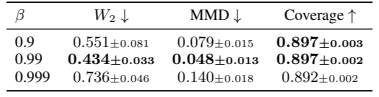
Table 8 :TRS EMA decay(2D target corruption). Mean±std over 3 seeds.
원문 · CC BY 4.0 · Mert Can Kurucu, Erik Englesson, Hossein Azizpour · Robust Flow Matching under Target Corruption and Label Noise · 원문 그림 인용 · 원본 PDF 20쪽에서 그림 영역을 추출했습니다.
Figure 4 :TRS score behavior across FM time.Residual-based separation between clean and corrupted samples becomes stronger at intermediate-to-late FM times. This supports the FM-TRS design: under target corruption, later points on the interpolation path expose the geometric effect of endpoint corruption more clearly, making residual-based reliability scoring more informative than at early times.
원문 · CC BY 4.0 · Mert Can Kurucu, Erik Englesson, Hossein Azizpour · Robust Flow Matching under Target Corruption and Label Noise · 원문 그림 인용 · 원본 PDF 25쪽에서 그림 영역을 추출했습니다.레이블 노이즈에서는 보간 경로와 속도 목표가 깨끗하게 유지되고, 관측 레이블 ỹ에 해당하는 조건부 벡터장이 잘못 선택됩니다. 이때 잔차는 깨끗한 잔차에 같은 상태에서 두 레이블의 벡터장 차이가 더해진 형태입니다. 저자들은 관측 레이블과 대안 레이블들의 손실을 비교하는 Comparative Conditional Score(CCS)를 제안합니다. CCS는 관측 레이블의 손실에서 다른 레이블 손실의 최솟값을 뺀 값을 프로브 시점들에서 평균하고, 0을 기준으로 하는 시그모이드로 가중치를 계산합니다.
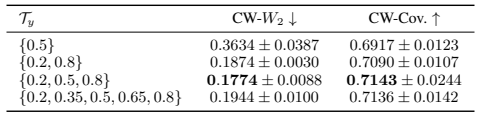
Table 14 :CCS probe-time ablationunder 40% symmetric label noise on the 2D benchmark. Values are mean±standard deviation.
원문 · CC BY 4.0 · Mert Can Kurucu, Erik Englesson, Hossein Azizpour · Robust Flow Matching under Target Corruption and Label Noise · 원문 그림 인용 · 원본 PDF 22쪽에서 그림 영역을 추출했습니다.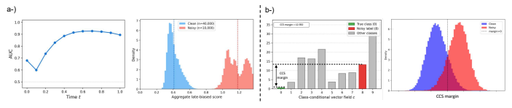
Figure 5 :Aggregated score separation under target corruption and label noise. Left:FM-TRS score distribution under target corruption. Aggregated residual scores separate clean and corrupted samples, with corrupted samples concentrated in the high-score region that receives lower weights. Right:FM-CCS score distribution under label noise. The comparative margin separates clean and label-flipped samples around zero: positive scores indicate that an alternative class-conditional VF explains the trajectory better than the observed label, while negative scores indicate that the observed label explains the trajectory better than the alternatives.
원문 · CC BY 4.0 · Mert Can Kurucu, Erik Englesson, Hossein Azizpour · Robust Flow Matching under Target Corruption and Label Noise · 원문 그림 인용 · 원본 PDF 26쪽에서 그림 영역을 추출했습니다.2D와 CIFAR-10에서의 검증 설계
2D 목표 손상 실험은 스파이럴 분포에 오프매니폴드 가우시안 외곽값을 추가해 수행됩니다. 이 설정에서 OT-FM과 FM-TRS를 Wasserstein-2 거리(W2), MMD, Coverage로 비교합니다. 2D 레이블 노이즈 실험에서는 대칭 20%, 40%와 비대칭 40% 노이즈를 사용하고 클래스별 지표인 CW-W2와 CW-Coverage로 평가합니다. CIFAR-10에서는 목표 손상(Gaussian, Salt-and-Pepper)과 레이블 노이즈(대칭 20%, 40%, 비대칭 40%)를 적용하고, FID, IS, Coverage 및 CW-FID, CAS로 평가합니다.
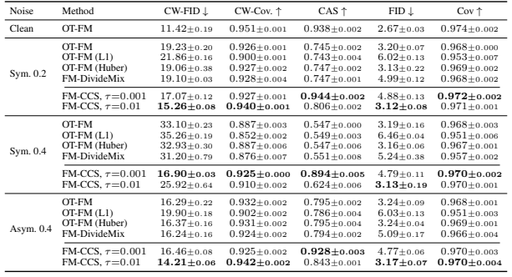
Table 4 :CIFAR-10 label-noise results.Sym. and Asym. denote symmetric and asymmetric label noise, with headers indicating noise rate. CW-FID and CW-Cov. are metrics averaged over classes.
원문 · CC BY 4.0 · Mert Can Kurucu, Erik Englesson, Hossein Azizpour · Robust Flow Matching under Target Corruption and Label Noise · 원문 그림 인용 · 원본 PDF 9쪽에서 그림 영역을 추출했습니다.비교 기준은 표준 최적수송 FM(OT-FM), L1과 Huber 손실 변형, DeepGUM 또는 DivideMix를 FM에 맞게 이식한 기준선입니다. 저자들은 결과를 세 시드의 평균과 표준편차로 보고하고, 주요 비교에 대해 쌍체 t-검정을 추가로 제시합니다.
주요 결과와 비교 범위
2D 목표 손상 실험에서 FM-TRS는 OT-FM의 W2 1.199와 MMD 0.279를 각각 0.434와 0.048로 낮춥니다. CIFAR-10 가우시안 목표 손상에서는 OT-FM의 FID가 73.17이었으나 FM-TRS는 2.91을 기록하며, 깨끗한 기준 FID 2.67에 가까워집니다.

Figure 2 :2D results.(a)-(c) Under target corruption, FM-TRS downweights the off-manifold outliers; (d)-(f) under label noise, FM-CCS reduces cross-class mixing and improves class-aligned spirals.
원문 · CC BY 4.0 · Mert Can Kurucu, Erik Englesson, Hossein Azizpour · Robust Flow Matching under Target Corruption and Label Noise · 원문 그림 인용 · 원본 PDF 8쪽에서 그림 영역을 추출했습니다.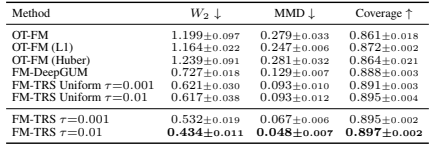
Table 1 :2D target corruption results for spirals.FM-TRS improves over robust-regression baselines under off-manifold target corruption. “Uniform” denotes TRS scoring with uniform rather than late-biased time sampling, and bold numbers indicate the best performance in each column.
원문 · CC BY 4.0 · Mert Can Kurucu, Erik Englesson, Hossein Azizpour · Robust Flow Matching under Target Corruption and Label Noise · 원문 그림 인용 · 원본 PDF 8쪽에서 그림 영역을 추출했습니다.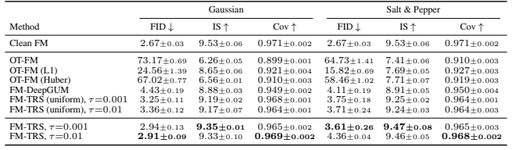
Table 3 :CIFAR-10 target corruption results.We corrupt training images with Gaussian or Salt- and-Pepper noise and evaluate against the clean test distribution. “Uniform” denotes TRS scoring with uniform rather than late-biased time sampling, and bold numbers indicate the best performance.
원문 · CC BY 4.0 · Mert Can Kurucu, Erik Englesson, Hossein Azizpour · Robust Flow Matching under Target Corruption and Label Noise · 원문 그림 인용 · 원본 PDF 9쪽에서 그림 영역을 추출했습니다.레이블 노이즈에서는 FM-CCS가 2D 실험에서 CW-W2를 기준선보다 크게 낮춥니다. 다만 같은 설정에서 FM-CCS의 비조건부 FID가 OT-FM보다 높아지는 절충이 보고됩니다.
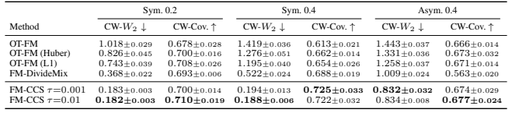
Table 2 :2D label-noise results on segmented spirals.CW- W2 and CW-Cov. are class-wise metrics averaged over classes, and bold numbers indicate the best performance in each column.
원문 · CC BY 4.0 · Mert Can Kurucu, Erik Englesson, Hossein Azizpour · Robust Flow Matching under Target Corruption and Label Noise · 원문 그림 인용 · 원본 PDF 8쪽에서 그림 영역을 추출했습니다.적용 범위와 한계
저자들은 TRS가 손상 샘플이 비지배적 성분을 이루고 중간에서 후반 시간의 잔차가 깨끗한 다수와 구분될 때 적합하다고 설명합니다. 희귀하지만 유효한 모드나 고주파 구조가 큰 잔차를 만들면 잘못 낮은 가중치를 받을 수 있고, 쉽게 맞추어지는 손상 샘플은 높은 가중치를 유지할 수 있습니다. TRS의 후반 시간 샘플링은 최적화의 시간적 가중치도 바꾸므로, 그 효과는 데이터셋, 모델, 확률 경로에 따라 달라질 수 있습니다.

Table 10 :Ablation of late-biased time sampling without reweightingon 2D target corruption. OT-FM with late-biased sampling alone improves only modestly over OT-FM, while FM-TRS yields substantially larger gains, showing that the benefit of TRS does not come from time bias alone.
원문 · CC BY 4.0 · Mert Can Kurucu, Erik Englesson, Hossein Azizpour · Robust Flow Matching under Target Corruption and Label Noise · 원문 그림 인용 · 원본 PDF 21쪽에서 그림 영역을 추출했습니다.CCS는 이산 레이블에 대해 개발되었으며, 조건 손실이 충분히 구분되어야 하고, 조건 수가 늘어날수록 갱신 비용이 커진다고 명시됩니다. 동시 손상 평가는 제어된 2D 설정에 한정되며, 더 넓은 손상 모델과 심한 클래스 불균형, 확산 모델과의 직접 비교는 향후 과제로 남아 있습니다.
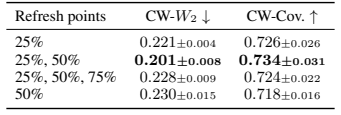
Table 11 :CCS refresh schedule(2D40%symmetric label noise). Mean±std over 3 seeds.
원문 · CC BY 4.0 · Mert Can Kurucu, Erik Englesson, Hossein Azizpour · Robust Flow Matching under Target Corruption and Label Noise · 원문 그림 인용 · 원본 PDF 21쪽에서 그림 영역을 추출했습니다.
Table 16 :Simultaneous target and label corruption on segmented spirals.Mean ± standard deviation over three seeds.
원문 · CC BY 4.0 · Mert Can Kurucu, Erik Englesson, Hossein Azizpour · Robust Flow Matching under Target Corruption and Label Noise · 원문 그림 인용 · 원본 PDF 23쪽에서 그림 영역을 추출했습니다.논문 정보
- 저자
- Mert Can Kurucu, Erik Englesson, Hossein Azizpour
- 학회·저널
- arXiv · 프리프린트
- 최초 공개일
- 2026년 11월 9일
- 등록일
- 2026년 11월 11일
- 수정일
- 2026년 11월 9일
- 버전
- v1
- arXiv
- 2611.13324
- 분류
- cs.LG · cs.CV
- 원문 이용 조건
- CC BY 4.0
- 제공 범위
- 논문 정보, 해설, 허용된 원문 그림
AI 해설은 논문 원문과 별개의 설명이며 오류가 있을 수 있습니다. 원문과 그림은 각 출처의 이용 조건과 따로 표시된 권리를 따릅니다.
초록
Flow Matching (FM) is a strong framework for generative modeling due to its stable training and efficient sampling. However, FM assumes clean target data and labels, an assumption often violated in practice. We formulate FM training as a time-dependent regression problem over conditional vector fields and analyze how the two corruption types affect the objective: i) target corruption adds a time-dependent residual term that grows with time, ii) label noise causes updates to the wrong class-conditional vector field. Based on this analysis, we propose to improve FM robustness by mapping corruption-specific residual scores to sample weights. For target corruption, we propose the Temporal Residual Score (TRS), which emphasizes residual magnitudes at intermediate-to-late FM times, where clean and corrupted samples are more separable. For label noise, we propose the Comparative Conditional Score (CCS), which compares the residual of the observed class-conditional vector field against alternative class-conditional vector fields for the same trajectory and velocity target. Experiments across controlled corruption settings and real-world noisy labels show that the proposed methods improve robustness over standard FM and robust-training baselines, supporting corruption-specific residual structure as a practical basis for robust FM.
원문 인용
Mert Can Kurucu, Erik Englesson, Hossein Azizpour (2026). Robust Flow Matching under Target Corruption and Label Noise. arXiv:2611.13324v1. https://arxiv.org/abs/2611.13324v1
BibTeX
@misc{kurucu2026robust,
  title = {{Robust Flow Matching under Target Corruption and Label Noise}},
  author = {Mert Can Kurucu and Erik Englesson and Hossein Azizpour},
  year = {2026},
  eprint = {2611.13324},
  archivePrefix = {arXiv},
  url = {https://arxiv.org/abs/2611.13324v1}
}